Within Hungary's Collective Fears
How a Disappearance Became Hungary's Blood Libel Scare
A missing girl's disappearance became an antisemitic media and political campaign even though the accused were acquitted.
On this page
- The disappearance of Eszter Solymosi
- How testimony and newspapers spread the accusation
- Why acquittal failed to end the panic
Page outline Jump by section
Introduction
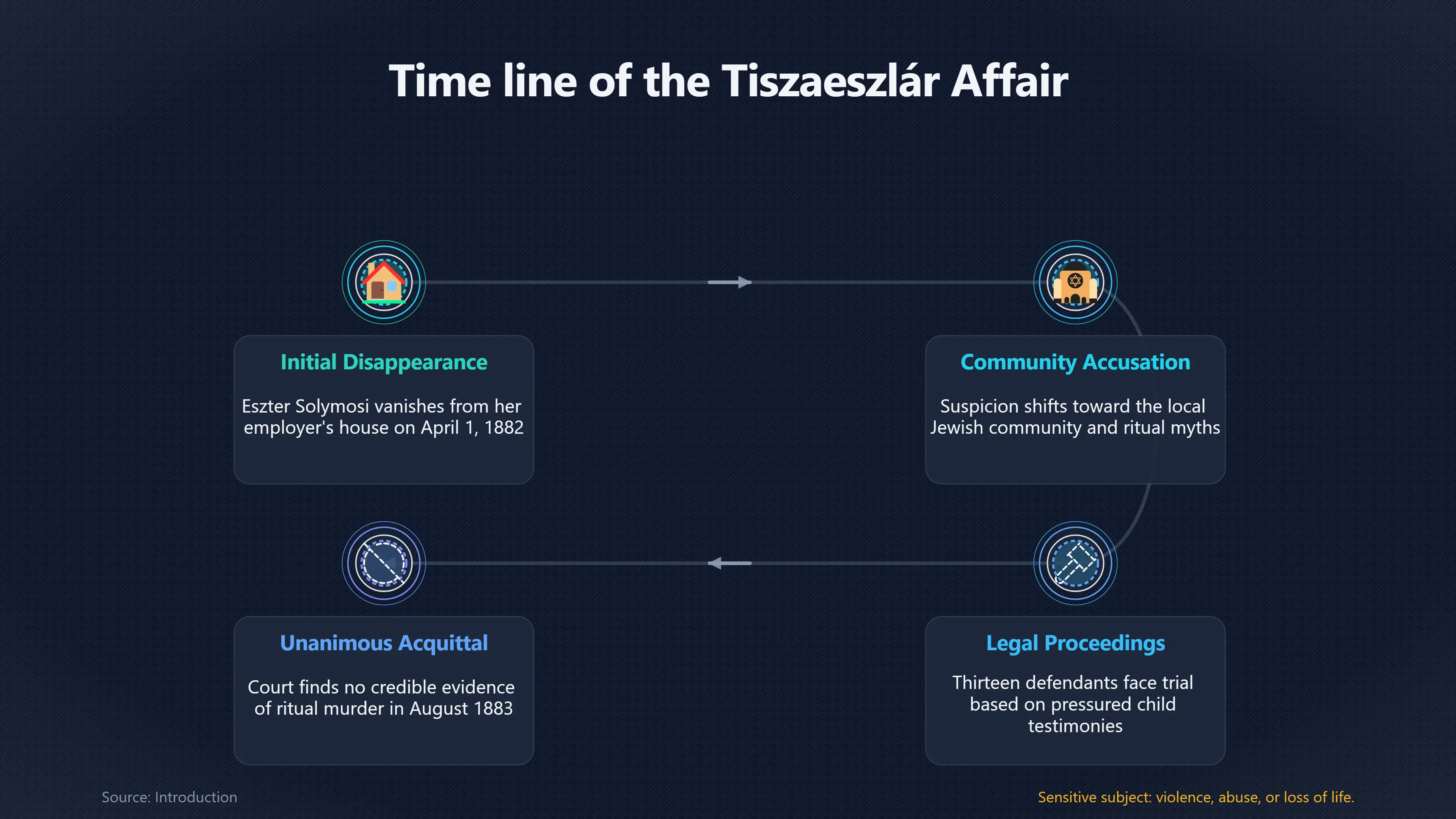
The Tiszaeszlár affair of 1882–1883 is one of the most significant examples of a modern blood-libel scare in Europe. It began with the disappearance of a 14-year-old servant girl, Eszter Solymosi, in a village in north-eastern Hungary. Instead of remaining a local missing-person investigation, the case became the centre of a nationwide campaign claiming that local Jews had murdered her for ritual purposes—a medieval myth with no factual basis. Although every defendant was acquitted after a lengthy trial, the verdict did not end the panic. Newspapers, political activists and organised antisemitic movements continued to present the accusation as true, helping to spread anti-Jewish hostility across Hungary. The affair demonstrates how rumours can gain authority when reinforced by politics and the media, and how a false accusation can continue shaping public opinion long after it has been disproved.[YIVO Encyclopedia]encyclopedia.yivo.orgEncyclopedia Tiszaeszlár Blood LibelYIVO EncyclopediaTiszaeszlár Blood Libel - YIVO EncyclopediaFebruary 12, 2010…

The disappearance of Eszter Solymosi
On 1 April 1882, Eszter Solymosi disappeared from the village of Tiszaeszlár after leaving her employer’s house. Her unexplained absence quickly became the subject of speculation. Instead of concentrating on ordinary possibilities such as accident, murder by an unknown person or voluntary flight, suspicion increasingly focused on the village’s Jewish community.
The accusation drew on the ancient blood libel—the false claim that Jews murdered Christian children for religious rituals, especially around Passover. This myth had circulated in parts of Europe for centuries despite repeated religious and legal refutations. By the late nineteenth century it had little legal credibility in western Europe, but it could still be revived where political tensions, economic uncertainty and antisemitic agitation created fertile ground for conspiracy theories.[YIVO Encyclopedia]encyclopedia.yivo.orgEncyclopedia Tiszaeszlár Blood LibelYIVO EncyclopediaTiszaeszlár Blood Libel - YIVO EncyclopediaFebruary 12, 2010…
Investigators arrested thirteen Jewish defendants, including the synagogue caretaker and other members of the local community. Rather than uncovering physical evidence of a crime, the prosecution came to depend heavily on statements extracted from children under intense pressure. Historians regard these testimonies as deeply unreliable because they were repeatedly questioned, coached and contradicted by other evidence presented during the proceedings.[YIVO Encyclopedia]encyclopedia.yivo.orgEncyclopedia Tiszaeszlár Blood LibelYIVO EncyclopediaTiszaeszlár Blood Libel - YIVO EncyclopediaFebruary 12, 2010…
How testimony and newspapers spread the accusation
The Tiszaeszlár affair became far more than a criminal investigation because it unfolded during the rise of mass-circulation newspapers and organised party politics. Daily reporting transformed a local case into a national spectacle, with sensational coverage often repeating allegations before they had been tested in court.
A central witness was the young son of the synagogue caretaker, who claimed to have witnessed the supposed murder. During the trial, defence lawyers exposed numerous inconsistencies in his testimony, while the circumstances under which it had been obtained raised serious concerns about coercion and suggestion. Nevertheless, many newspapers presented the accusations as convincing evidence long before the court had reached any conclusion.[YIVO Encyclopedia]encyclopedia.yivo.orgEncyclopedia Tiszaeszlár Blood LibelYIVO EncyclopediaTiszaeszlár Blood Libel - YIVO EncyclopediaFebruary 12, 2010…
Political activists seized on the case as proof of broader antisemitic claims. Members of parliament such as Győző Istóczy and Géza Ónody portrayed the affair as confirmation that Hungary faced a hidden Jewish threat. The case rapidly became a rallying point not only within Hungary but also for emerging international antisemitic networks, which cited Tiszaeszlár as supposed evidence for long-discredited ritual-murder myths.[YIVO Encyclopedia]encyclopedia.yivo.orgEncyclopedia Tiszaeszlár Blood LibelYIVO EncyclopediaTiszaeszlár Blood Libel - YIVO EncyclopediaFebruary 12, 2010…
The speed with which rumours travelled illustrates an important feature of modern moral panics. Newspapers did not simply report events; many actively shaped them by amplifying dramatic accusations, repeating speculation and encouraging readers to interpret uncertainty as proof of conspiracy rather than as a reason for caution.[CEU Research Pure Portal]research.ceu.eduCEU Research Pure PortalBlood libel as spectacle: representing and reproducing “ritual murder” in the modern era - CEU Research Pure Portal…

Why the acquittal failed to end the panic
The trial concluded in August 1883 with the unanimous acquittal of all defendants. The judges found that the prosecution had failed to establish any credible evidence that a ritual murder had occurred. The supposed eyewitness testimony had proved unreliable, and the allegations collapsed under legal scrutiny.[YIVO Encyclopedia]encyclopedia.yivo.orgEncyclopedia Tiszaeszlár Blood LibelYIVO EncyclopediaTiszaeszlár Blood Libel - YIVO EncyclopediaFebruary 12, 2010…
Yet the verdict did not restore calm. Instead, many people who had already accepted the accusation dismissed the court’s decision as the product of political influence or legal technicalities. Anti-Jewish demonstrations and riots broke out in several Hungarian towns before and after the trial, showing that the emotional power of the rumour had become detached from the evidence examined in court. The acquitted defendants themselves could not safely return to ordinary life in Tiszaeszlár.[YIVO Encyclopedia]encyclopedia.yivo.orgEncyclopedia Tiszaeszlár Blood LibelYIVO EncyclopediaTiszaeszlár Blood Libel - YIVO EncyclopediaFebruary 12, 2010…
The affair also accelerated the development of organised political antisemitism in Hungary. Shortly after the trial, supporters of the accusations established the National Antisemitic Party. Although the party itself proved relatively short-lived, the case helped normalise antisemitic language within public debate and parliamentary politics.[yivo.org]encyclopedia.yivo.orgEncyclopedia Tiszaeszlár Blood LibelYIVO EncyclopediaTiszaeszlár Blood Libel - YIVO EncyclopediaFebruary 12, 2010…
Why historians see the affair as a modern moral panic
Historians generally reject any interpretation of the case as evidence for ritual murder. Instead, they examine how social tensions, political opportunism and changing media systems combined to produce a collective belief that survived despite its failure in court.
Several factors reinforced one another:
- An emotionally powerful event: the disappearance of a young Christian girl generated genuine fear and a desire for answers.
- An existing prejudice: the medieval blood-libel myth offered a familiar explanation that required no evidence.
- Political entrepreneurs: antisemitic politicians transformed a local tragedy into a national ideological campaign.
- Expanding mass media: newspapers spread accusations faster than courts could examine them.
- Confirmation bias: once many people accepted the story, contradictory evidence became easier to dismiss than to reconsider.[Cambridge University Press & Assessment]cambridge.orgCambridge University Press & AssessmentHungary's Antisemitic Provinces: Violence and Ritual Murder in the 1880s | Slavic Review | Cambrid…
Rather than describing irrational crowds alone, historians emphasise the interaction between institutions and public opinion. Local investigators, politicians and sections of the press gave credibility to claims that would otherwise have remained village rumours. This distinguishes Tiszaeszlár from spontaneous episodes of collective fear: official processes themselves helped sustain the panic.[Cambridge University Press & Assessment]cambridge.orgCambridge University Press & AssessmentHungary's Antisemitic Provinces: Violence and Ritual Murder in the 1880s | Slavic Review | Cambrid…

The affair’s long cultural afterlife
The Tiszaeszlár affair has continued to occupy an important place in Hungarian historical memory because it represents more than a failed prosecution. It became a symbol of how prejudice can survive legal defeat.
Modern scholars note that writers, artists, playwrights and filmmakers have repeatedly returned to the case, using it to explore wider questions about justice, memory, antisemitism and the relationship between truth and public belief. Because the affair unfolded at the beginning of modern mass politics and modern mass media, it also serves as an early example of how misinformation can spread beyond the courtroom and become embedded in political culture.[CEU Research Pure Portal]research.ceu.eduCEU Research Pure PortalBlood libel as spectacle: representing and reproducing “ritual murder” in the modern era - CEU Research Pure Portal…
For historians of Hungary, the lasting lesson is not simply that innocent people were falsely accused. The deeper significance lies in the fact that a court’s careful examination of evidence proved less influential than sensational reporting and organised political campaigning. The Tiszaeszlár blood-libel scare therefore remains one of the clearest demonstrations of how conspiracy theories and moral panics can outlive the facts that disprove them.[cambridge.org]cambridge.orgCambridge University Press & AssessmentHungary's Antisemitic Provinces: Violence and Ritual Murder in the 1880s | Slavic Review | Cambrid…
Amazon book picks
Further Reading
Books and field guides related to How a Disappearance Became Hungary's Blood-Libel Scare. Use these as the next step if you want deeper reading beyond the article.
Extraordinary Popular Delusions and the Madness of Crowds
Rating: 4.0/5 from 5 Google Books ratings
Illustrates mechanisms through which destructive rumors gain traction.

Blood Libel
Directly addresses the false accusation underlying the Tiszaeszlár affair.
Endnotes
1.
Source: encyclopedia.yivo.org
Title: Encyclopedia Tiszaeszlár Blood Libel
Link:https://encyclopedia.yivo.org/article.aspx/Tiszaeszlar_Blood_Libel
Source snippet
YIVO EncyclopediaTiszaeszlár Blood Libel - YIVO EncyclopediaFebruary 12, 2010...
Published: February 12, 2010
2.
Source: cambridge.org
Link:https://www.cambridge.org/core/journals/slavic-review/article/abs/hungarys-antisemitic-provinces-violence-and-ritual-murder-in-the-1880s/5149BDFA023E51BB2542BE54875F56D2
Source snippet
Cambridge University Press & AssessmentHungary's Antisemitic Provinces: Violence and Ritual Murder in the 1880s | Slavic Review | Cambrid...
3.
Source: research.ceu.edu
Link:https://research.ceu.edu/en/publications/blood-libel-as-spectacle-representing-and-reproducing-ritual-murd/
Source snippet
CEU Research Pure PortalBlood libel as spectacle: representing and reproducing “ritual murder” in the modern era - CEU Research Pure Portal...
4.
Source: encyclopedia.yivo.org
Link:https://encyclopedia.yivo.org/article/322
5.
Source: encyclopedia.com
Link:https://www.encyclopedia.com/religion/encyclopedias-almanacs-transcripts-and-maps/tiszaeszlar
Additional References
6.
Source: tandfonline.com
Link:https://www.tandfonline.com/doi/abs/10.1080/13501674.2025.2558663
Source snippet
emory of Móric Scharf (1966): East European Jewish Affairs: Vol 53, No 2-3September 17, 2025 — East European Jewish Affairs Volume 53, 20...
Published: September 17, 2025
7.
Source: tandfonline.com
Link:https://www.tandfonline.com/doi/full/10.1080/13501674.2025.2558663
Source snippet
emory of Móric Scharf (1966): East European Jewish Affairs: Vol 53, No 2-3 - Get AccessSeptember 17, 2025 — Image: Publication Cover Eas...
Published: September 17, 2025
8.
Source: youtube.com
Title: Blood Libel: On the Trail of an Antisemitic Myth, talk by Magda Teter
Link:https://www.youtube.com/watch?v=Y4Cb0zGNH0o
Source snippet
The Blood Libel: New Media and Conspiracy Theories with Professors Magda Teter and David Myers...
9.
Source: tandfonline.com
Link:https://www.tandfonline.com/doi/abs/10.1080/13501674.2025.2479250
Source snippet
Full article: The blood libel in postwar New York: Erwin Piscator’s The Burning Bush (1949)March 21, 2025 — THE BLOOD LIBEL IN POSTWAR NE...
Published: March 21, 2025
10.
Source: youtube.com
Link:https://www.youtube.com/watch?v=OrB-xldFKus
Source snippet
Magda Teter on the Trail of an Antisemitic Myth...
11.
Source: youtube.com
Title: What Is Blood Libel? The Antisemitic Myth Still Spreading Today
Link:https://www.youtube.com/watch?v=fb5VTfwHE9I
Source snippet
Blood Libel Myth: Antisemitism in Medieval England...
12.
Source: youtube.com
Title: Magda Teter on the Trail of an Antisemitic Myth
Link:https://www.youtube.com/watch?v=K5CwB1FivAY
Source snippet
What Is Blood Libel? The Antisemitic Myth Still Spreading Today...
13.
Source: nli.org.il
Link:https://www.nli.org.il/en/books/NNL_ALEPH990017938540205171/NLI
Source snippet
National Library of IsraelThe glorious victory of truth: the Tiszaeszlar blood libel trial, 1882-3: a historical-legal-medical research...
14.
Source: tandfonline.com
Link:https://www.tandfonline.com/doi/full/10.1080/13501674.2025.2479253?af=R
15.
Source: tandfonline.com
Link:https://www.tandfonline.com/doi/full/10.1080/13501674.2025.2479253
Topic Tree