Within Lithuania
Was There Ever a Lithuanian Witch Craze?
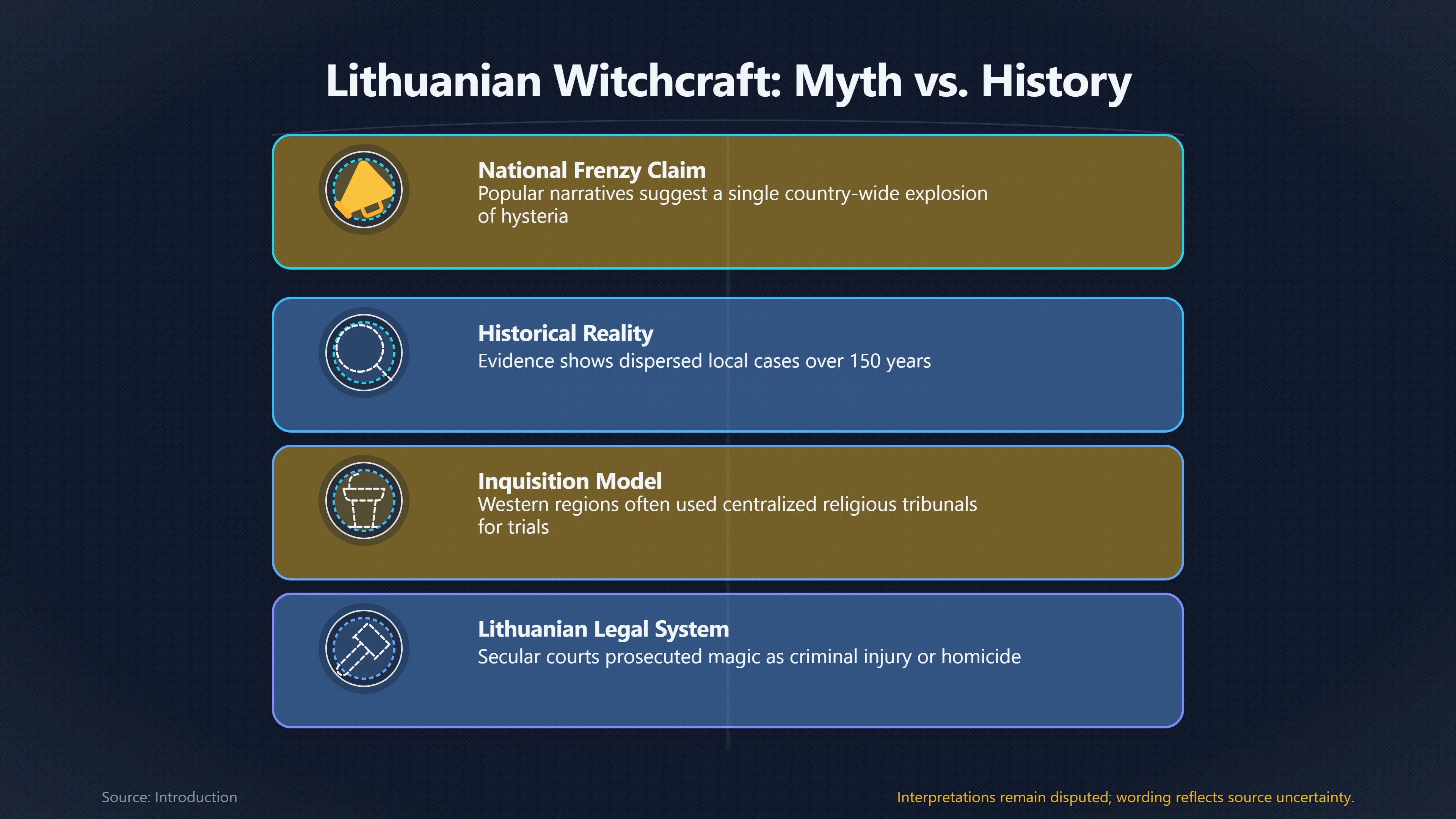
Lithuania's witch trials were often lethal local disputes, but the evidence does not support a single nationwide frenzy.
On this page
- What accusations and trials actually involved
- How illness, healing and neighbour disputes spread suspicion
- Why historians reject the idea of a national frenzy
Page outline Jump by section
Introduction
Lithuania experienced real witch trials, some of them ending in execution, but historians do not regard them as a single nationwide witch craze comparable to the large-scale persecutions seen in parts of Germany, Scotland or Switzerland. Instead, the surviving evidence points to hundreds of cases spread across more than 150 years, heard mainly in secular courts, with accusations emerging from local conflicts over illness, livestock, failed healing, property, honour and neighbourly disputes rather than a self-sustaining national panic. This distinction matters because later retellings sometimes exaggerate Lithuania’s experience by treating every surviving case as evidence of one vast frenzy. Modern research instead presents a more complex picture of recurring local persecutions shaped by law, religion and everyday social tensions.[ldkistorija.lt]ldkistorija.ltOrbis Lituaniae -Sorcery and Witchcraft in the Grand Duchy of LithuaniaOrbis LituaniaeSeptember 24, 2020…
Was There Ever a Lithuanian Witch Craze?
The short answer is no—not if “witch craze” means a country-wide explosion of accusations driven by central authorities or an uncontrollable chain reaction of mass prosecutions.
From the sixteenth century until the early eighteenth century, witchcraft accusations appeared throughout the Grand Duchy of Lithuania, a state far larger than modern Lithuania that also included much of present-day Belarus and parts of Ukraine. Surviving records document several hundred prosecutions, but they are unevenly preserved and represent only a fraction of all court activity. Historians therefore warn against projecting modern national boundaries onto early modern records or assuming that all cases involved ethnic Lithuanians.[ldkistorija.lt]ldkistorija.ltOrbis Lituaniae -Sorcery and Witchcraft in the Grand Duchy of LithuaniaOrbis LituaniaeSeptember 24, 2020…
Compared with Europe’s major witch-hunting regions, Lithuania shows several important differences:
- accusations remained dispersed rather than erupting into one overwhelming nationwide campaign;
- prosecutions were usually handled by local secular courts rather than an Inquisition, which never operated in the Grand Duchy;
- legal practice treated harmful magic largely as a form of criminal injury rather than creating an entirely separate legal system devoted to witches;
- execution rates, although still severe, appear lower than in many regions that experienced the largest witch panics.[ldkistorija.lt]ldkistorija.ltOrbis Lituaniae -Sorcery and Witchcraft in the Grand Duchy of LithuaniaOrbis LituaniaeSeptember 24, 2020…
This does not minimise the suffering of those accused. Many defendants faced torture, imprisonment, exile or execution. Rather, it explains why historians describe Lithuania as an important but distinctive part of the wider European witch-hunting phenomenon instead of a centre of continent-wide hysteria.
What Accusations and Trials Actually Involved
Most accusations concerned maleficium—the belief that someone had deliberately caused tangible harm through supernatural means.
Typical allegations included:
- causing illness or sudden death;
- killing or weakening livestock;
- damaging crops or harvests;
- preventing successful childbirth;
- destroying marriages or fertility;
- using harmful charms after personal quarrels;
- poisoning or magical assault disguised as everyday contact.[ResearchGate]researchgate.netOpen source on researchgate.net.
Many defendants were not isolated strangers but well-known members of their communities. Some worked as healers, herbal practitioners or midwives whose specialised knowledge inspired both respect and suspicion. A healer whose remedies failed might quickly become suspected of causing the illness in the first place.
Court records also reveal accusations arising after ordinary neighbour disputes. Arguments over boundaries, debts, insults or livestock losses could later be reinterpreted once misfortune struck. The accusation often followed the disaster rather than preceding it, allowing communities to construct a convincing narrative from unrelated events.[ResearchGate]researchgate.netOpen source on researchgate.net.
How Illness, Healing and Neighbour Disputes Spread Suspicion
Lithuanian witch trials illustrate how belief spread through local social networks rather than through national propaganda.
When unexplained illness or repeated bad luck affected a household, people searched for a human explanation. If someone had recently threatened the victim, refused assistance or possessed a reputation for unusual healing skills, suspicion could harden rapidly into accusation.
Several mechanisms repeatedly appear in surviving records:
- Failed healing. People sought magical and religious remedies alongside conventional medicine. Recovery enhanced a healer’s reputation, while failure could reverse it.
- Neighbourhood memory. Communities retrospectively linked old disagreements to recent tragedies, making ordinary conflicts appear meaningful.
- Rumour reinforced by testimony. Once witnesses repeated similar stories before a court, rumours acquired legal authority.
- Coercive interrogation. Torture or intense questioning sometimes produced confessions or implicated additional suspects, although Lithuanian legal practice varied considerably by court and period.[researchgate.net]researchgate.netOpen source on researchgate.net.
These processes resemble patterns identified elsewhere in Europe but usually remained confined to particular communities rather than expanding into continuous regional waves.
Why Lithuania’s Legal System Produced a Different Pattern
One reason historians reject the image of a national witch craze is that the Grand Duchy’s legal framework differed from that of some western European territories.
The Lithuanian Statutes contained no comprehensive offence specifically defining witchcraft. Instead, courts generally prosecuted alleged magical harm through broader criminal principles dealing with injury or homicide. Judges therefore retained greater flexibility, and procedures varied between different local courts.[Orbis Lituaniae]ldkistorija.ltOrbis Lituaniae -Sorcery and Witchcraft in the Grand Duchy of LithuaniaOrbis LituaniaeSeptember 24, 2020…
The absence of an Inquisition also mattered. Witchcraft cases were heard by town courts, castle courts and other secular judicial institutions. Local magistrates and landowners therefore played a greater role than a central religious tribunal.
Research suggests that roughly one fifth of known defendants received death sentences, usually by burning, while others received whipping, banishment, church penalties or other punishments depending on the circumstances. This demonstrates genuine persecution while also distinguishing Lithuania from regions where execution became almost automatic once accusations began.[Lituanistika]lituanistika.ltLituanistika | Witchcraft court cases in the Grand Duchy of Lithuania in the sixteenth to eighteenth centuries…
A Diverse Society, Not a Single Religious Conflict
Older popular narratives sometimes portray Lithuanian witch trials as Christianity suppressing surviving pagan religion. Modern scholarship finds the reality much more complicated.
The Grand Duchy was one of Europe’s most religiously and ethnically diverse states. Catholics, Orthodox Christians, Protestants, Jews, Muslims and various migrant communities lived within its borders. Members of these communities could appear as accusers, defendants or witnesses depending on local circumstances.
Research on ethnic minorities shows that accusations reflected social position, occupations, economic competition and neighbourhood relationships at least as much as religious identity. Minority communities were neither uniformly targeted nor uniformly protected. Instead, witchcraft accusations became one more way in which existing social tensions could be expressed.[lituanistika.lt]lituanistika.ltLituanistika | The Other witch: ethnic minorities and witchcraft accusations in the Grand Duchy of Lithuania…
This diversity also weakens any simple explanation that Lithuania experienced a single ideological campaign against one religious group.

Why Historians Reject the National-Frenzy Myth
Several strands of evidence support the modern historical consensus.
First, the chronology extends across more than a century and a half rather than clustering into one short-lived national emergency.
Second, surviving records reveal many local outbreaks instead of one centrally directed campaign.
Third, the legal system lacked some of the institutional features associated with Europe’s largest witch crazes, including a dedicated inquisitorial structure and a detailed statutory definition of witchcraft.
Finally, modern archival work has uncovered a more varied picture than earlier summaries suggested. New research emphasises courtroom practice, regional variation, ethnic diversity and local conflict rather than treating Lithuanian witch trials as a uniform phenomenon. Recent English-language scholarship has further reinforced this interpretation by placing the Grand Duchy within the wider comparative history of European witch-hunting while stressing its distinctive legal and cultural setting.[springer.com]link.springer.comWitch Trials in the Grand Duchy of Lithuania in the Sixteenth to Eighteenth Centuries: Enchanted Borderlands | Springer Nature Link…
Why the Distinction Still Matters
Describing Lithuania as having experienced a nationwide witch craze obscures what makes its history distinctive.
The documented trials show that belief in harmful magic could produce lethal consequences without generating a continent-famous panic. Local communities could persecute neighbours, rely on coerced confessions and execute defendants while remaining part of a more fragmented pattern of judicial violence.
For historians of collective fear, Lithuania therefore provides an important reminder that witch-hunting was not a single European experience. Between isolated accusations and continent-wide mass persecutions lay a broad middle ground of recurring local conflicts, shaped by ordinary anxieties over sickness, healing, reputation and justice. Understanding those local dynamics offers a more accurate—and ultimately more revealing—picture than the misleading image of a single Lithuanian witch frenzy.[springer.com]link.springer.comWitch Trials in the Grand Duchy of Lithuania in the Sixteenth to Eighteenth Centuries: Enchanted Borderlands | Springer Nature Link…
Amazon book picks
Further Reading
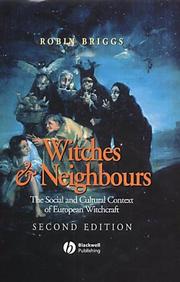
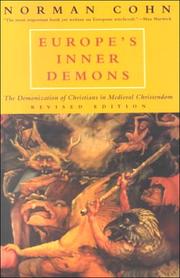
Books and field guides related to Was There Ever a Lithuanian Witch Craze?. Use these as the next step if you want deeper reading beyond the article.
The witch-hunt in early modern Europe
Best single overview for understanding Lithuanian witch trials.

Endnotes
1.
Source: researchgate.net
Link:https://www.researchgate.net/publication/339503878_Witchcraft_Court_Cases_in_the_Grand_Duchy_of_Lithuania_in_the_Sixteenth_to_Eighteenth_Centuries
2.
Source: link.springer.com
Link:https://link.springer.com/book/10.1007/978-3-032-00671-4
Source snippet
Witch Trials in the Grand Duchy of Lithuania in the Sixteenth to Eighteenth Centuries: Enchanted Borderlands | Springer Nature Link...
3.
Source: lituanistika.lt
Link:https://www.lituanistika.lt/content/67632
Source snippet
Lituanistika | Witchcraft court cases in the Grand Duchy of Lithuania in the sixteenth to eighteenth centuries...
4.
Source: lituanistika.lt
Link:https://www.lituanistika.lt/content/102625
Source snippet
Lituanistika | The Other witch: ethnic minorities and witchcraft accusations in the Grand Duchy of Lithuania...
5.
Source: nec.ro
Link:https://nec.ro/publication_library/the-other-witch-ethnic-minorities-and-witchcraft-accusations-in-the-grand-duchy-f-lithuania/
6.
Source: link.springer.com
Link:https://link.springer.com/book/9783032006707
Source snippet
Trials in the Grand Duchy of Lithuania in the Sixteenth to Eighteenth Centuries: Enchanted Borderlands | Springer Nature LinkJanuary 1, 2...
7.
Source: researchgate.net
Title: Shades of Witchcraft: Accusations Diversified
Link:https://www.researchgate.net/publication/399337180_Shades_of_Witchcraft_Accusations_Diversified
8.
Source: researchgate.net
Title: Mosaic of (In)justice: Witch Trials in Particular Courts
Link:https://www.researchgate.net/publication/399337275_Mosaic_of_Injustice_Witch_Trials_in_Particular_Courts
9.
Source: lituanistika.lt
Link:https://www.lituanistika.lt/content/73636
10.
Source: researchgate.net
Link:https://www.researchgate.net/publication/398888416_The_Flight_to_Satrija_Hill_Lithuanian_Folk_Legends_of_the_Witches%27_Sabbath
11.
Source: lituanistika.lt
Link:https://www.lituanistika.lt/content/93324
12.
Source: lituanistika.lt
Link:https://www.lituanistika.lt/content/95539
13.
Source: lituanistika.lt
Link:https://www.lituanistika.lt/content/54357
14.
Source: ldkistorija.lt
Title: Orbis Lituaniae -Sorcery and Witchcraft in the Grand Duchy of Lithuania
Link:https://www.ldkistorija.lt/sorcery-and-witchcraft-in-the-grand-duchy-of-lithuania/
Source snippet
Orbis LituaniaeSeptember 24, 2020...
Published: September 24, 2020
Additional References
15.
Source: drfrancisyoung.com
Link:https://drfrancisyoung.com/2026/07/03/review-witch-trials-in-the-grand-duchy-of-lithuania-in-the-sixteenth-to-eighteenth-centuries-by-vital-byl/
Source snippet
July 3, 2026 — REVIEW: ‘WITCH TRIALS IN THE GRAND DUCHY OF LITHUANIA IN THE SIXTEENTH TO EIGHTEENTH CENTURIES’ BY VITAL BYL Vital Byl, Wi...
Published: July 3, 2026
16.
Source: library.hrmtc.com
Link:https://library.hrmtc.com/2026/04/04/witch-trials-in-the-grand-duchy-of-lithuania-in-the-sixteenth-to-eighteenth-centuries/
Source snippet
Trials in the Grand Duchy of Lithuania in the Sixteenth to Eighteenth Centuries - The Hermetic Library BlogApril 4, 2026 — WITCH TRIALS I...
Published: April 4, 2026
17.
Source: youtube.com
Title: Francis Young: Lithuanian paganism during the Reformation
Link:https://www.youtube.com/watch?v=ekizMq5l6EE
Source snippet
What is Lithuania Hiding? Stranger Things, Paganism, and the Ninth Fort...
18.
Source: youtube.com
Title: The Secret History of Witches | Witch Trials and Fear in History
Link:https://www.youtube.com/watch?v=HvNHzeM3EjU
Source snippet
Francis Young: Lithuanian paganism during the Reformation...
19.
Source: epub.ub.uni-greifswald.de
Link:https://epub.ub.uni-greifswald.de/frontdoor/index/index/year/2024/docId/10399
20.
Source: zurnalai.vu.lt
Link:https://www.zurnalai.vu.lt/open-series/en/article/view/45799
21.
Source: youtube.com
Title: Who Were the Last Pagans of Europe?
Link:https://www.youtube.com/watch?v=drA6PifnsFU
Source snippet
The History of Lithuania - Prehistory to Modernity...
22.
Source: youtube.com
Title: What is Lithuania Hiding? Stranger Things, Paganism, and the Ninth Fort
Link:https://www.youtube.com/watch?v=TSr3ZSH9QV4
Source snippet
Who Were the Last Pagans of Europe?...
23.
Source: lithuaniatribune.com
Title: Sorcery and witchcraft in the Grand Duchy of Lithuania
Link:https://lithuaniatribune.com/sorcery-and-witchcraft-in-the-grand-duchy-of-lithuania/
24.
Source: witches.hca.ed.ac.uk
Title: ed.ac.uk The Survey of Scottish Witchcraft
Link:https://witches.hca.ed.ac.uk/faq/
Topic Tree