Within Laos Belief Panics
Why Did Holy Men Inspire a Colonial Revolt?
Prophecy helped unite southern Lao communities facing taxation, forced labour and colonial violence, but the struggle also brought years of bloodshed.
On this page
- Colonial disruption and the spread of prophecy
- Ong Keo, Ong Kommadam and armed resistance
- Miracle claims, political strategy and historical debate
Page outline Jump by section
Introduction
The Holy Men’s Rebellion was one of the most significant anti-colonial movements in the history of southern Laos. Beginning in 1901, it combined religious prophecy, political resistance and armed struggle across what are now southern Laos and north-eastern Thailand. Rather than being a simple outbreak of irrational enthusiasm, it was a response to rapid colonial change. Charismatic leaders promised that a new and more just order was approaching, one in which oppressive rulers would fall, taxes would disappear and spiritually worthy communities would regain control of their own affairs. These promises helped unite diverse ethnic groups confronting French colonial expansion and Siamese state centralisation, but they also drew thousands of people into a conflict that lasted for decades and caused widespread violence. Modern historians generally view the rebellion as a millenarian movement: one in which expectations of a transformed world became inseparable from anti-colonial resistance.[Sage Journals]journals.sagepub.comSage JournalsMillenarian Movements in Southern Laos and North Eastern Siam (Thailand) at the Turn of the Twentieth Century - Ian G. Baird…
Colonial disruption and the spread of prophecy
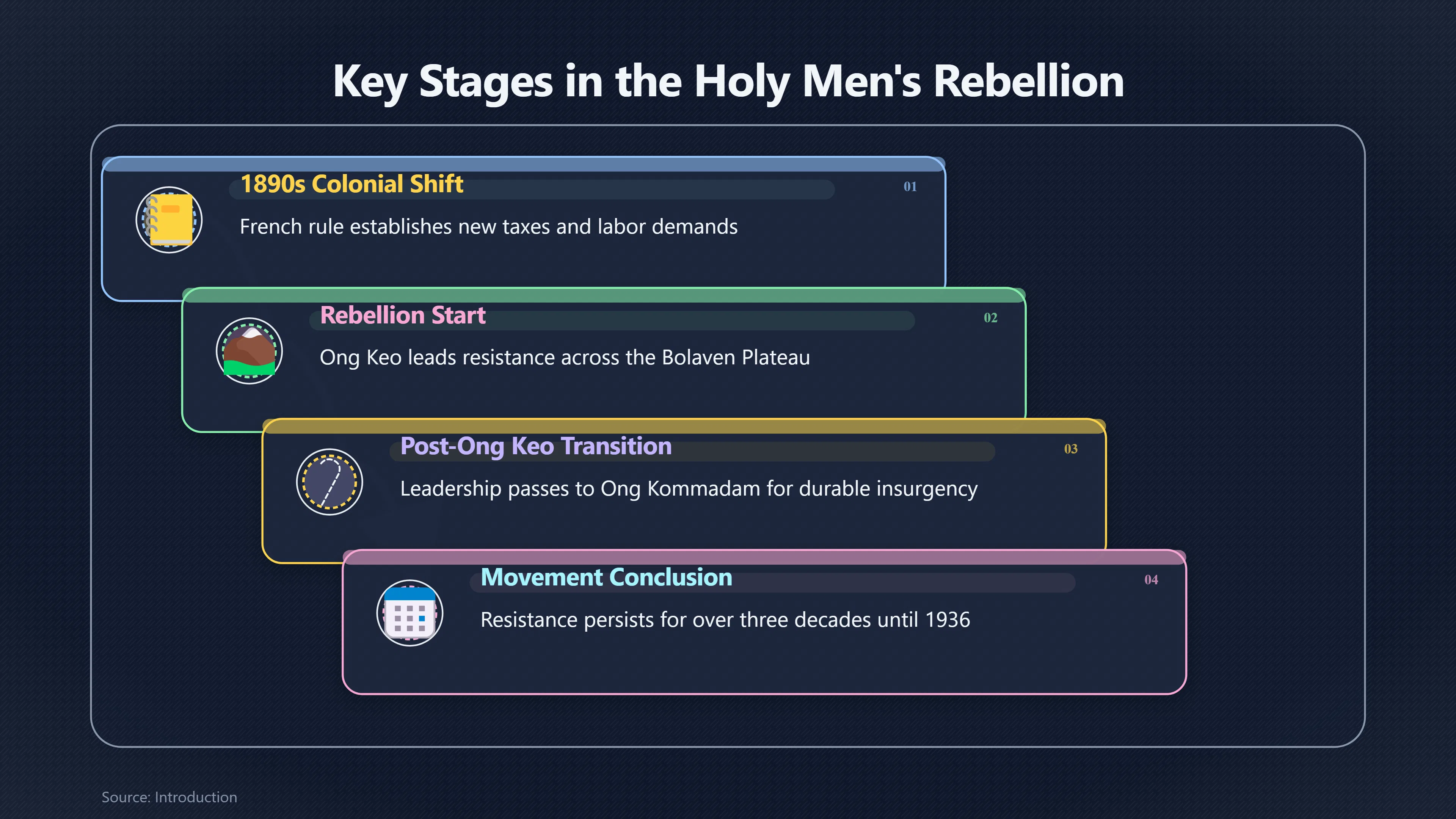
The rebellion emerged during a period of profound upheaval. Following the establishment of French rule over Laos in the 1890s and the tightening of Siamese control west of the Mekong, long-established political relationships were disrupted. Colonial officials imposed new taxes, expanded demands for labour, strengthened administrative control and challenged the authority of local leaders.
These changes affected many upland communities particularly severely. Groups such as the Alak, Laven, Sedang and others living around the Bolaven Plateau faced increasing interference from governments that often understood little about their political traditions or religious practices. Local grievances accumulated around forced labour, taxation, military expeditions and the weakening of customary authority.[Sage Journals]journals.sagepub.comSage JournalsMillenarian Movements in Southern Laos and North Eastern Siam (Thailand) at the Turn of the Twentieth Century - Ian G. Baird…
In this atmosphere, prophecies circulated that foretold the collapse of the existing political order. Palm-leaf manuscripts, local religious teachers and respected spiritual figures spread predictions that catastrophe would soon be followed by the arrival of a righteous ruler. The new age would restore justice, overturn foreign domination and reward those who remained faithful.
These ideas were not confined by modern national borders. Communities on both sides of the Mekong shared languages, trade networks, family connections and religious traditions, allowing rumours and prophecies to travel rapidly across French Laos and north-eastern Siam. Rather than representing isolated superstition, prophecy became a practical means of coordinating resistance among scattered communities facing similar pressures.[Sage Journals]journals.sagepub.comSage JournalsMillenarian Movements in Southern Laos and North Eastern Siam (Thailand) at the Turn of the Twentieth Century - Ian G. Baird…
Why did people believe the holy men?
European colonial reports frequently portrayed the movement as the work of deceivers manipulating gullible followers. More recent scholarship paints a more complex picture.
In the political culture of the region, spiritual power and political legitimacy were closely connected. A leader believed to possess exceptional merit or supernatural protection could also be seen as someone morally qualified to rule. Claims of miraculous abilities therefore carried political significance rather than existing separately from politics.
Reports associated with the movement described beliefs that holy leaders could:
- protect followers from bullets or enemy weapons;
- foresee future events;
- bring about the end of colonial rule;
- restore a morally legitimate kingdom;
- usher in an era without oppressive taxation or forced labour.
Whether every participant literally accepted these claims is impossible to determine. Many may have joined primarily because the movement offered hope, leadership and an organised response to worsening colonial conditions. Religious expectation and political calculation were not mutually exclusive.[Cambridge University Press & Assessment]cambridge.orgCambridge University Press & AssessmentThe Holy Man in the History of Thailand and Laos | Journal of Southeast Asian Studies | Cambridge…
Ong Keo, Ong Kommadam and armed resistance
The best-known leader of the movement in Laos was Ong Keo, an Alak holy man whose influence spread across the Bolaven Plateau in 1901. French attempts to arrest or suppress him instead triggered wider rebellion as thousands of supporters gathered around prophetic promises of liberation.
French military expeditions eventually forced many rebels into the mountains, but the movement survived. After Ong Keo’s death, leadership increasingly passed to Ong Kommadam, who transformed scattered resistance into a remarkably durable insurgency.
Unlike the brief uprisings imagined in some older histories, resistance continued in southern Laos for more than three decades. French authorities repeatedly launched military campaigns, established fortified posts and attempted to eliminate rebel networks, yet Ong Kommadam remained an important figure until his death in 1936. This longevity demonstrates that the movement rested on more than fleeting religious excitement. It reflected persistent social and political grievances that colonial rule failed to resolve.[wikipedia.org]WikipediaHoly Man's RebellionHoly Man's Rebellion
The conflict itself was violent. Colonial forces carried out punitive expeditions, while rebel groups attacked officials, military patrols and settlements associated with colonial authority. Communities were displaced, prisoners were taken and many people were killed during decades of fighting. The rebellion therefore cannot be understood either as a peaceful religious revival or as simple fanaticism.
Miracle claims, political strategy and historical debate
One of the most important developments in recent scholarship has been a reassessment of how the rebellion was organised.
Earlier interpretations often described it as a spontaneous uprising driven almost entirely by millenarian belief. Research by historian Ian G. Baird argues that this picture is incomplete. Drawing on archival evidence, he suggests that members of the former Champassak royal house may have supported or even helped coordinate elements of the rebellion in hopes of restoring their own political influence after French intervention reshaped regional power.[Sage Journals]journals.sagepub.comSage JournalsMillenarian Movements in Southern Laos and North Eastern Siam (Thailand) at the Turn of the Twentieth Century - Ian G. Baird…
This interpretation does not dismiss the movement’s religious character. Instead, it suggests several overlapping motivations:
- Religious expectation gave people confidence that a new age was possible.
- Anti-colonial resistance united communities against taxation, forced labour and foreign administration.
- Regional politics may have linked some rebels with displaced royal elites seeking to recover authority.
- Ethnic solidarity strengthened cooperation among upland groups facing common pressures.
The result was a movement that cannot easily be classified as either a political rebellion or a religious revival. It functioned as both.
Historians also debate how literally miracle stories should be interpreted. Colonial officials often highlighted supernatural claims to portray opponents as irrational, thereby legitimising harsh repression. Yet even if miraculous stories became exaggerated over time, belief in divine protection helped solve a practical military problem: it encouraged people to confront far better armed colonial forces despite overwhelming odds. In this sense, miracle narratives were both expressions of faith and powerful tools of mobilisation.[Sage Journals]journals.sagepub.comSage JournalsMillenarian Movements in Southern Laos and North Eastern Siam (Thailand) at the Turn of the Twentieth Century - Ian G. Baird…
Why the rebellion still matters
The Holy Men’s Rebellion occupies an important place in the history of Laos because it challenges simple distinctions between religion and politics. What colonial administrators dismissed as superstition appears, in modern scholarship, as a sophisticated response to profound social disruption.
The movement also illustrates why historians are cautious about applying labels such as “cult” or “mass hysteria”. Participants were not merely swept up by contagious belief. They lived through dramatic political transformation, experienced genuine economic hardship and sought leaders who could explain those changes while offering a credible path towards justice.
The promise of a coming righteous kingdom provided more than spiritual comfort. It offered a shared language through which diverse communities could organise resistance across ethnic boundaries and across the Mekong itself. Although the rebellion ultimately failed militarily, it remained one of the longest-running challenges to French authority in Laos and continues to shape historical understanding of anti-colonial movements in mainland Southeast Asia.[sagepub.com]journals.sagepub.comSage JournalsMillenarian Movements in Southern Laos and North Eastern Siam (Thailand) at the Turn of the Twentieth Century - Ian G. Baird…
Amazon book picks
Further Reading
Books and field guides related to Why Did Holy Men Inspire a Colonial Revolt?. Use these as the next step if you want deeper reading beyond the article.

The Spirit Catches You and You Fall Down
Offers accessible background on Hmong beliefs in Laos.

The Art of Not Being Governed
Interprets millenarian resistance in Southeast Asian uplands.
Endnotes
1.
Source: cambridge.org
Link:https://www.cambridge.org/core/journals/journal-of-southeast-asian-studies/article/abs/holy-man-in-the-history-of-thailand-and-laos/70EB745996B4821C9956AD02C22F6FB9
Source snippet
Cambridge University Press & AssessmentThe Holy Man in the History of Thailand and Laos | Journal of Southeast Asian Studies | Cambridge...
2.
Source: lao-online.com
Title: Rebellion in Laos
Link:https://lao-online.com/all_files/books/B01474.pdf
3.
Source: Wikipedia
Title: Holy Man’s Rebellion
Link:https://en.wikipedia.org/wiki/Holy_Man%27s_Rebellion
4.
Source: cambridge.org
Link:https://www.cambridge.org/core/journals/journal-of-southeast-asian-studies/article/abs/an-antivietnamese-rebellion-in-early-nineteenth-century-cambodia-precolonial-imperialism-and-a-prenationalist-response/13EF3837803AAB0565B338D8A06E46DF
5.
Source: journals.sagepub.com
Link:https://journals.sagepub.com/doi/10.5367/sear.2013.0147
Source snippet
Sage JournalsMillenarian Movements in Southern Laos and North Eastern Siam (Thailand) at the Turn of the Twentieth Century - Ian G. Baird...
6.
Source: so06.tci-thaijo.org
Link:https://so06.tci-thaijo.org/index.php/pub_jss/article/view/248867
Source snippet
Men of Another Kind | The Journal of the Siam SocietyMay 14, 2021 — HOLY MEN OF ANOTHER KIND A COMPARATIVE STUDY OF MILLENNIALISM IN NORT...
Published: May 14, 2021
Additional References
7.
Source: researchgate.net
Link:https://www.researchgate.net/publication/256841027_Millenarian_Movements_in_Southern_Laos_and_North_Eastern_Siam_Thailand_at_the_Turn_of_the_Twentieth_Century_Reconsidering_the_Involvement_of_the_Champassak_Royal_House
Source snippet
ResearchGate(PDF) Millenarian Movements in Southern Laos and North Eastern Siam (Thailand) at the Turn of the Twentieth Century: Reconsid...
8.
Source: theisaanrecord.co
Title: เดอะอีสานเรคคอร์ดPART II: The Holy Men Rise and Fall Across Borders
Link:https://theisaanrecord.co/2022/04/20/the-holy-men-rise-and-fall-across-borders/
Source snippet
PART II: The Holy Men Rise and Fall Across Borders - The Isaan RecordApril 20, 2022 — PART II: THE HOLY MEN RISE AND FALL ACROSS BORDERS...
Published: April 20, 2022
9.
Source: theisaanrecord.co
Title: PAR T I: The Holy Men Revolt: A Tale of Two Countries
Link:https://theisaanrecord.co/2022/04/19/the-holy-men-revolt-a-tale-of-two-countries/
Source snippet
PART I: The Holy Men Revolt: A Tale of Two Countries - The Isaan RecordApril 19, 2022 — PART I: THE HOLY MEN REVOLT: A TALE OF TWO COUNTR...
Published: April 19, 2022
10.
Source: youtube.com
Title: LAOS: The Only Landlocked Country in Southeast Asia
Link:https://www.youtube.com/watch?v=bLEwzE3Zdzw
Source snippet
The Laotian Civil War: A Forgotten Battleground of the Cold War...
11.
Source: researchgate.net
Link:https://www.researchgate.net/publication/272120201_Millennialism_Charisma_and_Utopia_Revolutionary_Potentialities_in_Pre-modern_Lao_and_Thai_Theravada_Buddhism
12.
Source: researchgate.net
Link:https://www.researchgate.net/publication/348333898_The_Emergence_of_an_Environmentally_Conscious_and_Buddhism-Friendly_Marginalized_Hmong_Religious_Sect_along_the_Laos-Thailand_Border
13.
Source: tandfonline.com
Link:https://www.tandfonline.com/doi/abs/10.5367/sear.2013.0147
14.
Source: cir.nii.ac.jp
Link:https://cir.nii.ac.jp/crid/1360307817985509632
15.
Source: youtube.com
Title: The French Colonization of Lao and World War Two
Link:https://www.youtube.com/watch?v=08bOnfyR2EQ
Source snippet
LAOS: The Only Landlocked Country in Southeast Asia...
16.
Source: jstage.jst.go.jp
Title: jst.go.jp Spiritual Beliefs and Eschatological Salvation of the Lao
Link:https://www.jstage.jst.go.jp/article/tak/54/2/54_237/_article/-char/en
Topic Tree