Within Trinidad Belief Panics
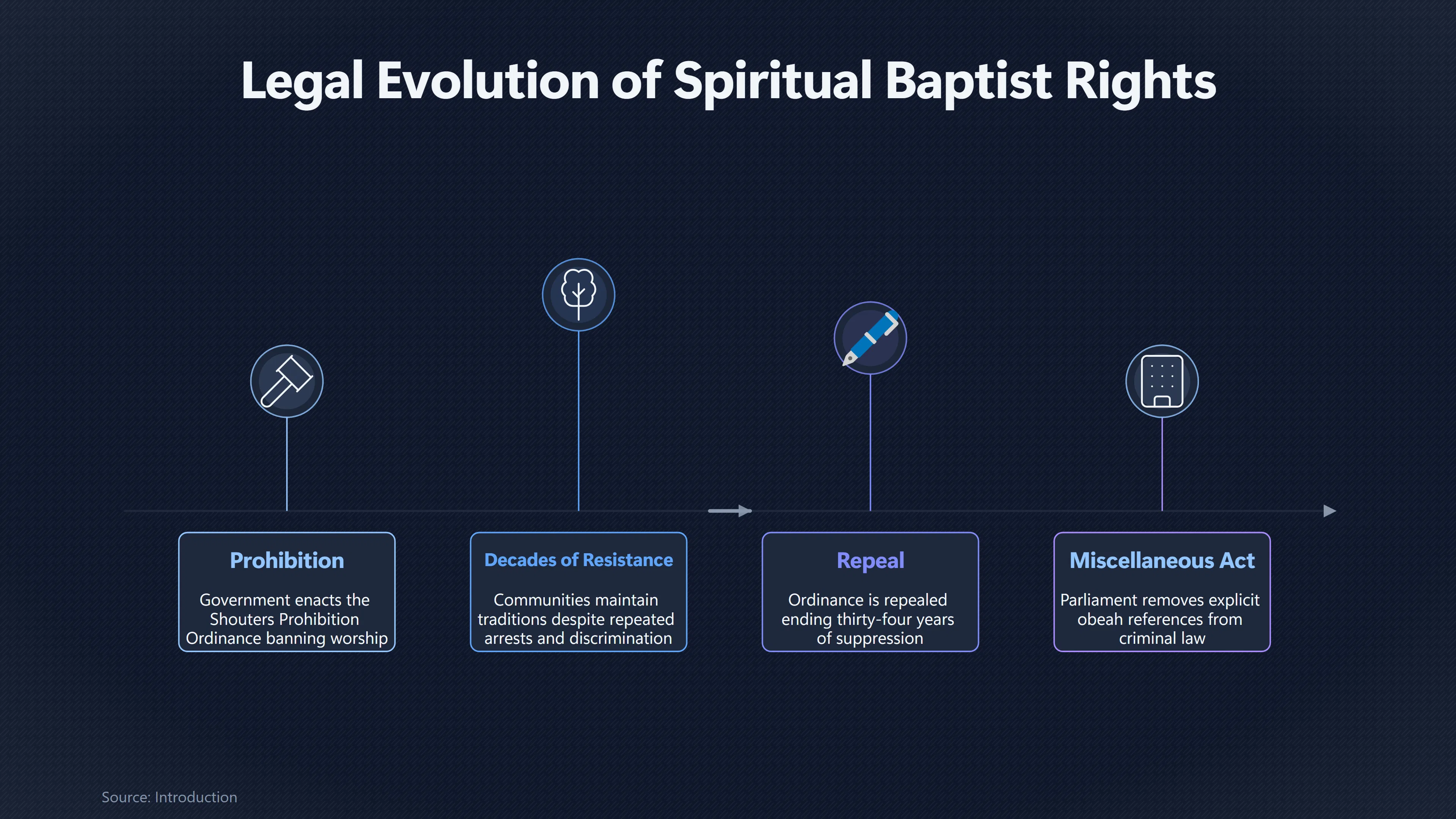
How Worship Was Turned Into a Crime
Colonial law turned African-derived worship into a public menace before later reforms recast it as religious freedom.
On this page
- How colonial law defined obeah as a threat
- Why Spiritual Baptists were banned and prosecuted
- Repeal, decriminalisation and public recognition
Page outline Jump by section
Introduction
The history of religious persecution in Trinidad and Tobago is not primarily a story of one forbidden faith. It is the story of how colonial governments defined certain forms of African-derived worship as public dangers rather than legitimate religions. Two legal campaigns illustrate this especially clearly: the long criminalisation of practices labelled as obeah and the prohibition of the Spiritual Baptist (often called “Shouter”) faith between 1917 and 1951. Together, they show how fear, racial prejudice and colonial ideas of respectability became embedded in law.
These measures were presented as necessary to protect public order, prevent fraud or suppress disorderly behaviour. Historians increasingly argue that they also reflected deeper anxieties about African cultural survival after emancipation. The eventual repeal of the Shouters Prohibition Ordinance and the later removal of anti-obeah provisions from Trinidad and Tobago’s criminal law marked an important shift from policing religious identity to protecting freedom of worship while leaving ordinary criminal offences available to deal with genuine fraud or violence.[obeahhistories.org]obeahhistories.orgObeah HistoriesSummary Convictions Ordinance, 1868 (Trinidad) | Obeah HistoriesNovember 12, 2012…
How colonial law defined obeah as a threat
Colonial officials never regulated a single organised religion called “obeah”. Instead, the term became a broad legal category covering a wide range of African-derived healing, divination and spiritual practices that colonial authorities regarded with suspicion.
This distinction matters. Modern historians note that the law itself helped create the impression that many diverse traditions formed one dangerous practice. Rather than recognising religious diversity, legislation portrayed claims of supernatural knowledge as deception or criminal conduct, making belief itself appear suspicious.[Obeah Histories]obeahhistories.orgObeah Histories Legislation | Obeah HistoriesObeah HistoriesLegislation | Obeah HistoriesSeptember 18, 2012…
Following emancipation, Trinidad replaced earlier slave-era restrictions with new legislation. The Summary Convictions Ordinance of 1868 made it an offence to engage in what it described as the “pretended assumption of supernatural power or knowledge” for fraudulent, harmful or financial purposes. The wording did not attempt to distinguish sincere religious practice from deliberate deception. Instead, it assumed that supernatural claims associated with obeah were inherently suspect. Punishments included imprisonment and corporal punishment under nineteenth-century colonial law.[Obeah Histories]obeahhistories.orgSummary Convictions Ordinance, 1868 (Trinidad) | Obeah HistoriesNovember 12, 2012…
Why the law mattered beyond individual prosecutions
Anti-obeah laws did more than punish isolated practitioners.
They also:
- reinforced the idea that African-derived spirituality belonged outside respectable society;
- gave police broad powers to investigate practices viewed as suspicious;
- encouraged newspapers and courts to describe unrelated traditions under the single label of “obeah”;
- blurred the distinction between religious healing, folk medicine, spiritual consultation and deliberate fraud.
This process transformed cultural prejudice into legal authority. Fear became institutional rather than merely social, with courts helping to define which religious expressions counted as acceptable Christianity and which were treated as criminal superstition.[Obeah Histories]obeahhistories.orgObeah Histories Legislation | Obeah HistoriesObeah HistoriesLegislation | Obeah HistoriesSeptember 18, 2012…
Why Spiritual Baptists were banned and prosecuted
The persecution of the Spiritual Baptist faith demonstrates even more clearly how a religious minority could become the target of a colonial moral panic.
The movement combined Christian belief with African forms of worship, including energetic singing, bell-ringing, rhythmic movement, visions, fasting and experiences understood by believers as the work of the Holy Spirit. To many colonial officials and members of established churches, these practices appeared noisy, emotional and socially disruptive rather than recognisably Christian.[nalis.gov.tt]nalis.gov.ttOpen source on nalis.gov.tt.
In 1917 the colonial government enacted the Shouters Prohibition Ordinance, formally banning the religion. Officials justified the measure by arguing that loud worship disturbed public peace. Contemporary accounts and later historical research, however, indicate that the legislation reflected wider concerns about race, class and religious authority. African-derived forms of worship were frequently portrayed as uncivilised or “heathen”, while established churches worried about losing members to the rapidly growing movement.[nalis.gov.tt]nalis.gov.ttOpen source on nalis.gov.tt.
The Ordinance authorised extensive restrictions. Spiritual Baptists were prohibited from maintaining places of worship or holding meetings, police could enter suspected meeting places without warrants, and estate managers were expected to report gatherings. Worshippers were arrested, prosecuted and, according to numerous historical accounts, sometimes beaten or forced to conduct ceremonies secretly in forests and remote areas.[nalis.gov.tt]nalis.gov.ttOpen source on nalis.gov.tt.

A moral panic rather than evidence of dangerous worship
Modern scholarship generally does not interpret the prohibition as a response to demonstrated criminal behaviour by the faith itself.
Instead, historians point to several interacting forces:
- Colonial racial attitudes, which associated African customs with backwardness.
- Religious competition, as established churches feared losing followers.
- Respectability politics, in which emotional and ecstatic worship was judged inferior to European forms of Christianity.
- Public-order arguments, which framed unfamiliar worship as disorder rather than protected religious expression.
Viewed this way, the “danger” attached to Spiritual Baptists was largely constructed through official language, legislation and policing rather than evidence that the faith threatened society.[nalis.gov.tt]nalis.gov.ttOpen source on nalis.gov.tt.
From prohibition to liberation
Opposition to the ban continued throughout the decades in which it remained law.
Spiritual Baptist communities maintained their traditions despite repeated arrests and social discrimination. Campaigners, including Elton Griffith, organised petitions and lobbying efforts seeking repeal, while labour leader Tubal Uriah Butler’s prominence helped challenge stereotypes surrounding the faith and broaden public sympathy. Parliamentary debates and later historical accounts identify these campaigns as central to changing political attitudes.[T&T News]news.gov.ttNo. 24) Friday 22nd March, 2013T&T NewsREPUBLIC OF TRINIDAD AND TOBAGOJune 13, 2025…
The Shouters Prohibition (Repeal) Ordinance came into force in 1951, ending thirty-four years of legal suppression. Repeal did not instantly remove prejudice, but it restored the legal right of Spiritual Baptists to worship openly and marked an important recognition that religious difference should not itself be treated as criminal behaviour.[nalis.gov.tt]nalis.gov.ttOpen source on nalis.gov.tt.
The significance of this struggle is recognised nationally through Spiritual Baptist Liberation Day, commemorated annually on 30 March as a reminder that freedom of religion in Trinidad and Tobago was won through sustained resistance to discriminatory colonial law.[nalis.gov.tt]nalis.gov.ttOpen source on nalis.gov.tt.

Decriminalisation and broader religious recognition
The process of reform did not end with the repeal of the Shouters Ordinance.
For decades afterwards, colonial-era references to obeah and provisions that disproportionately affected Orisha and Spiritual Baptist worship remained within Trinidad and Tobago’s statute book. In 2000 Parliament enacted the Miscellaneous Laws Act, removing explicit references to obeah from criminal legislation and replacing language that favoured conventional Christian institutions with more inclusive wording applicable to all religions. Police powers aimed specifically at disrupting Orisha and Spiritual Baptist ceremonies were also removed.[Refworld]refworld.orgU.S. Department of State Annual Report on International Religious Freedom for 2001 - Trinidad and Tobago | Refworld…
The reforms did not legalise fraud, intimidation or violence carried out under religious cover. Instead, they shifted the legal emphasis towards prosecuting demonstrable criminal acts through ordinary criminal law rather than criminalising religious identity or spiritual belief itself.[Refworld]refworld.orgU.S. Department of State Annual Report on International Religious Freedom for 2001 - Trinidad and Tobago | Refworld…
Why this history remains important
The journey from anti-obeah legislation to Spiritual Baptist liberation illustrates how collective fears can become embedded in institutions as well as in popular opinion. Unlike classic witch hunts driven by village rumours, these campaigns were sustained through legislation, policing and court prosecutions that presented African-derived religion as a permanent social threat.
Today, historians treat these episodes as examples of colonial governance shaping public perceptions of religion. They reveal how categories such as “superstition”, “disorder” and “danger” were used to justify unequal treatment, and how later legal reform reflected changing ideas about citizenship, cultural identity and religious freedom.
Within the wider history of Trinidad and Tobago, this transformation stands as one of the country’s clearest examples of a state-created moral panic being gradually dismantled through political activism, legal reform and changing public attitudes.[obeahhistories.org]obeahhistories.orgOpen source on obeahhistories.org.
Amazon book picks
Further Reading
Books and field guides related to How Worship Was Turned Into a Crime. Use these as the next step if you want deeper reading beyond the article.
The Serpent and the Rainbow
Provides accessible context for supernatural belief systems in the Caribbean and Central American region.

Afro-Creole: Power, Opposition, and Play in the Caribbean
Explores African-derived cultural traditions under colonial rule.
Endnotes
1.
Source: nalis.gov.tt
Link:https://www.nalis.gov.tt/resources/tt-content-guide/baptist-liberation-day/
2.
Source: refworld.org
Link:https://www.refworld.org/reference/annualreport/usdos/2001/en/8034
Source snippet
U.S. Department of State Annual Report on International Religious Freedom for 2001 - Trinidad and Tobago | Refworld...
3.
Source: news.gov.tt
Title: (No. 24) Friday 22nd March, 2013
Link:https://news.gov.tt/sites/default/files/E-Gazette/Gazette%202022/Debate%20of%20the%20House%20of%20Representatives/%28No.%2024%29%20Friday%2022nd%20March%2C%202013.pdf
Source snippet
T&T NewsREPUBLIC OF TRINIDAD AND TOBAGOJune 13, 2025...
Published: June 13, 2025
4.
Source: tha.gov.tt
Title: Baptist Liberation – Tobago House of Assembly
Link:https://www.tha.gov.tt/info-hub/baptist-liberation/
5.
Source: laws.gov.tt
Link:https://laws.gov.tt/ttdll-web/revision/byrepealed?format=&max=30&offset=660
6.
Source: obeahhistories.org
Title: Obeah Histories
Link:https://obeahhistories.org/trinidad-1868/
Source snippet
Summary Convictions Ordinance, 1868 (Trinidad) | Obeah HistoriesNovember 12, 2012...
Published: November 12, 2012
7.
Source: obeahhistories.org
Title: Obeah Histories Legislation | Obeah Histories
Link:https://obeahhistories.org/law/
Source snippet
Obeah HistoriesLegislation | Obeah HistoriesSeptember 18, 2012...
Published: September 18, 2012
8.
Source: obeahhistories.org
Link:https://obeahhistories.org/
9.
Source: visittrinidad.tt
Title: Spiritual Baptist Liberation Day
Link:https://visittrinidad.tt/event/spiritual-baptist-liberation-day/
10.
Source: academic.oup.com
Link:https://academic.oup.com/chicago-scholarship-online/book/38106
Additional References
11.
Source: youtube.com
Link:https://www.youtube.com/watch?v=gNfsOxALtk8
Source snippet
This documentary on the Shouter Baptist religion examines the legacy of colonialism, the 1917–1951 Prohibition Ordinance, and the histori...
12.
Source: otp.tt
Title: message on spiritual baptist liberation shouter day 2025
Link:https://otp.tt/message-on-spiritual-baptist-liberation-shouter-day-2025/
Source snippet
The Office of the President of the Republic of Trinidad and TobagoMarch 30, 2025 — MESSAGE ON SPIRITUAL BAPTIST LIBERATION SHOUTER DAY 20...
Published: March 30, 2025
13.
Source: otp.tt
Title: message on spiritual baptist liberation day 2020
Link:https://otp.tt/message-on-spiritual-baptist-liberation-day-2020/
Source snippet
Office of the President TTMessage on Spiritual Baptist Liberation Day 2020 | The Office of the President of the Republic of Trinidad and...
14.
Source: visittrinidad.tt
Title: Spiritual Baptist Liberation Day- March 31
Link:https://visittrinidad.tt/festivals/spiritual-baptist-liberation-day/
Source snippet
visitTrinbagoMay 18, 2026 — Home / SPIRITUAL BAPTIST LIBERATION DAY- MARCH 31 Posted: May 18, 2026 By: Jaden Batson < 1 Image: Spiritual...
Published: May 18, 2026
15.
Source: youtube.com
Title: Author Dianne M. Stewart | Obeah, Orisa, and Religious Identity in Trinidad
Link:https://www.youtube.com/watch?v=3P_Wy4DTmkY
Source snippet
Spiritual Baptist Liberation Day: Trinidad & Tobago's Story of Faith, Freedom & Resistance...
16.
Source: youtube.com
Link:https://www.youtube.com/watch?v=VM91ZI4bZ-g
Source snippet
Spiritual (Shouter) Baptist || Liberation Day Explained...
17.
Source: youtube.com
Title: Spiritual (Shouter) Baptist || Liberation Day Explained
Link:https://www.youtube.com/watch?v=imUZ__7T-08
Source snippet
The Story of the Spiritual Shouter Baptists & The Liberation Day Holiday (Trinidad and Tobago)...
18.
Source: otp.tt
Link:https://otp.tt/shouter-baptist-liberation-day-2018/
19.
Source: cambridge.org
Link:https://www.cambridge.org/core/journals/journal-of-law-and-religion/article/abs/obeah-vagrancy-and-the-boundaries-of-religious-freedom-analyzing-the-proscription-of-pretending-to-possess-supernatural-powers-in-the-anglophone-caribbean/11EEE1AD5948F72F423FE174FFE61F87
20.
Source: dukeupress.edu
Link:https://dukeupress.edu/obeah-orisa-and-religious-identity-in-trinidad-volume-i-obeah
Topic Tree