Within Bhutan Panics
Why Did Bhutan's Headhunter Rumour Feel Real?
In 2018, an unsupported headhunter story emptied streets and closed shops across parts of eastern Bhutan.
On this page
- How the rumour began and spread
- Why construction sacrifice legends seemed plausible
- What changed despite no verified attacks
Page outline Jump by section
Introduction
In 2018, parts of eastern Bhutan experienced one of the country’s clearest documented episodes of collective fear driven by rumour rather than verified crime. Stories spread that mysterious “headhunters” were abducting people so their heads could be buried beneath bridges, hydropower projects or other major construction works as sacrificial offerings to strengthen foundations. No confirmed beheadings or organised headhunting network was ever found, yet the rumours were powerful enough to empty streets, close shops early, frighten schoolchildren and persuade many people to avoid travelling alone.[The Bhutanese]thebhutanese.btThe Bhutanese Mo HCA and Dzongkhags dispel Khegpa rumors – The BhutaneseThe BhutaneseMoHCA and Dzongkhags dispel Khegpa rumors – The BhutaneseMay 26, 2018…

The episode is significant because it demonstrates how an old folk belief could rapidly gain credibility in a modern society connected by mobile phones and social media. Rather than revealing a hidden criminal conspiracy, the scare offers a case study in how collective fear spreads when familiar legends, trusted personal networks and genuine uncertainty reinforce one another.
Why Did Bhutan’s Headhunter Rumour Feel Real?
The rumours emerged in eastern Bhutan during the first half of 2018 before spreading into other districts. They claimed that strangers—often described simply as outsiders or “khegpa” (headhunters)—were searching for victims whose heads would be used in foundation rituals connected with large construction projects, especially bridges and hydropower developments.[The Bhutanese]thebhutanese.btThe Bhutanese Mo HCA and Dzongkhags dispel Khegpa rumors – The BhutaneseThe BhutaneseMoHCA and Dzongkhags dispel Khegpa rumors – The BhutaneseMay 26, 2018…
Although the claims lacked evidence, they did not appear completely random to many residents. Instead, they echoed a much older body of folklore found across parts of South and Southeast Asia: the belief that important buildings require a human offering to guarantee their stability or success. Similar legends have appeared around dams, bridges and public works in neighbouring countries for generations, often re-emerging during periods of rapid infrastructure development.[ResearchGate]researchgate.netOpen source on researchgate.net.
For many Bhutanese, particularly older rural residents, stories about headhunters had also circulated long before 2018 as cautionary tales told to children. The modern rumour therefore revived an existing cultural narrative instead of inventing an entirely new one.[The Bhutanese]thebhutanese.btThe Bhutanese Mo HCA and Dzongkhags dispel Khegpa rumors – The BhutaneseThe BhutaneseMoHCA and Dzongkhags dispel Khegpa rumors – The BhutaneseMay 26, 2018…

How the Rumour Began and Spread
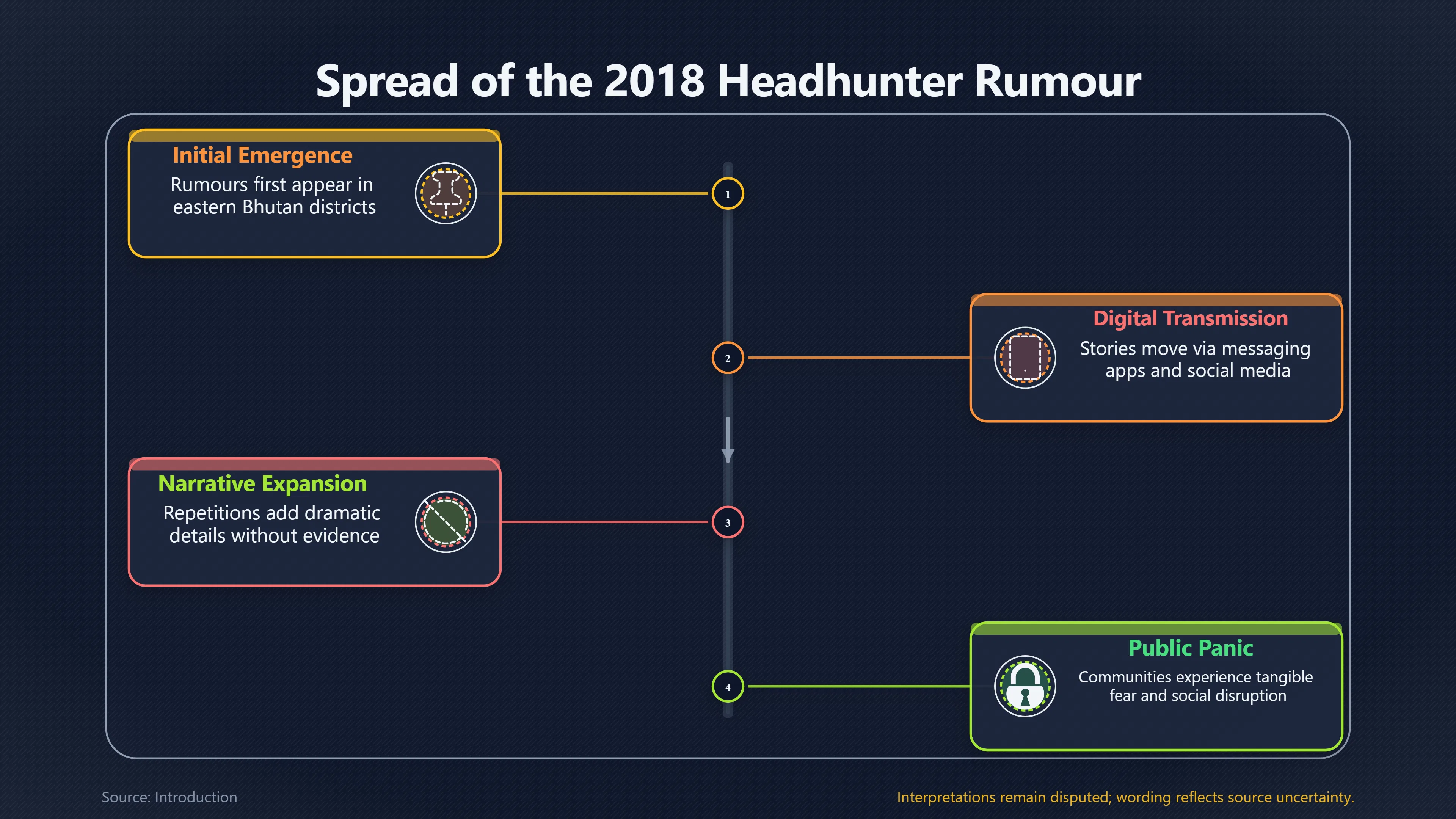
No single verified point of origin has been established. Contemporary reporting suggested the rumours began in eastern Bhutan before moving between communities through conversations, messaging applications and social media. As people repeated increasingly dramatic versions of the story, warnings acquired the appearance of eyewitness testimony even when no direct evidence existed.[The Bhutanese]thebhutanese.btThe Bhutanese Mo HCA and Dzongkhags dispel Khegpa rumors – The BhutaneseThe BhutaneseMoHCA and Dzongkhags dispel Khegpa rumors – The BhutaneseMay 26, 2018…
Several features accelerated the spread:
- Messages often came from relatives or trusted friends rather than anonymous strangers.
- Stories referred to unnamed “people who had seen” suspicious vehicles or unfamiliar visitors.
- Each repetition added apparent detail without adding verifiable evidence.
- Social media allowed local rumours to circulate far beyond the villages where they first appeared.[Jab]jab.btDisinformation: A ToolkitJournalists’ As…
This pattern resembles many rumour panics worldwide. Credibility came less from proof than from repeated warnings issued by trusted members of one’s own social network.
What Actually Happened?
Despite the extraordinary claims, authorities found no verified cases of people being killed for construction sacrifices.
Nevertheless, the rumours produced tangible social consequences. Contemporary reports described businesses closing before nightfall, unusually quiet streets, parents restricting children’s movements and widespread anxiety about travelling after dark. People became suspicious of unfamiliar visitors, and ordinary encounters with strangers could trigger alarm.[The Bhutanese]thebhutanese.btThe Bhutanese Mo HCA and Dzongkhags dispel Khegpa rumors – The BhutaneseThe BhutaneseMoHCA and Dzongkhags dispel Khegpa rumors – The BhutaneseMay 26, 2018…
The panic therefore illustrates an important distinction in the study of collective fear: a rumour can produce genuine behavioural changes even when the underlying claim is false.
Why Construction Sacrifice Legends Seemed Plausible
The belief that major construction projects require human sacrifice has appeared repeatedly across Asia in different forms. Folklore researchers have documented recurring kidnapping and headhunting rumours linked to bridges, churches, roads and other large structures, especially where communities experience rapid political or economic change.[ResearchGate]researchgate.netOpen source on researchgate.net.
In Bhutan, several factors made the story unusually believable.
First, eastern Bhutan had seen continuing infrastructure development, including roads and hydropower-related activity. Large projects naturally brought unfamiliar workers and contractors into rural communities, making “outsiders” a visible presence.
Second, oral tradition remained influential. Even in a country with rising literacy and internet access, stories transmitted through families and neighbours retained considerable authority.
Third, uncertainty encouraged people to favour caution. Faced with an alarming warning that could not easily be disproved, many preferred to alter their behaviour temporarily rather than risk becoming the supposed exception.
These mechanisms did not require widespread belief in literal human sacrifice. Instead, they demonstrate how older folklore can become psychologically persuasive when attached to contemporary events.

How Authorities Responded
Bhutanese authorities responded by publicly denying the rumours and attempting to reassure communities.
The Ministry of Home and Cultural Affairs stated that stories about headhunters collecting skulls for construction foundations were myths rather than genuine criminal activity. Police and local administrations visited affected communities to calm fears, while warning that deliberately spreading false alarms could constitute a criminal offence under Bhutanese law. One individual suspected of spreading the rumour was reportedly detained for investigation.[The Bhutanese]thebhutanese.btThe Bhutanese Mo HCA and Dzongkhags dispel Khegpa rumors – The BhutaneseThe BhutaneseMoHCA and Dzongkhags dispel Khegpa rumors – The BhutaneseMay 26, 2018…
Officials also emphasised that although communities should remain alert to ordinary crime, there was no evidence supporting claims of organised headhunters operating in Bhutan.[The Bhutanese]thebhutanese.btThe Bhutanese Mo HCA and Dzongkhags dispel Khegpa rumors – The BhutaneseThe BhutaneseMoHCA and Dzongkhags dispel Khegpa rumors – The BhutaneseMay 26, 2018…
What Changed Despite No Verified Attacks?
The 2018 scare had lasting importance despite the absence of confirmed victims.
It became one of Bhutan’s most widely cited examples of misinformation producing measurable social disruption. Journalism and media-literacy organisations have since used the incident as an illustration of how rumours can spread rapidly through modern communication networks while drawing their emotional force from much older oral traditions.[Jab]jab.btDisinformation: A ToolkitJournalists’ As…
The episode also highlighted the challenges facing authorities in a changing information environment. Official statements can struggle to compete with personal warnings shared among relatives and friends, particularly when those warnings fit familiar cultural narratives.
Later discussions of misinformation in Bhutan have frequently referenced the headhunter scare alongside false stories about earthquakes, religious prophecies and other viral claims that spread through messaging platforms.[Jab]jab.btDisinformation: A ToolkitJournalists’ As…
What the Evidence Shows Today
The historical evidence is unusually clear on one central point: the panic was real, but the alleged headhunting campaign was not.
Reliable contemporary reporting documents widespread fear, altered behaviour and official intervention. It does not document verified killings, organised kidnappings for construction sacrifices or confirmed evidence that such a network existed in Bhutan during 2018.[The Bhutanese]thebhutanese.btThe Bhutanese Mo HCA and Dzongkhags dispel Khegpa rumors – The BhutaneseThe BhutaneseMoHCA and Dzongkhags dispel Khegpa rumors – The BhutaneseMay 26, 2018…
That distinction makes the Eastern Bhutan headhunter rumour panic an important case in Bhutan’s social history. It demonstrates how collective fear can reshape everyday life without requiring the feared threat to be real. The lasting lesson is less about supernatural belief than about the enduring power of rumour, trusted social networks and cultural memory to influence behaviour during periods of uncertainty.[Jab]jab.btDisinformation: A ToolkitJournalists’ As…
Amazon book picks
Further Reading
Books and field guides related to Why Did Bhutan's Headhunter Rumour Feel Real?. Use these as the next step if you want deeper reading beyond the article.


The folklore of world holidays
Provides comparative background on enduring folk beliefs and legends.
Endnotes
1.
Source: jab.bt
Link:https://www.jab.bt/wp-content/uploads/2022/10/Combating-Disinformation.pdf
Source snippet
Disinformation: A ToolkitJournalists’ As...
2.
Source: researchgate.net
Link:https://www.researchgate.net/publication/249109628_Death_at_the_Building_Site_Construction_Sacrifice_in_Southeast_Asia
3.
Source: thebhutanese.bt
Title: The Bhutanese Mo HCA and Dzongkhags dispel Khegpa rumors – The Bhutanese
Link:https://thebhutanese.bt/mohca-and-dzongkhags-dispel-khegpa-rumors/
Source snippet
The BhutaneseMoHCA and Dzongkhags dispel Khegpa rumors – The BhutaneseMay 26, 2018...
Published: May 26, 2018
4.
Source: thebhutanese.bt
Title: Controversy over recruitment tender in Kholongchu project – The Bhutanese
Link:https://thebhutanese.bt/controversy-over-recruitment-tender-in-kholongchu-project/
Additional References
5.
Source: tandfonline.com
Link:https://www.tandfonline.com/doi/full/10.1080/13639811.2017.1247547
Source snippet
Taylor & Francis OnlineConstruction sacrifice in Eastern Indonesia: Indonesia and the Malay World: Vol 45, No 131 - Get Access...
6.
Source: malaymail.com
Title: u00e2u20acu201d Picture by Ahmad Zamzahuri
Link:https://www.malaymail.com/news/malaysia/2020/09/01/sabah-police-story-of-pengait-targeting-children-untrue/1899197
Source snippet
Sabah police: Story of ‘pengait’ targeting children untrue | Malay MailSeptember 1, 2020 — SABAH POLICE: STORY OF ‘PENGAIT’ TARGETING CHI...
Published: September 1, 2020
7.
Source: defindia.co
Title: Digital Empowerment Foundation Glimpses of digital change in Bhutan
Link:https://defindia.co/glimpses-of-digital-change-in-bhutan/
Source snippet
Digital Empowerment FoundationGlimpses of digital change in Bhutan - Digital Empowerment Foundation...
8.
Source: straitstimes.com
Title: Bring Bhutanese job seekers home: Kuensel | The Straits Times
Link:https://www.straitstimes.com/asia/bring-bhutanese-job-seekers-home-kuensel
Source snippet
January 8, 2020 — BRING BHUTANESE JOB SEEKERS HOME: KUENSEL In its editorial, the paper urges Bhutan's government to bring home young job...
Published: January 8, 2020
9.
Source: youtube.com
Title: Bhutan’s Unwritten Rules & Sacred Balance Explained | Foreign Fine Print
Link:https://www.youtube.com/watch?v=95vA6GdiB5c
Source snippet
Gross National Happiness and Democracy | Kuenga Tashi | TEDxKG Institutions...
10.
Source: youtube.com
Link:https://www.youtube.com/watch?v=6rcwKdFAEcM
Source snippet
Christians in Bhutan: "We are pressured, we are cornered"...
11.
Source: youtube.com
Title: Why 100,000 Hindus Were Kicked Out of Bhutan
Link:https://www.youtube.com/watch?v=xQsZIhQKq8I
Source snippet
Bhutan's Unwritten Rules & Sacred Balance Explained | Foreign Fine Print...
12.
Source: kuenselonline3.rssing.com
Title: all p368
Link:https://kuenselonline3.rssing.com/chan-51129451/all_p368.html
Source snippet
January 15, 2020, 2:32 am ≫ Next: Accountant embezzles more than Nu 8.4M ≪ Previous: Health issues mounting in the mountains Visibly, Bhu...
Published: January 15, 2020
13.
Source: factcheck.afp.com
Link:https://factcheck.afp.com/bangladesh-says-human-sacrifice-claim-about-padma-bridge-which-triggered-lynchings-baseless-rumour
14.
Source: cyber.megpolice.gov.in
Link:https://cyber.megpolice.gov.in/fact-check
Topic Tree