Within Korean Cult Scares
Why Do National Crises Produce Cult Scapegoats?
Major disasters and outbreaks can turn contested religious links into sweeping accusations against entire groups and their members.
On this page
- How the Sewol disaster revived older cult narratives
- Why Shincheonji became a symbol of pandemic failure
- Separating misconduct, institutional blame and collective hostility
Page outline Jump by section
Introduction
South Korea has experienced repeated episodes in which national crises became closely associated with controversial religious movements. Two of the clearest examples are the aftermath of the 2014 Sewol ferry disaster and the first major COVID-19 outbreak in 2020, when the Shincheonji Church of Jesus became the centre of national attention. In both cases, there were legitimate questions about the conduct of specific organisations or leaders. Yet the public response also demonstrated how quickly blame can expand beyond documented responsibility, turning individual wrongdoing or institutional failures into sweeping suspicion of entire religious communities. Understanding this distinction is essential to understanding modern South Korean social history. These episodes reveal not only the dangers posed by secrecy, poor governance or public-health failures, but also how fear, grief and anger can encourage broad scapegoating that exceeds the available evidence.
How the Sewol disaster revived older cult narratives
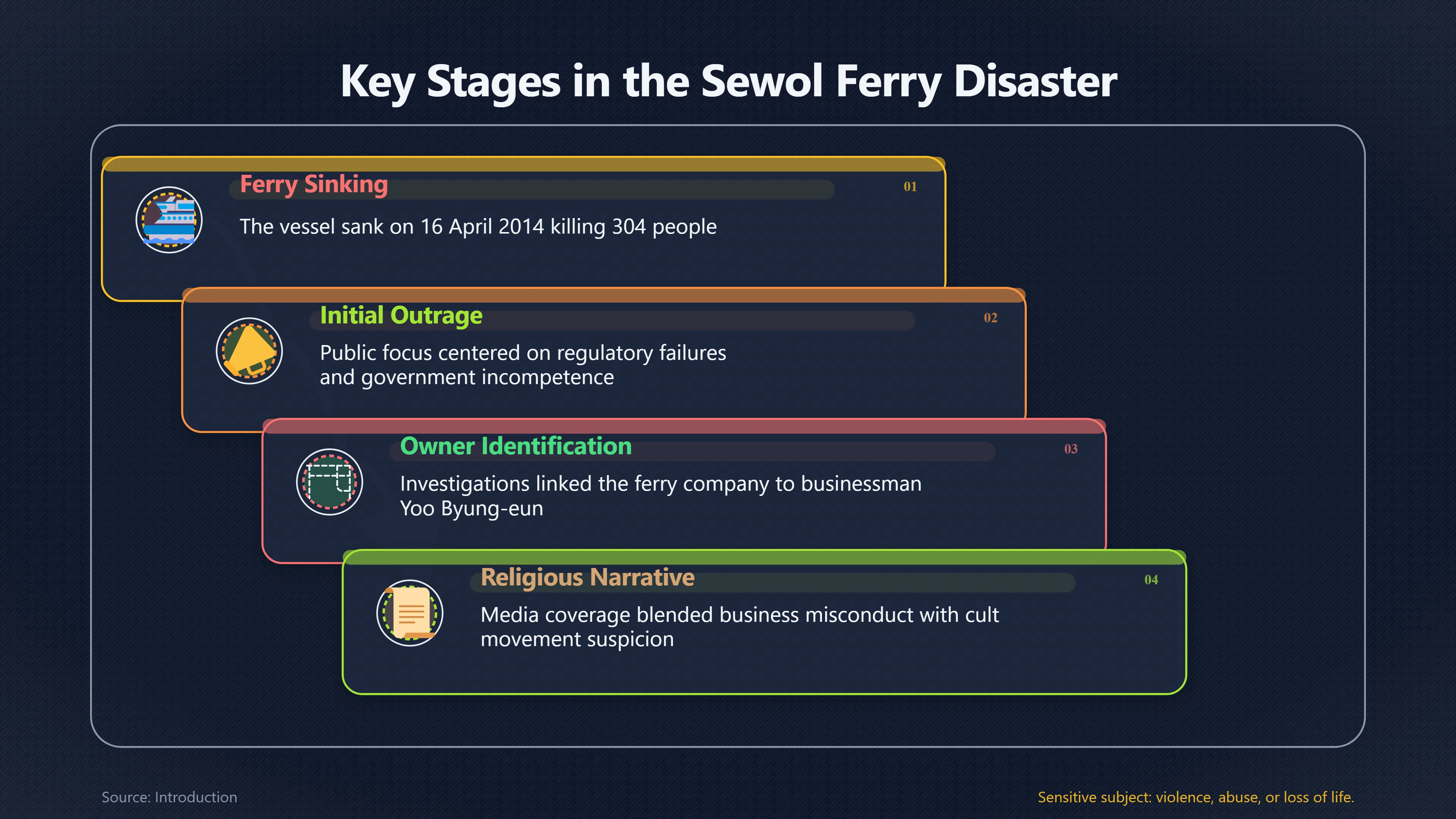
The sinking of the Sewol ferry on 16 April 2014 killed 304 people, most of them schoolchildren. Public outrage initially focused on the ferry operator, regulatory failures, emergency response and government incompetence. As investigations progressed, attention also turned towards businessman Yoo Byung-eun, whose family controlled the ferry company through a network of affiliated firms.
Yoo was not simply a businessman. He had long been associated with the Evangelical Baptist Church of Korea, often referred to by critics as the Salvation Sect. His religious influence, unusual leadership style and earlier controversies made him an immediately recognisable figure in media coverage. When he fled police before later being found dead, reporting increasingly blended questions about business misconduct with older narratives about secretive religious movements.
This distinction matters. Criminal investigations uncovered serious corporate governance failures, financial irregularities and regulatory weaknesses linked to the ferry company. Those findings justified scrutiny of Yoo and his business empire. However, historians and scholars of Korean religion note that public discussion frequently widened from the actions of one leader and associated companies to suspicion of the wider religious movement itself, even where direct evidence of involvement in the disaster was lacking. The episode reinforced an existing tendency in South Korea to interpret opaque organisations through the familiar language of “cults”, particularly during moments of national trauma.[KCI]kci.go.krKCI스티그마와 카리스마: 코로나-19 위기 시기 신천지의 정치신학KCI스티그마와 카리스마: 코로나-19 위기 시기 신천지의 정치신학
The Sewol disaster therefore became more than a maritime catastrophe. It also strengthened a cultural narrative that secretive religious organisations could represent hidden threats within society, making later controversies easier to frame through similar assumptions.
Why Shincheonji became a symbol of pandemic failure
When COVID-19 reached South Korea in early 2020, the country’s first explosive outbreak was linked to Shincheonji worship services in Daegu after the country’s thirty-first confirmed patient attended church activities while infectious. Epidemiological research confirmed that the resulting cluster spread exceptionally quickly because of prolonged indoor gatherings, close physical proximity and the timing of infections before widespread awareness of community transmission. Mathematical modelling has shown that transmission within this cluster was substantially higher than estimates for the wider population during the same period.[ScienceDirect]sciencedirect.comRapid transmission of coronavirus disease 2019 within a religious sect in South Korea: A mathematical modeling study - Scien…
These facts made Shincheonji a legitimate focus of public-health investigation. Authorities sought membership lists to trace contacts, investigated allegations that information had initially been incomplete, and prosecuted senior figures over various legal issues. The organisation’s reputation for secrecy complicated contact tracing and intensified criticism.
However, the public reaction rapidly extended beyond epidemiological concerns.
Media coverage frequently portrayed Shincheonji not simply as the location of a major outbreak but as a uniquely dangerous social actor or even a “social virus”. Researchers examining Korean media discourse argue that reporting often merged theological hostility, political conflict and public-health concerns into a single narrative, presenting the movement as a symbol of the pandemic itself rather than distinguishing between specific actions, institutional practices and individual believers.[KCI]kci.go.krKCI스티그마와 카리스마: 코로나-19 위기 시기 신천지의 정치신학KCI스티그마와 카리스마: 코로나-19 위기 시기 신천지의 정치신학
For many South Koreans, Shincheonji came to embody broader anxieties about government preparedness, transparency and social trust. The movement’s existing reputation as a controversial new religious organisation made it an unusually effective target for collective anger.

Separating misconduct, institutional blame and collective hostility
The Shincheonji case illustrates why several different questions must be kept separate.
Public-health responsibility. There is strong evidence that the Daegu cluster accelerated national transmission and that rapid tracing of church members became essential to outbreak control. Those facts are well established in epidemiological research.[ScienceDirect]sciencedirect.comRapid transmission of coronavirus disease 2019 within a religious sect in South Korea: A mathematical modeling study - Scien…
Organisational behaviour. Authorities examined whether leaders delayed cooperation or failed to provide complete information during the emergency. Some legal cases addressed these issues directly, although not every allegation resulted in conviction. Courts later acquitted founder Lee Man-hee of violating infectious disease law while convicting him on separate embezzlement-related offences, illustrating that legal responsibility depended on specific evidence rather than general public sentiment.[Reuters]reuters.comHe is accused of orchestrating an illicit campaign for over 50,000 church members to join the conservative People Power Party (PPP) betwe…
Treatment of ordinary members. Academic studies and interviews with current and former members found that many believers experienced severe social stigma. Some concealed their religious identity, lost employment opportunities, faced harassment or withdrew from public life because they feared being blamed for the national crisis regardless of their own conduct.[KCI]kci.go.krKCI낙인찍힌 사람들의 행동 전략: 신천지 교인 사례 연구KCI낙인찍힌 사람들의 행동 전략: 신천지 교인 사례 연구
Keeping these levels separate avoids two common errors: denying genuine organisational problems on the one hand, or assuming that every member shared responsibility for leadership decisions on the other.
Why crises encourage religious scapegoating
South Korea’s experience reflects several broader patterns identified by sociologists and historians.
First, major disasters generate intense public demand for clear explanations. Complex failures involving regulators, corporations and governments are often difficult to understand. Identifiable groups provide simpler targets for public anger.
Second, groups already regarded as secretive or socially marginal are especially vulnerable. Both Yoo Byung-eun’s religious network and Shincheonji had long attracted criticism from mainstream Protestant organisations and anti-cult activists before either national crisis occurred. Existing suspicion therefore provided a ready-made framework through which new events were interpreted.
Third, media incentives favour personalised stories. Investigating institutional failures in regulation, emergency management or disease surveillance requires sustained reporting. A controversial religious movement offers a more dramatic narrative centred on identifiable leaders, hidden meetings and secrecy. Scholars analysing COVID-19 coverage argue that this framing sometimes reproduced broader political and cultural assumptions about acceptable religion rather than carefully distinguishing theological disagreement from demonstrable misconduct.[KCI]kci.go.krKCI코로나19 상황에서의 신천지 보도에 대한 비판적 담론 분석KCI코로나19 상황에서의 신천지 보도에 대한 비판적 담론 분석
Finally, stigma can become self-reinforcing. As members fear exposure, they may become less willing to identify themselves publicly, which outsiders then interpret as further evidence of secrecy or guilt. Researchers studying Shincheonji members describe this as a classic cycle of social stigma rather than proof that every member intended to obstruct authorities.[KCI]kci.go.krKCI낙인찍힌 사람들의 행동 전략: 신천지 교인 사례 연구KCI낙인찍힌 사람들의 행동 전략: 신천지 교인 사례 연구
What these episodes changed
Together, Sewol and the COVID-19 outbreak strengthened public expectations that unconventional religious organisations should be more transparent, particularly where public safety is concerned. They also reinforced demands for stronger corporate oversight, emergency preparedness and faster information-sharing during crises.
At the same time, these episodes have prompted wider discussion among scholars of religion, media and sociology about the risks of allowing justified investigation to become indiscriminate hostility. The evidence supports close scrutiny of specific organisations, leaders and institutional decisions where misconduct is documented. It does not support treating every unconventional religious movement—or every member of one—as inherently responsible for national disasters.
For that reason, Sewol and Shincheonji remain important not simply as stories about controversial religious movements, but as case studies in how societies under extreme stress search for responsibility. They demonstrate that accountability and scapegoating are not the same process, even when they emerge from the same traumatic event.
Amazon book picks
Further Reading
Books and field guides related to Why Do National Crises Produce Cult Scapegoats?. Use these as the next step if you want deeper reading beyond the article.
Extraordinary Popular Delusions and the Madness of Crowds
Rating: 4.0/5 from 5 Google Books ratings
Illustrates how collective blame narratives spread.


Cults in Our Midst
Provides context for public attitudes toward new religious movements.

Endnotes
1.
Source: sciencedirect.com
Link:https://www.sciencedirect.com/science/article/pii/S1755436521000657
Source snippet
Rapid transmission of coronavirus disease 2019 within a religious sect in South Korea: A mathematical modeling study - Scien...
2.
Source: reuters.com
Link:https://www.reuters.com/world/asia-pacific/south-korea-arrests-shincheonji-church-leader-meddling-politics-media-report-2026-06-24/
Source snippet
He is accused of orchestrating an illicit campaign for over 50,000 church members to join the conservative People Power Party (PPP) betwe...
3.
Source: sciencedirect.com
Link:https://www.sciencedirect.com/science/article/pii/S2212420921007032
4.
Source: sciencedirect.com
Link:https://www.sciencedirect.com/science/article/pii/S0362331919300035
5.
Source: kci.go.kr
Title: KCI스티그마와 카리스마: 코로나-19 위기 시기 신천지의 정치신학
Link:https://www.kci.go.kr/kciportal/landing/article.kci?arti_id=ART003257145
6.
Source: kci.go.kr
Title: KCI스티그마와 카리스마: 코로나-19 위기 시기 신천지의 정치신학
Link:https://www.kci.go.kr/kciportal/ci/sereArticleSearch/ciSereArtiView.kci?sereArticleSearchBean.artiId=ART003257145
7.
Source: kci.go.kr
Title: KCI코로나19 상황에서의 신천지 보도에 대한 비판적 담론 분석
Link:https://www.kci.go.kr/kciportal/ci/sereArticleSearch/ciSereArtiView.kci?sereArticleSearchBean.artiId=ART002748328
8.
Source: kci.go.kr
Title: KCI낙인찍힌 사람들의 행동 전략: 신천지 교인 사례 연구
Link:https://www.kci.go.kr/kciportal/landing/article.kci?arti_id=ART002816333
9.
Source: kci.go.kr
Title: 어떤 죽음이 잊히는가?
Link:https://www.kci.go.kr/kciportal/ci/sereArticleSearch/ciSereArtiView.kci?sereArticleSearchBean.artiId=ART003326927
Source snippet
세월호 참사를 통해 보는 구조적 망각 -January 1, 2026 — HOME > 논문 > 논문 상세 KCI 등재 어떤 죽음이 잊히는가? - 세월호 참사를 통해 보는 구조적 망각 - WHOSE DEATH IS FORGOTTEN? - STRUCT...
Published: January 1, 2026
10.
Source: kci.go.kr
Title: ci Sere Arti View.kci
Link:https://www.kci.go.kr/kciportal/ci/sereArticleSearch/ciSereArtiView.kci?sereArticleSearchBean.artiId=ART002230437
11.
Source: kci.go.kr
Link:https://www.kci.go.kr/kciportal/ci/sereArticleSearch/ciSereArtiView.kci?sereArticleSearchBean.artiId=ART002816333
12.
Source: kci.go.kr
Link:https://www.kci.go.kr/kciportal/mobile/ci/sereArticleSearch/ciSereArtiView.kci?sereArticleSearchBean.artiId=ART003251518
13.
Source: kci.go.kr
Link:https://www.kci.go.kr/kciportal/ci/sereArticleSearch/ciSereArtiView.kci?sereArticleSearchBean.artiId=ART003251518
14.
Source: kci.go.kr
Link:https://www.kci.go.kr/kciportal/ci/sereArticleSearch/ciSereArtiView.kci?sereArticleSearchBean.artiId=ART002146646
15.
Source: kci.go.kr
Link:https://www.kci.go.kr/kciportal/ci/sereArticleSearch/ciSereArtiView.kci?sereArticleSearchBean.artiId=ART002109519
16.
Source: kci.go.kr
Link:https://www.kci.go.kr/kciportal/ci/sereArticleSearch/ciSereArtiView.kci?sereArticleSearchBean.artiId=ART002583072
Additional References
17.
Source: earticle.net
Link:https://www.earticle.net/Public/Articles/5/2223/3653
Source snippet
October 1, 2025 — This study examines the processes of public stigmatization and strategic response involving the Shincheonji Chu...
Published: October 1, 2025
18.
Source: youtube.com
Title: Shincheonji Church Leader Apologises for Spread of COVID-19 in South Korea
Link:https://www.youtube.com/watch?v=f58vQ5lxXU4
Source snippet
South Korean Tycoon Implicated in Sewol Ferry Disaster Found Dead...
19.
Source: youtube.com
Title: South Korea Sect Leader Asks for Forgiveness Over Coronavirus Surge
Link:https://www.youtube.com/watch?v=H86aF-n4uQ8
Source snippet
Shincheonji Church Leader Apologises for Spread of COVID-19 in South Korea...
20.
Source: youtube.com
Title: Uncovering the Web of Intrigue Surrounding the Sewol Ferry Disaster
Link:https://www.youtube.com/watch?v=BtX28Tb8Ldc
Source snippet
Spotlight on Shincheonji Religious Sect in South Korea...
21.
Source: youtube.com
Title: Spotlight on Shincheonji Religious Sect in South Korea
Link:https://www.youtube.com/watch?v=3l7oxAWkhsY
Source snippet
South Korea Sect Leader Asks for Forgiveness Over Coronavirus Surge...
22.
Source: onlinelibrary.wiley.com
Title: 1468 5973.70197
Link:https://onlinelibrary.wiley.com/doi/10.1111/1468-5973.70197
Source snippet
A Ten‐Year Longitudinal Analysis of the Sewol Ferry Disaster Agendas and the Reconstruction of Cultural Memory in South Korea - Ham - 202...
23.
Source: cambridge.org
Link:https://www.cambridge.org/core/journals/journal-of-east-asian-studies/article/abs/leviathan-for-sale-maritime-police-privatization-bureaucratic-corruption-and-the-sewol-disaster/8109362E2EC8FC5C6137852CBAE88788
24.
Source: ubiquityproceedings.com
Link:https://ubiquityproceedings.com/articles/10.5334/uproc.60
25.
Source: era.ed.ac.uk
Link:https://era.ed.ac.uk/items/3dab11ae-a41d-4835-a0c6-aa86561b20e4/full
26.
Source: journal.kci.go.kr
Link:https://journal.kci.go.kr/socioling/archive/articleView?artiId=ART003251518
Topic Tree