Within Zambia's Hidden Fears
How Ritual Murder Rumours Turned Into Mob Violence
Real crimes, inequality and occult fears repeatedly merged into rumours that targeted foreigners, traders and minority churches without reliable proof.
On this page
- Why Satanism became a flexible accusation
- From mutilated bodies to hidden network claims
- Mansa, Lusaka and the human cost of rumour
Page outline Jump by section
Introduction
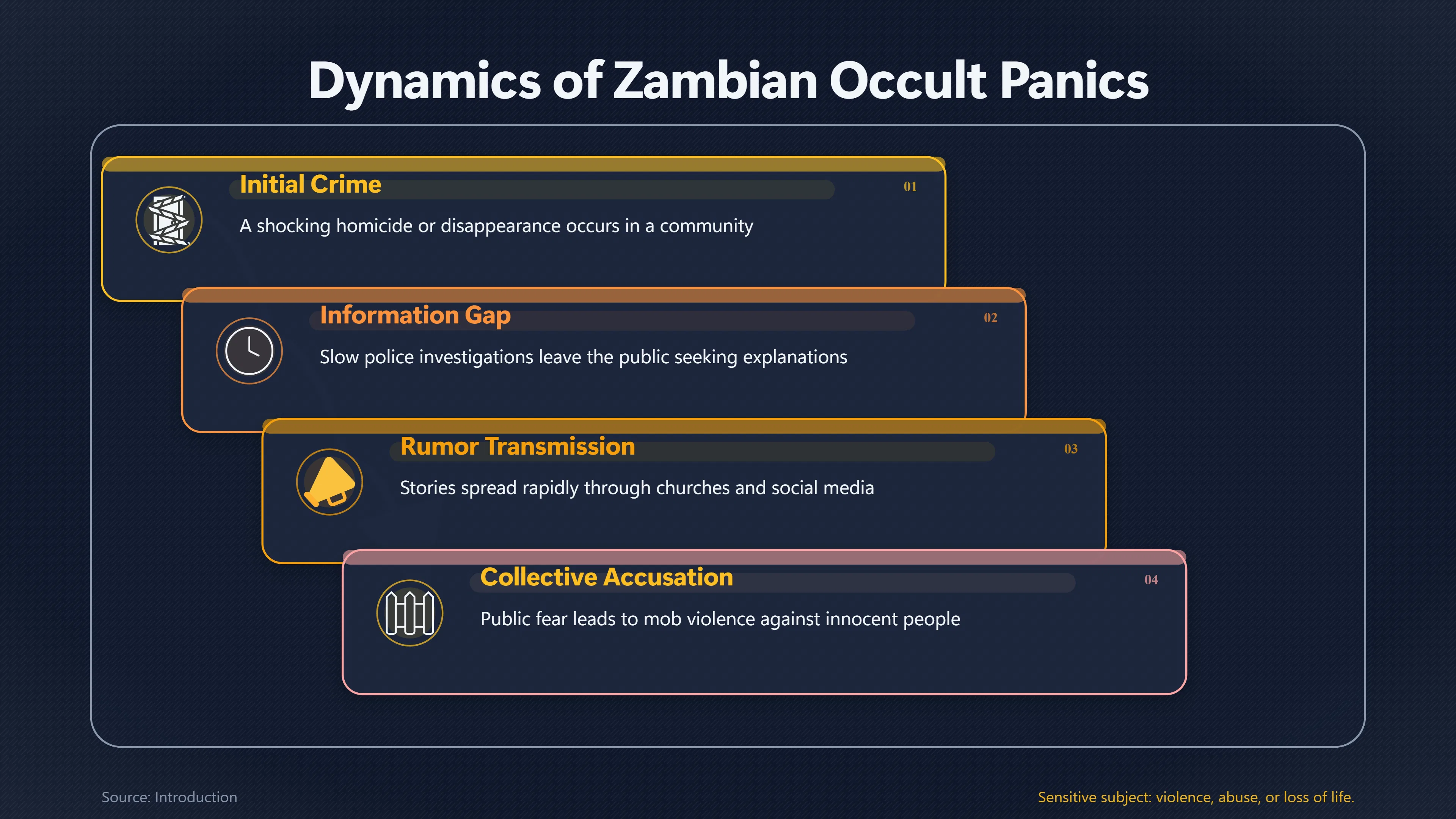
From the 1990s onwards, Zambia experienced repeated waves of fear about Satanism, ritual murder and hidden occult networks. These scares did not emerge from imagination alone: some involved genuine murders in which bodies were mutilated, while others grew from unresolved disappearances, economic anxiety, political distrust and longstanding beliefs about spiritual power. The crucial distinction is that although a small number of homicide investigations uncovered real crimes, claims of organised Satanist conspiracies, foreign-controlled cults or nationwide ritual-murder rings were often unsupported by reliable evidence. Even so, rumours frequently spread faster than police investigations, sometimes leading to mob violence against innocent people, particularly traders, migrants and members of minority churches.[investing.com]investing.comMay 10, 2016…
Rather than representing a single panic, Zambia’s occult scares form a recurring pattern in which genuine criminal cases, religious beliefs and public distrust merged into accusations that were difficult to verify but socially persuasive. Understanding these episodes helps explain why rumours have repeatedly become a source of violence in their own right.
Why Satanism became a flexible accusation
In Zambia, accusations of Satanism rarely referred to organised groups resembling modern Western Satanist organisations. Instead, the term became a broad label for hidden evil, unexplained wealth or crimes believed to involve supernatural power. Academic studies note that people often associated Satanism with sudden riches, political influence, business success or unexplained misfortune, reflecting wider anxieties about inequality and corruption rather than evidence of identifiable occult organisations.[ResearchGate]researchgate.netOpen source on researchgate.net.
Christian revival movements also shaped the language of these accusations. Pentecostal and evangelical churches frequently warned believers about spiritual warfare, demonic influence and occult practices. While many churches promoted these ideas without encouraging violence, the language sometimes blended with popular rumours about ritual killings, making Satanism a convenient explanation whenever a shocking crime remained unsolved.[ResearchGate]researchgate.netOpen source on researchgate.net.
Researchers emphasise that rumours persisted because they provided simple explanations for complex problems. When police investigations were slow or inconclusive, hidden Satanist networks offered an apparently coherent account of random violence, disappearances or economic inequalities, even where evidence remained weak.[ResearchGate]researchgate.netOpen source on researchgate.net.
From mutilated bodies to hidden-network claims
The persistence of these rumours owed much to the existence of genuine criminal cases involving mutilated bodies. Police occasionally investigated murders in which organs or other body parts had been removed, fuelling widespread speculation that victims had been sacrificed for supernatural wealth or political power. Such crimes were real homicides requiring criminal investigation, but the leap from individual offenders to nationwide Satanist conspiracies was often unsupported by evidence.[Investing.com]investing.comMay 10, 2016…
Scholars studying these narratives draw an important distinction between different phenomena that are often collapsed into the phrase “ritual murder”:
- Human sacrifice, a historically recognised religious practice in some societies but not one documented as an organised contemporary institution in Zambia.
- Murders committed to obtain body parts, allegedly for magical or medicinal purposes, which have been investigated in parts of southern Africa.
- Claims of secret Satanist organisations conducting systematic ritual killings, which researchers argue are largely products of rumour, moral panic and conspiracy narratives unless supported by independent evidence.[researchgate.net]researchgate.netOpen source on researchgate.net.
This distinction matters because real murders do not automatically demonstrate the existence of coordinated occult networks. Academic work on Zambia repeatedly concludes that many dramatic allegations ultimately rested on hearsay, alleged confessions or stories that could not be independently verified.[ResearchGate]researchgate.netOpen source on researchgate.net.
Mansa, Lusaka and the human cost of rumour
The most damaging consequences often arose not from the original crimes but from public reactions.
In Lusaka during the mid-1990s, reports of children being abducted for ritual murder created an atmosphere of extreme suspicion. Innocent strangers were attacked simply for interacting with children. Contemporary reporting described several mob assaults and lynchings triggered by rumours that suspected abductors intended to deliver children to ritual killers. One victim was reportedly attacked after offering sweets to a child, while another narrowly escaped after being mistaken for a kidnapper.[Inter Press Service]ipsnews.netInter Press ServiceZAMBIA-HUMAN RIGHTS: Giving Candy to a Child Can be Fatal | Inter Press ServiceFebruary 23, 1996…
A similar pattern reappeared repeatedly in later decades. In Katete in 2013, following the murder of a schoolgirl, rumours rapidly identified an ethnic Indian businessman as responsible for a supposed satanic sacrifice. Claims circulated that body parts had been discovered in his possession, despite no reliable evidence supporting the allegation. Shops were looted and businesses attacked before the rumours could be checked. Researchers cite the incident as a clear example of how occult accusations became intertwined with ethnic suspicion and economic resentment.[ResearchGate]researchgate.netOpen source on researchgate.net.
Mansa and other northern towns have likewise experienced recurring rumours linking disappearances or suspicious deaths to ritual killing. In several cases, community fear escalated long before police investigations established what had actually happened, illustrating how uncertainty itself became a catalyst for collective accusation. Although each incident differed, the recurring mechanism remained similar: shocking crime, limited information, rapid rumour transmission and pressure to identify hidden perpetrators.[ResearchGate]researchgate.netOpen source on researchgate.net.
The 2016 Lusaka ritual-murder investigation
One of the clearest examples of the distinction between genuine crime and wider conspiracy occurred in Lusaka in 2016.
Police investigated a series of murders in which victims had suffered similar injuries and body parts had been removed. The investigation led to the arrest of four suspects, including military personnel and a traditional healer, who were charged with multiple murders. The case demonstrated that killings involving body-part removal could occur and deserved serious criminal investigation.[Investing.com]investing.comMay 10, 2016…
However, before the arrests, rumours had already spread widely that foreign communities were responsible. Riots targeted mainly Rwandan migrants, whose homes and businesses were attacked despite no evidence linking them to the crimes. The violence highlighted how quickly fear could shift from unknown offenders to vulnerable minorities. Police investigations ultimately focused on specific suspects rather than the broad conspiratorial claims circulating during the unrest.[Investing.com]investing.comMay 10, 2016…
The episode illustrates an important feature of Zambia’s occult panics: genuine criminal investigations and unfounded conspiracy theories often evolved simultaneously, making it difficult for the public to distinguish verified facts from speculation.
Why these rumours spread so easily
Researchers identify several overlapping factors behind the resilience of Satanism rumours.
Visible inequality. Sudden wealth in communities with widespread poverty often invited suspicion that success had been achieved through supernatural means rather than ordinary business or politics.[ResearchGate]researchgate.netOpen source on researchgate.net.
Religious language. Sermons about spiritual warfare provided a familiar framework for interpreting unexplained events without necessarily endorsing violence.[ResearchGate]researchgate.netOpen source on researchgate.net.
Distrust of institutions. Where police investigations appeared slow or ineffective, unofficial explanations filled the information gap. Rumours could therefore seem more convincing than incomplete official statements.[ResearchGate]researchgate.netOpen source on researchgate.net.
Social transmission. Stories circulated through churches, schools, neighbourhood conversations, radio and, more recently, social media. Academic studies found that many people’s knowledge of alleged Satanism came primarily through rumours and religious messages rather than direct evidence.[UnisaIR]ir.unisa.ac.zaOpen source on unisa.ac.za.

How historians and social scientists interpret the panics
Most scholars do not dismiss these episodes simply as irrational superstition. Instead, they argue that rumours should be understood as responses to genuine social anxieties.
People were reacting to real concerns: violent crime, economic insecurity, political distrust and unexplained deaths. Rumours about Satanism transformed those anxieties into stories with identifiable villains, hidden organisations and supernatural motives. This made frightening events feel understandable, even when the explanations lacked evidential support.[researchgate.net]researchgate.netOpen source on researchgate.net.
Comparative research on moral panics also notes that allegations of secret Satanic conspiracies have appeared in many countries despite limited supporting evidence. Zambia’s experience differs because local beliefs about witchcraft, spiritual power and ritual medicines intersected with imported Christian ideas about Satanism, producing a distinctive hybrid form of occult panic rather than a simple copy of Western “Satanic Panic” narratives.[researchgate.net]researchgate.netOpen source on researchgate.net.
Why the episodes remain important
Occult rumours continue to influence public life because they expose a recurring tension between genuine criminal investigation and collective suspicion.
Some ritual-murder investigations have uncovered real offenders. At the same time, broader claims about nationwide Satanist networks have often remained unproven, while rumours have repeatedly led to attacks on innocent people, including migrants, traders and individuals falsely associated with occult practices. The lasting lesson is therefore not that ritual killings never occurred, nor that every rumour concealed a hidden conspiracy, but that unresolved violence and public distrust created conditions in which fear itself became socially dangerous.[investing.com]investing.comMay 10, 2016…
Amazon book picks
Further Reading
Books and field guides related to How Ritual-Murder Rumours Turned Into Mob Violence. Use these as the next step if you want deeper reading beyond the article.
Extraordinary Popular Delusions and the Madness of Crowds
Rating: 4.0/5 from 5 Google Books ratings
Examines the dynamics of rumours and public panics.

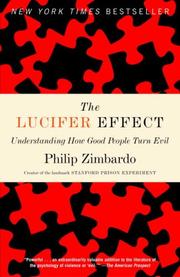
The Lucifer Effect
Explains how ordinary people participate in harmful collective behaviour.
African religions and philosophy
Provides cultural context for beliefs about witchcraft and spiritual power.
Endnotes
1.
Source: investing.com
Link:https://www.investing.com/news/world-news/zambia-police-arrest-four-suspects-for-ritual-murders-that-sparked-riots-401105
Source snippet
May 10, 2016...
Published: May 10, 2016
2.
Source: researchgate.net
Link:https://www.researchgate.net/publication/367446419_Speaking_of_Satan_in_Zambia_Making_cultural_and_personal_sense_of_narratives_about_Satanism
3.
Source: researchgate.net
Title: (PDF) ‘These things are real!’ Satanism and epistemic anxiety
Link:https://www.researchgate.net/publication/367445970_%27These_things_are_real%27_Satanism_and_epistemic_anxiety
4.
Source: researchgate.net
Title: (PDF) Dreams of modernity turning into nightmares of Satanism
Link:https://www.researchgate.net/publication/367441208_Dreams_of_modernity_turning_into_nightmares_of_Satanism
5.
Source: ir.unisa.ac.za
Link:https://ir.unisa.ac.za/handle/10500/11978
6.
Source: ojp.gov
Link:https://www.ojp.gov/ncjrs/virtual-library/abstracts/satanism-myth-and-reality-contemporary-moral-panic
7.
Source: journals.sagepub.com
Title: Sage Journals Ritual Abuse and the Moral Crusade against Satanism
Link:https://journals.sagepub.com/doi/10.1177/009164719202000317
Source snippet
Sage JournalsRitual Abuse and the Moral Crusade against Satanism - Jeffrey S. Victor, 1992...
8.
Source: ipsnews.net
Link:https://www.ipsnews.net/1996/02/zambia-human-rights-giving-candy-to-a-child-can-be-fatal/
Source snippet
Inter Press ServiceZAMBIA-HUMAN RIGHTS: Giving Candy to a Child Can be Fatal | Inter Press ServiceFebruary 23, 1996...
Published: February 23, 1996
9.
Source: ipsnews.net
Link:https://www.ipsnews.net/1998/09/religion-bulletin-zambia-government-bans-church-for-alleged-satanic-rituals/
Additional References
10.
Source: zambiamonitor.com
Link:https://www.zambiamonitor.com/two-arrested-after-mob-kills-man-in-samfya-over-witchcraft-allegation/
Source snippet
May 18, 2026 — TWO ARRESTED AFTER MOB KILLS MAN IN SAMFYA OVER WITCHCRAFT ALLEGATION Image: AUGUSTINE SICHULABy AUGUSTINE SICHULA May 18...
Published: May 18, 2026
11.
Source: youtube.com
Title: Ritual attacks and stigma — why are Zambia’s people with albinism still unsafe?
Link:https://www.youtube.com/watch?v=8q_MX5906Hk
Source snippet
This book analysis of Satanism narratives in Zambia provides direct academic context on how rumours of occult networks spread and trigger...
12.
Source: ritualkillinginafrica.org
Title: Zambia: four suspected ritual killers nabbed | Ritual Killing In Africa
Link:https://www.ritualkillinginafrica.org/2023/03/31/zambia-four-suspected-ritual-killers-nabbed/
Source snippet
F.P.M. van der Kraaij ”Police have arrested four people including a witch doctor and his son in connection with a suspec...
13.
Source: youtube.com
Title: Rwandans return to their homes after xenophobic attacks in Lusaka
Link:https://www.youtube.com/watch?v=4LjTkZhPK2o
Source snippet
At least 2 burned to death in Zambia's capital amid xenophobic riots...
14.
Source: youtube.com
Title: BOOK INSIGHTS
Link:https://www.youtube.com/watch?v=tOqmrTyf7vI
Source snippet
Rwandans return to their homes after xenophobic attacks in Lusaka...
15.
Source: diggers.news
Link:https://diggers.news/local/2020/02/04/ig-engages-zitca-to-trace-people-spreading-ritual-killing-rumors-on-social-media/
16.
Source: research-portal.uu.nl
Link:https://research-portal.uu.nl/en/publications/speaking-of-satan-in-zambia-the-persuasiveness-of-contemporary-na/
17.
Source: dspace.library.uu.nl
Link:https://dspace.library.uu.nl/handle/1874/359194
18.
Source: dspace.unza.zm
Link:https://dspace.unza.zm/items/7205ee06-3fd3-4a37-b470-dbc163c81f35
19.
Source: psychiatryonline.org
Link:https://psychiatryonline.org/doi/10.1176/appi.ajp.158.6.981
Topic Tree