Within Madagascar
Was the Menalamba Revolt Really Fanaticism?
The Menalamba uprising joined religious restoration, anti-colonial resistance and anger over labour, famine and exploitation.
On this page
- What drove the uprising
- Religion, protection and political resistance
- How colonial accounts distorted the revolt
Page outline Jump by section
Introduction
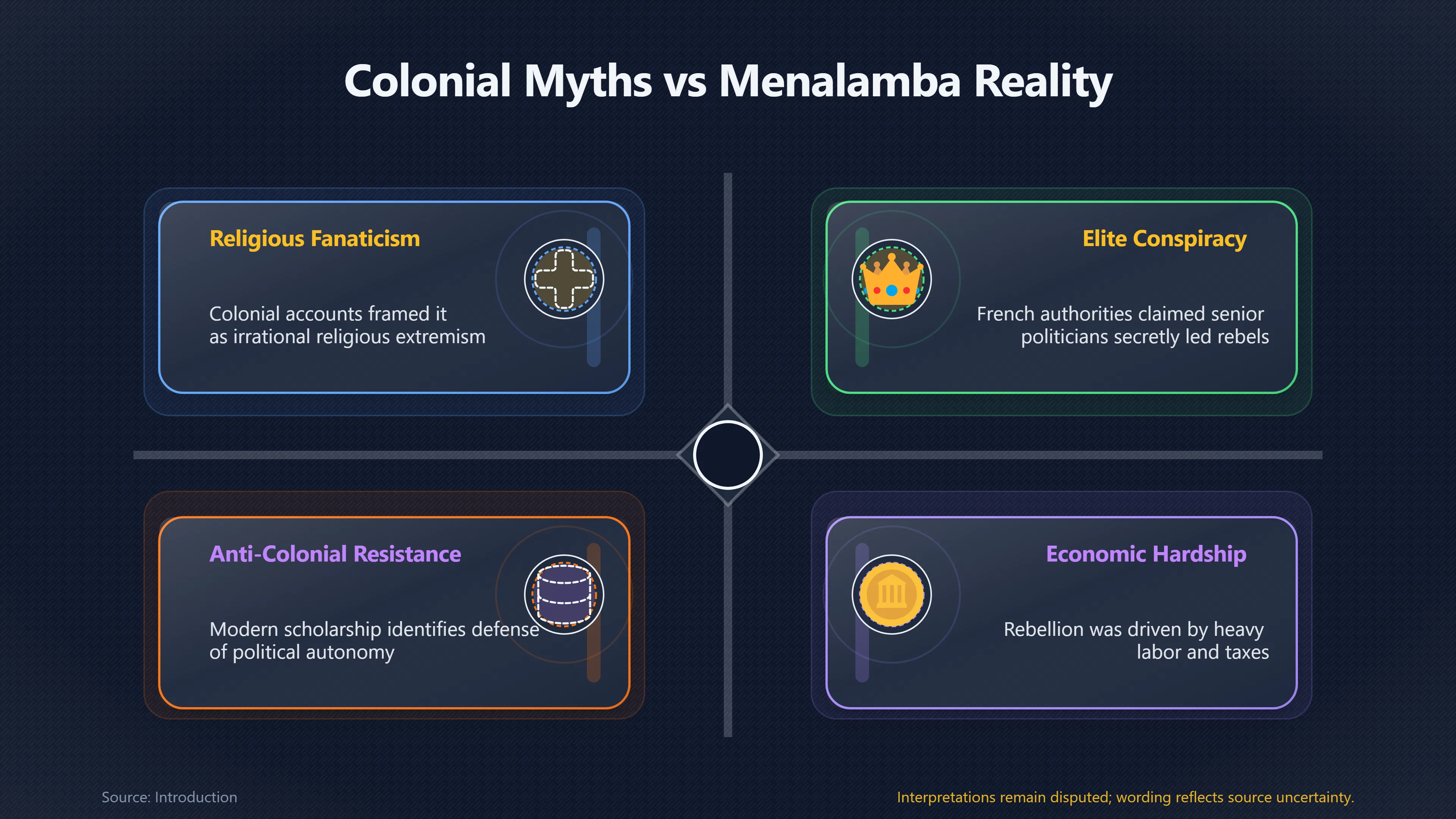
The Menalamba Revolt of 1895–1897 is often described in older colonial accounts as an outbreak of religious fanaticism against Christianity and modernity. That interpretation is now widely regarded by historians as incomplete and misleading. The uprising certainly contained a powerful religious dimension, but it was also an anti-colonial rebellion rooted in the social upheaval caused by the French conquest of Madagascar, resentment towards forced labour and taxation, famine, political uncertainty and anger at local elites seen as collaborators. Rather than representing irrational mass violence, the revolt reflected the way religious belief, political resistance and everyday economic hardship became inseparable during a period of profound crisis.[Cambridge University Press & Assessment]cambridge.orgCambridge University Press & AssessmentThe political elite of Imerina and the revolt of the Menalamba: the creation of a colonial myth in…

Understanding the Menalamba Revolt matters because it shows how colonial authorities often interpreted resistance through the language of fanaticism while overlooking the grievances that motivated ordinary participants. Modern scholarship instead treats the uprising as a complex movement whose religious symbolism helped unite communities confronting military occupation, social disruption and the collapse of the old political order.[Cambridge University Press & Assessment]cambridge.orgCambridge University Press & AssessmentThe political elite of Imerina and the revolt of the Menalamba: the creation of a colonial myth in…
What drove the uprising?
The revolt began shortly after French forces captured Antananarivo in 1895 and dismantled the authority of the Merina monarchy. Although France quickly occupied the capital, its control over much of the countryside remained fragile. Across central Madagascar, communities experienced rapid political change alongside economic disruption.
Several pressures combined to produce rebellion:
- French military occupation and the loss of Malagasy political independence.
- Heavy labour demands and taxation imposed or expanded under colonial rule.
- Earlier systems of compulsory service that had already burdened rural communities.
- Food shortages, disease and famine that increased hardship during the 1890s.
- Anger towards officials, converts and local elites viewed as benefiting from the new colonial order.[tandfonline.com]tandfonline.comTaylor & Francis OnlineMissionaries, fanompoana and the Menalamba revolt in late nineteenth century Madagascar: Journal of Southern Afric…
The movement drew support largely from rural populations rather than simply from royal politicians. While some members of the old aristocracy were later accused of directing the rebellion, later archival research suggests French authorities greatly exaggerated elite involvement. Many participants acted through local networks rather than under a single national leadership.[Cambridge University Press & Assessment]cambridge.orgCambridge University Press & AssessmentThe political elite of Imerina and the revolt of the Menalamba: the creation of a colonial myth in…
Religion, protection and political resistance
Religion was central to the revolt, but not in the simplistic sense suggested by colonial descriptions.
Many rebels sought to defend ancestral customs that they believed were threatened by French rule and by the rapid expansion of Christian institutions. Mission churches, schools and Malagasy Christian officials became visible symbols of a wider political transformation. Attacks on churches therefore carried both religious and political meanings: they rejected institutions associated with colonial authority rather than expressing indiscriminate hostility towards every Christian believer.[Taylor & Francis Online]tandfonline.comTaylor & Francis OnlineMissionaries, fanompoana and the Menalamba revolt in late nineteenth century Madagascar: Journal of Southern Afric…
Protective rituals also played an important role. Participants believed that sacred objects, ancestral blessing and ritual practices could offer spiritual protection against bullets and foreign armies. Such beliefs were neither unique to Madagascar nor evidence of collective irrationality. Similar combinations of spiritual protection and military resistance appeared in numerous African anti-colonial movements, where religious practice helped strengthen morale, solidarity and identity under conditions of overwhelming military disadvantage.[Africabib]africabib.orgAfricaBib | The Menalamba Revolt and Brigandry in Imperial Madagascar, 1820-1897…
The movement’s name, usually translated as “Red Shawls”, referred to the reddish earth-stained garments worn by many followers. The clothing became a visible symbol of commitment rather than proof of membership in a tightly organised religious sect.[African Studies Centre Leiden]ascleiden.nlrising red shawls revolt madagascarAfrican Studies Centre LeidenThe rising of the Red Shawls: a revolt in Madagascar, 1895-1899 | African Studies Centre Leiden…
Why ordinary villagers joined
Earlier explanations concentrated on political intrigue at the royal court or on religious conservatism. Later historians have broadened the picture by examining the experiences of ordinary villagers.
Research by Gwyn Campbell argues that the revolt cannot be understood without recognising the cumulative burden of compulsory labour, known broadly as fanompoana, which had existed before French conquest but continued to shape popular resentment. Labour obligations connected to the state, churches and missionary institutions consumed time, resources and agricultural production. For many rural people, Christianity became associated not only with new beliefs but also with additional demands on already strained households.[Taylor & Francis Online]tandfonline.comTaylor & Francis OnlineMissionaries, fanompoana and the Menalamba revolt in late nineteenth century Madagascar: Journal of Southern Afric…
This does not mean that all Christians supported colonial rule or that all rebels rejected Christianity. Malagasy society was more divided than colonial stereotypes suggested. Some Christians sympathised with resistance, while many rebels mixed Christian ideas with older religious traditions. The boundaries between political loyalty and religious identity were often blurred rather than absolute.[Taylor & Francis Online]tandfonline.comTaylor & Francis OnlineMissionaries, fanompoana and the Menalamba revolt in late nineteenth century Madagascar: Journal of Southern Afric…

How colonial accounts distorted the revolt
French officials had practical and political reasons to describe the Menalamba primarily as fanatics.
Presenting the uprising as irrational religious violence served several purposes:
- It justified harsh military suppression as a civilising mission.
- It portrayed colonial rule as restoring order rather than provoking resistance.
- It diverted attention from unpopular taxation, labour demands and political repression.
- It allowed blame to be placed on alleged conspirators instead of recognising widespread rural dissatisfaction.[Cambridge University Press & Assessment]cambridge.orgCambridge University Press & AssessmentThe political elite of Imerina and the revolt of the Menalamba: the creation of a colonial myth in…
Stephen Ellis’s research in previously inaccessible archives challenged one of the central colonial claims—that senior Merina politicians secretly directed the entire rebellion. He found that evidence for a centrally organised conspiracy was weak and that French authorities constructed a powerful narrative linking court elites to the revolt. The resulting prosecutions helped legitimise broader political changes, including the abolition of the monarchy and tighter colonial administration.[cambridge.org]cambridge.orgCambridge University Press & AssessmentThe political elite of Imerina and the revolt of the Menalamba: the creation of a colonial myth in…
This reinterpretation does not deny that some elite figures sympathised with resistance. Instead, it argues that colonial authorities transformed scattered contacts and rumours into an overarching conspiracy that suited their political objectives.[OUP Academic]academic.oup.comAcademic The Political Elite of Imerina and the Revolt of the MenalambaThe Creation of a Colonial Myth in Madagascar, 1895–18981Madagascar, 1895–18981 | Charlatans, Spirits and Rebels in Africa: The Stephen E…
Violence and its consequences
The revolt was violent and caused suffering across central Madagascar.
Rebels attacked churches, missionaries, Malagasy Christian converts and officials identified with the colonial regime. Several foreign missionaries were killed, along with numerous Malagasy church workers and converts. French forces responded with severe military repression, executions and punitive expeditions that devastated affected regions. By the end of 1897, organised resistance had largely been defeated, although isolated fighting continued in some areas afterwards.[Africabib]africabib.orgAfricaBib | The Menalamba Revolt and Brigandry in Imperial Madagascar, 1820-1897…
The suppression of the revolt accelerated French consolidation of power. In 1896 France formally abolished the Merina monarchy, and General Joseph Gallieni expanded a system of direct colonial administration designed to prevent similar uprisings.[African Studies Centre Leiden]ascleiden.nlrising red shawls revolt madagascarAfrican Studies Centre LeidenThe rising of the Red Shawls: a revolt in Madagascar, 1895-1899 | African Studies Centre Leiden…
Why historians no longer see it as simple fanaticism
Modern historians generally reject any explanation that reduces the Menalamba Revolt to religious extremism or mass hysteria.
Instead, the movement is understood as the product of several interacting forces:
- Anti-colonial resistance: defence of Malagasy political autonomy after conquest.
- Religious restoration: protection of ancestral practices threatened by colonial expansion.
- Economic hardship: resistance to labour demands, taxation and rural exploitation.
- Social crisis: famine, disease and political uncertainty that intensified existing grievances.
- Colonial storytelling: official narratives that exaggerated conspiracy and fanaticism to legitimise repression.[cambridge.org]cambridge.orgCambridge University Press & AssessmentThe political elite of Imerina and the revolt of the Menalamba: the creation of a colonial myth in…
Seen through this broader lens, religion was neither a disguise nor the sole cause of the uprising. It provided the language, symbols and rituals through which communities interpreted colonial domination and organised collective resistance.

Lasting importance
The Menalamba Revolt remains one of Madagascar’s defining episodes of anti-colonial resistance because it demonstrates how belief, politics and material conditions can become inseparable during periods of upheaval.
For historians of collective belief, it is an important reminder that accusations of fanaticism often reveal as much about those making the accusation as about the people being described. Colonial officials tended to frame the uprising as irrational religious violence, whereas later scholarship shows a movement driven by genuine political dispossession, economic suffering and cultural defence, expressed through the religious traditions that gave many Malagasy communities meaning and solidarity.[cambridge.org]cambridge.orgCambridge University Press & AssessmentThe political elite of Imerina and the revolt of the Menalamba: the creation of a colonial myth in…
Amazon book picks
Further Reading
Books and field guides related to Was the Menalamba Revolt Really Fanaticism?. Use these as the next step if you want deeper reading beyond the article.

The anthropology of religion, magic, and witchcraft
Helps interpret the religious dimensions of the revolt.
Endnotes
1.
Source: cambridge.org
Link:https://www.cambridge.org/core/journals/journal-of-african-history/article/abs/political-elite-of-imerina-and-the-revolt-of-the-menalamba-the-creation-of-a-colonial-myth-in-madagascar-189518981/41A475B55A35891C4D4764642FBC0C49
Source snippet
Cambridge University Press & AssessmentThe political elite of Imerina and the revolt of the Menalamba: the creation of a colonial myth in...
2.
Source: africabib.org
Link:https://www.africabib.org/rec.php?DB=p&RID=108711927
Source snippet
AfricaBib | Crisis of Faith and Colonial Conquest. The Impact of Famine and Disease in Late Nineteenth-Century Madagascar...
3.
Source: africabib.org
Link:https://www.africabib.org/rec.php?RID=091716527
Source snippet
AfricaBib | The Menalamba Revolt and Brigandry in Imperial Madagascar, 1820-1897...
4.
Source: africabib.org
Link:https://www.africabib.org/rec.php?DB=p&RID=18861687X
Source snippet
AfricaBib | The Political Elite of Imerina and the Revolt of the Menalamba: The Creation of a Colonial Myth in Madagascar, 1895...
5.
Source: academic.oup.com
Title: Academic The Political Elite of Imerina and the Revolt of the Menalamba
Link:https://academic.oup.com/book/44040/chapter-abstract/373132631
Source snippet
The Creation of a Colonial Myth in Madagascar, 1895–18981Madagascar, 1895–18981 | Charlatans, Spirits and Rebels in Africa: The Stephen E...
6.
Source: africabib.org
Link:https://africabib.org/rec.php?RID=119545292
Source snippet
Missionaries, Fanompoana and the Menalamba Revolt in Late Nineteenth Century MadagascarOctober 1, 1988 —...
Published: October 1, 1988
7.
Source: africabib.org
Link:https://www.africabib.org/rec.php?RID=250201143
8.
Source: tandfonline.com
Link:https://www.tandfonline.com/doi/abs/10.1080/03057078808708191
Source snippet
Taylor & Francis OnlineMissionaries, fanompoana and the Menalamba revolt in late nineteenth century Madagascar: Journal of Southern Afric...
9.
Source: ascleiden.nl
Title: rising red shawls revolt madagascar 1895 1899
Link:https://www.ascleiden.nl/publications/rising-red-shawls-revolt-madagascar
Source snippet
African Studies Centre LeidenThe rising of the Red Shawls: a revolt in Madagascar, 1895-1899 | African Studies Centre Leiden...
10.
Source: ascleiden.nl
Link:https://www.ascleiden.nl/publications/political-elite-imerina-and-revolt-menalamba-creation-colonial-myth-madagascar-1895
11.
Source: ascleiden.nl
Title: linsurrection des menalamba une revolte madagascar 1895 1899
Link:https://www.ascleiden.nl/publications/linsurrection-des-menalamba-une-revolte-madagascar
Additional References
12.
Source: researchgate.net
Title: Uprisings in other regions of the isl
Link:https://www.researchgate.net/publication/270404116_The_Menalamba_Revolt_and_Brigandry_in_Imperial_Madagascar
Source snippet
"(PDF) The Menalamba Revolt and Brigandry in Imperial Madagascar, 1820-1897January 1, 1991 — All use subject to [https://about.jstor.org/te..."](https://about.jstor.org/te...")...
Published: January 1, 1991
13.
Source: youtube.com
Title: Gallieni and the “Politics of Races” in Madagascar
Link:https://www.youtube.com/watch?v=ZZA42qO8pW8
Source snippet
When Military Victory Sparked Africa's Most Unexpected Resistance Movement | GHA-VII | Ashaware...
14.
Source: youtube.com
Link:https://www.youtube.com/watch?v=ve4qOnM0028
Source snippet
Queen Ranavalona I, Madagascar's Queen of Colonial Resistance...
15.
Source: researchgate.net
Link:https://www.researchgate.net/publication/271821666_Missionaries_Fanompoana_and_the_Menalamba_Revolt_in_late_nineteenth_century_Madagascar
16.
Source: youtube.com
Title: Queen Ranavalona I of Madagascar
Link:https://www.youtube.com/watch?v=u_JZm4-FT64
Source snippet
Ranavalona Madagascar's Forgotten Evil Queen...
17.
Source: persee.fr
Title: Résistance et rébellion. Une lecture de l’insurrection menalamba
Link:https://www.persee.fr/doc/cea_0008-0055_1985_num
18.
Source: youtube.com
Title: Queen Ranavalona I, Madagascar’s Queen of Colonial Resistance
Link:https://www.youtube.com/watch?v=ntm4OdEXOV8
Source snippet
Queen Ranavalona I of Madagascar...
19.
Source: persee.fr
Title: outre 1631 0438 2002 num 89 334 3970 t1 0675 0000 5
Link:https://www.persee.fr/doc/outre_1631-0438_2002_num_89_334_3970_t1
20.
Source: youtube.com
Title: Ranavalona Madagascar’s Forgotten Evil Queen
Link:https://www.youtube.com/watch?v=BkGzdY_q5fI
Topic Tree