Within Liechtenstein Panics
How Did the Witch Panic Keep Growing?
Torture, inherited suspicion and village conflict turned isolated accusations into a self-reinforcing persecution.
On this page
- Accusations that created new suspects
- Family reputation and village hostility
- Why coercive confessions looked convincing
Page outline Jump by section
Introduction
The witch persecutions in the counties of Vaduz and Schellenberg did not spread because evidence against alleged witches became stronger. They spread because the legal process itself generated new suspects. Between the late sixteenth century and 1680, accusations, torture, inherited suspicion and long-running village conflicts combined to create a self-reinforcing cycle in which almost every investigation pointed towards another one. By the final wave of 1679–80, the process had become one of the largest witch-hunt episodes then taking place in the German-speaking world, despite the territory’s tiny population. Historians see the panic as an example of how ordinary neighbourhood tensions, combined with coercive legal practices and weak institutional restraints, could transform isolated suspicions into a devastating campaign of persecution.[Liechtenstein Lexicon]historisches-lexikon.liLiechtenstein Lexicon Hexenverfolgung – Historisches LexikonLiechtenstein LexiconHexenverfolgung – Historisches LexikonDecember 31, 2011…
How did the witch panic keep growing?
The central mechanism was simple but extraordinarily destructive. Every successful prosecution increased the apparent evidence that a hidden conspiracy existed.
Early modern courts in Vaduz and Schellenberg accepted the widespread belief that witches belonged to an organised group allied with the Devil rather than acting alone. Because judges expected a conspiracy, interrogators demanded that prisoners identify supposed accomplices. Each additional name justified another arrest, which produced another interrogation and another list of alleged participants. The investigation therefore expanded through its own procedures rather than through independent evidence.[Liechtenstein Lexicon]historisches-lexikon.liLiechtenstein Lexicon Hexenverfolgung – Historisches LexikonLiechtenstein LexiconHexenverfolgung – Historisches LexikonDecember 31, 2011…
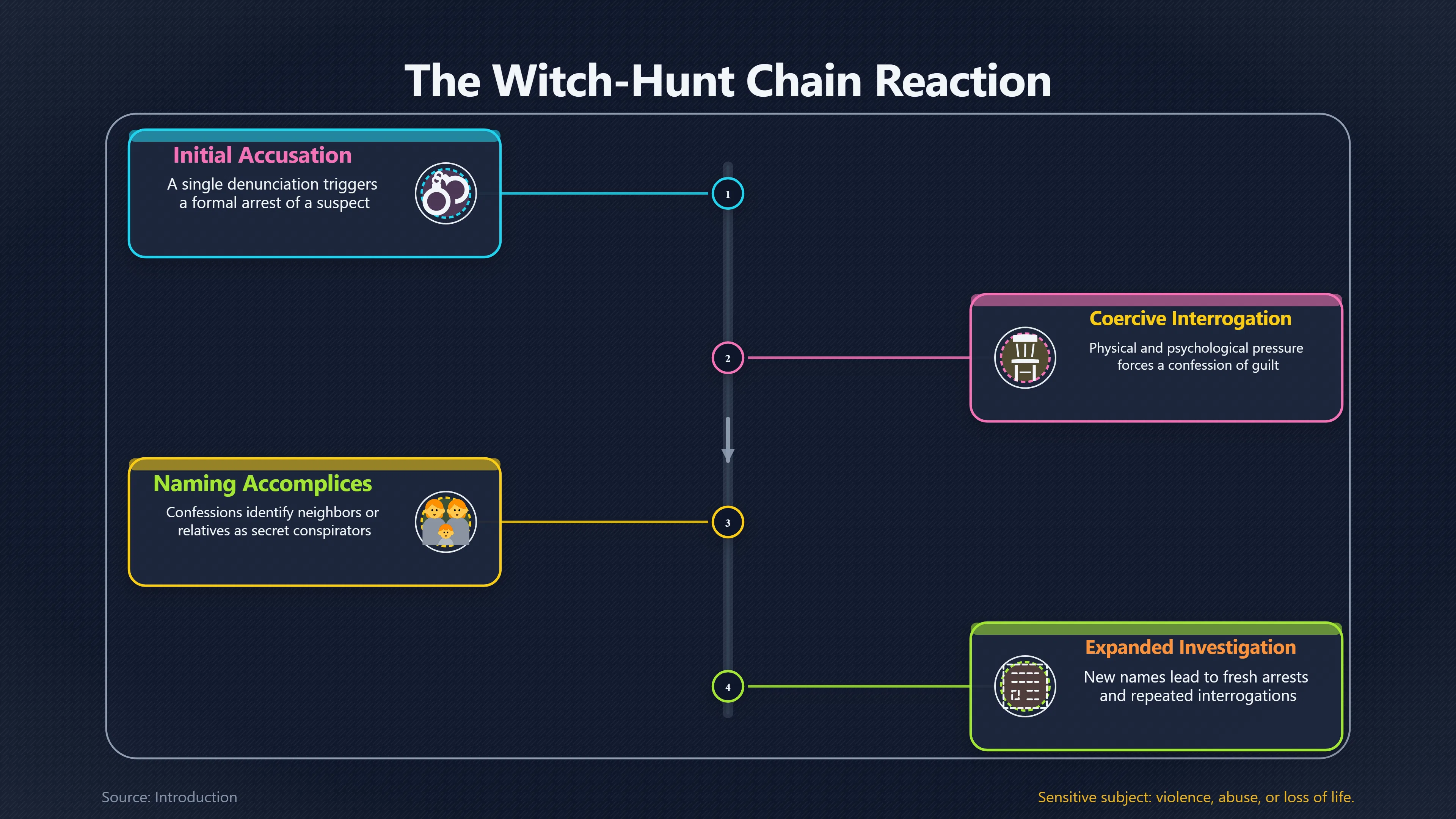
This logic created a chain reaction:
- one accusation led to an arrest;
- torture produced a confession;
- the confession named neighbours or relatives;
- those people were arrested and interrogated in turn;
- the growing list of suspects appeared to confirm that the conspiracy was real.
Modern historians describe this as a self-sustaining process rather than the uncovering of an actual secret organisation. The trials created the network they claimed to expose.[Historisches Lexikon Bayerns]historisches-lexikon-bayerns.deHistorisches Lexikon Bayerns EN:Persecution of witchesHistorisches Lexikon BayernsEN:Persecution of witches - Historisches Lexikon Bayerns…
Accusations that created new suspects
The courts treated denunciations from accused prisoners as valuable evidence, even though they were obtained under intense physical and psychological pressure.
Once torture was authorised, prisoners faced overwhelming incentives to admit guilt and satisfy interrogators by naming others. Since officials already believed that witches met together, failing to identify accomplices could itself be taken as proof that the suspect was concealing information. The result was an ever-expanding circle of accusations.
Legal historians note that this pattern appeared across many of the worst witch hunts in the Holy Roman Empire, where witchcraft increasingly came to be treated as an exceptional crime allowing departures from ordinary legal safeguards. The trials in Vaduz and Schellenberg followed this broader pattern but were especially difficult to stop because the territory lacked the administrative checks found in larger neighbouring states.[Historisches Lexikon Bayerns]historisches-lexikon-bayerns.deHistorisches Lexikon Bayerns EN:Persecution of witchesHistorisches Lexikon BayernsEN:Persecution of witches - Historisches Lexikon Bayerns…
Family reputation and village hostility
The panic also spread through memory. Once one member of a family had been accused, later generations could inherit suspicion.
A well-known example is Maria Eberle of Planken. Contemporary records indicate that both her grandfather and an aunt had previously been executed for witchcraft. By the time she herself came under suspicion, she already carried the reputation of belonging to a “witch family”. Her arrest therefore reflected not simply a single allegation but years of accumulated local prejudice.[Liechtenstein Lexicon]historisches-lexikon.liLiechtenstein Lexicon Hexenverfolgung – Historisches LexikonLiechtenstein LexiconHexenverfolgung – Historisches LexikonDecember 31, 2011…
Village life amplified this process. Small communities remembered disputes over land, livestock, debts, inheritance and personal insults for decades. When illness, crop failure or unexplained deaths occurred, existing grievances could be reinterpreted as evidence of supernatural harm. A difficult neighbour or an already unpopular family became a plausible target because many people were prepared to believe the accusation before any formal investigation began.[Historisches Lexikon Bayerns]historisches-lexikon-bayerns.deHistorisches Lexikon Bayerns EN:Persecution of witchesHistorisches Lexikon BayernsEN:Persecution of witches - Historisches Lexikon Bayerns…
The result was a feedback loop between local reputation and legal procedure. Social hostility generated accusations, while prosecutions strengthened the belief that certain families had always been involved in witchcraft.
Why coercive confessions looked convincing
From a modern perspective, confessions extracted under torture have no evidential value. In the seventeenth century, however, many judges regarded them as the strongest possible proof.
Once a suspect confessed, the confession often included highly detailed descriptions of meetings with the Devil, gatherings of witches and harmful magic. These stories appeared persuasive precisely because they contained elaborate detail. In reality, historians point out that the details reflected repeated questioning, leading questions and the expectations of interrogators rather than independent memories.[Historisches Lexikon Bayerns]historisches-lexikon-bayerns.deHistorisches Lexikon Bayerns EN:Persecution of witchesHistorisches Lexikon BayernsEN:Persecution of witches - Historisches Lexikon Bayerns…
The confessions also seemed to corroborate one another. If several prisoners described similar events or named overlapping individuals, officials interpreted this as confirmation. Modern research instead views these similarities as the predictable outcome of prisoners responding to the same assumptions under the same coercive conditions. Because each confession borrowed from earlier accusations, the body of evidence became increasingly consistent while remaining fundamentally unreliable.[Historisches Lexikon Bayerns]historisches-lexikon-bayerns.deHistorisches Lexikon Bayerns EN:Persecution of witchesHistorisches Lexikon BayernsEN:Persecution of witches - Historisches Lexikon Bayerns…

Why the panic became unusually severe
Historians argue that the political structure of Vaduz and Schellenberg helped the persecution continue longer than it might have elsewhere.
The counties were small jurisdictions with relatively few institutional barriers capable of reviewing local judicial decisions. The Liechtenstein Historical Lexicon notes that neighbouring territories gained a reputation for stronger administrative controls that could sometimes restrain arbitrary prosecutions, whereas Vaduz and Schellenberg lacked comparable safeguards. During the final persecutions of 1679–80, neighbouring regions even acquired the impression that the counties had become a “land of witches” because the trials continued with unusual intensity.[Liechtenstein Lexicon]historisches-lexikon.liLiechtenstein Lexicon Hexenverfolgung – Historisches LexikonLiechtenstein LexiconHexenverfolgung – Historisches LexikonDecember 31, 2011…
Only outside intervention eventually interrupted the cycle. Appeals beyond the local authorities challenged both the legality of the proceedings and the methods being used. Historians therefore see the end of the panic not as the result of the accusations collapsing on their own, but because higher political authorities finally intervened to halt a process that had become self-perpetuating.[Liechtenstein Lexicon]historisches-lexikon.liLiechtenstein Lexicon Hexenverfolgung – Historisches LexikonLiechtenstein LexiconHexenverfolgung – Historisches LexikonDecember 31, 2011…
Amazon book picks
Further Reading
Books and field guides related to How Did the Witch Panic Keep Growing?. Use these as the next step if you want deeper reading beyond the article.
The witch-hunt in early modern Europe
Explains escalation through legal processes and torture.

Endnotes
1.
Source: historisches-lexikon.li
Title: Liechtenstein Lexicon Hexenverfolgung – Historisches Lexikon
Link:https://historisches-lexikon.li/Hexenverfolgung
Source snippet
Liechtenstein LexiconHexenverfolgung – Historisches LexikonDecember 31, 2011...
Published: December 31, 2011
2.
Source: historisches-lexikon-bayerns.de
Title: Historisches Lexikon Bayerns EN:Persecution of witches
Link:https://www.historisches-lexikon-bayerns.de/Lexikon/EN%3APersecution_of_witches
Source snippet
Historisches Lexikon BayernsEN:Persecution of witches - Historisches Lexikon Bayerns...
3.
Source: news.historisches-lexikon.li
Link:https://news.historisches-lexikon.li/maria-eberle-und-das-ende-der-hexenverfolgungen
Source snippet
Eberle und das Ende der Hexenverfolgungen:: news für eHFLApril 15, 2024 — MARIA EBERLE UND DAS ENDE DER HEXENVERFOLGUNGEN 15.04.2024 - F...
Published: April 15, 2024
4.
Source: historisches-lexikon-bayerns.de
Link:https://www.historisches-lexikon-bayerns.de/Lexikon/Hexenverfolgung
Source snippet
Historisches Lexikon BayernsJanuary 20, 2022 — AUS HISTORISCHES LEXIKON BAYERNS Rechts im Bild wird die Verbrennung Hans Böhms, des sogen...
Published: January 20, 2022
5.
Source: historisches-lexikon.li
Title: Landsgemeinde – Historisches Lexikon
Link:https://historisches-lexikon.li/Landsgemeinde
6.
Source: historisches-lexikon.li
Title: Tobelhocker – Historisches Lexikon
Link:https://historisches-lexikon.li/Tobelhocker
7.
Source: historisches-lexikon-bayerns.de
Title: Gerichtsverfahren (Spätmittelalter/Frühe Neuzeit) – Historisches Lexikon Bayerns
Link:https://www.historisches-lexikon-bayerns.de/Lexikon/Gerichtsverfahren_%28Sp%C3%A4tmittelalter/Fr%C3%BChe_Neuzeit%29
8.
Source: historisches-lexikon.li
Title: Schellenberg (Herrschaft) – Historisches Lexikon
Link:https://historisches-lexikon.li/Schellenberg_%28Herrschaft%29
9.
Source: historisches-lexikon.li
Title: Liechtenstein (Land) – Historisches Lexikon
Link:https://historisches-lexikon.li/Liechtenstein_%28Land%29?marker=Liechtenstein
10.
Source: historisches-lexikon.li
Title: Kaiserliche Administration – Historisches Lexikon
Link:https://historisches-lexikon.li/Kaiserliche_Administration
11.
Source: historisches-lexikon.li
Title: Walser, Andreas Josef – Historisches Lexikon
Link:https://historisches-lexikon.li/Walser%2C_Andreas_Josef
12.
Source: historisches-lexikon.li
Title: Scharfrichter – Historisches Lexikon
Link:https://historisches-lexikon.li/Scharfrichter
13.
Source: historisches-lexikon.li
Title: Eberle (Eberlin), Maria – Historisches Lexikon
Link:https://historisches-lexikon.li/Eberle_%28Eberlin%29%2C_Maria
14.
Source: historisches-lexikon-bayerns.de
Title: Bambergische Halsgerichtsordnung – Historisches Lexikon Bayerns
Link:https://www.historisches-lexikon-bayerns.de/Lexikon/Bambergische_Halsgerichtsordnung
Additional References
15.
Source: reddit.com
Link:https://www.reddit.com/r/AskHistorians/comments/1l1gzqa
Source snippet
What was the legal process like for being accused of witchcraft in early 17th-century Germany?...
16.
Source: lie-zeit.li
Title: Hexenverfolgungen in Liechtenstein – lie:zeit online
Link:https://www.lie-zeit.li/2023/03/hexenverfolgungen-in-liechtenstein/
Source snippet
März 2023 Bild, das auf die Hexenprozesse hinweist ALS HEXENVERFOLGUNG BEZEICHNET MAN DAS AUFSPÜREN, FESTNEHMEN, FOLTERN UND BESTRAFEN, I...
17.
Source: blog.nationalmuseum.ch
Title: The spread of the plague claime
Link:https://blog.nationalmuseum.ch/en/2024/08/how-the-principality-of-liechtenstein-came-into-being/
Source snippet
the Principality of Liechtenstein came into being – Swiss National Museum - Swiss history blogAugust 20, 2024 — PURCHASE OF THE LORDSHIP...
Published: August 20, 2024
18.
Source: fis.uni-bamberg.de
Link:https://fis.uni-bamberg.de/entities/publication/57a299cf-1ce3-4eb2-8952-9a7b2cf0076c
Source snippet
of witchesFebruary 25, 2025 — Persecution of witches Flurschütz da Cruz, Andreas (2025): Persecution of witches, in: Historisches Lexikon...
Published: February 25, 2025
19.
Source: reddit.com
Title: How were witch trials finally refuted?
Link:https://www.reddit.com/r/AskHistorians/comments/17dm9q5
Source snippet
How were witch trials finally refuted?...
20.
Source: liechtenstein-institut.li
Link:https://liechtenstein-institut.li/en/research-projects/die-kaiserliche-administration-der-reichsgrafschaft-vaduz-und-der-reichsherrschaft-schellenberg-1684-16991712
21.
Source: liechtenstein-institut.li
Link:https://liechtenstein-institut.li/forschungsprojekte/die-kaiserliche-administration-der-reichsgrafschaft-vaduz-und-der-reichsherrschaft-schellenberg-1684-16991712
22.
Source: liechtenstein-institut.li
Link:https://liechtenstein-institut.li/en/publications/frommelt-fabian-2014-kaiserliches-krisenmanagement-der-peripherie-zur-kaiserlichen-administration-vaduzschellenberg-1684-1712-fa
23.
Source: youtube.com
Title: Europe’s Witch Trials: Context for Salem Part 1
Link:https://www.youtube.com/watch?v=oY–nodAvU8
Source snippet
Ugly History: Witch Hunts - Brian A. Pavlac...
24.
Source: youtube.com
Title: The Horrors of the German Witch Hunts
Link:https://www.youtube.com/watch?v=NvEzvu_uYEI
Source snippet
Europe's Witch Trials: Context for Salem Part 1...
Topic Tree