Within Eswatini
How Can Fear Make a Whole School Ill?
School outbreaks can spread through stress, observation, rumour and expectation even when the symptoms are entirely genuine.
On this page
- What mass psychogenic illness means
- How symptoms spread through school communities
- Why careless responses can prolong an outbreak
Page outline Jump by section
Introduction
School outbreaks in which dozens of pupils suddenly faint, shake, scream, struggle to walk or complain of physical symptoms can appear mysterious and frightening. In Eswatini, as in several other African countries, these incidents are often interpreted through competing explanations that include poisoning, demonic possession, witchcraft or contagious illness. Medical research shows that some of these episodes are best understood as mass psychogenic illness (MPI), also known as mass sociogenic illness: a real pattern of physical symptoms that spreads through a socially connected group without evidence of an infectious disease or environmental toxin causing the outbreak. The symptoms are genuine, not faked, but they spread through shared stress, expectation, observation and fear rather than through a virus or poison.[PMC]pmc.ncbi.nlm.nih.govPMCEpisodes of mass hysteria in African schools: A study of literaturePMCEpisodes of mass hysteria in African schools: A study of literature
Understanding how these episodes spread helps explain why school communities can become caught in a cycle of escalating anxiety, and why careful communication is as important as medical investigation.
What does mass psychogenic illness mean?
Mass psychogenic illness describes a situation in which physical symptoms spread rapidly through a group because of psychological and social processes rather than a contagious pathogen or toxic exposure. Before reaching that conclusion, health authorities must still investigate ordinary medical causes such as food contamination, infectious disease, heat, poor ventilation, chemicals or neurological illness. MPI is never an excuse to dismiss pupils’ experiences or to skip a proper medical assessment.[New England Journal of Medicine]nejm.orgNew England Journal of MedicineMass Psychogenic Illness Attributed to Toxic Exposure at a High School | New England Journal of MedicineJa…
Typical symptoms include:
- Fainting or collapsing.
- Shaking or seizure-like movements.
- Difficulty breathing or hyperventilation.
- Headaches, dizziness and nausea.
- Weakness or difficulty walking.
- Crying, screaming or panic.
These symptoms are real physiological responses to intense stress and anxiety. They are not deliberate performances, even when medical tests fail to identify an underlying physical disease.[PMC]pmc.ncbi.nlm.nih.govPMCEpisodes of mass hysteria in African schools: A study of literaturePMCEpisodes of mass hysteria in African schools: A study of literature
How symptoms spread through school communities
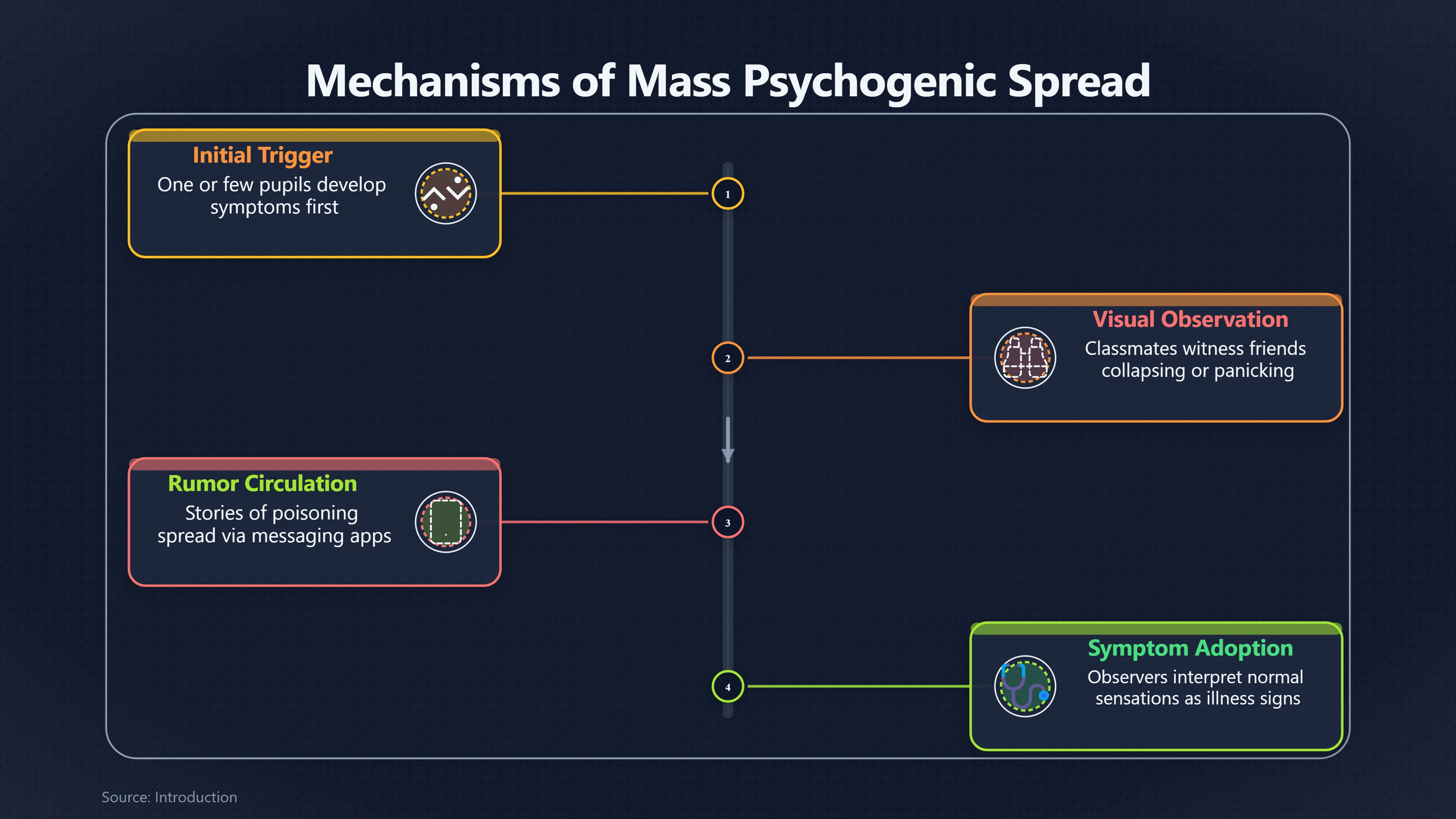
School outbreaks rarely begin with dozens of pupils becoming ill at once. Instead, researchers describe a chain reaction in which one or a few pupils develop symptoms before others begin experiencing similar problems.
Several mechanisms help explain this pattern.
Observation and imitation. When students see classmates collapse or panic, especially close friends or respected peers, anxiety increases. Normal bodily sensations—such as dizziness, a racing heart or light-headedness—may suddenly be interpreted as signs that they too are becoming ill. Visual and auditory exposure is one of the strongest drivers of spread.[New England Journal of Medicine]nejm.orgNew England Journal of MedicineMass Psychogenic Illness Attributed to Toxic Exposure at a High School | New England Journal of MedicineJa…
Rumours and expectation. Stories about poisoning, evil spirits or mysterious illnesses can circulate through classrooms, dormitories, messaging apps and families within minutes. Once people expect danger, they become more alert to ordinary physical sensations, making additional cases more likely. A recent systematic review identified rumours and misinformation among the most consistent factors amplifying school outbreaks.[PubMed]pubmed.ncbi.nlm.nih.govFactors related to the occurrence of mass psychogenic illness in schools: a systematic review - PubMed…
Shared stress. Schools are environments where many pupils experience the same pressures at the same time. Examinations, disciplinary disputes, bullying, family problems, bereavement or fear of authority can create widespread psychological strain long before any outbreak begins. When one pupil becomes visibly distressed, others already carrying similar stress may develop comparable symptoms.[PMC]pmc.ncbi.nlm.nih.govPMCEpisodes of mass hysteria in African schools: A study of literaturePMCEpisodes of mass hysteria in African schools: A study of literature
Close social contact. Schools concentrate large numbers of young people who spend many hours together. Research consistently finds that physical proximity, boarding accommodation and close friendship networks increase opportunities for symptoms and fears to spread.[South African Journal of Psychiatry]sajp.org.zaOpen source on sajp.org.za.
Why adolescents are often affected
Many documented school outbreaks involve adolescents, particularly girls, although boys can also be affected. Researchers do not argue that girls are inherently more vulnerable. Instead, they point to social patterns.
Adolescence is a period of rapid emotional development, peer influence is especially strong, and schools create tightly connected social groups where pupils observe one another constantly. Boarding schools may intensify these dynamics because pupils live together, discuss events repeatedly and have fewer opportunities to leave the stressful environment.[PMC]pmc.ncbi.nlm.nih.govPMCEpisodes of mass hysteria in African schools: A study of literaturePMCEpisodes of mass hysteria in African schools: A study of literature
A case-control study of an outbreak in Botswana found that residence in school boarding facilities, previous traumatic experiences, contact with affected classmates and perceptions of an insecure boarding environment all increased the likelihood of becoming ill. The findings suggest that psychological stress and social conditions matter more than any single trigger.[South African Journal of Psychiatry]sajp.org.zaOpen source on sajp.org.za.

What the Eswatini experience illustrates
The widely reported events at Sobokazane High School in 2022 demonstrate why school outbreaks cannot be understood simply as medical puzzles or religious controversies.
Reports described pupils collapsing, screaming and behaving in ways that many community members interpreted as demonic possession. At the same time, journalists and local reporting connected the incident with allegations of sexual abuse, disputes involving school leadership and wider tensions within the school community. Rather than pointing to one simple cause, the episode illustrates how psychological stress, community beliefs and institutional conflict can become intertwined.[PMC]pmc.ncbi.nlm.nih.govPMCEpisodes of mass hysteria in African schools: A study of literaturePMCEpisodes of mass hysteria in African schools: A study of literature
This complexity matters. People may sincerely interpret frightening events through religious or spiritual frameworks while health professionals investigate medical and psychological explanations. These perspectives often coexist within the same community, shaping how rumours spread and how pupils, parents and teachers respond.
Why careless responses can prolong an outbreak
Research repeatedly shows that the reaction to an outbreak can influence how long it lasts.
Several responses can unintentionally make matters worse:
- Repeatedly gathering affected pupils together, allowing symptoms to spread through observation.
- Public speculation that confirms rumours before investigations are complete.
- Intense media attention that repeatedly shows dramatic scenes.
- Contradictory statements from officials that undermine public confidence.
- Delays in communicating investigation results, encouraging alternative explanations to flourish.[New England Journal of Medicine]nejm.orgNew England Journal of MedicineMass Psychogenic Illness Attributed to Toxic Exposure at a High School | New England Journal of MedicineJa…
At the same time, simply announcing that an illness is “all in the mind” is rarely helpful. Pupils experiencing genuine physical distress may feel dismissed or accused of pretending, increasing mistrust and anxiety. Researchers instead recommend acknowledging that symptoms are real while clearly explaining that extensive investigations have found no evidence of poisoning or infection.[New England Journal of Medicine]nejm.orgNew England Journal of MedicineMass Psychogenic Illness Attributed to Toxic Exposure at a High School | New England Journal of MedicineJa…
What helps bring an outbreak under control?
Evidence from school outbreaks across Africa and elsewhere suggests several practical measures.
First, health authorities should rapidly investigate possible physical causes. This reassures families that serious medical explanations have not been ignored.[New England Journal of Medicine]nejm.orgNew England Journal of MedicineMass Psychogenic Illness Attributed to Toxic Exposure at a High School | New England Journal of MedicineJa…
Second, schools should reduce unnecessary exposure by separating affected pupils where appropriate, avoiding dramatic public scenes and maintaining calm routines whenever it is safe to do so.[New England Journal of Medicine]nejm.orgNew England Journal of MedicineMass Psychogenic Illness Attributed to Toxic Exposure at a High School | New England Journal of MedicineJa…
Third, communication should be consistent. Parents, teachers, community leaders and pupils benefit from receiving the same evidence-based information rather than competing explanations that fuel uncertainty. Recent reviews also emphasise the importance of addressing misinformation and social media rumours before they become self-reinforcing.[PubMed]pubmed.ncbi.nlm.nih.govFactors related to the occurrence of mass psychogenic illness in schools: a systematic review - PubMed…
Finally, underlying stress should not be ignored. Counselling, attention to bullying or safeguarding concerns, improvements to boarding conditions and opportunities for pupils to discuss fears openly may reduce the likelihood of future outbreaks. Studies from southern Africa suggest that addressing the social environment can be as important as managing the immediate medical incident.[sajp.org.za]sajp.org.zaOpen source on sajp.org.za.

Why this matters beyond a single school
School panics are not simply strange historical curiosities. They reveal how fear, uncertainty and social relationships shape human behaviour. In Eswatini, episodes such as the Sobokazane crisis also show that outbreaks often become focal points for wider concerns about trust, authority, safeguarding, religion and community wellbeing.
Understanding the mechanisms of mass psychogenic illness does not require dismissing local beliefs or treating pupils’ experiences as imaginary. Instead, it provides a framework for recognising that genuine physical suffering can spread through shared stress and expectation, and that calm investigation, clear communication and attention to the pressures facing young people offer the best chance of ending the cycle before fear itself becomes contagious.[nih.gov]pubmed.ncbi.nlm.nih.govFactors related to the occurrence of mass psychogenic illness in schools: a systematic review - PubMed…
Amazon book picks
Further Reading
Books and field guides related to How Can Fear Make a Whole School Ill?. Use these as the next step if you want deeper reading beyond the article.

Extraordinary Popular Delusions and the Madness of Crowds
Rating: 4.0/5 from 5 Google Books ratings
Broad background on collective behaviour.

Endnotes
1.
Source: pmc.ncbi.nlm.nih.gov
Title: PMCEpisodes of mass hysteria in African schools: A study of literature
Link:https://pmc.ncbi.nlm.nih.gov/articles/PMC3588562/
2.
Source: pmc.ncbi.nlm.nih.gov
Link:https://pmc.ncbi.nlm.nih.gov/articles/PMC9210177/
Source snippet
2022 May 30;28:1671. doi: 10.4102/sajpsychiatry.v28i0.1671 PREDICTORS OF MASS PSYCHOGENIC ILLNESS IN A JUNIOR SECONDARY SCHOOL IN RURAL B...
3.
Source: pubmed.ncbi.nlm.nih.gov
Link:https://pubmed.ncbi.nlm.nih.gov/40537604/
Source snippet
Factors related to the occurrence of mass psychogenic illness in schools: a systematic review - PubMed...
4.
Source: nejm.org
Link:https://www.nejm.org/doi/full/10.1056/NEJM200001133420206
Source snippet
New England Journal of MedicineMass Psychogenic Illness Attributed to Toxic Exposure at a High School | New England Journal of MedicineJa...
5.
Source: sajp.org.za
Link:https://sajp.org.za/index.php/sajp/article/view/1671/2648
6.
Source: sajp.org.za
Link:https://sajp.org.za/index.php/sajp/article/view/1671
Source snippet
ournal of PsychiatryMay 30, 2022 — Affiliation Home ▶ Vol 28 (2022) ▶ Siamisang ORIGINAL RESEARCH PREDICTORS OF MASS PSYCHOGENIC ILLNESS...
Published: May 30, 2022
7.
Source: pubmed.ncbi.nlm.nih.gov
Link:https://pubmed.ncbi.nlm.nih.gov/35747341/
Source snippet
2022 May 30:28:1671. doi: 10.4102/sajpsychiatry.v28i0.1671. eCollection 2022. PREDICTORS OF MASS PSYCHOGENIC ILLNESS IN A JUNIOR SECONDAR...
Additional References
8.
Source: scielo.org.za
Link:https://scielo.org.za/scielo.php?pid=S2078-67862022000100038&script=sci_arttext
Source snippet
May 30, 2022 — Predictors of mass psychogenic illness in a junior secondary school in rural Botswana: A case control study Keatlaretse Si...
Published: May 30, 2022
9.
Source: scielo.org.za
Link:https://scielo.org.za/scielo.php?lng=pt&nrm=iso&pid=S2078-67862022000100038&script=sci_abstract&tlng=en
Source snippet
Predictors of mass psychogenic illness in a junior secondary school in rural Botswana: A case control study* ImageSciELO Analytics * Imag...
11.
Source: youtube.com
Title: Mass Hysteria in Le Roy, New York? | Mass Psychogenic Illness
Link:https://www.youtube.com/watch?v=ZvLtO6ObLsw
Source snippet
Stop that! It’s not Tourette’s but a new type of mass sociogenic illness...
12.
Source: youtube.com
Title: Stop that! It’s not Tourette’s but a new type of mass sociogenic illness
Link:https://www.youtube.com/watch?v=-nsIZwlHUBM
Source snippet
The Bizarre Phenomenon of Mass Psychogenic Illness...
13.
Source: scielo.org.za
Link:https://scielo.org.za/scielo.php?lng=en&pid=S2078-67862022000100038&script=sci_isoref&tlng=en
Source snippet
Afr. j. psyc. vol.28 issue1; S2078-67862022000100038HOW TO CITE BIBLIOGRAPHICAL FORMATS * ##### Electronic Document Format(ISO) SIAMISANG...
14.
Source: scielo.org.za
Link:https://scielo.org.za/scielo.php?lng=pt&pid=S2078-67862022000100038&script=sci_isoref&tlng=en
Source snippet
Afr. j. psyc. vol.28 número1; S2078-67862022000100038COMO CITAR FORMATOS BIBLIOGRÁFICOS [Input][Input] GERENCIADORES DE REFERÊNCIAS * Exp...
15.
Source: youtube.com
Title: Teens’ uncontrollable mystery illness
Link:https://www.youtube.com/watch?v=JcKL8ihDL2Y
Source snippet
Mass Hysteria in Le Roy, New York? | Mass Psychogenic Illness...
16.
Source: youtube.com
Link:https://www.youtube.com/watch?v=3BD0_2Ehfsc
Source snippet
Mass psychogenic illness schools hysteria Teens' uncontrollable mystery illness CNN...
17.
Source: youtube.com
Title: The Bizarre Phenomenon of Mass Psychogenic Illness
Link:https://www.youtube.com/watch?v=e898xSzxOhk
Topic Tree