Within Syria
How a False Murder Charge Gripped Damascus
A disappearance in 1840 became a ritual-murder panic when prejudice, torture and official authority transformed accusation into apparent proof.
On this page
- The disappearance and ritual murder accusation
- Torture, forced confessions and official complicity
- International intervention and the panic's legacy
Page outline Jump by section
Introduction
The Damascus Affair was one of the nineteenth century’s most influential examples of a blood-libel persecution: the false claim that Jews murdered Christians to obtain blood for religious rituals. Triggered by the disappearance of a Capuchin friar and his servant in Damascus in February 1840, the case rapidly became far more than a local criminal investigation. Under pressure from prejudiced officials and foreign diplomatic interests, torture produced false confessions, respected members of Damascus’s Jewish community were imprisoned or killed, and an unfounded accusation was transformed into apparent legal proof. The affair became an international diplomatic crisis, galvanised Jewish political organisation across Europe, and left a lasting legacy in discussions of antisemitism, judicial abuse and the dangers of collective fear.[cambridge.org]cambridge.orgUniversity Press & Assessment DCambridge University Press & AssessmentD - The Cambridge Dictionary of Judaism and Jewish CultureAugust 5, 2014…

The disappearance and the ritual-murder accusation
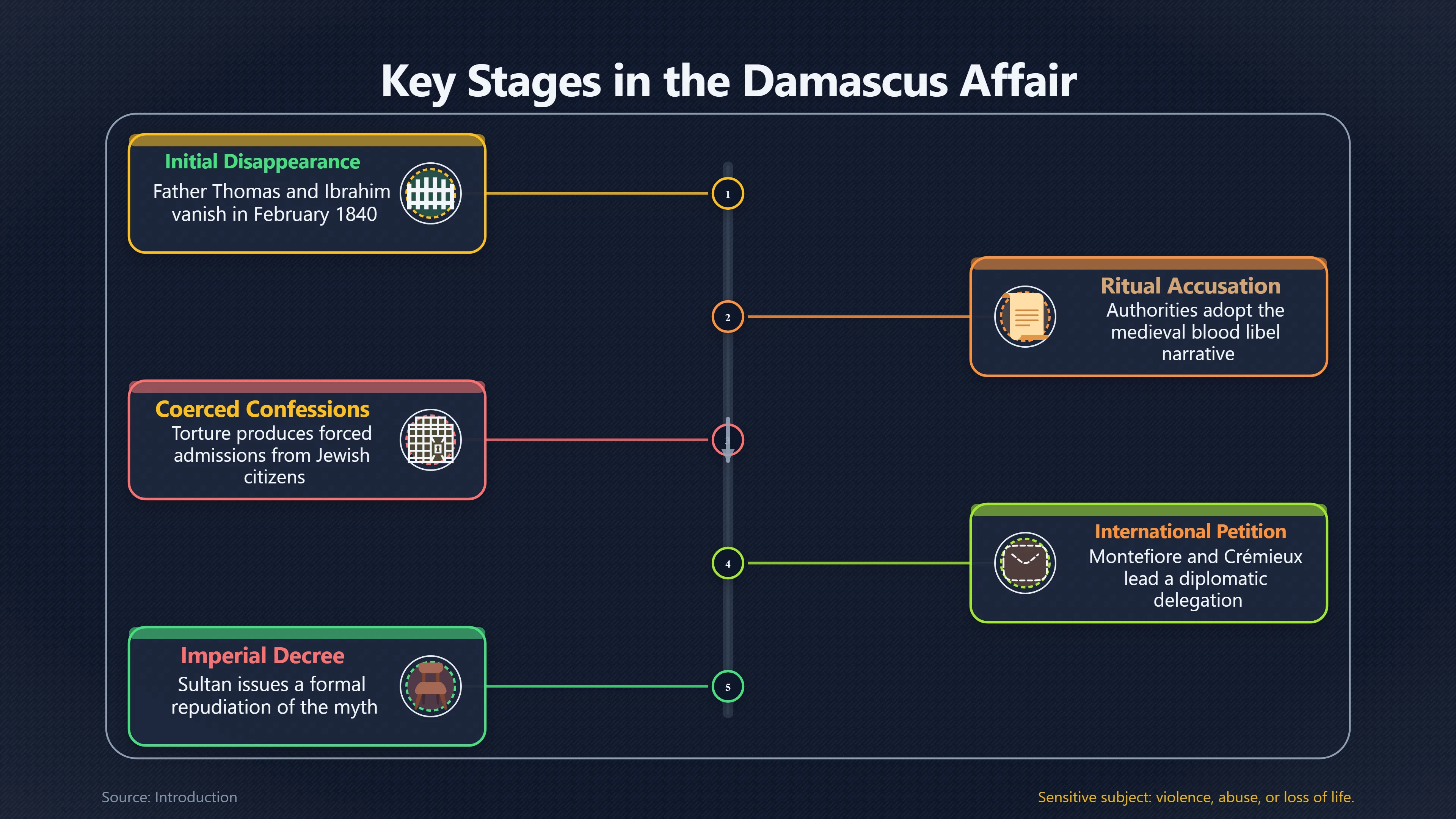
On 5 February 1840, the Italian Capuchin friar Father Thomas and his Muslim servant, Ibrahim, disappeared in Damascus, then governed by Muhammad Ali of Egypt. Their bodies were never conclusively recovered, and no reliable evidence established what had happened to them. Instead, suspicion quickly focused on the city’s Jewish community.[Encyclopedia.com]encyclopedia.comdamascus affair 1840Damascus Affair (1840) | Encyclopedia.com…
The accusation rested on the medieval blood libel: the entirely false belief that Jews murdered Christians in order to use their blood in preparing food for Passover or for other religious purposes. This myth had circulated in parts of Christian Europe for centuries despite having no basis in Jewish law or practice. By the nineteenth century it was already a well-established form of antisemitic persecution, but it had rarely appeared in the Ottoman Middle East on such a scale.[Holocaust Encyclopedia]encyclopedia.ushmm.orgHolocaust Encyclopedia Blood Libel: History and Impact | Holocaust EncyclopediaHolocaust Encyclopedia Blood Libel: History and Impact | Holocaust Encyclopedia
Several local factors made the accusation unusually powerful:
- Existing tensions between religious communities in Damascus.
- The influence of European consuls competing for prestige and influence in the region.
- A judicial system in which torture could still be used to obtain confessions.
- Widespread willingness among some officials to accept inherited religious stereotypes instead of requiring material evidence.[cambridge.org]cambridge.orgUniversity Press & Assessment DCambridge University Press & AssessmentD - The Cambridge Dictionary of Judaism and Jewish CultureAugust 5, 2014…
Rather than beginning with evidence and following it wherever it led, investigators largely began with a predetermined belief about who must be guilty.
Torture, forced confessions and official complicity
The investigation soon became an example of how state authority can turn rumour into apparent fact. The French consul in Damascus, Count Ulysse de Ratti-Menton, strongly supported the ritual-murder accusation and worked closely with the Egyptian governor, Sherif Pasha, during the investigation. Instead of questioning whether the blood-libel allegation itself was credible, they treated it as a plausible explanation from the outset.[Encyclopedia.com]encyclopedia.comDamascus Affair | Encyclopedia.comDamascus Affair | Encyclopedia.com
Prominent Jewish citizens were arrested and subjected to severe torture. Contemporary accounts and later historical studies describe beatings, prolonged abuse and other coercive methods intended to force admissions of guilt. Several prisoners died under torture, while another converted to Islam in an attempt to escape further abuse. Others eventually signed or gave “confessions” after sustained mistreatment. These statements became the central evidence against them despite having been extracted under coercion.[Encyclopedia.com]encyclopedia.comDamascus Affair | Encyclopedia.comDamascus Affair | Encyclopedia.com
Modern historians treat these confessions as classic examples of unreliable evidence produced through torture rather than proof of any crime. The case illustrates a recurring feature of persecution panics: once authorities become convinced of a hidden conspiracy, every forced confession appears to confirm the original belief, even though the investigation itself has created the evidence it claims to discover.[Open Library]openlibrary.orgOpen Library The Damascus affair by Jonathan Frankel | Open LibraryOpen Library The Damascus affair by Jonathan Frankel | Open Library
The affair also demonstrates that collective persecution need not involve an uncontrolled popular mob. Here, official institutions—including police, courts and diplomatic representatives—gave credibility to an accusation that otherwise lacked convincing factual support.

Why the accusation spread so quickly
The Damascus Affair cannot be explained simply as an outbreak of irrational fear. It developed through the interaction of religious prejudice, imperial politics and international diplomacy.
European powers were competing for influence in the eastern Mediterranean during Muhammad Ali’s occupation of Syria. France presented itself as protector of Catholic interests, while Austria and Britain often took different positions. These rivalries affected how the investigation was conducted and how reports circulated internationally.[cambridge.org]cambridge.orgUniversity Press & Assessment DCambridge University Press & AssessmentD - The Cambridge Dictionary of Judaism and Jewish CultureAugust 5, 2014…
The blood libel itself was attractive because it appeared to explain a mysterious disappearance through an already familiar story. Once the accusation had official backing, many people interpreted subsequent arrests and confessions as confirmation rather than asking whether those confessions had been obtained lawfully.
The case therefore followed a pattern seen in many historical persecution panics:
- an unexplained event;
- an already stigmatised minority;
- authorities convinced they know the culprit;
- coercive investigation producing false confirmation;
- wider public acceptance because official institutions appear to have validated the claim.
The affair shows how collective belief can spread through legal and administrative systems rather than through rumour alone.
International intervention changed the outcome
News of the arrests spread rapidly through Jewish communities across Europe and the Ottoman Empire. The Damascus Affair became one of the first major international campaigns in defence of persecuted Jews.
British Jewish leader Sir Moses Montefiore and the French lawyer and statesman Adolphe Crémieux led a delegation that travelled to Egypt to petition Muhammad Ali directly. Their efforts, combined with diplomatic pressure from several European governments, secured the release of the surviving prisoners in August 1840.[cambridge.org]cambridge.orgUniversity Press & Assessment DCambridge University Press & AssessmentD - The Cambridge Dictionary of Judaism and Jewish CultureAugust 5, 2014…
The campaign did not stop there. Montefiore continued to Constantinople, where Sultan Abdülmecid I issued an imperial decree rejecting ritual-murder accusations against Jews as baseless slander. Although this decree did not permanently end blood-libel accusations within the Ottoman world, it represented an important official repudiation of the myth and strengthened legal protections for Jewish subjects.[Encyclopedia.com]encyclopedia.comdamascus affair 1840Damascus Affair (1840) | Encyclopedia.com…
Historians also regard the affair as an important moment in the emergence of organised international Jewish political advocacy. Networks of communication, fundraising and diplomacy developed during the crisis influenced later organisations, including the Alliance Israélite Universelle, founded in 1860 to defend Jewish communities facing persecution.[Cambridge University Press & Assessment]cambridge.orgUniversity Press & Assessment DCambridge University Press & AssessmentD - The Cambridge Dictionary of Judaism and Jewish Culture…

Why historians still study the Damascus Affair
The Damascus Affair remains important because it reveals how prejudice can become institutionalised. It was not merely a local misunderstanding but an example of false belief acquiring the authority of law through torture, diplomatic influence and official endorsement.
For historians of collective fear, the affair illustrates several broader themes:
- Persecution through established myths. Ancient stereotypes provided ready-made explanations for unexplained events.
- Authority reinforcing panic. Government officials and foreign representatives amplified rather than questioned unsupported allegations.
- The danger of coerced evidence. Torture created testimony that appeared convincing precisely because it had been extracted under extreme pressure.
- International consequences. A local criminal investigation evolved into a diplomatic dispute involving multiple governments and reshaped Jewish political organisation.[openlibrary.org]openlibrary.orgOpen Library The Damascus affair by Jonathan Frankel | Open LibraryOpen Library The Damascus affair by Jonathan Frankel | Open Library
The case also demonstrates that moral panics and persecution are not always spontaneous. They may be sustained by institutions whose investigations, legal procedures and public authority lend credibility to claims that would otherwise collapse under scrutiny.
The affair’s place in Syria’s history of collective fear
Within Syria’s wider history of collective belief and social panic, the Damascus Affair occupies a distinctive place. Unlike later wartime rumours or sectarian conspiracy theories, it centred on a formal criminal investigation whose conclusions were driven by inherited prejudice rather than reliable evidence.
Its significance lies less in the disappearance itself than in the process that followed. An unsupported accusation became accepted truth because respected authorities endorsed it, torture produced apparent confirmation, and longstanding religious hostility shaped how evidence was interpreted. The affair therefore stands as one of the clearest historical examples in Syria of how collective fear, official power and judicial abuse can combine to produce persecution whose consequences extend far beyond the original event.[cambridge.org]cambridge.orgUniversity Press & Assessment DCambridge University Press & AssessmentD - The Cambridge Dictionary of Judaism and Jewish CultureAugust 5, 2014…
Amazon book picks
Further Reading
Books and field guides related to How a False Murder Charge Gripped Damascus. Use these as the next step if you want deeper reading beyond the article.
Black earth
First published 2015. Subjects: Moral and ethical aspects, Genocide, Jews, World War, 1939-1945, Holocaust, Jewish (1939-1945).

Anti-Judaism
First published 2013. Subjects: Antisemitism, Jewish influences, Judaism and philosophy, Western Civilization, Ethnic relations.

The Damascus affair
First published 1997. Subjects: Blood accusation, Jews, Ethnic relations, Persecutions, Jews, politics and government.
Blood Libel
First published 2020. Subjects: Blood accusation, Christianity and antisemitism, Anti-jewish propaganda, Europe, history, Judaism.
Endnotes
1.
Source: cambridge.org
Title: University Press & Assessment D
Link:https://www.cambridge.org/core/books/cambridge-dictionary-of-judaism-and-jewish-culture/d/E199E81FB6AFCCA04CE6BC3D2E4B9DDA
Source snippet
Cambridge University Press & AssessmentD - The Cambridge Dictionary of Judaism and Jewish CultureAugust 5, 2014...
Published: August 5, 2014
2.
Source: encyclopedia.com
Title: damascus affair 1840
Link:https://www.encyclopedia.com/humanities/encyclopedias-almanacs-transcripts-and-maps/damascus-affair-1840
Source snippet
Damascus Affair (1840) | Encyclopedia.com...
3.
Source: encyclopedia.com
Title: Damascus Affair | Encyclopedia.com
Link:https://www.encyclopedia.com/religion/encyclopedias-almanacs-transcripts-and-maps/damascus-affair
4.
Source: cambridge.org
Title: University Press & Assessment D
Link:https://www.cambridge.org/core/books/abs/cambridge-dictionary-of-judaism-and-jewish-culture/d/E199E81FB6AFCCA04CE6BC3D2E4B9DDA
Source snippet
Cambridge University Press & AssessmentD - The Cambridge Dictionary of Judaism and Jewish Culture...
5.
Source: cambridge.org
Link:https://www.cambridge.org/core/journals/comparative-studies-in-society-and-history/article/abs/nationalism-and-the-jewish-international-religious-internationalism-in-europe-and-the-middle-east-c1840c1880/97AFD62FD41743FE22AC77333425DB81
6.
Source: cambridge.org
Link:https://www.cambridge.org/core/journals/comparative-studies-in-society-and-history/article/abs/litigants-and-neighbors-the-communal-topography-of-ottoman-damascus/9AB936A08703A563CD83C19D4B63D03B
7.
Source: encyclopedia.ushmm.org
Title: Holocaust Encyclopedia Blood Libel: History and Impact | Holocaust Encyclopedia
Link:https://encyclopedia.ushmm.org/content/en/article/blood-libel
8.
Source: openlibrary.org
Title: Open Library The Damascus affair by Jonathan Frankel | Open Library
Link:https://openlibrary.org/books/OL968765M/The_Damascus_affair
9.
Source: jewishencyclopedia.com
Title: Jewish Encyclopedia DAMASCUS AFFAIR
Link:https://jewishencyclopedia.com/articles/4862-damascus-affair
Source snippet
Jewish EncyclopediaDAMASCUS AFFAIR - JewishEncyclopedia.com...
10.
Source: jewishencyclopedia.com
Title: DAMASCU S AFFAIR
Link:https://www.jewishencyclopedia.com/articles/14374-thomas-father
11.
Source: historyatlas.com
Title: damascus affair
Link:https://www.historyatlas.com/topics/damascus-affair/
12.
Source: books.google.com
Title: Blood Libel
Link:https://books.google.com/books/about/Blood_Libel.html?id=HMhtAAAAMAAJ
Additional References
13.
Source: research.monash.edu
Link:https://research.monash.edu/en/publications/from-violent-acts-to-violent-hatred-french-catholic-responses-to–2
Source snippet
Monash UniversityFrom violent acts to violent hatred: French Catholic responses to the Damascus and Dreyfus Affairs - Monash University...
14.
Source: shs.cairn.info
Title: info V I
Link:https://shs.cairn.info/criminaliser-les-juifs–9791037002280-page-179?lang=fr
Source snippet
L’affaire de Damas (1840) et ses suites | Cairn.infoMarch 13, 2025 — VI. L’AFFAIRE DE DAMAS (1840) ET SES SUITES * Par Pierre-André Tagui...
Published: March 13, 2025
15.
Source: academic.oup.com
Link:https://academic.oup.com/ehr/article/141/608/290/8503379?rss=1
Source snippet
oup.com1840 Rhodes Blood Libel: Ottoman Jews at the Dawn of the Tanzimat Era, by Olga Borovaya | The English Historical Review | Oxford A...
16.
Source: youtube.com
Title: The Farhis of Damascus
Link:https://www.youtube.com/watch?v=GXq_T4NPZcE
Source snippet
The History of Sir Moses Montefiore & the Damascus Affair of 1840...
17.
Source: jta.org
Title: Considerable Material on Damascus Blood Libel Discovered by Professor
Link:https://www.jta.org/archive/considerable-material-on-damascus-blood-libel-discovered-by-professor
19.
Source: youtube.com
Link:https://www.youtube.com/watch?v=0vXi6xi7UhQ
Source snippet
Who Was Sir Moses Montefiore?...
20.
Source: kclpure.kcl.ac.uk
Title: laffaire de damas 1840 perspectives franco allemandes die damasku
Link:https://kclpure.kcl.ac.uk/portal/en/publications/laffaire-de-damas-1840-perspectives-franco-allemandes-die-damasku
21.
Source: research.monash.edu
Title: von gewaltsamen handlungen zu gewaltsamen hass französisch kathol
Link:https://research.monash.edu/en/publications/von-gewaltsamen-handlungen-zu-gewaltsamen-hass-franz%C3%B6sisch-kathol
22.
Source: youtube.com
Title: Who Was Sir Moses Montefiore?
Link:https://www.youtube.com/watch?v=7vqkk8cSBi8
Source snippet
The History of Antisemitism: Blood Libel...
Topic Tree