Within Tajikistan
How Minority Faiths Became Suspect Communities
Jehovah's Witnesses, Protestants, independent Muslims and Pamiri Ismailis reveal how whole communities can be treated as security risks.
On this page
- Bans, registration rules and the language of cults
- Pamiri Ismailis and repression in Gorno Badakhshan
- The human cost of collective suspicion
Page outline Jump by section
Introduction
Religious minorities in Tajikistan have often found themselves treated not simply as communities with different beliefs, but as potential security threats. Since the country’s civil war in the 1990s, the government has justified extensive control over religious life as a safeguard against violent extremism. While Tajikistan has faced genuine security challenges, including attacks linked to Islamist groups and concerns about regional instability, human-rights organisations, United Nations experts and religious-freedom monitors argue that official suspicion has frequently expanded far beyond people involved in violence. Instead, entire communities—including Jehovah’s Witnesses, Protestant Christians, independent Muslim believers and the Pamiri Ismaili population of the Gorno-Badakhshan Autonomous Oblast (GBAO)—have been subjected to bans, surveillance, restrictions or collective punishment because of their religious identity or regional association rather than proven criminal conduct.[USCIRF]uscirf.govreleases report religious freedom tajikistanUSCIRF Releases Report on Religious Freedom in Tajikistan | USCIRFDecember 11, 2023…
This pattern is important because it illustrates a recurring mechanism of collective suspicion. Rather than identifying specific offenders, state policy has often treated visible religious difference, independent organisation or regional identity as indicators of possible extremism. The result has been a climate in which minority faiths can be portrayed as suspect communities whose ordinary religious activities become matters of national security.[USCIRF]uscirf.govTajikistan Country Update | USCIRFTajikistan Country Update | USCIRF…
Bans, registration rules and the language of cults
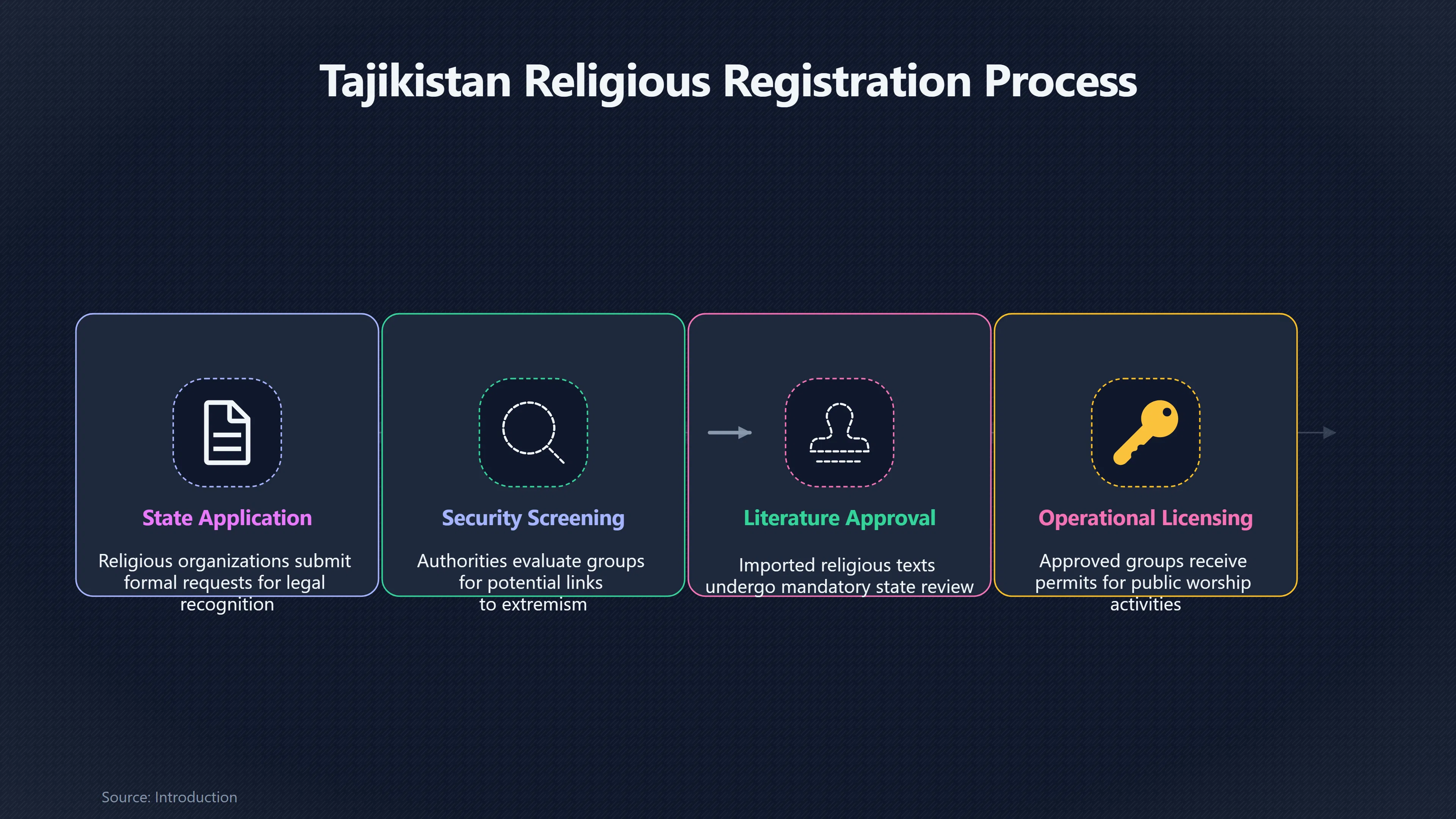
Tajikistan regulates religion through one of Central Asia’s most restrictive legal systems. Religious organisations must register with the state, religious education is tightly controlled, imported religious literature requires approval, and many forms of worship outside officially recognised institutions are prohibited or heavily restricted. Officials present these measures as necessary to prevent radicalisation and preserve public order, particularly after the country’s civil war and continuing security concerns linked to neighbouring Afghanistan.[ecoi.net]ecoi.netUSDOS – US Department of State (Author): “2022 Report on International Religious Freedom: Tajikistan”, Document #2091915 - ecoi.net…
Critics argue that this legal framework encourages collective suspicion because registration is not merely administrative. Recognition effectively determines which forms of religious life are considered legitimate and which become associated with extremism or unlawful activity. Groups that fail to obtain approval—or whose beliefs differ from state-approved religious structures—can quickly be portrayed as security concerns despite the absence of evidence that they advocate violence.[uscirf.gov]uscirf.govreleases report religious freedom tajikistanUSCIRF Releases Report on Religious Freedom in Tajikistan | USCIRFDecember 11, 2023…
Jehovah’s Witnesses provide one of the clearest examples. The government banned the organisation in 2007, citing concerns including public proselytising and conscientious objection to military service. The ban has remained in force despite repeated attempts by the community to regain legal status. International bodies have consistently argued that peaceful religious activity has been wrongly equated with extremism. In 2022 the UN Human Rights Committee concluded that the ban violated international human-rights obligations, yet Tajikistan’s Supreme Court rejected the group’s subsequent appeal in 2023.[Human Rights Watch]hrw.orgcountry chapters 4Human Rights WatchWorld Report 2008: Tajikistan | Human Rights Watch…
Other Christian minorities have also experienced pressure. Protestant congregations have faced prosecutions under anti-extremism legislation, restrictions on religious literature and close monitoring of their activities. Human-rights observers note that these measures generally arise from broad state control of religion rather than evidence that the churches themselves promote violence.[Human Rights Watch]hrw.orgHuman Rights WatchWorld Report 2011: World Report 2011: Tajikistan | Human Rights Watch…
The language surrounding these policies rarely focuses on theology alone. Instead, official discourse frequently links unregistered religious activity, foreign religious influence and non-state religious organisation with social instability. This framing allows peaceful minority groups to become symbols of broader fears about national security and ideological loyalty.[USCIRF]uscirf.govTajikistan Country Update | USCIRFTajikistan Country Update | USCIRF…
Pamiri Ismailis and repression in Gorno-Badakhshan
The experience of the Pamiri Ismailis demonstrates how religious identity can become inseparable from regional and political suspicion.
The Pamiris are an ethnically and linguistically distinct population concentrated in the mountainous Gorno-Badakhshan Autonomous Oblast. Most belong to the Ismaili branch of Shia Islam, making them religiously distinct from Tajikistan’s Sunni Muslim majority. Their religious life has historically been connected with institutions supported by the Aga Khan Development Network, which has invested heavily in education, healthcare and community development across the region.[USCIRF]uscirf.govreleases report religious freedom tajikistanUSCIRF Releases Report on Religious Freedom in Tajikistan | USCIRFDecember 11, 2023…
Following unrest and security operations in GBAO, particularly during 2021 and 2022, international observers documented an extensive crackdown that extended well beyond individuals accused of participating in protests. Human Rights Watch, Freedom House and the United States Commission on International Religious Freedom report that authorities closed or nationalised institutions associated with the Aga Khan Foundation, restricted Ismaili religious education, prohibited certain communal religious activities and targeted activists, journalists and lawyers connected with the region.[hrw.org]hrw.orgHuman Rights WatchWorld Report 2024: Tajikistan | Human Rights Watch…
In 2023, authorities reportedly prohibited members of the Ismaili community from holding collective prayers in private homes and prevented Ismaili centres from providing religious education for children despite legal provisions allowing some forms of parental consent. These restrictions were directed at ordinary religious practice rather than violent activity.[Human Rights Watch]hrw.orgHuman Rights WatchWorld Report 2024: Tajikistan | Human Rights Watch…
Human Rights Watch has also argued that Tajik authorities increasingly refused to recognise the Pamiris as a distinct minority while simultaneously dismantling many independent organisations operating in the region. Several local organisations were closed after being accused of connections with criminal groups, although critics questioned the evidence supporting such allegations.[Human Rights Watch]hrw.orgHuman Rights WatchWorld Report 2024: Tajikistan | Human Rights Watch…
This illustrates a characteristic feature of collective suspicion: regional unrest became associated with an entire religious and ethnic community. Rather than separating individuals accused of criminal offences from the wider population, restrictions often affected educational institutions, charities, religious centres and ordinary community life.
How independent Muslims became objects of suspicion
Collective suspicion has not been limited to recognised religious minorities. Independent Muslim believers who operate outside state-approved religious structures have also faced extensive restrictions.
Successive governments have banned several Islamic movements, regulated mosque construction, supervised sermons and controlled religious education. Organisations such as the Salafi movement and Jamaat Tabligh have been prohibited, while prosecutions have frequently relied upon broad anti-extremism legislation. Human-rights organisations acknowledge that governments have legitimate responsibilities to prevent terrorism but argue that peaceful religious conservatism has often been treated as inherently suspect.[hrw.org]hrw.orgHuman Rights WatchWorld Report 2011: World Report 2011: Tajikistan | Human Rights Watch…
The same approach extends into everyday religious practice. Reports have documented restrictions affecting attendance by children at religious services, approval of religious publications, informal religious teaching and visible expressions of religious identity. Freedom House also reports continuing unofficial pressure concerning religious clothing and facial hair, illustrating how visible markers of faith can become interpreted as indicators of political loyalty rather than simply religious observance.[Freedom House]freedomhouse.orgfreedom worldFreedom HouseTajikistan: Freedom in the World 2024 Country Report | Freedom House…
The result is a security framework in which religious independence itself can attract official attention, even where no evidence exists of plans for violence.
The human cost of collective suspicion
Treating whole communities as potential security risks has consequences extending well beyond legal restrictions.
For minority believers, the practical effects include uncertainty over whether places of worship may remain open, limits on children’s religious education, obstacles to community organisation and fear that ordinary religious activities could attract official scrutiny. Registration rules also discourage independent religious life by making legality dependent upon state approval rather than peaceful conduct.[ecoi.net]ecoi.netUSDOS – US Department of State (Author): “2022 Report on International Religious Freedom: Tajikistan”, Document #2091915 - ecoi.net…
In Gorno-Badakhshan, many residents have experienced an additional burden because religious identity overlaps with regional identity. Crackdowns following episodes of unrest affected not only political activists but also charities, educational institutions, journalists and religious organisations associated with the wider Pamiri community. Critics argue that this deepens mistrust between the state and local populations while making it harder to distinguish genuine security operations from collective punishment.[Human Rights Watch]hrw.orgHuman Rights WatchWorld Report 2024: Tajikistan | Human Rights Watch…
International observers also warn that broad suspicion can become counterproductive. When peaceful religious expression is routinely associated with extremism, authorities may weaken independent civil society, reduce opportunities for dialogue and make legitimate religious practice more difficult without necessarily improving public security. The UN Special Rapporteur on freedom of religion or belief has therefore urged Tajikistan to shift from treating religion primarily through a counter-terrorism lens towards protecting freedom of belief while addressing genuine security threats through evidence-based law enforcement.[USCIRF]uscirf.govreleases report religious freedom tajikistanUSCIRF Releases Report on Religious Freedom in Tajikistan | USCIRFDecember 11, 2023…
Why this matters in Tajikistan’s history of collective fear
Tajikistan does not provide a classic example of a mass religious panic driven by rumour or popular hysteria. Instead, its experience shows how collective suspicion can be institutionalised through law, security policy and official rhetoric.
The country’s history demonstrates that genuine concerns about violent extremism can gradually broaden until minority faiths, independent religious organisations and regionally distinct communities become viewed through the same security framework. For Jehovah’s Witnesses, Protestant Christians, independent Muslim believers and Pamiri Ismailis, the defining issue has often not been isolated acts of violence but the assumption that religious difference itself represents potential danger.
This makes Tajikistan an important case study in how modern states can create enduring moral and political suspicion around entire communities without relying on traditional witch hunts or popular mass hysteria. The fear is sustained less by spontaneous public panic than by administrative systems, legal classifications and official narratives that encourage citizens to see religious diversity as a question of security rather than ordinary pluralism.[uscirf.gov]uscirf.govReligious Freedom Conditions in Tajikistan| USCIRFReligious Freedom Conditions in Tajikistan| USCIRF…

Endnotes
1.
Source: uscirf.gov
Title: releases report religious freedom tajikistan
Link:https://www.uscirf.gov/news-room/releases-statements/uscirf-releases-report-religious-freedom-tajikistan
Source snippet
USCIRF Releases Report on Religious Freedom in Tajikistan | USCIRFDecember 11, 2023...
Published: December 11, 2023
2.
Source: uscirf.gov
Title: Religious Freedom Conditions in Tajikistan| USCIRF
Link:https://www.uscirf.gov/countries/tajikistan
Source snippet
Religious Freedom Conditions in Tajikistan| USCIRF...
3.
Source: uscirf.gov
Title: Tajikistan Country Update | USCIRF
Link:https://www.uscirf.gov/publications/tajikistan-country-update
Source snippet
Tajikistan Country Update | USCIRF...
4.
Source: ecoi.net
Link:https://www.ecoi.net/en/document/2091915.html
Source snippet
USDOS – US Department of State (Author): “2022 Report on International Religious Freedom: Tajikistan”, Document #2091915 - ecoi.net...
5.
Source: uscirf.gov
Title: Commission on International Relig
Link:https://www.uscirf.gov/events/hearings/religious-freedom-tajikistan-policy-options-country-particular-concern
Source snippet
Religious Freedom in Tajikistan: Policy Options for a Country of Particular Concern | USCIRFJuly 20, 2023 — RELIGIOUS FREEDOM IN TAJIKIST...
Published: July 20, 2023
6.
Source: uscirf.gov
Link:https://www.uscirf.gov/publication/tajikistan-country-update
Source snippet
pments in neighboring Afghanistan reinforce the intersection between authoritarianism and secur...
7.
Source: youtube.com
Title: USCIRF Hearing on Religious Freedom in Tajikistan: Policy Options for a CPC
Link:https://www.youtube.com/watch?v=SC1Kf6LNY98
Source snippet
Crackdown on Pamiris in Tajikistan: Domestic, Regional, and Geopolitical Contexts...
8.
Source: hrw.org
Link:https://www.hrw.org/world-report/2024/country-chapters/tajikistan
Source snippet
Human Rights WatchWorld Report 2024: Tajikistan | Human Rights Watch...
9.
Source: freedomhouse.org
Title: freedom world
Link:https://freedomhouse.org/country/tajikistan/freedom-world/2024
Source snippet
Freedom HouseTajikistan: Freedom in the World 2024 Country Report | Freedom House...
10.
Source: hrw.org
Title: country chapters 4
Link:https://www.hrw.org/world-report/2008/country-chapters-4
Source snippet
Human Rights WatchWorld Report 2008: Tajikistan | Human Rights Watch...
11.
Source: hrw.org
Link:https://www.hrw.org/world-report/2011/country-chapters/tajikistan
Source snippet
Human Rights WatchWorld Report 2011: World Report 2011: Tajikistan | Human Rights Watch...
12.
Source: hrw.org
Link:https://www.hrw.org/world-report/2025/country-chapters/tajikistan
Source snippet
Human Rights WatchWorld Report 2025: Tajikistan | Human Rights Watch...
Additional References
13.
Source: jw.org
Link:https://www.jw.org/en/news/region/tajikistan/United-Nations-Human-Rights-Committee-Declares-Tajikistans-Ban-on-Jehovahs-Witnesses-Unlawful/
Source snippet
October 13, 2022 — UNITED NATIONS HUMAN RIGHTS COMMITTEE DECLARES TAJIKISTAN’S BAN ON JEHOVAH’S WITNESSES UNLAWFUL English United Nations...
Published: October 13, 2022
14.
Source: youtube.com
Link:https://www.youtube.com/watch?v=B84H-e6irWw
Source snippet
Young People Disallowed From Church: Barnabas Aid on Persecution in Tajikistan...
15.
Source: youtube.com
Title: Hearing on Laws Regulating Religion in Central Asia
Link:https://www.youtube.com/watch?v=3ssfsSezBqM
Source snippet
Systematic Rights Violations Against Pamiri Minority in Tajikistan, Reports Amnesty International...
16.
Source: youtube.com
Title: Young People Disallowed From Church: Barnabas Aid on Persecution in Tajikistan
Link:https://www.youtube.com/watch?v=FAWGjIgwJRQ
Source snippet
Hearing on Laws Regulating Religion in Central Asia...
17.
Source: youtube.com
Link:https://www.youtube.com/watch?v=CFoiIw29iWk
Topic Tree