Within Trinidad Belief Panics
What Happened at Moruga Composite School?
The 2010 Moruga school outbreak shows how distress, rumour and spiritual interpretation can spread through a close community.
On this page
- The reported symptoms and disruption
- Possession, panic and psychogenic illness
- How schools and authorities can respond safely
Page outline Jump by section
Introduction
In November 2010, Moruga Composite School in southern Trinidad became the centre of one of the country’s best-known school “possession” episodes. During the school day, groups of pupils reportedly screamed, collapsed, rolled on the floor, spoke incoherently and appeared to struggle against unseen forces. The disruption spread rapidly through the school and was widely interpreted by many students, parents and local residents as evidence of supernatural attack or spirit possession.[guardian.co.tt]guardian.co.ttPanic after 'Devil attack' at schoolTrinidad GuardianNovember 10, 2010…
More than a decade later, the Moruga incident remains important not because there is clear evidence that a supernatural event occurred, but because it illustrates how frightening physical and emotional symptoms can spread through a close-knit community when interpreted through shared religious and cultural beliefs. The episode sits at the intersection of genuine distress, rumour, local spirituality and what psychologists describe as mass psychogenic illness, sometimes called mass sociogenic illness.
What Happened at Moruga Composite School?
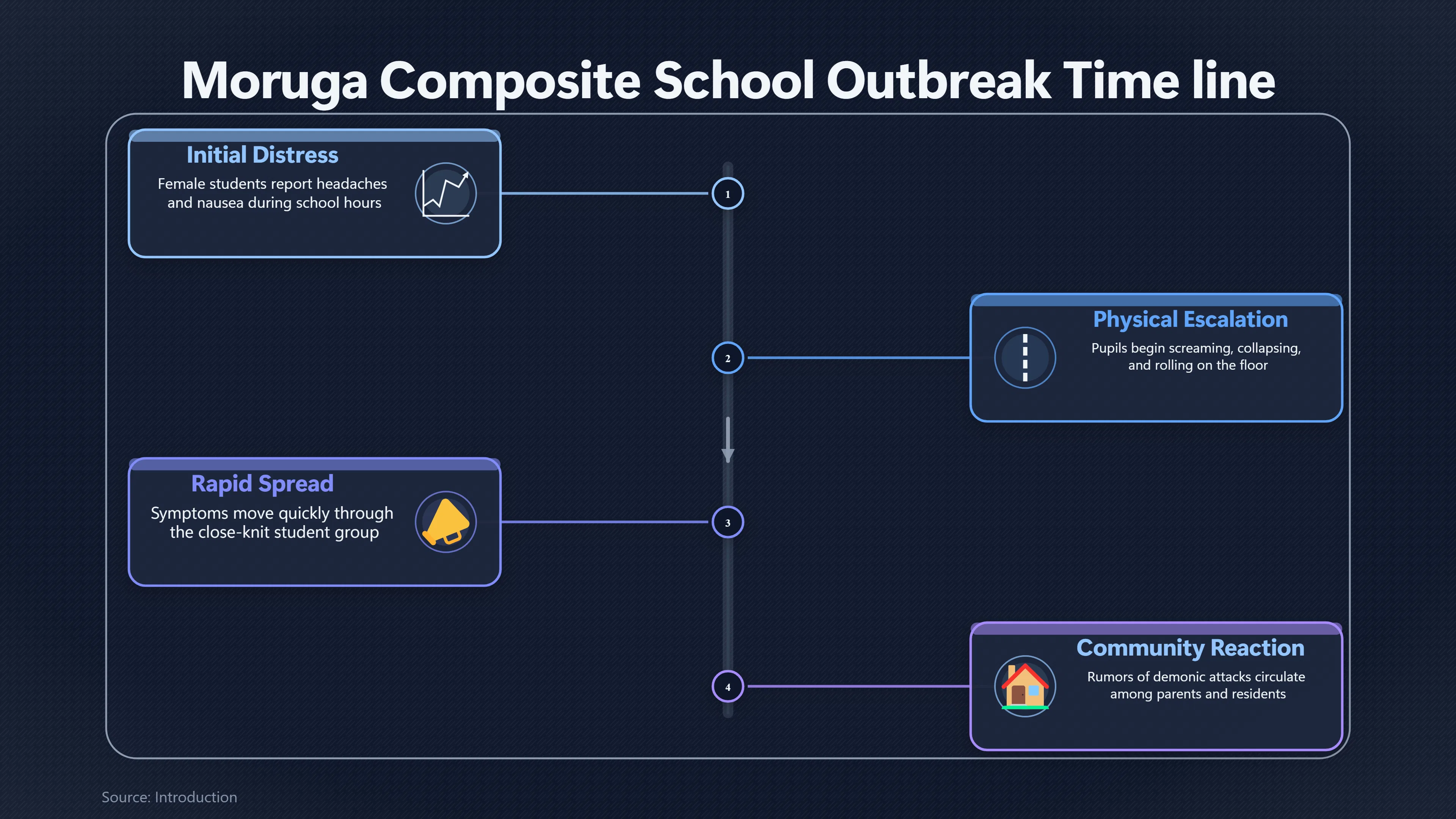
The incident began during the school day in early November 2010. According to contemporary news reports, several female students suddenly became distressed, complaining of symptoms including headaches and nausea before screaming, collapsing or behaving in ways that classmates described as highly unusual. Witnesses reported pupils rolling on the ground, crying uncontrollably, speaking strangely and appearing unaware of their surroundings. Some students reportedly had to be physically restrained because they attempted to run or climb over railings.[guardian.co.tt]guardian.co.ttPanic after 'Devil attack' at schoolTrinidad GuardianNovember 10, 2010…
As often happens in similar incidents, the reaction spread quickly beyond those first affected. Students gathered around the victims, teachers attempted to restore order, and frightened rumours circulated almost immediately that the school had come under a demonic or spiritual attack. The disruption affected normal lessons and generated intense anxiety among pupils and parents.[guardian.co.tt]guardian.co.ttPanic after 'Devil attack' at schoolTrinidad GuardianNovember 10, 2010…
Although press coverage frequently referred to a “devil attack” or “possession”, these descriptions reflected the beliefs of witnesses and sections of the community rather than an official finding.
The Reported Symptoms and Disruption
Accounts of the outbreak describe a mixture of emotional and physical symptoms rather than a single medical condition. Reported behaviours included:
- screaming and crying;
- collapsing or falling to the ground;
- shaking or uncontrolled body movements;
- apparent confusion or semi-consciousness;
- complaints of headaches and nausea;
- attempts to flee or resist those trying to help.
These experiences were real for the students involved. Whether interpreted medically or spiritually, the distress was not simply pretend behaviour or deliberate mischief. Similar school outbreaks elsewhere in the world have shown that intense fear can produce genuine physical symptoms without evidence of poisoning, infection or neurological disease.[New England Journal of Medicine]nejm.orgNew England Journal of MedicineMass Psychogenic Illness Attributed to Toxic Exposure at a High School | New England Journal of MedicineJa…
Possession, Panic and Psychogenic Illness
The Moruga episode has never produced convincing public evidence of a toxic exposure, infectious disease or other environmental cause that would explain the entire outbreak. As a result, many psychologists and medical researchers view incidents of this type through the framework of mass psychogenic illness.
Mass psychogenic illness describes the rapid spread of physical symptoms among members of a closely connected group after stress, fear or expectation triggers real bodily responses. Symptoms are genuine, but they are not caused by an infectious agent or poison. Researchers have repeatedly documented outbreaks in schools, factories and workplaces around the world.[New England Journal of Medicine]nejm.orgNew England Journal of MedicineMass Psychogenic Illness Attributed to Toxic Exposure at a High School | New England Journal of MedicineJa…
Several features of the Moruga incident resemble recognised patterns:
- the outbreak occurred within a close social group;
- symptoms spread rapidly after the first cases became visible;
- witnesses interpreted events through a shared cultural framework;
- fear increased as more pupils became affected.
None of this proves that Moruga was a case of mass psychogenic illness, because no detailed scientific investigation has been published that conclusively classifies the event. Instead, it offers one evidence-based explanation that fits many characteristics of the reports while acknowledging that many local residents understood the experience in spiritual terms.
Why Spiritual Explanations Spread So Quickly
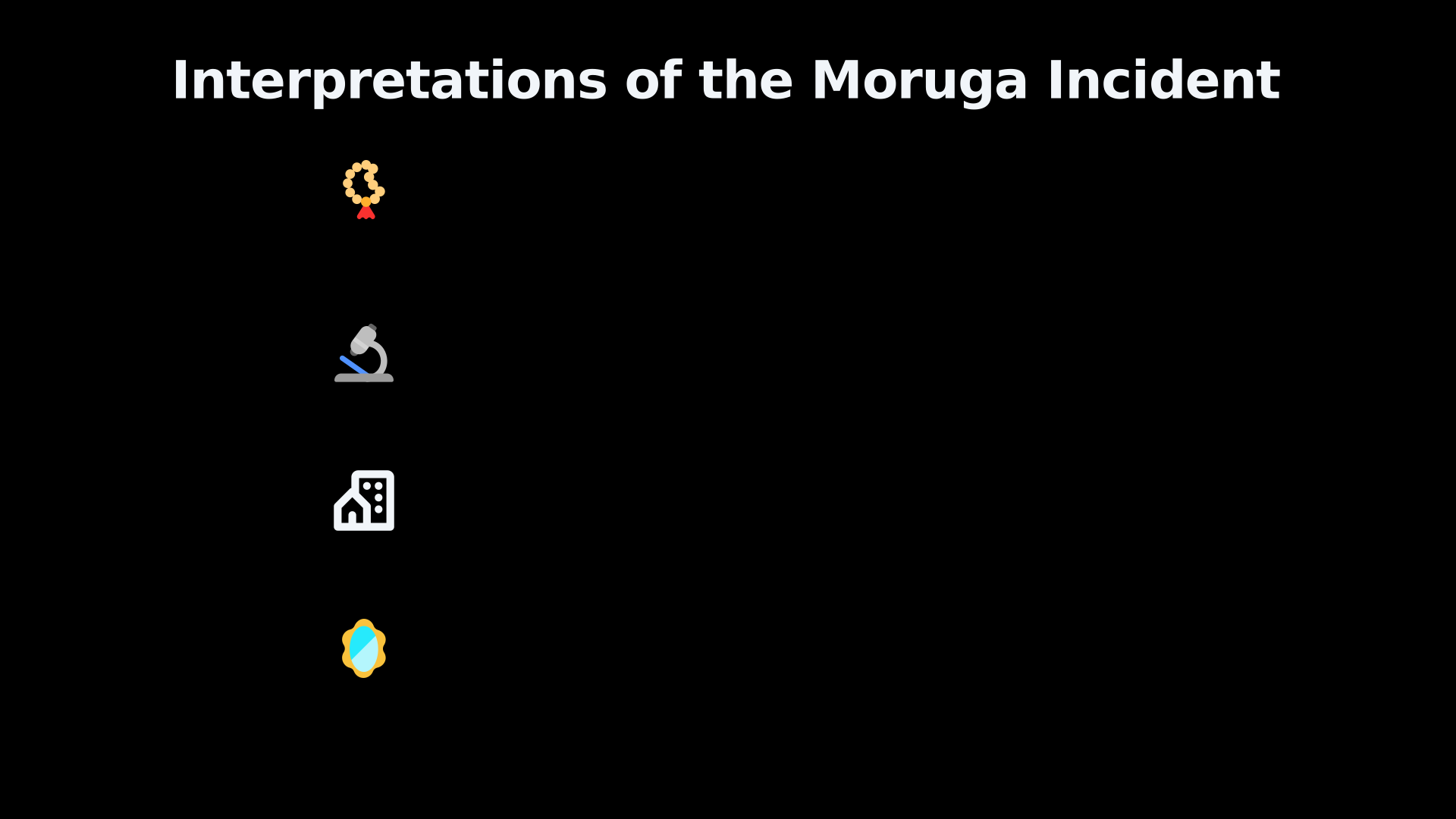
Understanding Moruga requires appreciating Trinidad and Tobago’s religious diversity. Christian churches, Spiritual Baptist traditions, Pentecostal movements and beliefs about spirits or supernatural influence all coexist within many communities. For people whose worldview accepts the possibility of spirit possession, dramatic behaviour can naturally be interpreted as evidence of supernatural forces rather than psychological stress.
During the Moruga incident, some students reportedly prayed over affected classmates, while others believed religious intervention was necessary. Such responses reflected existing beliefs rather than creating them from nothing. Once the idea of possession became established, it may also have influenced how later symptoms were understood by observers.
Psychologists note that expectation itself can shape how distress is experienced. If a frightened group believes a supernatural attack is unfolding, new cases may develop within that same interpretive framework, making the event appear to confirm the original belief even when no external cause is identified.[New England Journal of Medicine]nejm.orgNew England Journal of MedicineMass Psychogenic Illness Attributed to Toxic Exposure at a High School | New England Journal of MedicineJa…
Why School Outbreaks Are Especially Vulnerable
School outbreaks of unexplained illness have been documented across many countries and cultures. They occur most often among adolescents in environments where students spend long periods together under academic and social pressure.
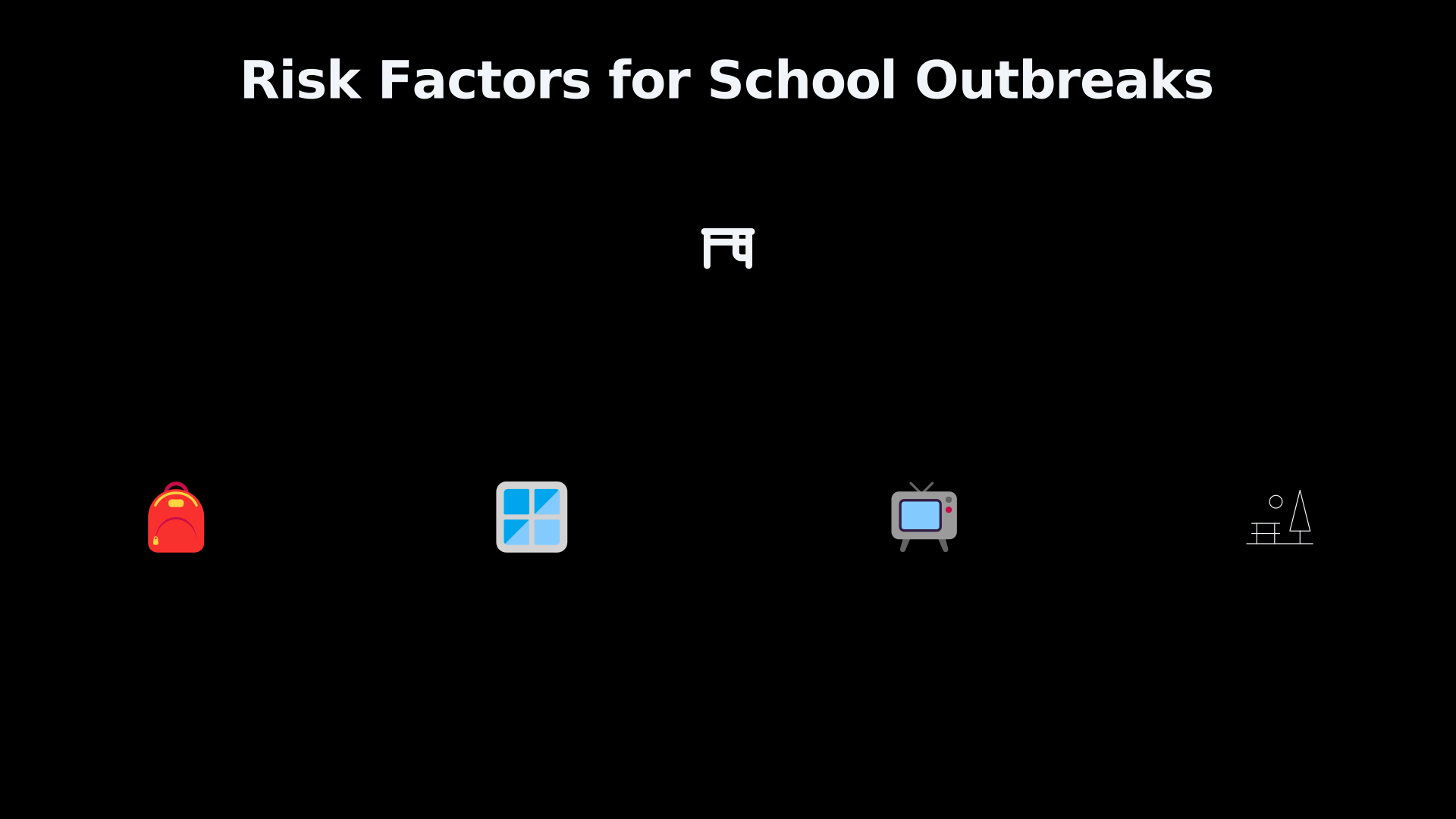
Research has identified several recurring conditions that make such episodes more likely:
- close daily contact between students;
- high levels of emotional stress;
- rapid observation of classmates becoming ill;
- widespread discussion of possible causes;
- intense media or community attention.
Studies of comparable school outbreaks consistently show that seeing another person become ill, hearing reports of illness and believing a threatening explanation can all increase the likelihood that additional people develop symptoms.[New England Journal of Medicine]nejm.orgNew England Journal of MedicineMass Psychogenic Illness Attributed to Toxic Exposure at a High School | New England Journal of MedicineJa…
This does not mean affected students are consciously copying one another. Rather, psychological stress can produce genuine physical responses that spread through social influence.
How Schools and Authorities Can Respond Safely
Experience from school outbreaks internationally suggests that responses work best when they take both physical health and community beliefs seriously.
Good practice generally includes:
- carrying out appropriate medical assessments to rule out environmental or infectious causes;
- communicating clearly with parents to reduce unnecessary rumours;
- avoiding sensational language that may intensify fear;
- providing psychological support for affected students;
- respecting families’ religious beliefs while maintaining evidence-based medical care.
Importantly, psychological explanations should never be presented as implying that students were inventing symptoms. Mass psychogenic illness involves genuine distress requiring compassionate treatment, reassurance and careful communication.[New England Journal of Medicine]nejm.orgNew England Journal of MedicineMass Psychogenic Illness Attributed to Toxic Exposure at a High School | New England Journal of MedicineJa…
Why the Moruga Incident Still Matters
The Moruga Composite School episode has become one of Trinidad and Tobago’s most frequently discussed examples of an apparent possession outbreak. It illustrates how extraordinary events can emerge from the interaction of culture, religion, stress and collective interpretation.
Rather than demonstrating a clear supernatural occurrence or a proven medical disorder, the incident highlights the difficulty of interpreting dramatic events that unfold in emotionally charged communities. For believers, it reinforced existing spiritual understandings. For psychologists and sociologists, it provides an example of how shared expectations and anxiety may spread through a closely connected group.
Within the wider history of Trinidad and Tobago, Moruga is therefore best understood not as proof of one explanation over another, but as a revealing case study in how collective fear, sincere belief and real human distress can become intertwined during moments of crisis.
Amazon book picks
Further Reading
Books and field guides related to What Happened at Moruga Composite School?. Use these as the next step if you want deeper reading beyond the article.
Extraordinary Popular Delusions and the Madness of Crowds
Rating: 4.0/5 from 5 Google Books ratings
Foundational reading on collective belief.


Mistakes Were Made (But Not by Me)
Explains belief persistence and social interpretation.
Mistakes Were Made (but Not by Me) Third Edition
Renowned social psychologists Carol Tavris and Elliot Aronson take a compelling look into how the brain is wired for self-justification....
Endnotes
1.
Source: guardian.co.tt
Title: Panic after ‘Devil attack’ at school
Link:https://www.guardian.co.tt/news/panic-after-devil-attack-at-school-6.2.345741.299ab6870c
Source snippet
Trinidad GuardianNovember 10, 2010...
Published: November 10, 2010
2.
Source: guardian.co.tt
Title: ps probe fight between student and teacher at Moruga Sec
Link:https://www.guardian.co.tt/news/cops-probe-fight-between-student-and-teacher-at-moruga-sec-6.2.2210126.e64c518ae1
Source snippet
ps probe fight between student and teacher at Moruga Sec - Trinidad GuardianJanuary 18, 2025 — Thursday, May 28, 2026 COPS PROBE FIGHT...
Published: January 18, 2025
3.
Source: guardian.co.tt
Title: Claims of demons shut down Moruga school again
Link:https://www.guardian.co.tt/article-6.2.453766.29d411e7d4
4.
Source: guardian.co.tt
Title: Mass hysteria or demonic posession
Link:https://www.guardian.co.tt/article-6.2.345979.faa225c878
5.
Source: guardian.co.tt
Title: Second batch of students falls ill
Link:https://www.guardian.co.tt/news/second-batch-of-students-falls-ill-6.2.345815.a9593a950e
6.
Source: nejm.org
Link:https://www.nejm.org/doi/full/10.1056/NEJM200001133420206
Source snippet
New England Journal of MedicineMass Psychogenic Illness Attributed to Toxic Exposure at a High School | New England Journal of MedicineJa...
7.
Source: nejm.org
Link:https://www.nejm.org/doi/abs/10.1056/NEJM200001133420206
Additional References
8.
Source: sciencedirect.com
Link:https://www.sciencedirect.com/science/article/pii/S2667242123000416
Source snippet
June 1, 2023 — IBRO NEUROSCIENCE REPORTS Volume 14, June 2023, Pages 435-440 Research paper Advantage of neuroeducation in m...
Published: June 1, 2023
9.
Source: pmc.ncbi.nlm.nih.gov
Title: It primarily affects female students in governmen
Link:https://pmc.ncbi.nlm.nih.gov/articles/PMC10300494/
Source snippet
of neuroeducation in managing mass psychogenic illness among rural school children in Nepal - PMCMay 12, 2023 — ABSTRACT INTRODUCTION Mas...
Published: May 12, 2023
10.
Source: youtube.com
Title: The Razor-Thin Line Between Contagion and Connection | Dan Taberski | TED
Link:https://www.youtube.com/watch?v=u0fFIJapsRY
Source snippet
This TED talk on the psychological mechanisms of mass hysteria explains how emotional contagion and shared social stress express physical...
11.
Source: pmc.ncbi.nlm.nih.gov
Link:https://pmc.ncbi.nlm.nih.gov/articles/PMC9210177/
Source snippet
2022 May 30;28:1671. doi: 10.4102/sajpsychiatry.v28i0.1671 PREDICTORS OF MASS PSYCHOGENIC ILLNESS IN A JUNIOR SECONDARY SCHOOL IN RURAL B...
12.
Source: youtube.com
Title: MOH: Starehe Girls students suffering from mass hysteria
Link:https://www.youtube.com/watch?v=UBVlHRtLibk
Source snippet
The Razor-Thin Line Between Contagion and Connection | Dan Taberski | TED...
13.
Source: sajp.org.za
Link:https://sajp.org.za/index.php/sajp/article/view/1671/2648
Source snippet
ournal of Psychiatry...
14.
Source: frontiersin.org
Link:https://www.frontiersin.org/journals/psychiatry/articles/10.3389/fpsyt.2020.493094/full
15.
Source: health.gov.tt
Link:https://health.gov.tt/health-facilities/moruga-health-centre
16.
Source: youtube.com
Title: Teens’ uncontrollable mystery illness
Link:https://www.youtube.com/watch?v=JcKL8ihDL2Y
Source snippet
East African Laughing Epidemic – History Documentary...
17.
Source: researchportal.ukhsa.gov.uk
Title: ukhsa.gov.uk Frequency and predictors of mass psychogenic illness
Link:https://researchportal.ukhsa.gov.uk/en/publications/frequency-and-predictors-of-mass-psychogenic-illness/
Topic Tree