When Fear, Folklore and Healing Spread in Oman
Oman does not have a well-documented equivalent of the Salem witch trials, a European dancing plague or a large modern outbreak of mass psychogenic illness.
Page outline Jump by section
Introduction
The distinction matters. Belief in spirits may be an ordinary part of religious or cultural life; a healing ritual may provide social support rather than demonstrate collective delusion; and a frightening rumour may contain a real concern even when its most dramatic claims are false. Oman’s record is therefore best understood as a history of folklore, shared explanations for distress and periodic moral panic—not as a catalogue of irrational crowds.
Why Oman has no simple “mass hysteria” story
Published research on Oman contains substantial material about spirit possession, traditional healing and supernatural belief, but little firm evidence of classic mass psychogenic outbreaks in which groups suddenly developed similar unexplained symptoms. Nor is there a strong documentary record of organised witch hunts or mass prosecutions comparable with early modern Europe.
That absence should not be mistaken for an absence of collective fear. It reflects the kinds of evidence that survive. Oman’s social history was transmitted partly through oral storytelling, family knowledge and ritual practice, while researchers have examined its healing traditions more often than its rumour panics. Sensational travel accounts also tend to repeat legends without establishing when they began or whether the events described ever occurred.
A useful approach is therefore to separate four overlapping phenomena:
- Folklore: stories about spirits, cursed places and extraordinary events.
- Possession and healing: culturally recognised explanations and treatments for distress.
- Moral panic: disproportionate public fear focused on a supposed threat to society.
- Mass psychogenic illness: symptoms spreading within a group without a sufficient toxic, infectious or physical cause.
Much of the best-documented Omani material belongs to the first two categories rather than the last.

Bahla: how a real town became Oman’s “city of spirits”
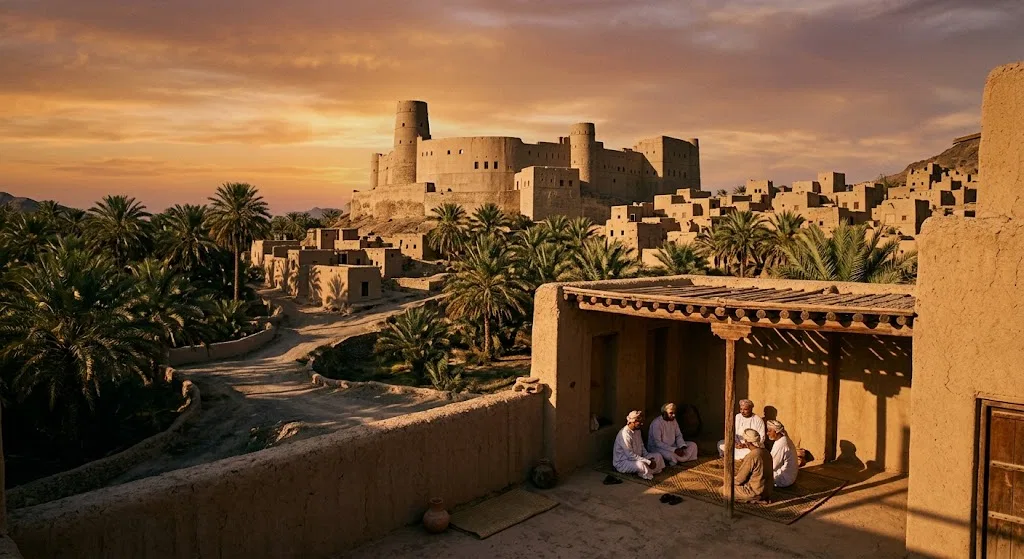
Bahla, an oasis town in Oman’s interior, is the country’s strongest cultural symbol of magic and supernatural danger. Its imposing fort and surrounding settlement were centres of political power under the Banu Nebhan dynasty from roughly the twelfth to the late fifteenth century. UNESCO’s official account emphasises the fortress, mud-brick settlement, irrigation landscape and historical importance—not witchcraft.[UNESCO World Heritage Centre]whc.unesco.orgUNESCO World Heritage CentreBahla FortThe fort and settlement, a mud-walled oasis in the Omani desert, owed its prosperity to the Banu Ne…
Alongside that documented history sits a dense body of folklore. Stories claim that spirits built Bahla’s long defensive wall in a single night, that people or animals were transformed, and that supernatural beings inhabited particular roads, ruins or palm groves. Recent reporting found that such tales remain widely associated with the town, although residents often resist the suggestion that Bahla is an active centre of sorcery.[Qantara]qantara.deMagical myths haunt ancient Omani oasisMagical myths haunt ancient Omani oasis - Qantara.de20 Nov 2023 — Magical stories permeate Bahla, including the popular myth that…
These stories are culturally important, but they are not evidence of a historic witch panic. There is no securely documented period in which Bahla’s population collectively hunted alleged magicians on a large scale. Many dramatic claims circulate through tourism writing and retellings that provide no contemporary records, court documents or reliable dates.
Bahla’s reputation is better understood as a form of place-based legend. Its old walls, narrow lanes, abandoned structures and political antiquity provide an ideal setting for stories about hidden knowledge. Repetition by visitors and the media then strengthens the association: people arrive expecting tales of magic, ask residents about them and publish new versions, making the legend appear more uniform and ancient than oral traditions usually are.
The result resembles a mild “miracle panic” in reverse. Rather than crowds responding to one sudden supernatural event, generations have accumulated warnings and wonders around a particular landscape. The town becomes a container for uncertainty: an ordinary accident, strange noise or personal misfortune can be fitted into an already familiar story about spirits.
Possession rituals were healing systems, not simply collective delusion
The clearest scholarly evidence concerning contagious supernatural belief in Oman comes from research on possession and communal healing. Omani psychiatrist Samir Al-Adawi and colleagues described a possession tradition in which distress is attributed to spirits and addressed through organised ritual, music, movement and social participation. Their interpretation presented the practice as a way of expressing suffering, creating a shared language for it and mobilising support around the affected person.[Taylor & Francis Online]tandfonline.comSkip PDF viewer. ArticleTaylor & Francis OnlineZar: Group distress and healingby SH Al-Adawi · 2001 · Cited by 68 — In this paper, we report the phenomenon of Za…
Later research on communities of healing along Oman’s Al-Batinah coast warned against reducing these practices to a simplistic story of oppressed women acting out resistance. Participants and healers form social networks with their own ideas about illness, identity, responsibility and recovery. Such practices may coexist with hospital treatment rather than forming a sealed “cult” opposed to modern medicine.[JSTOR]jstor.orgCommunities of healing practice on al-Batinah coast of OmanJuly 14, 2013 — by H Ismail · 2013 · Cited by 3 — Liminal Rites and Femal…
In a typical possession account, persistent pain, exhaustion, emotional disturbance, seizures or altered behaviour may be interpreted as signs that a spirit has attached itself to a person. A specialist healer uses rhythmic music and ritual questioning to identify the supposed spirit and determine what has caused the conflict. The ceremony may involve relatives and neighbours, turning an individual crisis into a communal event.[Pacific Standard]psmag.comPacific Standard The Jinn of OmanPacific Standard The Jinn of Oman
From a medical perspective, possible explanations vary. Some experiences may involve recognised neurological or psychiatric conditions; others may reflect dissociation, trauma, anxiety or socially learned behaviour. A 2019 Omani study reported measurable differences in executive functioning among people classified into different grades of spirit-possession experience, illustrating that the subject cannot be resolved merely by declaring participants fraudulent or irrational.[PMC]pmc.ncbi.nlm.nih.govOpen source on nih.gov.
Nor should possession ceremonies automatically be called mass psychogenic illness. In mass psychogenic outbreaks, similar symptoms usually spread rapidly through a bounded group, often in a school, workplace or tightly connected community. Omani possession rituals instead tend to organise pre-existing distress within a cultural framework. Behaviour may be socially contagious during a ceremony, but the ritual’s primary purpose is diagnosis, relief and reintegration.
The word “cult” is equally misleading here. Researchers sometimes used older expressions such as “possession cult”, but in contemporary public writing “ritual community”, “healing tradition” or “possession practice” is usually clearer. There is no evidence that all participants belonged to a coercive organisation, followed one controlling leader or withdrew from ordinary society.
What possession beliefs reveal about social pressure
Spirit explanations can make distress understandable when direct discussion of family conflict, mental illness or emotional suffering is difficult. They may allow a person to communicate pain without openly accusing a relative, rejecting a social role or accepting a stigmatised psychiatric diagnosis. The explanation also directs the community to respond: relatives gather, money is spent, music is performed and the sufferer is publicly recognised.
This can be supportive, but there are risks. Treatable illnesses may go undiagnosed, frightened families may pay fraudulent healers, and distressed people may undergo harmful interventions. Research on mental-health interpretations across societies influenced by spirit belief shows that attributing symptoms exclusively to possession can delay clinical treatment, although religious and medical explanations do not always exclude one another.[PMC]pmc.ncbi.nlm.nih.govPMCThe Attribution of Mental Health Problems to JinnPMCThe Attribution of Mental Health Problems to Jinn
The traditions also carry the imprint of Oman’s connections with East Africa and the wider Indian Ocean. Reporting and scholarship link some possession practices to communities whose histories include migration, enslavement and exchange between Oman and the African coast. That background makes hostile descriptions of the ceremonies especially sensitive: calling them alien, primitive or sinister can reproduce older social divisions around ancestry and status.[Pacific Standard]psmag.comPacific Standard The Jinn of OmanPacific Standard The Jinn of Oman
A humane interpretation therefore asks what the ceremony does for participants before asking whether outsiders accept its supernatural explanation. It may provide attention, collective care and emotional release while also presenting medical, financial or coercive risks. Both sides of that assessment can be true.
From spirit stories to digital scares
Oman’s clearest modern panic episodes are less about ancient magic than about rapidly circulating information. During the COVID-19 pandemic, officials repeatedly confronted rumours about infections, restrictions and supposed new variants. In January 2021, Oman’s health authorities publicly rejected claims that a new coronavirus strain had been detected in the country and directed the public towards official updates.[Gulf News]gulfnews.comGulf News COVID-19: Oman condemns fake news about 'new strainGulf News COVID-19: Oman condemns fake news about 'new strain
Earlier in the pandemic, Oman’s Public Prosecution warned that false coronavirus reports were producing fear and panic and announced legal action against people spreading them. These statements show that the rumours had social consequences, although they do not prove that every disputed report was maliciously invented. In emergencies, genuine uncertainty, misunderstanding and deliberate deception often travel together.[The Arabian Stories]thearabianstories.comThe Arabian Stories Oman takes legal action against individuals spreading fakeThe Arabian Stories Oman takes legal action against individuals spreading fake
The regional setting intensified the problem. The World Health Organization described misinformation and rumours as major obstacles to the Eastern Mediterranean pandemic response and urged governments to combine public-health measures with clear risk communication. Oman simultaneously expanded official reporting and digital tracking, attempting to replace informal warnings with a central flow of information.[EMRO]emro.who.intEMRORegional ministerial working group highlightsEMRORegional ministerial working group highlights
This is a recognisable rumour-panic mechanism:
- A real and poorly understood danger creates high demand for immediate information.
- Personal messages appear faster and more vivid than official statements.
- Repetition is mistaken for confirmation.
- Authorities issue warnings, which may calm people but can also advertise the rumour to a wider audience.
- Enforcement shifts the issue from public health to questions of credibility, trust and acceptable speech.
The same dynamics appear in global scares about supposedly lethal online “challenges”. Oman’s information authorities reportedly warned families about the Momo Challenge, part of an international wave of claims that an online figure was directing children towards self-harm. Subsequent research into Momo, Blue Whale and similar “suicide games” found that the evidence for organised games was often weak, while alarming headlines and official warnings helped spread their names and imagery.[Facebook]facebook.comOpen source on facebook.com.
The underlying concern—children encountering harmful content or experiencing mental-health crises—was real. The panic lay in transforming scattered incidents, hoaxes and frightening images into a single organised enemy. This pattern is common in moral panics: complex problems become attached to a vivid “folk devil” that seems easier to identify and defeat.
How authorities respond to fear and rumour
Oman’s response to contemporary scares tends to be centralised. Ministries, police and prosecutors contradict false claims, direct people towards official channels and warn that spreading harmful rumours may lead to legal consequences. The country’s Penal Code includes offences connected with disseminating false or alarming information under certain circumstances, giving the state substantial power to treat rumour as a public-order issue.[admincourt.gov.om]admincourt.gov.omEnglish)قانون الجزاء مترجمةEnglish)قانون الجزاء مترجمة
This approach can limit dangerous claims during cyclones, epidemics or other emergencies. False evacuation notices, invented disease reports and fraudulent cures can cause measurable harm. Yet strong enforcement also raises a recurring problem in the study of panic: officials decide which account is an irresponsible rumour before the full facts may be available.
The most effective corrections do more than deny a story. They explain what is known, what remains uncertain and where new evidence will be published. Research on misinformation suggests that trust, speed and transparency matter because frightened audiences do not simply need instructions; they need a credible explanation that competes with the rumour’s emotional force.[Emerald]emerald.comOpen source on emerald.com.
Myth, illness and panic should not be confused
Oman’s supernatural traditions are sometimes packaged for foreign readers as proof of a hidden world of magicians, possessions and haunted settlements. That framing obscures more than it reveals. Bahla’s legends are part of a living cultural identity, not a verified record of mass witchcraft. Possession ceremonies are communal responses to distress, not automatically evidence of mental illness or manipulation. Digital rumours can produce real fear, but calling all public concern “hysteria” dismisses legitimate uncertainty.
The country’s experience is most revealing precisely because it resists a sensational label. It shows how different forms of contagious belief can overlap:
- A folktale becomes attached to a historic landscape.
- A community learns a shared way of recognising and expressing suffering.
- A frightening message gains authority through repetition.
- News coverage and official warnings enlarge a threat while trying to contain it.
- Later retellings merge documented events with rumours and legend.
Oman’s history therefore belongs within the wider study of cults, panics and collective belief, but mainly as a lesson in careful classification. The central question is not whether Omanis “believed in magic”. It is how supernatural ideas, social pressure, illness, heritage, media and state authority interacted—and why an explanation that comforted one person could frighten, stigmatise or exploit another.

Why these stories still matter
Bahla’s reputation now forms part of Oman’s public image, especially in travel writing and online storytelling. The danger is that the legends can eclipse the town’s documented history as a major fortified oasis and political centre. UNESCO’s recognition rests on that material and historical significance, not on claims of paranormal activity.[UNESCO World Heritage Centre]whc.unesco.orgUNESCO World Heritage CentreBahla FortThe fort and settlement, a mud-walled oasis in the Omani desert, owed its prosperity to the Banu Ne…
Possession traditions remain important because they reveal how people make suffering socially intelligible. They also challenge health services to work with, rather than merely ridicule, patients whose explanations involve spirits. Respecting a belief does not require clinicians to confirm its supernatural claims; it requires them to understand how those claims influence fear, treatment choices and family behaviour.
Modern rumour scares matter for a different reason. Oman’s rapid development, widespread smartphone use and tightly managed public information environment allow anxiety to travel through two competing channels: informal social networks and authoritative official announcements. Each crisis becomes a test of which channel people trust.
The lasting significance of Oman’s panic history is therefore not a spectacular outbreak but a recurring negotiation over explanation. Is an unusual experience a spirit encounter, an illness, a family crisis, a fraud or a story? Is an alarming message a public warning, careless speculation or deliberate misinformation? The answers determine who receives care, who is blamed, whose knowledge is believed and how far authorities may go to control collective fear.
Amazon book picks
Further Reading
Books and field guides related to When Fear, Folklore and Healing Spread in Oman. Use these as the next step if you want deeper reading beyond the article.


Folk Devils and Moral Panics the Creation of the Mods and Roc...
First published 1972. Subjects: Youth, great britain, Deviant behavior, Case studies, Subculture, Young adults.
Endnotes
1.
Source: whc.unesco.org
Link:https://whc.unesco.org/en/list/433/
Source snippet
UNESCO World Heritage CentreBahla FortThe fort and settlement, a mud-walled oasis in the Omani desert, owed its prosperity to the Banu Ne...
2.
Source: whc.unesco.org
Title: World Heritage Centre Document
Link:https://whc.unesco.org/en/documents/107089
Source snippet
fort lastly occupied by the Portuguese. Bahla Fort – vestiges of an immense medieval fortress. Bahla Fort was built in the 13th and 14th...
3.
Source: qantara.de
Title: Magical myths haunt ancient Omani oasis
Link:https://qantara.de/en/article/bahla-city-djinns-magical-myths-haunt-ancient-omani-oasis
Source snippet
Magical myths haunt ancient Omani oasis - Qantara.de20 Nov 2023 — Magical stories permeate Bahla, including the popular myth that...
4.
Source: jstor.org
Link:https://www.jstor.org/stable/43782874
Source snippet
Communities of healing practice on al-Batinah coast of OmanJuly 14, 2013 — by H Ismail · 2013 · Cited by 3 — Liminal Rites and Femal...
Published: July 14, 2013
5.
Source: pmc.ncbi.nlm.nih.gov
Link:https://pmc.ncbi.nlm.nih.gov/articles/PMC6889563/
6.
Source: pmc.ncbi.nlm.nih.gov
Title: PMCThe Attribution of Mental Health Problems to Jinn
Link:https://pmc.ncbi.nlm.nih.gov/articles/PMC5882841/
7.
Source: emro.who.int
Title: EMRORegional ministerial working group highlights
Link:https://www.emro.who.int/media/news/regional-ministerial-working-group-highlights-achievements-and-challenges-as-vaccines-start-rolling-out-in-the-region.html
8.
Source: applications.emro.who.int
Title: EMRC677 eng
Link:https://applications.emro.who.int/docs/EMRC677-eng.pdf
9.
Source: facebook.com
Link:https://www.facebook.com/GDNOnline/posts/omans-information-technology-authority-ita-warned-against-playing-the-momochalle/10157796311812796/
10.
Source: admincourt.gov.om
Title: (English)قانون الجزاء مترجمة
Link:https://www.admincourt.gov.om/userupload/laws/%28English%29%D9%82%D8%A7%D9%86%D9%88%D9%86%20%D8%A7%D9%84%D8%AC%D8%B2%D8%A7%D8%A1%20%D9%85%D8%AA%D8%B1%D8%AC%D9%85%D8%A9.pdf
11.
Source: emerald.com
Link:https://www.emerald.com/gkmc/article/74/1-2/54/1239548/An-exploration-of-perceptions-and-use-of
12.
Source: pmc.ncbi.nlm.nih.gov
Link:https://pmc.ncbi.nlm.nih.gov/articles/PMC7201200/
13.
Source: whc.unesco.org
Title: World Heritage Centre Bahla Fort
Link:https://whc.unesco.org/en/list/433/documents/
14.
Source: jstor.org
Link:https://www.jstor.org/stable/2744119
15.
Source: jstor.org
Link:https://www.jstor.org/stable/2796794
16.
Source: rop.gov.om
Link:https://www.rop.gov.om/pdfs/ropmagazine/en/roppdf124en.pdf
17.
Source: facebook.com
Link:https://www.facebook.com/natgeo/posts/the-mass-hysteria-and-superstition-that-enabled-witch-hunts-through-history-resu/541210507376384/
18.
Source: facebook.com
Link:https://www.facebook.com/timesofoman/posts/news-being-circulated-on-social-media-is-false-the-gc-said/3263076620438637/
19.
Source: facebook.com
Link:https://www.facebook.com/karakwithmahreen/posts/is-black-magic-real-in-oman-many-people-wonder-about-the-beliefs-and-stories-fou/122262690596066463/
20.
Source: facebook.com
Link:https://www.facebook.com/qfmzambia/posts/magistrates-court-hands-witchcraft-sentences/1215467947289860/
21.
Source: facebook.com
Title: Tuko.co.ke’s post
Link:https://www.facebook.com/tuko.co.ke/posts/naomba-mnichangie-nisiuwe-watoto-wangu-wengine-moraa-saidkenyan-actress-nyaboke-/1393457512926493/
22.
Source: facebook.com
Link:https://www.facebook.com/Timesnow/posts/what-is-the-blue-whale-challenge-which-claimed-the-life-of-an-indian-student/870648221773108/
23.
Source: facebook.com
Link:https://www.facebook.com/timesofoman/posts/times-of-oman-warns-readers-of-fake-social-media-posts/928607492635737/
24.
Source: facebook.com
Title: the cyber crime law issued by royal decree no 612026 establishes the fundamental
Link:https://www.facebook.com/omaninfo1/posts/the-cyber-crime-law-issued-by-royal-decree-no-612026-establishes-the-fundamental/1318187513824340/
25.
Source: facebook.com
Link:https://www.facebook.com/muscatdailyonline/posts/theres-no-need-to-panic-over-coronavirusthe-ministry-also-requested-everyone-to-/2887146088012821/
26.
Source: facebook.com
Link:https://www.facebook.com/timesofoman/posts/the-ministry-of-health-warns-that-what-is-circulating-on-some-social-media-platf/3617373878342241/
27.
Source: facebook.com
Link:https://www.facebook.com/groups/281886105961506/posts/1019186278898148/
28.
Source: facebook.com
Link:https://www.facebook.com/groups/1743950902487795/posts/1753818284834390/
29.
Source: unesdoc.unesco.org
Link:https://unesdoc.unesco.org/ark%3A/48223/pf0000071872
30.
Source: whc.unesco.org
Link:https://whc.unesco.org/document/153465
31.
Source: unesdoc.unesco.org
Link:https://unesdoc.unesco.org/ark%3A/48223/pf0000149369
32.
Source: whc.unesco.org
Link:https://whc.unesco.org/en/list/433/gallery/
33.
Source: whc.unesco.org
Link:https://whc.unesco.org/en/statesparties/om
34.
Source: unesdoc.unesco.org
Link:https://unesdoc.unesco.org/ark%3A/48223/pf0000193091
35.
Source: whc.unesco.org
Link:https://whc.unesco.org/document/216737
36.
Source: whc.unesco.org
Link:https://whc.unesco.org/en/documents/109699
37.
Source: who.int
Title: 20200728 covid 19 sitrep 190
Link:https://www.who.int/docs/default-source/coronaviruse/situation-reports/20200728-covid-19-sitrep-190.pdf
38.
Source: files.aho.afro.who.int
Link:https://files.aho.afro.who.int/afahobckpcontainer/production/files/Report_of_Vaccine_Hesitancy_Study_Report.pdf
39.
Source: who.int
Title: COVI D-19
Link:https://www.who.int/emergencies/disease-outbreak-news/item/2025-DON572
40.
Source: emro.who.int
Title: int Faces of health
Link:https://www.emro.who.int/about-who/rc72/faces-of-health.html
41.
Source: who.int
Title: 20200429 sitrep 100 covid 19
Link:https://www.who.int/docs/default-source/coronaviruse/situation-reports/20200429-sitrep-100-covid-19.pdf
42.
Source: who.int
Title: Coronavirus disease (COVID-19)
Link:https://www.who.int/docs/default-source/coronaviruse/situation-reports/20200720-covid-19-sitrep-182.pdf
43.
Source: iris.who.int
Link:https://iris.who.int/bitstreams/603334aa-1fa4-48fa-84cc-31a976efdfd3/download
44.
Source: who.int
Link:https://www.who.int/emergencies/diseases/novel-coronavirus-2019/covid-19-vaccines/covid-19-vaccine-delivery-partnership/stories
45.
Source: nationalarchives.gov.uk
Link:https://www.nationalarchives.gov.uk/education/resources/early-modern-witch-trials/
46.
Source: cbo.gov.om
Title: Circular Booklet
Link:https://cbo.gov.om/sites/assets/Documents/English/Circulars/Booklet/CircularBooklet.pdf
47.
Source: 2021-2025.state.gov
Link:https://2021-2025.state.gov/reports/2023-report-on-international-religious-freedom/oman/
48.
Source: youtube.com
Title: Bahla… The City That Terrified People Without An Army
Link:https://www.youtube.com/watch?v=eUWO6VuXDJw
Source snippet
Bahla - Real Ghost City Made By Jinns in 1 Night |Oman Road Trip| #EP-4...
49.
Source: youtube.com
Link:https://www.youtube.com/watch?v=Yl_87htx49A
Source snippet
Castle Oman | Hidden History, Wadi Jin & UNESCO Heritage Site...
50.
Source: tandfonline.com
Title: Skip PDF viewer. Article
Link:https://www.tandfonline.com/doi/abs/10.1080/13674670124303
Source snippet
Taylor & Francis OnlineZar: Group distress and healingby SH Al-Adawi · 2001 · Cited by 68 — In this paper, we report the phenomenon of Za...
51.
Source: psmag.com
Title: Pacific Standard The Jinn of Oman
Link:https://psmag.com/social-justice/edge-of-the-arabian-desert-the-jinn-of-oman/
52.
Source: gulfnews.com
Title: Gulf News COVID-19: Oman condemns fake news about ‘new strain’
Link:https://gulfnews.com/world/gulf/oman/covid-19-oman-condemns-fake-news-about-new-strain-in-sultanate-1.76614696
53.
Source: thearabianstories.com
Title: The Arabian Stories Oman takes legal action against individuals spreading fake
Link:https://www.thearabianstories.com/2020/03/22/oman-takes-legal-action-against-individuals-spreading-fake-news-on-coronavirus/
54.
Source: Wikipedia
Title: Moral panic
Link:https://en.wikipedia.org/wiki/Moral_panic
55.
Source: Wikipedia
Link:https://en.wikipedia.org/wiki/Jinn
56.
Source: pmc.ncbi.nlm.nih.gov
Link:https://pmc.ncbi.nlm.nih.gov/articles/PMC7368451/
57.
Source: sciencedirect.com
Title: Mass Hysteria
Link:https://www.sciencedirect.com/topics/medicine-and-dentistry/mass-hysteria
58.
Source: x.com
Link:https://x.com/RoyalOmanPolice/status/1962434201757848054
Additional References
59.
Source: ingentaconnect.com
Link:https://www.ingentaconnect.com/content/routledg/cmhr/2001/00000004/00000001/art00004?crawler=true
60.
Source: thearabweekly.com
Title: bahla omans magical oasis
Link:https://thearabweekly.com/bahla-omans-magical-oasis
Source snippet
AWBahla, Oman's magical oasis | Khaled Abdel Malek | AW9 Oct 2016 — Bahla is known as the birthplace of “jinn” or black magic, a reputati...
61.
Source: youtube.com
Title: City of Jinns
Link:https://www.youtube.com/watch?v=xqP0H3tbOY0
Source snippet
Real Haunted City in Oman at Night | Terrifying Bahla Jinn Encounter Caught on Camera...
62.
Source: arxiv.org
Title: arXiv Online Suicide Games: A Form of Digital Self-harm or A Myth?
Link:https://arxiv.org/abs/2012.00530
63.
Source: academia.edu
Link:https://www.academia.edu/5368224/Apocalyptic_and_Millenarian_Movements
64.
Source: researchgate.net
Link:https://www.researchgate.net/publication/303958295_The_Regulation_of_Witchcraft_and_Sorcery_Practices_and_Beliefs
65.
Source: historysnob.com
Link:https://www.historysnob.com/war-and-historical-events/20-chilling-cases-mass-hysteria-throughout-history
66.
Source: researchgate.net
Link:https://www.researchgate.net/publication/355789883_Jinn_Possession_Black_Magic_Or_Mental_Illness_The_Impact_of_Demographic_Factors_Religion_on_People%27s_Perceptions
67.
Source: researchgate.net
Link:https://www.researchgate.net/publication/390690795_Moral_panics_in_social_media_times_Disinformation_and_panic_about_what_others_say_and_read_on_the_internet
68.
Source: researchgate.net
Link:https://www.researchgate.net/publication/7652866_Understanding_Genital-Shrinking_Epidemics_in_West_Africa_Koro_Juju_or_Mass_Psychogenic_Illness
Topic Tree
Follow this branch
Related pages 192
- Antigua and Barbuda
- Argentina Belief Scares
- Azerbaijan Belief
- Bahrain Beliefs
- North Korea
- +187 more in sidebar