Within Romanian Belief
How Maglavit Became Romania's Miracle Pilgrimage
A shepherd's 1935 vision drew vast crowds to Maglavit and turned healing claims, print media and religious hope into a national event.
On this page
- Petrache Lupu's vision and message
- Pilgrims, healing claims and public testimony
- Church, state and press responses
Page outline Jump by section
Introduction
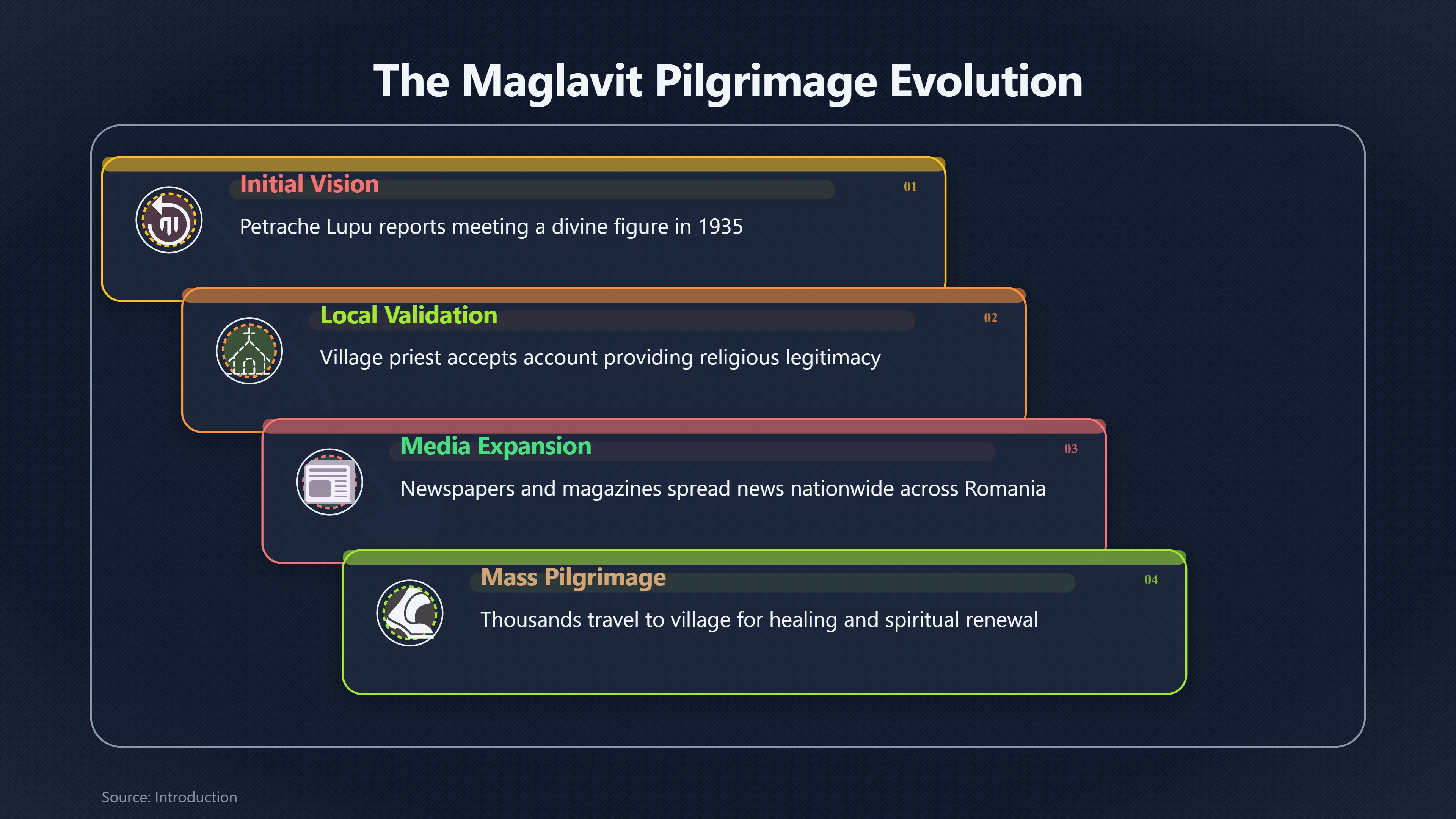
The Maglavit pilgrimage became one of the most remarkable episodes of collective religious belief in twentieth-century Romania after a shepherd named Petrache Lupu reported a series of visions in 1935. Within weeks, an obscure village on the Danube was attracting enormous crowds who hoped for healing, spiritual renewal or simply to witness an event that newspapers described as extraordinary. Unlike a moral panic driven by fear, Maglavit was a mass movement driven by hope. Claims of miraculous cures, intense media attention, religious expectation and public testimony reinforced one another, turning a local experience into a national phenomenon. At the same time, doctors, journalists, church leaders and state officials argued over whether the reported miracles represented divine intervention, psychological suggestion, misinterpretation or deliberate exaggeration. The episode remains one of Romania’s clearest examples of how reported miracles can reshape public behaviour on a national scale.[revistateologica.ro]revistateologica.roRadu Petre Mureșan The Maglavit Phenomenon 1935Revista TeologicaThe Maglavit Phenomenon (1935). Echoes From the „Site ofMarch 25, 2026…

Petrache Lupu’s vision and message
The story began in late May 1935, when Petrache Lupu, an illiterate shepherd from Maglavit in Dolj County, said he encountered an elderly figure whom he later identified as God. According to his account, the figure appeared on three successive Fridays and instructed him to urge people to repent, attend church, stop swearing, respect religious feast days and abandon sinful behaviour. The message contained no complex prophecy or new doctrine. Instead, it echoed familiar Orthodox calls for moral reform, which made it immediately understandable to rural audiences.[Radio România Internațional]rri.roRadio România Internațional Petrache LupuRadio România InternaționalPetrache Lupu - Radio Romania International…
Lupu himself became part of the story. Having lost much of his hearing and developed a speech impairment after childhood illness, he was regarded by many observers as an unlikely public preacher. Supporters interpreted this as evidence that God had chosen a humble messenger, while sceptics saw his personal circumstances as reasons to question the reliability of his testimony. Rather than ending the debate, these competing interpretations helped sustain public fascination.[Radio România Internațional]rri.roRadio România Internațional Petrache LupuRadio România InternaționalPetrache Lupu - Radio Romania International…
The village priest accepted Lupu’s account early on, giving the reports an important measure of local religious legitimacy. As news spread beyond the village, regional church authorities became involved, although they generally proceeded more cautiously than enthusiastic pilgrims or newspapers. The message itself remained centred on repentance rather than spectacular predictions, but public attention increasingly shifted from Lupu’s words to reports of miraculous events occurring around the site of the visions.[MDPI]mdpi.comCensorship of the Sacred and the Rationalisation of Society in the Early Years of the Communist Regime in Romania: Combating Pilgrima…
Why Maglavit drew enormous crowds
Within weeks, Maglavit became one of interwar Romania’s largest pilgrimage destinations. Visitors travelled from across the country, including peasants, clergy, intellectuals, politicians and members of the urban middle class. Temporary infrastructure developed to accommodate the influx, while the village itself was transformed into a place where thousands expected to witness evidence of divine action.[manastireamaglavit.ro]manastireamaglavit.roPetrache LupuPetrache Lupu
Several factors explain why the movement expanded so rapidly.
- Simple religious expectations. Lupu’s message matched familiar Orthodox teaching rather than introducing unfamiliar beliefs.
- Personal testimony. Pilgrims publicly described improvements in illness or disability after visiting the site or using water associated with the apparition.
- National newspaper coverage. Illustrated magazines and daily newspapers reported the visions, debates and testimonies, spreading awareness far beyond Oltenia.
- An atmosphere of uncertainty. Economic hardship and wider social anxieties during the interwar period made many people receptive to messages promising hope, repentance and divine intervention.[rri.ro]rri.roRadio România Internațional Petrache LupuRadio România InternaționalPetrache Lupu - Radio Romania International…
Modern historians often compare Maglavit with well-known Catholic pilgrimage sites such as Lourdes or Fatima, not because the traditions are identical, but because all combined visionary claims, reported healings, mass pilgrimage and extensive media attention. The comparison illustrates how miracle traditions could flourish across different Christian traditions during the early twentieth century.[Revista Teologica]revistateologica.roRadu Petre Mureșan The Maglavit Phenomenon 1935Revista TeologicaThe Maglavit Phenomenon (1935). Echoes From the „Site ofMarch 25, 2026…
Healing claims and the role of public testimony
The reported miracles were central to Maglavit’s influence. Pilgrims described recoveries from chronic illnesses, improvements in mobility and relief from long-standing medical conditions after praying at the site or collecting water believed to possess healing qualities. Individual testimonies circulated rapidly through newspapers, religious publications and word of mouth, encouraging still more visitors to travel to the village.[Revista Teologica]revistateologica.roRadu Petre Mureșan The Maglavit Phenomenon 1935Revista TeologicaThe Maglavit Phenomenon (1935). Echoes From the „Site ofMarch 25, 2026…
From a historical perspective, the important question is not whether every reported cure can be verified. Instead, scholars emphasise how testimony itself functioned. Every new account strengthened the expectation that miracles were occurring, making subsequent reports more believable to other pilgrims. The experience became socially self-reinforcing: belief encouraged pilgrimage, pilgrimage generated new testimonies, and those testimonies encouraged further belief.[ResearchGate]researchgate.net364362731 The miracle of Maglavit 1935 and the Romanian psychology of religionThe miracle of Maglavit (1935) and the Romanian psychology of religion…
This process does not necessarily imply deception. Historians of religion and psychologists note that sincere experiences of improvement may result from many interacting factors, including emotional intensity, religious expectation, spontaneous recovery, the placebo effect or changes in how symptoms are perceived. Such explanations coexist with the continued religious conviction of believers who regard the healings as genuine miracles.[ResearchGate]researchgate.net364362731 The miracle of Maglavit 1935 and the Romanian psychology of religionThe miracle of Maglavit (1935) and the Romanian psychology of religion…

How the press amplified the phenomenon
The interwar Romanian press played an essential role in transforming a local story into a national event. Newspapers and illustrated magazines published interviews, eyewitness accounts, photographs and competing interpretations almost continuously during the summer of 1935. Rather than presenting a single narrative, the media became a forum where supporters, sceptics, theologians and physicians debated the meaning of the events.[Radio România Internațional]rri.roRadio România Internațional Petrache LupuRadio România InternaționalPetrache Lupu - Radio Romania International…
This publicity produced a feedback loop. Reports of growing crowds became news in themselves, while stories of alleged healings encouraged further travel. Readers who might never have heard of Maglavit through church networks encountered the story through commercial newspapers whose interest was also driven by the public appetite for extraordinary events. Modern historians identify this interaction between mass media and lived religion as one of the defining features of the Maglavit phenomenon.[Universitatea Romano-Americana]rau.roUniversitatea Romano-AmericanaEvent: ”The Shepherd of Maglavit: Lived Religion in Modern Romania” - Romanian-American UniversityMay 16, 2022…
Church, state and scientific responses
The Romanian Orthodox Church did not simply endorse every miraculous claim. Many clergy welcomed the revival of religious commitment associated with Maglavit, while others urged caution before recognising supernatural events. Church leaders sought to supervise the pilgrimage rather than allowing enthusiasm to develop entirely outside ecclesiastical authority, and proposals were made to establish a permanent religious centre at the site.[MDPI]mdpi.comCensorship of the Sacred and the Rationalisation of Society in the Early Years of the Communist Regime in Romania: Combating Pilgrima…
Outside church circles, reactions were equally varied. Doctors considered possible medical and psychological explanations for Lupu’s visions and the reported cures. Intellectuals debated whether the movement reflected genuine religious renewal, widespread suggestibility or the tensions of a rapidly modernising society in which scientific authority and traditional faith increasingly competed for public trust.[ResearchGate]researchgate.net364362731 The miracle of Maglavit 1935 and the Romanian psychology of religionThe miracle of Maglavit (1935) and the Romanian psychology of religion…
The state largely tolerated the pilgrimage during the late 1930s. After the communist takeover, however, official attitudes changed dramatically. The new atheist authorities regarded large-scale miracle pilgrimages as politically and ideologically unacceptable. Petrache Lupu was arrested in 1949, public promotion of the phenomenon was suppressed and the wider pilgrimage culture surrounding Maglavit was dismantled. Only after the fall of communism did organised religious activity at the site revive.[mdpi.com]mdpi.comCensorship of the Sacred and the Rationalisation of Society in the Early Years of the Communist Regime in Romania: Combating Pilgrima…

Why Maglavit remains culturally important
Maglavit continues to attract attention because it demonstrates how collective belief can spread without coercion or fear. The episode was driven by hope, personal testimony and the expectation of healing rather than by persecution or conspiracy. It therefore occupies a distinctive place within Romania’s history of collective belief.
For historians and sociologists, the case illustrates several mechanisms working together:
- a trusted local witness whose apparent simplicity enhanced credibility for many believers;
- religious messages that resonated with existing cultural expectations;
- extensive national media coverage;
- repeated public testimonies that reinforced one another;
- continuing debate between faith, medicine and scientific scepticism rather than a decisive victory for either side.[researchgate.net]researchgate.net364362731 The miracle of Maglavit 1935 and the Romanian psychology of religionThe miracle of Maglavit (1935) and the Romanian psychology of religion…
Rather than fitting neatly into categories such as “mass hysteria” or “fraud”, Maglavit is better understood as a complex interaction between sincere religious experience, modern mass communication and collective expectation. Its enduring significance lies less in proving or disproving individual miracles than in showing how reported miracles can reshape national attention, create new pilgrimage traditions and reveal the ways belief spreads through communities during periods of social uncertainty.[revistateologica.ro]revistateologica.roRadu Petre Mureșan The Maglavit Phenomenon 1935Revista TeologicaThe Maglavit Phenomenon (1935). Echoes From the „Site ofMarch 25, 2026…




Endnotes
1.
Source: researchgate.net
Title: 364362731 The miracle of Maglavit 1935 and the Romanian psychology of religion
Link:https://www.researchgate.net/publication/364362731_The_miracle_of_Maglavit_1935_and_the_Romanian_psychology_of_religion
Source snippet
The miracle of Maglavit (1935) and the Romanian psychology of religion...
2.
Source: mdpi.com
Link:https://www.mdpi.com/2077-1444/16/10/1226
Source snippet
Censorship of the Sacred and the Rationalisation of Society in the Early Years of the Communist Regime in Romania: Combating Pilgrima...
3.
Source: manastireamaglavit.ro
Title: Petrache Lupu
Link:https://www.manastireamaglavit.ro/istoric/petrache-lupu
4.
Source: comunamaglavit.ro
Title: Petrache Lupu
Link:https://comunamaglavit.ro/2022/12/23/petrache-lupu/
Source snippet
Website primăria comunei Maglavit județul DoljDecember 23, 2022 — PETRACHE LUPU Image Petrache Lupu s-a născut pe 12 octombrie 1907, în c...
Published: December 23, 2022
5.
Source: comunamaglavit.ro
Title: Mănăstirea Maglavit
Link:https://comunamaglavit.ro/2022/12/23/manastirea-maglavit/
Source snippet
Website primăria comunei Maglavit județul Dolj...
6.
Source: comunamaglavit.ro
Title: Obiective turistice
Link:https://comunamaglavit.ro/comuna-maglavit/obiective-turistice/
7.
Source: manastireamaglavit.ro
Link:https://www.manastireamaglavit.ro/istoric/despre-lacas
8.
Source: revistateologica.ro
Title: Radu Petre Mureșan The Maglavit Phenomenon 1935
Link:https://www.revistateologica.ro/wp-content/uploads/Radu-Petre-Mure%C8%99an-The-Maglavit-Phenomenon-1935.pdf
Source snippet
Revista TeologicaThe Maglavit Phenomenon (1935). Echoes From the „Site ofMarch 25, 2026...
Published: March 25, 2026
9.
Source: rri.ro
Title: Radio România Internațional Petrache Lupu
Link:https://www.rri.ro/en/features-and-reports/rri-encyclopaedia/petrache-lupu-id169822.html
Source snippet
Radio România InternaționalPetrache Lupu - Radio Romania International...
10.
Source: rau.ro
Link:https://www.rau.ro/event-the-shepherd-of-maglavit-lived-religion-in-modern-romania/?lang=en
Source snippet
Universitatea Romano-AmericanaEvent: ”The Shepherd of Maglavit: Lived Religion in Modern Romania” - Romanian-American UniversityMay 16, 2022...
Published: May 16, 2022
Additional References
11.
Source: youtube.com
Title: Petrache Lupu de la Maglavit
Link:https://www.youtube.com/watch?v=nV8xSfdQm9M
Source snippet
Petrache Lupu şi Miracolele care au zguduit România...
12.
Source: youtube.com
Title: The Prophecy of the Shepherd Who Saw God
Link:https://www.youtube.com/watch?v=7frJd1R778E
Source snippet
Petrache Lupu de la Maglavit - ciobanul care l-a văzut pe Dumnezeu...
13.
Source: youtube.com
Title: Petrache Lupu şi Miracolele care au zguduit România
Link:https://www.youtube.com/watch?v=uLzegmxPur4
Source snippet
A Pilgrim's Way [Orthodox Documentary] Part 1/8...
14.
Source: agerpres.ro
Link:https://agerpres.ro/culte/2021/09/08/dolj-sute-de-credinciosi-au-participat-la-hramul-manastirii-maglavit-de-nasterea-maicii-domnului-gal–776404
15.
Source: historia.ro
Link:https://historia.ro/sectiune/general/petrache-lupu-de-la-nebun-la-sfant-579575.html
16.
Source: b365.ro
Link:https://b365.ro/izvorul-tamaduirii-2014-minunea-de-la-maglavit-aduna-credincio-ii-de-izvorul-tamaduirii-206763/
17.
Source: romania-actualitati.ro
Title: „Fenomenul Maglavit şi Petrache Lupu” | Istorica | Radio România Actualitați
Link:https://www.romania-actualitati.ro/emisiuni/istorica/fenomenul-maglavit-si-petrache-lupu-id151717.html
18.
Source: basilica.ro
Title: Sărbătoarea Izvorului Tămăduirii în Mănăstirile Maglavit și Lainici
Link:https://basilica.ro/sarbatoarea-izvorului-tamaduirii-in-manastirile-maglavit-si-lainici/
19.
Source: youtube.com
Title: A Pilgrim’s Way [Orthodox Documentary] Part 1/8
Link:https://www.youtube.com/watch?v=bhQ98qolWTE
Source snippet
Father Arsenie Boca - Man of God...
20.
Source: ziarullumina.ro
Title: Profeţiile ciobanului vizionar din Maglavit
Link:https://ziarullumina.ro/regionale/oltenia/profetiile-ciobanului-vizionar-din-maglavit-136532.html
Topic Tree