Within Italy's Strange Beliefs
When Italian Prophets Challenged Church and State
Figures such as Davide Lazzaretti turned prophecy and social reform into public challenges for church, state and family authority.
On this page
- Davide Lazzaretti and rural social unrest
- How devotion became a political problem
- Fraud, coercion and the risks of the cult label
Page outline Jump by section
Introduction
Italy’s history includes several prophetic religious movements that blurred the boundaries between spiritual renewal, social protest and political dissent. The best-known example is the nineteenth-century movement led by Davide Lazzaretti, a Tuscan lay preacher whose visions, communal experiments and increasingly radical claims brought him into conflict with both the Catholic Church and the newly unified Italian state. His story illustrates how prophecy could become a public issue rather than a purely private religious experience. Authorities worried not only about doctrine but also about mass mobilisation, alternative loyalties and challenges to established institutions.

These movements are best understood as responses to periods of rapid social change. Rather than treating them simply as examples of “cults” or collective irrationality, historians emphasise the interaction between poverty, religious expectation, political upheaval and local traditions. The debates surrounding Lazzaretti also show why labels such as “heretic”, “fraud”, “madman” or “cult leader” remain contested, reflecting different political, religious and scholarly perspectives rather than settled historical fact.[Riviste UNIMI]riviste.unimi.itfessionaleApril 3, 2021…
Davide Lazzaretti and rural social unrest
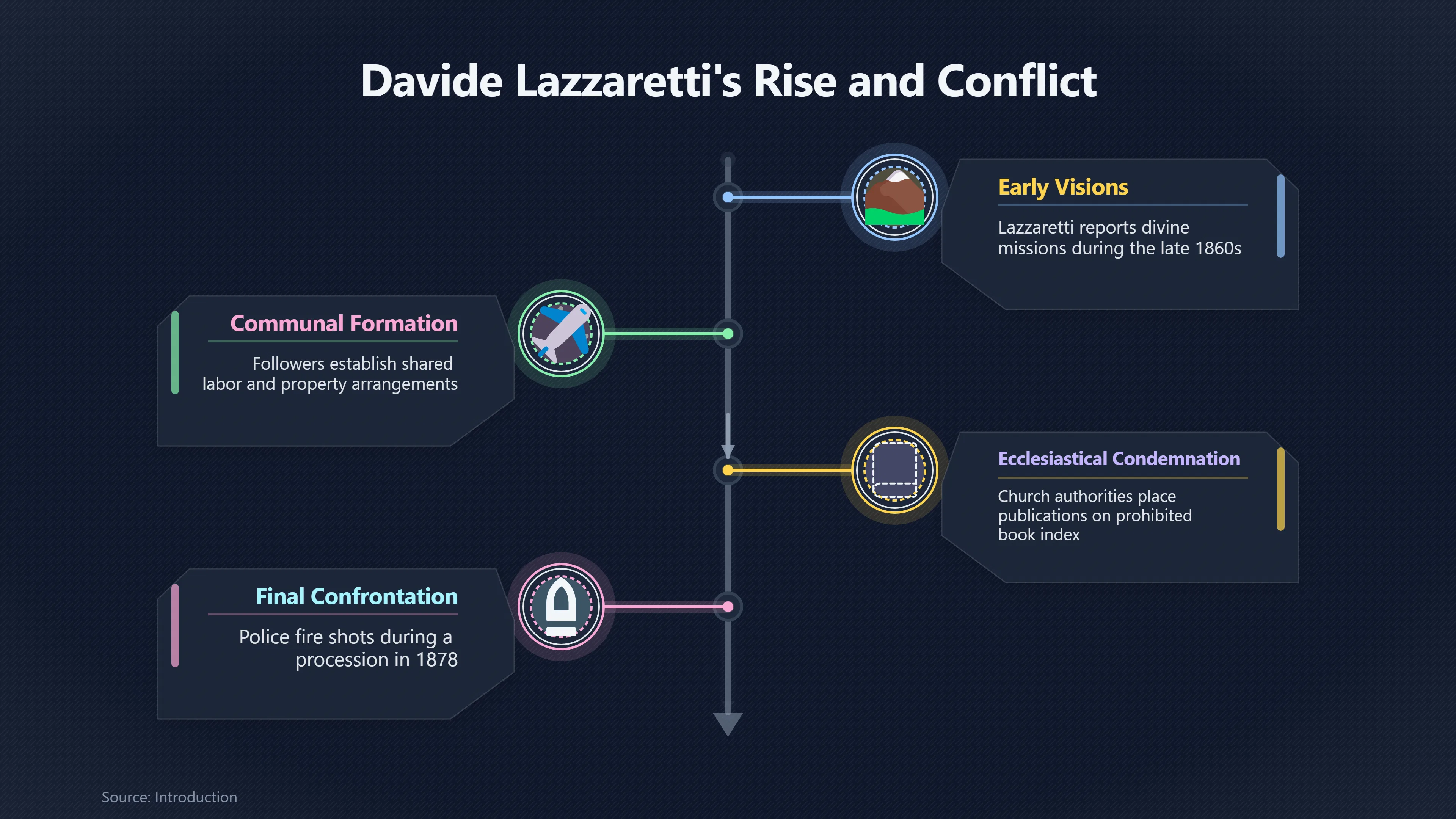
Davide Lazzaretti (1834–1878), often called the “Prophet of Monte Amiata” or the “Messiah of Amiata”, began life as a cart driver in southern Tuscany. During the late 1860s he reported a series of religious visions that convinced him he had received a divine mission. He embraced an intensely ascetic lifestyle before attracting followers among rural labourers and small farmers living around Monte Amiata, an area marked by economic hardship and political uncertainty following Italian unification.[Treccani]treccani.itLAZZARETTI, DavidLAZZARETTI, David - Enciclopedia - Treccani…
His movement combined traditional Catholic devotion with millenarian expectations—the belief that history was approaching a decisive transformation under divine guidance. Lazzaretti founded religious communities including the Congregation of Hermits, Penitents and Penitentiaries and later the Society of Christian Families. Members shared labour, property and mutual support, creating an unusually communal form of religious life that appealed to many poor families. Around eighty families reportedly participated in these collective arrangements.[Treccani]treccani.itLAZZARETTI, DavideLAZZARETTI, Davide - Enciclopedia - Treccani…
To many supporters, Lazzaretti represented moral renewal rather than revolution. He encouraged prayer, penance and social solidarity while criticising corruption and inequality. Historians increasingly interpret the movement as combining genuine religious conviction with demands for greater social justice rather than reducing it to simple fanaticism or political rebellion.[Riviste UNIMI]riviste.unimi.itfessionaleApril 3, 2021…
How devotion became a political problem
The Italian state created in 1861 was still consolidating its authority, while relations between the new government and the papacy were deeply strained. Against this background, any large independent religious movement could appear politically dangerous.
Initially, Lazzaretti remained within the framework of Catholic belief. Some clergy tolerated or even supported aspects of his preaching, and priests were permitted to celebrate Mass at the sanctuary established on Monte Labbro. Over time, however, his teachings became more ambitious. Drawing on apocalyptic interpretations of Christian history, he proclaimed the coming “Age of the Holy Spirit” and increasingly portrayed himself as a uniquely chosen figure in salvation history.[Treccani]treccani.itLAZZARETTI, DavideLAZZARETTI, Davide - Enciclopedia - Treccani…
Church authorities gradually concluded that his claims exceeded acceptable Catholic teaching. His publications were placed on the Index of Prohibited Books, sympathetic priests were disciplined, and the movement was condemned. By 1878 Lazzaretti openly identified himself as a second incarnation of Christ, placing himself in direct conflict with ecclesiastical authority.[Treccani]treccani.itLAZZARETTI, DavideLAZZARETTI, Davide - Enciclopedia - Treccani…
Civil authorities viewed the movement through a different lens. Large religious processions, highly disciplined followers and predictions of dramatic political change raised fears that a local prophetic movement might become a wider social disturbance. In August 1878, as Lazzaretti led a procession from Monte Labbro towards Arcidosso, police and carabinieri attempted to stop it. Shots were fired and Lazzaretti was killed. Whether officials believed they were preventing an uprising or reacted to confusion on the ground remains debated by historians, but his death transformed him into a martyr for many followers.[treccani.it]treccani.itLAZZARETTI, DavideLAZZARETTI, Davide - Enciclopedia - Treccani…
Why scholars no longer see only a “mad prophet”
Lazzaretti’s reputation has changed dramatically over time. Contemporary critics often portrayed him as either a dangerous impostor or a mentally ill religious fanatic. Influential psychiatrists and criminal anthropologists of the late nineteenth century, including figures associated with the emerging field of criminal psychiatry, attempted to explain his visions through theories of mental illness rather than religious experience.[Riviste UNIMI]riviste.unimi.itfessionaleApril 3, 2021…
Twentieth-century historians took a broader approach. Social historians, including Eric Hobsbawm, considered Lazzaretti within the wider tradition of rural millenarian movements that emerged where poor communities faced rapid economic and political disruption. Rather than dismissing prophetic belief as irrational, they examined how religious language expressed hopes for justice, communal equality and moral reform. Later scholarship has likewise stressed that his movement cannot be reduced to either political protest or religious delusion alone.[Treccani]treccani.itLAZZARETTI, DavidLAZZARETTI, David - Enciclopedia - Treccani…
Researchers also note that Lazzaretti repeatedly faced criminal accusations of fraud but was acquitted in state courts. Those trials reflected official suspicion of charismatic leadership without producing proof that his movement operated primarily as a criminal enterprise.[Treccani]treccani.itLAZZARETTI, DavideLAZZARETTI, Davide - Enciclopedia - Treccani…

Fraud, coercion and the risks of the cult label
Modern discussions of controversial religious movements often raise questions about manipulation, coercion and “cult” behaviour. Lazzaretti’s movement demonstrates why historians use such language carefully.
There is evidence that followers displayed extraordinary loyalty to their leader, accepted prophetic authority and participated in demanding communal practices. His increasingly exalted claims about his own religious status also alarmed both church leaders and civil officials. These features explain why hostile observers described the movement as a dangerous sect.[Treccani]treccani.itLAZZARETTI, DavideLAZZARETTI, Davide - Enciclopedia - Treccani…
However, surviving evidence does not support every accusation made by opponents. Modern research distinguishes between:
- Theological disagreement, where Church authorities rejected teachings viewed as heretical.
- Political anxiety, as the Italian state feared large independent religious gatherings during a period of fragile national consolidation.
- Criminal allegations, including fraud, which did not result in convictions despite repeated prosecutions.
- Later stereotypes, which sometimes exaggerated the movement’s secrecy or coercive character by applying modern ideas about “cults” to a nineteenth-century rural religious community.[unimi.it]riviste.unimi.itfessionaleApril 3, 2021…
Using “cult” as a blanket description can therefore obscure important distinctions. The movement clearly revolved around charismatic authority and prophetic claims, but it also reflected sincere religious belief, communal welfare and widespread dissatisfaction with existing social conditions.

Legacy in Italian religious history
Although Lazzaretti died in 1878, the community he founded did not disappear immediately. A small body of followers, known as the Giurisdavidici, continued to preserve elements of his teaching around Monte Amiata, and traces of the movement survive into the present day.[Treccani]treccani.itLazzarétti, DavideLazzarétti, Davide - Enciclopedia - Treccani…
His story remains important because it sits at the intersection of several recurring themes in Italian history:
- the tension between charismatic prophecy and institutional religious authority;
- the relationship between rural poverty and religious innovation;
- the uncertain boundary between spiritual enthusiasm and perceived public disorder;
- the tendency of governments, churches and medical experts to offer competing explanations for unconventional religious experience.
Rather than representing a simple episode of mass hysteria, the Lazzaretti movement reveals how prophetic religion could become a struggle over legitimacy itself. For believers, prophecy promised moral renewal and social justice. For church authorities, it threatened doctrinal unity. For the state, it raised questions about political order and competing sources of public loyalty. Those competing interpretations continue to shape how one of Italy’s most remarkable prophetic movements is understood today.
Amazon book picks
Further Reading
Books and field guides related to When Italian Prophets Challenged Church and State. Use these as the next step if you want deeper reading beyond the article.


Extraordinary Popular Delusions and the Madness of Crowds
Rating: 4.0/5 from 5 Google Books ratings
First published in 1841, Extraordinary Popular Delusions and the Madness of Crowds is often cited as the best book ever written about mar...
Endnotes
1.
Source: riviste.unimi.it
Link:https://riviste.unimi.it/index.php/statoechiese/article/view/15397
Source snippet
fessionaleApril 3, 2021...
Published: April 3, 2021
2.
Source: treccani.it
Title: LAZZARETTI, David
Link:https://www.treccani.it/enciclopedia/david-lazzaretti_%28Dizionario-Biografico%29/
Source snippet
LAZZARETTI, David - Enciclopedia - Treccani...
3.
Source: treccani.it
Title: Lazzarétti, Davide
Link:https://www.treccani.it/enciclopedia/davide-lazzaretti/
Source snippet
Lazzarétti, Davide - Enciclopedia - Treccani...
4.
Source: treccani.it
Title: LAZZARETTI, Davide
Link:https://www.treccani.it/enciclopedia/davide-lazzaretti_%28Enciclopedia-Italiana%29/
Source snippet
LAZZARETTI, Davide - Enciclopedia - Treccani...
5.
Source: treccani.it
Title: AMIAT A, monte
Link:https://www.treccani.it/enciclopedia/monte-amiata_%28Enciclopedia-Italiana%29/
Source snippet
T., 24-25-26; Montitmiata o Montagnata delle antiche carte, o Montagna di Zanta Fiora, o semplicemente La Montagna com...
6.
Source: treccani.it
Title: david lazzaretti
Link:https://www.treccani.it/enciclopedia/tag/david-lazzaretti/
Source snippet
Tag e risultati - TreccaniDAVID LAZZARETTI RISULTATI TROVATI PER enciclopedia biografico Tutti i risultati (13) Image: Lazzarétti, Davide...
7.
Source: treccani.it
Title: Amiata, Monte
Link:https://www.treccani.it/enciclopedia/monte-amiata/
Source snippet
Enciclopedia - TreccaniAMIATA, MONTE ENCICLOPEDIA ON LINE Montagna (1.734 m) della Toscana merid., isolata tra le valli dell'Orcia, del F...
8.
Source: treccani.it
Link:https://www.treccani.it/enciclopedia/amiata/
Source snippet
Enciclopedia - TreccaniAMIATA ENCICLOPEDIA ON LINE categorie europa in geografia italia in geografia TAG Abbadia san salvatoreCastagnetiM...
9.
Source: monte-amiata.eu
Link:https://www.monte-amiata.eu/english/amiata_culture_lazzaretti.asp
Additional References
10.
Source: ncamiata.it
Link:https://www.ncamiata.it/david-lazzaretti-storia-di-un-predicatore-italiano/
Source snippet
March 19, 2021 — DAVID LAZZARETTI: STORIA DI UN PREDICATORE ITALIANO Pubblicato il 19 marzo 2021 alle 10:48 in Cultura generale da redazi...
Published: March 19, 2021
11.
Source: youtube.com
Title: ALL’OMBRA DEL MONTE
Link:https://www.youtube.com/watch?v=tMFkneLZyio
Source snippet
Savonarola Part 2: The Bonfire of the Vanities...
12.
Source: youtube.com
Title: Roberto Mancini
Link:https://www.youtube.com/watch?v=HhfbSvSdYl4
Source snippet
Savonarola and the Bonfires of the Vanities...
13.
Source: youtube.com
Title: Savonarola Part 2: The Bonfire of the Vanities
Link:https://www.youtube.com/watch?v=uVFuz0aa28M
Source snippet
Roberto Mancini - Freedom and the Apocalypse. The Case of Davide Lazzaretti, Prophet, Reformer, a...
14.
Source: youtube.com
Title: Savonarola and the Bonfires of the Vanities
Link:https://www.youtube.com/watch?v=gVtKR4pwlDw
Source snippet
David Lazzaretti - Il Drago d'Acciaio – La lotta per la terra nel Sud del Brasile...
15.
Source: webamiata.it
Link:https://www.webamiata.it/tidavid.htm
16.
Source: centrostudilazzaretti.it
Link:https://www.centrostudilazzaretti.it/david-lazzaretti/edizione-degli-scritti/
17.
Source: youtube.com
Title: David Lazzaretti
Link:https://www.youtube.com/watch?v=k0dJbelH_c0
18.
Source: siusa-archivi.cultura.gov.it
Title: cultura.gov.it SIUS A | Archivi di personalità
Link:https://siusa-archivi.cultura.gov.it/cgi-bin/pagina.pl?Chiave=9848&RicProgetto=personalita&TipoPag=comparc
19.
Source: centrostudilazzaretti.it
Title: david lazzaretti e la comunita giurisdavidica
Link:https://www.centrostudilazzaretti.it/archivio/david-lazzaretti-e-la-comunita-giurisdavidica/
Topic Tree