Within Sierra Leone Beliefs
Why Sierra Leone Tried to Disarm Witchcraft
A post-war movement treated witches as hidden fighters, staged public recoveries of 'witch guns' and promised purification through disarmament.
On this page
- How wartime disarmament language was reused
- Public ceremonies, confessions and recovered objects
- Authority, oversight and suspicion of witch finders
Page outline Jump by section
Introduction
In the years after Sierra Leone’s civil war, one of the country’s most unusual public campaigns borrowed the language of post-war reconstruction to confront an invisible enemy. Rather than collecting rifles from former fighters, a prominent organisation of traditional healers announced a programme to recover “witch guns”—supernatural weapons believed by many people to cause illness, misfortune or death. The campaign presented itself as a form of national disarmament, claiming that hidden occult violence had survived the end of armed conflict and now had to be neutralised before the country could fully recover.[AnthroSource]anthrosource.onlinelibrary.wiley.comOpen source on wiley.com.
The campaign became notable not because it reflected a universal belief shared by all Sierra Leoneans, but because it transformed familiar post-war ideas of disarmament, demobilisation and reintegration into a public anti-witchcraft movement. It also exposed difficult questions about authority, evidence, religious belief and the limits of state oversight. While supporters saw it as a patriotic effort to remove dangerous supernatural forces, critics questioned the methods used to identify witches and the claims that invisible weapons could be physically recovered.[AnthroSource]anthrosource.onlinelibrary.wiley.comOpen source on wiley.com.
How wartime disarmament language was reused
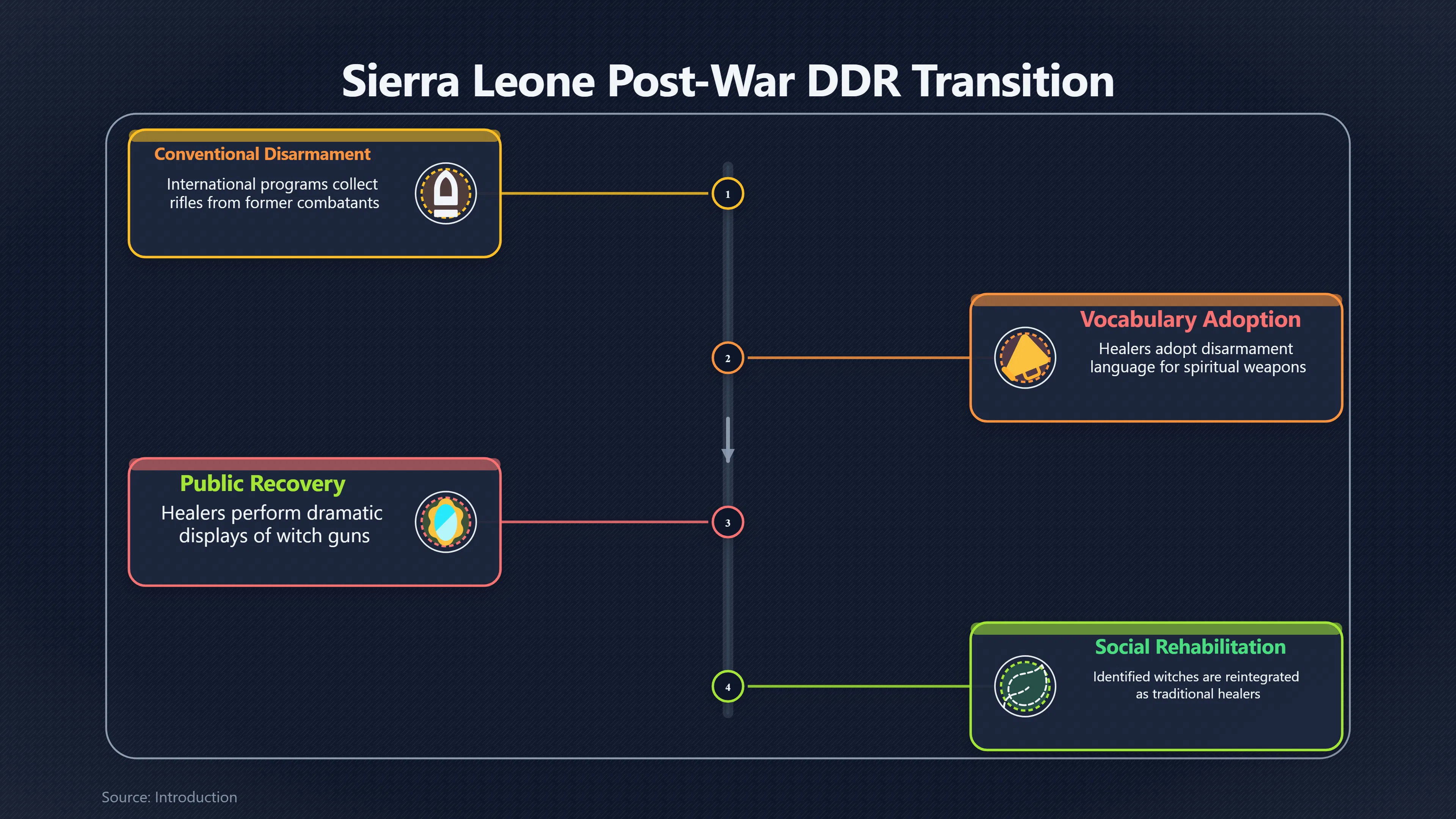
Sierra Leone’s civil war ended in 2002 after years of violence, followed by internationally backed programmes known as Disarmament, Demobilisation and Reintegration (DDR). These programmes aimed to collect conventional weapons from former combatants and help them return to civilian life. The language of “disarmament” quickly became associated with national recovery and rebuilding.[AnthroSource]anthrosource.onlinelibrary.wiley.comOpen source on wiley.com.
Around a decade later, members of the Sierra Leone Indigenous Traditional Healers Union (SLITHU), led by Alhaji Dr. Sulaiman Kabba, deliberately adopted this same vocabulary. Kabba described the organisation’s operations as a “disarmament programme” for witches, arguing that although guns and ammunition had been collected after the war, dangerous occult weapons remained hidden within society. According to this view, the country had not been fully disarmed because supernatural violence continued to threaten communities.[AnthroSource]anthrosource.onlinelibrary.wiley.comOpen source on wiley.com.
This framing was politically effective because it connected spiritual concerns with recent national experience. Rather than presenting witchcraft as an ancient rural problem, the campaign portrayed it as another unresolved legacy of war. Anthropologist Samuel Mark Anderson argues that this rhetorical link allowed anti-witchcraft organisers to present themselves as participants in national reconstruction rather than simply traditional healers.[AnthroSource]anthrosource.onlinelibrary.wiley.comOpen source on wiley.com.
The campaign also reflected memories of the conflict itself. During the civil war, many armed groups were associated with protective medicines, bullet-proofing rituals and other supernatural claims. Although these beliefs varied greatly, the war reinforced the idea that invisible spiritual forces could influence physical violence. The post-war campaign suggested that such powers had not disappeared when the fighting stopped.[AnthroSource]anthrosource.onlinelibrary.wiley.comOpen source on wiley.com.
Public ceremonies, confessions and recovered objects
The anti-witchcraft operations were deliberately public events. Groups of healers assembled wearing protective ritual clothing and carrying ritual objects including mirrors, horns, charms and medicinal plants. Teams searched markets, forests, neighbourhoods and other locations where they believed occult weapons had been concealed.[AnthroSource]anthrosource.onlinelibrary.wiley.comOpen source on wiley.com.
Central to the campaign was the claimed recovery of “witch guns” and other supernatural devices. Participants asserted that these invisible weapons could be located through specialised spiritual knowledge, rendered harmless and then displayed as physical objects. Reports also described the recovery of supposed “witch planes” and other unusual constructions presented as evidence that hidden occult technologies had been uncovered.[AnthroSource]anthrosource.onlinelibrary.wiley.comOpen source on wiley.com.
These public displays mattered because they transformed an invisible threat into something audiences could see. Rather than asking observers simply to trust spiritual claims, organisers staged dramatic recoveries that appeared to provide material proof. Anderson argues that these performances were essential to the campaign’s persuasive power, even though many other traditional practitioners disputed whether such objects genuinely represented supernatural weapons.[AnthroSource]anthrosource.onlinelibrary.wiley.comOpen source on wiley.com.
The movement also claimed to apprehend witches. Instead of advocating execution or permanent exclusion, organisers described their goal as rehabilitation. Individuals identified as witches were said to be fed, instructed and eventually returned to society as responsible herbalists or traditional healers. This language consciously echoed the reintegration element of post-war DDR programmes, in which former combatants were expected to become productive citizens.[AnthroSource]anthrosource.onlinelibrary.wiley.comOpen source on wiley.com.
Authority, oversight and suspicion of witch-finders
The campaign’s ambitions immediately raised questions about who possessed the authority to identify witches. Sierra Leone’s legal system does not recognise supernatural evidence as a basis for criminal guilt, and there is no official state procedure for proving the existence of witchcraft. Consequently, the movement occupied an uncertain space between religious practice, traditional healing and public performance.[AnthroSource]anthrosource.onlinelibrary.wiley.comOpen source on wiley.com.
Traditional healing itself is highly diverse in Sierra Leone, and not all practitioners accepted SLITHU’s methods. Anderson notes that many healers questioned whether invisible witch weapons could truly be materialised or whether dramatic public recoveries represented authentic spiritual practice. The campaign therefore generated disagreements within the country’s own healing traditions rather than simply between believers and sceptics.[AnthroSource]anthrosource.onlinelibrary.wiley.comOpen source on wiley.com.
Human-rights concerns also surround any organised effort to identify witches. Across West Africa, accusations of witchcraft have sometimes led to violence, forced confessions, social exclusion or other abuses. Although SLITHU described its approach as rehabilitation rather than punishment, critics remained concerned about the potential consequences for people publicly identified as witches, particularly where accusations rested on unverifiable supernatural claims rather than observable evidence.[AnthroSource]anthrosource.onlinelibrary.wiley.comOpen source on wiley.com.
The movement also depended heavily on public trust in charismatic specialists. Because outsiders could not independently verify claims about invisible weapons, success rested largely on confidence in the organisers’ expertise and integrity. This made the campaign vulnerable to scepticism whenever claimed discoveries appeared implausible or inconsistent.[AnthroSource]anthrosource.onlinelibrary.wiley.comOpen source on wiley.com.
Why the campaign matters in Sierra Leone’s history of collective belief
The post-war disarmament campaign illustrates how collective beliefs can adapt to changing political circumstances instead of simply preserving old traditions. Rather than repeating older forms of witch-finding, organisers borrowed the language, symbolism and institutional logic of international peacebuilding. National security, post-conflict reconstruction and supernatural danger became intertwined within a single public narrative.[AnthroSource]anthrosource.onlinelibrary.wiley.comOpen source on wiley.com.
For historians and anthropologists, this makes the campaign important not because it proves or disproves the existence of witchcraft, but because it demonstrates how societies reinterpret recent experience. The concepts of disarmament, rehabilitation and reconstruction acquired meanings that extended beyond conventional weapons into the moral and spiritual health of the nation.[AnthroSource]anthrosource.onlinelibrary.wiley.comOpen source on wiley.com.
The episode also highlights an important distinction in Sierra Leone’s history of collective belief. Many citizens may accept the possibility of witchcraft while simultaneously questioning particular witch-finders, specific accusations or spectacular public demonstrations. The debate therefore centred not only on belief itself, but on who had the right to define hidden threats, reveal invisible evidence and claim the authority to restore social order.[AnthroSource]anthrosource.onlinelibrary.wiley.comOpen source on wiley.com.
Amazon book picks
Further Reading
Books and field guides related to Why Sierra Leone Tried to Disarm Witchcraft. Use these as the next step if you want deeper reading beyond the article.


Magic, science, and religion, and other essays
Examines ritual authority and magical practice.
Endnotes
1.
Source: anthrosource.onlinelibrary.wiley.com
Link:https://anthrosource.onlinelibrary.wiley.com/doi/full/10.14506/ca34.2.04
2.
Source: anthrosource.onlinelibrary.wiley.com
Link:https://anthrosource.onlinelibrary.wiley.com/doi/abs/10.1111/amet.70019
Source snippet
2...
0
1
- “Epidemics (Especially Ebola).” Annual Review of Anthropology 46: 421–45. https://doi.org/10.1146/annurev-anthro-102116-041
6
1
- Web
3.
Source: anthrosource.onlinelibrary.wiley.com
Title: j.1548 1433.2012.01448.x
Link:https://anthrosource.onlinelibrary.wiley.com/doi/10.1111/j.1548-1433.2012.01448.x
4.
Source: anthrosource.onlinelibrary.wiley.com
Link:https://anthrosource.onlinelibrary.wiley.com/doi/abs/10.1525/ae.1997.24.4.856
5.
Source: sierra-leone.org
Title: Sierra Leone Web
Link:https://www.sierra-leone.org/Archives/slnews0102.html
Additional References
6.
Source: royalliteglobal.com
Link:https://royalliteglobal.com/njhs/article/view/863
Source snippet
i Journal of Humanities and Social SciencesNovember 3, 2022 — POPULAR PUBLIC PERCEPTION OF WITCHCRAFT PRACTICES, WITCHCRAFT WEALTH, RECRU...
Published: November 3, 2022
7.
Source: undp.org
Link:https://www.undp.org/sierra-leone/news/72-small-arms-destroyed-rural-communities-sierra-leone-support-weapons-development-initiative
Source snippet
Development ProgrammeNovember 25, 2020 — 72 SMALL ARMS DESTROYED BY RURAL COMMUNITIES IN SIERRA LEONE WITH SUPPORT FROM THE ‘WEAPONS FOR...
Published: November 25, 2020
8.
Source: apexnewssl.com
Title: Small Arms Commission Destroys 3,900 Weapons
Link:https://apexnewssl.com/?p=4873
Source snippet
7, 2025 — SMALL ARMS COMMISSION DESTROYS 3,900 WEAPONS admin August 7, 2025 0 By John Marah Sierra Leone has destroyed approximately 3,90...
Published: August 7, 2025
9.
Source: maginternational.org
Title: lessons effective arms control sierra leone
Link:https://www.maginternational.org/whats-happening/lessons-effective-arms-control-sierra-leone/
Source snippet
Lessons in effective arms control from Sierra Leone | MAGSeptember 1, 2021 — LESSONS IN EFFECTIVE ARMS CONTROL FROM SIERRA LEONE MAG - Se...
Published: September 1, 2021
10.
Source: youtube.com
Title: Money Rituals: Africa’s Deadliest Taboo
Link:https://www.youtube.com/watch?v=EjDe1D8NlOY
Source snippet
4 An Honest Explanation of Sierra Leone's Civil War...
11.
Source: youtube.com
Title: An Honest Explanation of Sierra Leone’s Civil War
Link:https://www.youtube.com/watch?v=EoBCCAuvBuk
Source snippet
5 1999: The Hell of the Sierra Leonean Civil War | INA History x CAPA...
12.
Source: culanth.org
Link:https://www.culanth.org/fieldsights/articulating-the-invisible-ebola-beyond-witchcraft-in-sierra-leone
13.
Source: royalliteglobal.com
Link:https://royalliteglobal.com/index.php/njhs/article/view/863
14.
Source: tandfonline.com
Link:https://www.tandfonline.com/doi/full/10.1080/00083968.2020.1723658
15.
Source: researchgate.net
Link:https://www.researchgate.net/publication/333366351_A_Disarmament_Program_for_Witches_The_Prospective_Politics_of_Antiwitchcraft_Postwarcraft_and_Rebrandcraft_in_Sierra_Leone
Topic Tree