Within Gabon
Why Colonial Authorities Feared Bwiti
Missionaries and officials often treated Bwiti ceremonies as a secret threat, revealing more about colonial anxiety than the religion itself.
On this page
- What Bwiti traditions involve
- How missionaries created a cult scare
- Religion, solidarity and colonial control
Page outline Jump by section
Introduction
Bwiti is a family of indigenous initiatory religious traditions centred in Gabon and neighbouring parts of Central Africa. During the colonial era, however, many French administrators and Christian missionaries portrayed it as a dangerous “cult”, a source of disorder, or even a political conspiracy. The resulting scare says as much about colonial fears as it does about Bwiti itself. Rather than being a documented campaign of violence against the colonial state, Bwiti became a target because it offered an alternative source of spiritual authority, social solidarity and cultural identity outside missionary and government control. Modern historians generally view the colonial panic as a revealing example of how indigenous religions were misunderstood, exaggerated and sometimes deliberately misrepresented in order to justify intervention and repression.[Cambridge University Press & Assessment]cambridge.orgCambridge University Press & AssessmentMissionary Expertise, Social Science, and the uses of Ethnographic Knowledge in Colonial Gabon | H…
What Bwiti traditions involve
Bwiti is not a single, uniform religion but a broad family of initiatory traditions practised by several Gabonese peoples, including the Mitsogo, Fang and others. While practices differ between communities, initiation commonly involves ritual music, dancing, teachings about ancestors, moral obligations, healing and the ceremonial use of the iboga plant, whose psychoactive properties play an important role in some forms of initiation. These ceremonies are intended to provide spiritual insight, strengthen community ties and connect initiates with ancestral knowledge rather than recruit followers into an exclusive movement.[Antrocom]antrocom.netStudies on the iboga cults. I. The ancient documentsStudies on the iboga cults. I. The ancient documents - Antrocom…
This diversity mattered because colonial observers often treated every local variation as part of one secretive organisation. In reality, scholars describe Bwiti as an evolving set of religious traditions that absorbed influences from different ethnic groups and, in some cases, incorporated elements of Christianity while retaining indigenous beliefs. Its adaptability helped it survive periods of intense outside pressure.[Cambridge University Press & Assessment]cambridge.orgCambridge University Press & AssessmentMissionary Expertise, Social Science, and the uses of Ethnographic Knowledge in Colonial Gabon | H…
Why colonial authorities feared Bwiti
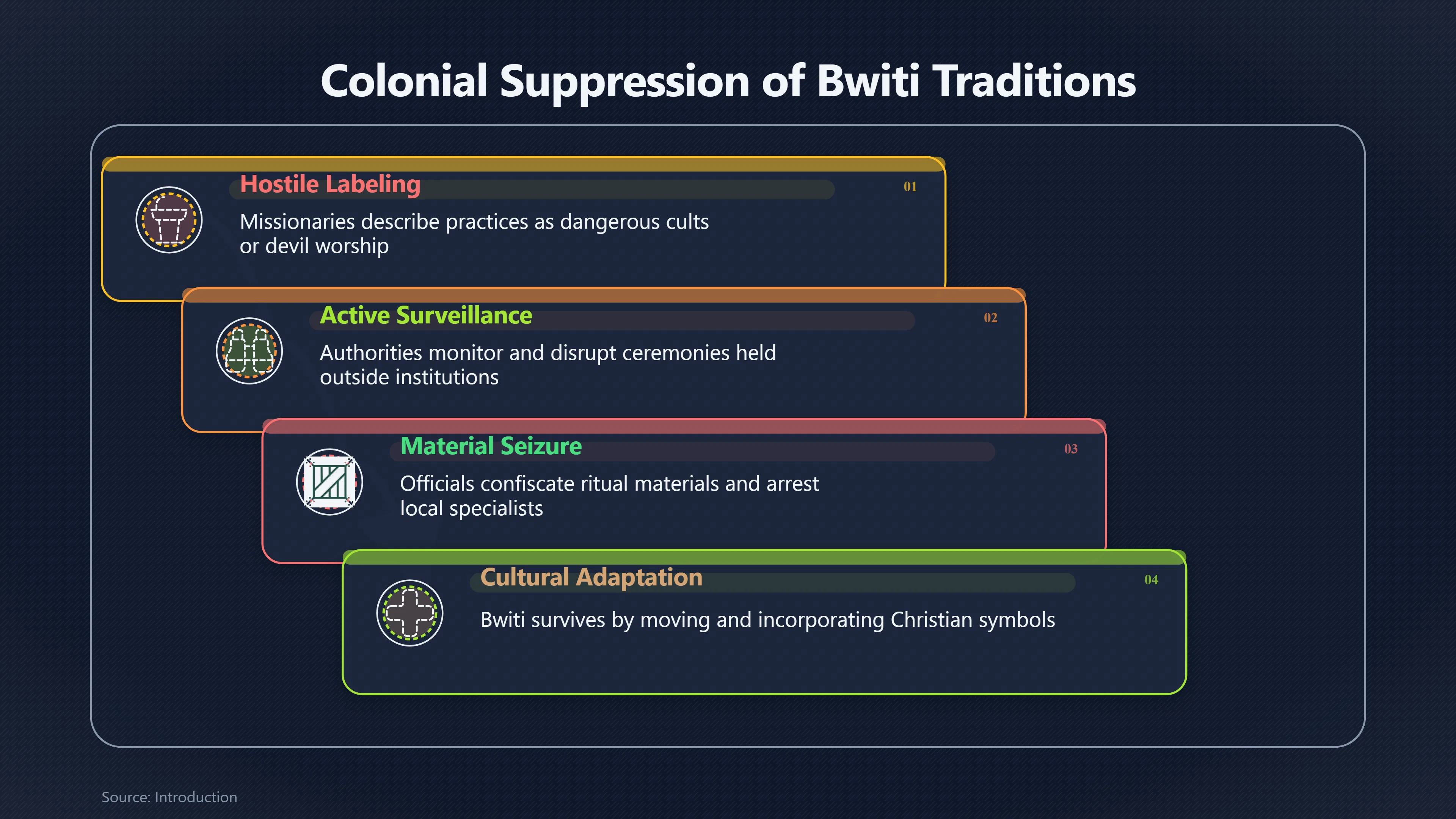
French colonial officials and Catholic missionaries increasingly regarded Bwiti with suspicion during the early twentieth century. Several features worried them.
First, initiation ceremonies took place outside colonial institutions and were controlled by respected ritual specialists rather than government-appointed leaders or missionaries. This created an independent sphere of authority that officials struggled to monitor.
Second, the ceremonies often continued through the night, involved restricted knowledge and were closed to outsiders. Colonial reports frequently interpreted secrecy as evidence of conspiracy or criminality instead of recognising that many initiation traditions protect sacred knowledge from casual observation.
Third, iboga consumption alarmed missionaries, who viewed it primarily as an intoxicant rather than as part of a religious practice. Missionary writings often portrayed visions experienced during initiation as deception or devil worship, reinforcing fears among colonial administrators that Bwiti threatened both Christian conversion and public order.[tianmu.org]tianmu.orgAnglican Church Bwiti — The Way of Iboga · Tianmu Anglican ChurchTianmu Anglican ChurchBwiti — The Way of Iboga · Tianmu Anglican ChurchJuly 5, 2026…
The result was a classic colonial “cult scare”: a religious tradition was presented not simply as different, but as inherently dangerous, irrational and politically suspect.
How missionaries helped create a cult scare
Missionary accounts became one of the main ways Europeans learned about Bwiti. Because many missionaries approached indigenous religions with the explicit aim of replacing them, their descriptions often emphasised practices they considered shocking while overlooking everyday religious life and community functions.
Some missionary publications associated Bwiti with claims of devil worship, human sacrifice, cannibalism or organised criminal behaviour. Modern researchers have shown that many of these allegations relied on rumour, misunderstanding, the merging of unrelated traditions or repeated colonial stereotypes rather than well-documented evidence. Later writers sometimes reproduced these claims without critically examining their origins, allowing exaggerated images of Bwiti to circulate for decades.[Antrocom]antrocom.netStudies on the iboga cults. II. Missionary and colonial mystificationsStudies on the iboga cults. II. Missionary and colonial mystifications - AntrocomJune 24, 2024…
Recent historical work argues that these portrayals reflected broader missionary assumptions about African religions. Indigenous ritual systems were frequently interpreted through European ideas about paganism, secret societies and moral danger, making it easier for colonial governments to justify restrictions on ceremonies and religious leaders.[Cambridge University Press & Assessment]cambridge.orgCambridge University Press & AssessmentMissionary Expertise, Social Science, and the uses of Ethnographic Knowledge in Colonial Gabon | H…
Repression and surveillance
The colonial response went beyond hostile language. Historical evidence indicates that administrations in parts of French Equatorial Africa periodically disrupted ceremonies, confiscated ritual materials, arrested ritual specialists and attempted to suppress initiation practices, often working alongside missionary institutions. Policies varied by place and period, but the overall direction was clear: authorities sought to weaken a religious network they believed challenged colonial authority.[Tianmu Anglican Church]tianmu.orgAnglican Church Bwiti — The Way of Iboga · Tianmu Anglican ChurchTianmu Anglican ChurchBwiti — The Way of Iboga · Tianmu Anglican ChurchJuly 5, 2026…
Yet suppression proved difficult. Bwiti was deeply embedded in local communities rather than organised around a single leadership structure. Ceremonies could move, adapt or incorporate selected Christian symbols while preserving core traditions. Instead of disappearing, Bwiti survived colonial rule and continued evolving after Gabon’s independence.[Antrocom]antrocom.netStudies on the iboga cults. I. The ancient documentsStudies on the iboga cults. I. The ancient documents - Antrocom…
Religion, solidarity and colonial control
Historians increasingly interpret colonial fears of Bwiti through the wider politics of empire rather than through claims that the religion itself posed an exceptional threat.
For many Gabonese communities, Bwiti offered:
- A framework for healing and coping with illness or personal crisis.
- A means of preserving ancestral traditions during rapid social change.
- Networks of mutual support that existed outside colonial administration.
- Moral authority independent of missionary churches.
For colonial officials, those same characteristics could appear threatening because they reduced dependence on colonial institutions. A religion capable of organising people, transmitting knowledge and maintaining loyalties beyond government oversight was easily portrayed as politically subversive even when its primary focus remained spiritual and communal.[Cambridge University Press & Assessment]cambridge.orgCambridge University Press & AssessmentMissionary Expertise, Social Science, and the uses of Ethnographic Knowledge in Colonial Gabon | H…
This pattern was not unique to Gabon. Across colonial Africa, administrators often viewed independent religious movements with suspicion, particularly when they crossed ethnic boundaries or attracted large numbers of followers. Bwiti therefore fits a broader history in which indigenous religions were labelled “cults” largely because they resisted colonial definitions of legitimate belief.
Separating myth from historical evidence
Several long-standing claims deserve careful distinction.
Claims that Bwiti routinely practised human sacrifice or institutional cannibalism are not supported by modern mainstream historical scholarship. Researchers tracing these stories have argued that many originated in missionary polemics, colonial rumours or the blending together of different traditions and accusations already circulating about Central African peoples.[Antrocom]antrocom.netStudies on the iboga cults. II. Missionary and colonial mystificationsStudies on the iboga cults. II. Missionary and colonial mystifications - AntrocomJune 24, 2024…
Likewise, while colonial officials sometimes suspected Bwiti of organising political resistance, evidence generally shows that its principal activities centred on initiation, healing, moral instruction and religious practice rather than coordinated rebellion. Individual practitioners undoubtedly held political opinions, but this differs from treating the religion itself as a revolutionary organisation.[Cambridge University Press & Assessment]cambridge.orgCambridge University Press & AssessmentMissionary Expertise, Social Science, and the uses of Ethnographic Knowledge in Colonial Gabon | H…
Recognising these distinctions is important because colonial documents often reflected the fears and objectives of those who produced them. They remain valuable historical sources, but they require careful reading alongside ethnographic research and Gabonese perspectives.

Why the colonial scare still matters
Today Bwiti is widely recognised as one of Gabon’s most important indigenous religious traditions and forms part of the country’s cultural heritage. Interest in iboga has also grown internationally because of research into its possible therapeutic uses, although these medical discussions are separate from Bwiti’s religious meaning.
The colonial scare surrounding Bwiti remains historically significant because it illustrates how moral panic can arise from unequal power rather than from objective evidence of danger. Missionaries and colonial officials often interpreted unfamiliar religious practices through assumptions about secrecy, superstition and political disloyalty. Modern scholarship instead presents Bwiti as a complex spiritual tradition whose colonial reputation was shaped as much by European anxieties about authority and cultural control as by the religion itself.[antrocom.net]antrocom.netStudies on the iboga cults. I. The ancient documentsStudies on the iboga cults. I. The ancient documents - Antrocom…
Amazon book picks
Further Reading
Books and field guides related to Why Colonial Authorities Feared Bwiti. Use these as the next step if you want deeper reading beyond the article.

African Religions A Very Short Introduction
Explains indigenous belief systems often misunderstood by colonial authorities.


African traditional religions in contemporary society
First published 1991. Subjects: Religion, Study and teaching, Congresses, Étude et enseignement, PRO Shaw, Gwendolyn Dubois, 1968- (donor).
Endnotes
1.
Source: cambridge.org
Link:https://www.cambridge.org/core/journals/history-in-africa/article/abs/missionary-expertise-social-science-and-the-uses-of-ethnographic-knowledge-in-colonial-gabon/EC5DD98282A41152D29A20464E5BA7DC
Source snippet
Cambridge University Press & AssessmentMissionary Expertise, Social Science, and the uses of Ethnographic Knowledge in Colonial Gabon | H...
2.
Source: cambridge.org
Link:https://www.cambridge.org/core/journals/history-in-africa/article/resources-for-the-history-of-gabon-in-french-missionary-archives-in-rome/1554CE904A098D9ACBC7D747D62886A3
Source snippet
Cambridge University Press & AssessmentResources for the History of Gabon in French Missionary Archives in Rome | History in Africa | Cam...
3.
Source: antrocom.net
Title: Studies on the iboga cults. I. The ancient documents
Link:https://antrocom.net/archives/2024/volume-20-numer-1/studies-on-the-iboga-cults-i-the-ancient-documents/
Source snippet
Studies on the iboga cults. I. The ancient documents - Antrocom...
4.
Source: tianmu.org
Title: Anglican Church Bwiti — The Way of Iboga · Tianmu Anglican Church
Link:https://tianmu.org/good-work-library/ethnotheology/africa/bwiti-the-way-of-iboga
Source snippet
Tianmu Anglican ChurchBwiti — The Way of Iboga · Tianmu Anglican ChurchJuly 5, 2026...
Published: July 5, 2026
5.
Source: antrocom.net
Title: Studies on the iboga cults. II. Missionary and colonial mystifications
Link:https://antrocom.net/archives/2024/volume-20-numer-1/studies-on-the-iboga-cults-ii-missionary-and-colonial-mystifications/
Source snippet
Studies on the iboga cults. II. Missionary and colonial mystifications - AntrocomJune 24, 2024...
Published: June 24, 2024
6.
Source: cambridge.org
Link:https://www.cambridge.org/core/services/aop-cambridge-core/content/view/95F1E8B499A2BF29A1C95E1F712447F3/S036154130000718Xa.pdf/resources_of_paris_missionary_archives_and_libraries_for_the_history_of_gabon.pdf
7.
Source: revistas.uned.es
Link:https://revistas.uned.es/index.php/endoxa/article/view/16695
Additional References
8.
Source: canamo.net
Title: Bwiti, un culto psicodélico contra el poder colonial | Cáñamo
Link:https://canamo.net/cultura/reportaje/bwiti-un-culto-psicodelico-contra-el-poder-colonial
Source snippet
December 20, 2024 — ‘¿QUÉ PARTE DEL BWITI ATEMORIZABA?’ Image: Bwiti, un culto psicodélico contra el poder colonial A comienzos del siglo...
Published: December 20, 2024
9.
Source: researchgate.net
Title: (PDF) Studies on the iboga cults
Link:https://www.researchgate.net/publication/381670103_Studies_on_the_iboga_cults_I_The_ancient_documents
Source snippet
I. The ancient documentsJanuary 1, 2024 — Article PDF Available STUDIES ON THE IBOGA CULTS. I. THE ANCIENT DOCUMENTS * January 2024 Autho...
Published: January 1, 2024
10.
Source: nouveautes-editeurs.bnf.fr
Title: fr Nouveautés Éditeurs
Link:https://nouveautes-editeurs.bnf.fr/accueil?id_declaration=10000001259202&titre_livre=Les_missionnaires_protestants_au_Gabon_%281842-1961%29
Source snippet
bnf.frNouveautés Éditeurs - Accueil - Les missionnaires protestants au Gabon (1842-1961) État, Église et développement - l'Harmattan - Me...
11.
Source: youtube.com
Title: Experience BWITI: Renascence of the Healed
Link:https://www.youtube.com/watch?v=W7RTY5o_2MM
Source snippet
The Punu People and Their Fight to Protect Gabon's Sacred Forests | SLICE | FULL DOCUMENTARY...
12.
Source: youtube.com
Title: Iboga & Bwiti in Gabon: The National Temple Registration Initiative Begins
Link:https://www.youtube.com/watch?v=moJCzHJUEYc
Source snippet
Experience BWITI: Renascence of the Healed...
13.
Source: researchgate.net
Link:https://www.researchgate.net/publication/381670332_Studies_on_the_iboga_cults_II_Missionary_and_colonial_mystifications
14.
Source: samorini.it
Link:https://www.samorini.it/doc1/sam/bui_int.htm
15.
Source: africabib.org
Link:https://www.africabib.org/rec.php?RID=305657682
16.
Source: petitfute.co.uk
Link:https://www.petitfute.co.uk/p113-gabon/decouvrir/d2649-the-cult-of-the-ancestors/
17.
Source: persee.fr
Link:https://www.persee.fr/doc/jafr_0399-0346_1979_num
Topic Tree