Why America Keeps Fearing Hidden Threats
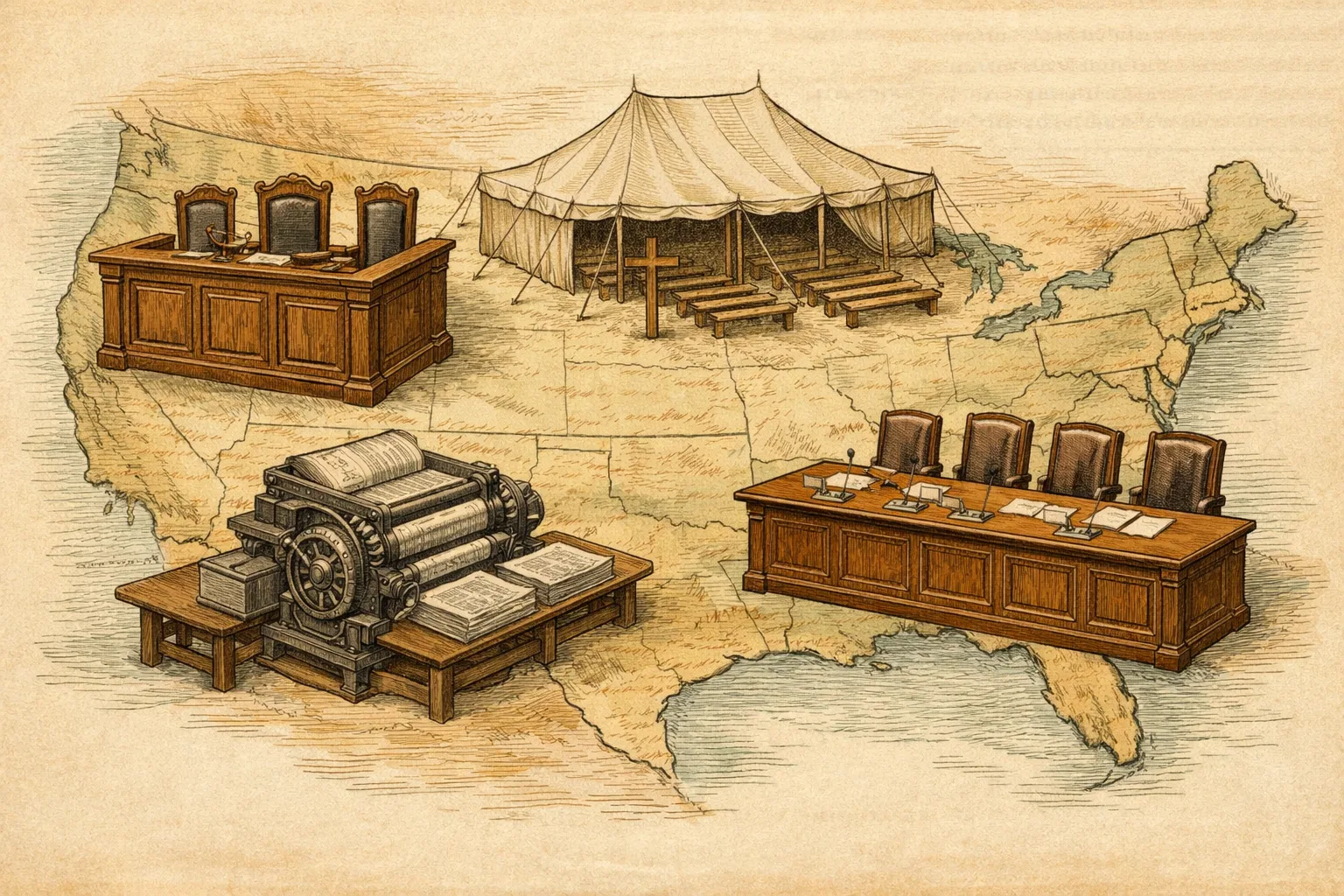
The United States has repeatedly turned uncertainty into stories about hidden enemies, supernatural threats and approaching catastrophe. The best-known examples range from the Salem witch trials and nineteenth-century predictions of Christ’s return to the Red Scares, the Satanic Panic, UFO religions, Jonestown, Waco and internet conspiracy movements.
Page outline Jump by section
Introduction
What links them is a recurring social process: an alarming interpretation gains credibility, trusted institutions repeat it, ambiguous events are treated as confirmation, and dissent becomes difficult. Yet “mass hysteria” is often too crude a label. It can dismiss real suffering, conceal political interests or imply that whole populations suddenly lost their reason. A more useful history distinguishes apocalyptic belief, moral panic, rumour, state repression, mass psychogenic illness and coercive religious leadership.
What counts as a panic, scare or collective belief?
A moral panic occurs when a person, practice or group is presented as a serious threat to society’s values, often through claims that are exaggerated, weakly evidenced or disproportionate to the actual danger. Public concern alone does not make a panic: some feared harms are real. The important questions are whether the scale of the threat was established, whether supposed offenders were turned into symbolic enemies, and whether media and authorities amplified the alarm faster than evidence could be tested.[Oxford Reference]oxfordreference.comOxford ReferenceMoral Panics and Folk DevilsConceptual Developments · Concern. For a moral panic to take place a concern must exist regar…
Mass psychogenic illness, sometimes called mass sociogenic illness, is different. People develop genuine symptoms—such as faintness, nausea, shaking or breathing difficulties—that spread through a group without a common organic cause being found. The symptoms are not fabricated. Research suggests that such outbreaks often reflect anxiety, observation, expectation and local social pressures; their form tends to mirror the fears of the period in which they occur.[PMC]pmc.ncbi.nlm.nih.govPMCMass sociogenic illnessNIHby E Weir · 2005 · Cited by 63 — A historical review of these events suggests that the features of mass sociogenic illnesses ten…
A millenarian movement expects a radical transformation of the world, commonly through divine intervention, apocalypse or entry into a perfected age. Failed prophecy does not necessarily destroy such a movement. Believers may revise the date, reinterpret what happened or conclude that the prediction was fulfilled in an invisible spiritual realm.
The word cult requires particular care. In ordinary speech it often implies manipulation, abuse or bizarre belief. In journalism and law enforcement it can become a verdict before conduct has been examined. Religious-studies scholars generally prefer more neutral descriptions such as “new religious movement”, “apocalyptic community” or the group’s own name, while still investigating coercion, exploitation and violence where evidence supports those findings. The distinction matters because unusual theology does not itself prove criminality, and hostile labelling can shape how officials treat a minority religion.
Salem: fear became courtroom evidence
The Salem crisis of 1692–93 remains the defining American witch panic, although prosecutions for witchcraft had occurred elsewhere in colonial New England. Massachusetts law treated witchcraft as a capital offence, reflecting biblical teaching, English legal precedent and a widespread belief that harmful magic was possible. The crisis began after several girls in Salem Village displayed disturbing behaviour and accused local people of afflicting them through witchcraft. The accusations expanded through families and neighbouring communities, eventually drawing more than 200 people into suspicion. Nineteen were hanged, Giles Corey was pressed to death after refusing to plead, and others died in prison.[Congregational Library & Archives]congregationallibrary.orgCongregational Library & Archives Salem Witch Trials Research GuideCongregational Library & ArchivesSalem Witch Trials Research GuideFebruary 15, 2026 — The first executions for witchcraft in New England…
The prosecutions became especially dangerous because judges accepted spectral evidence: testimony that an accused person’s spirit or apparition had attacked someone, even when the accused was physically elsewhere. The Law Library of Congress notes that the court’s approach drew partly upon English legal authority, but it created an almost impossible problem for defendants. An apparition could not be independently inspected, and denial could be treated as further evidence of deception.[The Library of Congress]blogs.loc.govevidence from invisible worlds in salemThe Library of CongressEvidence from Invisible Worlds in Salem | In Custodia Legis20 Aug 2020 — Record of that trial appeared in a 1682 p…
Salem was not simply a spontaneous outbreak of superstition among isolated villagers. Historians have connected it to factional conflict, unstable government, frontier warfare, religious anxiety, property disputes and the strains within Salem Village itself. Those pressures did not mechanically “cause” the accusations, but they made claims of invisible conspiracy easier to believe and gave existing conflicts a supernatural language.
Popular explanations have sometimes reduced the crisis to contaminated rye causing hallucinations. That theory remains speculative and cannot account for the legal decisions, the changing pattern of accusations or the social relationships behind them. The more persuasive interpretation treats Salem as an interaction between sincere supernatural belief, local antagonisms and a judicial system that briefly allowed unverifiable experiences to function as criminal proof.
Its lasting importance lies less in the idea that an entire society “went mad” than in the institutional failure. Ministers, magistrates and neighbours converted uncertainty into certainty, then placed the burden on defendants to disprove invisible acts. Salem therefore became an American warning about coerced confession, unreliable testimony, scapegoating and courts that relax ordinary standards during an emergency.
Apocalypse in a rapidly changing republic
The religious openness of the early United States encouraged experimentation as well as established denominations. Revivals, cheap print, westward migration and weak central religious authority gave charismatic preachers and lay interpreters room to build movements around prophecy.
The most influential nineteenth-century example was Millerism. William Miller, a Baptist lay preacher and farmer from New York, used biblical chronology to argue that Christ’s return was near. His lectures and publications attracted a large interdenominational following during the 1830s and 1840s. A final expectation centred on 22 October 1844. When no visible Second Coming occurred, the failure became known as the Great Disappointment.[Wikipedia]WikipediaGreat DisappointmentGreat Disappointment
The episode is important because it shows why failed prediction does not always end collective belief. Some followers abandoned the movement, while others reworked its meaning. One influential interpretation held that the predicted cleansing had occurred in heaven rather than on Earth. Millerism consequently became part of the background from which several Adventist traditions developed.[Christian History Institute]christianhistoryinstitute.orgOpen source on christianhistoryinstitute.org.
This was not merely gullibility. Miller’s followers inhabited a culture saturated with revival preaching, providential interpretations of history and confidence that scripture could be decoded through disciplined study. The same republic that celebrated technological progress and democratic expansion also produced intense uncertainty about economic upheaval, migration, slavery and national destiny. Apocalyptic systems offered both a timetable and a moral explanation.
Later American movements repeatedly combined older Christian prophecy with newer cultural materials. Spiritualism used the language of communication technologies to make contact with the dead seem plausible. Twentieth-century UFO religions joined biblical ascent, space travel and human evolution. The form changed, but the promise remained recognisable: ordinary history was about to end, and a small prepared community understood why.
Red Scares and the machinery of suspicion
American panics have often focused not on supernatural enemies but on political subversion. The first Red Scare followed the Russian Revolution, wartime repression, labour unrest and a series of bomb attacks. Federal raids, deportations and prosecutions turned radical politics and immigrant identity into signs of possible conspiracy.
The second Red Scare intensified after the Second World War as the Soviet Union gained nuclear weapons, Communist governments expanded and espionage cases revealed that some infiltration had genuinely occurred. The existence of Soviet intelligence activity did not validate every accusation. Senator Joseph McCarthy became the era’s most visible figure by making sweeping allegations about Communists in government, often without providing adequate evidence. His claims dominated headlines before the Senate censured him in 1954.[The Library of Congress]loc.govThe Library of Congress“Fire!”The Library of Congress“Fire!”
McCarthyism illustrates a central problem in studying moral panic: a panic can grow around a real issue. Soviet espionage was not imaginary, just as child abuse in the 1980s was not imaginary. The distortion lay in treating association, political dissent, past membership or refusal to inform as proof of a coordinated hidden enemy.
The consequences were practical rather than merely emotional. Loyalty programmes, blacklists, congressional investigations and employment dismissals narrowed acceptable political life. People accused others to protect their careers; institutions overreacted to avoid appearing weak; and ambiguous evidence accumulated authority through repetition. The fear also shaped popular culture, helping to normalise fantasies of “brainwashing” and remotely controlled citizens during the Cold War.[Smithsonian Magazine]smithsonianmag.comSmithsonian Magazine The True Story of Brainwashing and How It Shaped AmericaSmithsonian Magazine The True Story of Brainwashing and How It Shaped America
Satanic conspiracy and the danger of suggestive evidence
During the 1980s and early 1990s, parts of the United States became convinced that organised Satanists were abusing children in nurseries, conducting ritual killings and infiltrating ordinary communities. Heavy metal, occult imagery, fantasy games and adolescent rebellion were frequently folded into the same threatening picture. Schools and parent groups sometimes targeted Dungeons & Dragons as a supposed route into demon worship.[Smithsonian Magazine]smithsonianmag.comhow dungeons dragons sparked revolution how we play everything 180984498how dungeons dragons sparked revolution how we play everything 180984498
The panic drew strength from several sources. Public recognition of genuine child sexual abuse was increasing, creating justified pressure to listen to children and investigate institutions. At the same time, therapists promoted disputed ideas about repressed memories, campaigners circulated accounts of multigenerational Satanic networks, and sensational reporting gave extraordinary allegations national visibility.
The McMartin Preschool case in California became the emblematic prosecution. Children were repeatedly interviewed about abuse, secret tunnels, rituals and impossible journeys. The proceedings lasted for years, cost millions of dollars and produced no convictions. Later analysis focused on how repeated, leading or reward-based questioning can encourage children to give interviewers the answers they appear to expect.[ebsco.com]ebsco.commcmartin preschool trialsmcmartin preschool trials
The absence of evidence for vast Satanic networks did not mean that abuse never occurred in nurseries, families or religious settings. That distinction is essential. Investigators had to avoid two opposite errors: disbelieving genuine victims and accepting spectacular claims without corroboration. An influential FBI behavioural analysis warned against classifying crimes as Satanic merely because a suspect possessed unusual symbols or belonged to a minority religion. It also observed that abuse linked to spiritual belief was not necessarily part of Satanism or any wider conspiracy.[Office of Justice Programs]ojp.govOpen source on ojp.gov.
The Satanic Panic caused lasting damage. Innocent people lost years of freedom and reputation; families fractured; children were subjected to repeated questioning and frightening narratives; and real abuse investigations were sometimes diverted into searches for underground cults. It also left a reusable conspiracy pattern: endangered children, secret elites, coded symbols and institutions supposedly protecting the offenders.
Communities labelled as cults
Jonestown and coercive power
Peoples Temple began in the United States as a racially integrated religious and political organisation led by Jim Jones. It offered community, social services and an idealistic language of equality, while Jones gradually consolidated personal control. Allegations of abuse, intimidation and financial exploitation followed the group from Indiana to California and eventually to an agricultural settlement in Guyana.
On 18 November 1978, Congressman Leo Ryan and members of his party were attacked at a nearby airstrip after visiting Jonestown to investigate reports from relatives and former members. Ryan and four others were killed. At the settlement, more than 900 people died, most after being given or forced to take a cyanide-laced drink; many of the dead were children. The FBI’s investigation focused on Ryan’s murder and the deaths at Jonestown.[FBI]vault.fbi.govOpen source on fbi.gov.
The familiar expression “mass suicide” is incomplete. Some adults appear to have willingly participated, but children could not consent, and surviving evidence indicates coercion, armed supervision and the killing of people who resisted. “Murder-suicide” better captures the mixture of obedience, force and victimisation.
Jonestown changed American public language. “Cult” increasingly became associated with total control, communal isolation and mass death. That association helped draw attention to coercive leaders, but it also encouraged the public to treat all unfamiliar religions as smaller versions of Peoples Temple.
Waco and the cost of hostile framing
The 1993 siege near Waco, Texas, involved David Koresh and his followers, an apocalyptic community commonly called the Branch Davidians. Koresh claimed unique authority to interpret biblical prophecy and exercised extensive control over members’ sexual and family lives. Federal agents were also investigating possible firearms offences.
An attempted raid by the Bureau of Alcohol, Tobacco and Firearms on 28 February led to a gun battle in which four federal agents and six residents died. A 51-day siege followed. On 19 April, after the FBI introduced tear gas, fire consumed the compound and more than 70 residents, including children, died. Disputes over tactical decisions, responsibility for the fire and whether a different negotiating strategy could have prevented the deaths have continued ever since.[Wikipedia]WikipediaBranch DavidiansBranch Davidians
Religious-studies scholars have argued that describing the residents simply as a dangerous “cult” narrowed official understanding of their theology and encouraged a predominantly tactical approach. The label did not invent Koresh’s abuses, the weapons investigation or the lethal resistance. It may, however, have made officials less able to interpret the group’s apocalyptic expectations and the possibility that aggressive action would confirm its prophecy of persecution.[JSTOR]jstor.orgOpen source on jstor.org.
Waco later became a powerful symbol among militia movements and anti-government extremists. Its afterlife demonstrates that state responses to feared groups can generate new collective narratives, especially when official errors, unresolved disputes and graphic media images leave room for competing explanations.[The New Yorker]newyorker.comThe New Yorker A Fire Started in Waco. Thirty Years Later, It's Still BurningThe New Yorker A Fire Started in Waco. Thirty Years Later, It's Still Burning
Heaven’s Gate and an American UFO religion
Heaven’s Gate emerged in the 1970s under Bonnie Nettles and Marshall Applewhite. Its teachings blended Christianity, apocalyptic expectation, extraterrestrial life and the idea that the human body was only a temporary vehicle. Members adopted an ascetic communal life and sought to prepare themselves for entry into a higher evolutionary existence.
After Nettles died in 1985, the theology changed. Physical death could now be understood as leaving the bodily “vehicle” rather than evidence that the promised transformation had failed. In March 1997, 39 members died by suicide in California, believing that the appearance of Comet Hale–Bopp signalled an opportunity to reach the “Next Level”.[Wikipedia]WikipediaHeaven's Gate (religious groupHeaven's Gate (religious group
Media coverage often presented the group as an inexplicable mixture of UFO fantasy and internet eccentricity. Scholars have instead placed it within recognisable traditions of Christian millenarianism, New Age spirituality and American fascination with scientific progress. Context does not make the deaths less tragic. It explains why the beliefs were internally coherent to participants and why ridicule alone tells readers very little about recruitment, commitment or exit.
When fear produces physical symptoms
The United States has also experienced outbreaks in which people became physically unwell after a suspected smell, food, chemical exposure or social threat, but investigators could not identify a common medical cause. Reviews of mass sociogenic illness describe American school incidents involving fainting, convulsions, stomach pain and tremors that spread rapidly among students. In one 1970 summer-school outbreak, 78 mostly female students developed symptoms in a tense institutional setting.[PMC]pmc.ncbi.nlm.nih.govMass psychogenic illness and the social network - PMC - NIHby RE Bartholomew · 2012 · Cited by 107 — In 1970, a group of 78 mostly fem…
These episodes are easily mishandled. Calling them “imaginary” insults affected people and misunderstands the body’s response to fear. Anxiety can alter breathing, muscle control, balance, pain and gastrointestinal function. Seeing another person become ill can also sharpen attention to one’s own sensations, particularly when an invisible poison is feared.
Authorities nevertheless have to exclude infection, contamination and toxic exposure before settling on a psychogenic explanation. Declaring an outbreak psychological too early can miss a genuine hazard; delaying the explanation after evidence points away from toxins can prolong fear. Public-health communication works best when it acknowledges that symptoms are real, explains negative findings clearly and reduces dramatic exposure to suspected triggers.
Such outbreaks reveal how culture helps shape symptoms. Earlier incidents might be interpreted through possession or bewitchment; industrial-era episodes often centre on gas, fumes or contaminated food; digital-age cases may spread through videos and online imitation rather than physical proximity. Research on social-media-linked functional tic-like behaviours suggests that symptom contagion can now cross national boundaries without a shared school or workplace.[PMC]pmc.ncbi.nlm.nih.govOpen source on nih.gov.
Media panics, rumours and myths about panic
The 1938 radio adaptation of The War of the Worlds is routinely described as proof that Americans mistook a drama for a real Martian invasion and fled in nationwide terror. Some listeners were genuinely frightened, particularly those who joined after the programme’s introduction and heard realistic news-bulletin techniques. Yet later research indicates that the scale of the panic was exaggerated.
Newspapers had an incentive to portray radio as irresponsible and dangerously powerful because the newer medium was competing for advertising and audiences. The legend then benefited Orson Welles, broadcasters, psychologists studying persuasion and later commentators seeking an unforgettable example of mass gullibility. Evidence supports scattered confusion and alarm, not a country uniformly overcome by hysteria.[Vanity Fair]vanityfair.comVanity Fair Orson Welles and History's First Viral-Media EventVanity Fair Orson Welles and History's First Viral-Media Event
The case offers a useful warning: stories about mass panic can themselves become collective myths. Once an event is remembered as “the night America panicked”, every frightened telephone call becomes representative, while the much larger number of untroubled listeners disappears.
This pattern recurs in reporting on minority religions and youth culture. The most extreme allegation receives the greatest attention; repetition makes it familiar; familiarity is mistaken for corroboration; and later retellings simplify uncertainty into a neat lesson about irrational crowds.
From Satanic networks to online conspiracy movements
QAnon, which emerged online in 2017, repackaged several older American fears. Its central narrative alleged that a secret elite was abusing children and controlling institutions while a hidden patriotic counter-operation prepared a reckoning. The theory absorbed unrelated claims and enabled followers to interpret news events as clues within an unfolding apocalyptic struggle.[CSIS]csis.orgexamining extremism qanonexamining extremism qanon
The similarities to the Satanic Panic are substantial: endangered children, ritualised evil, concealed networks, coded messages and distrust of investigators who fail to confirm the conspiracy. QAnon also inherited older traditions of anti-Communist secrecy, millenarian expectation and political demonology. Research describes it as a fusion of conspiracy, political identity and quasi-religious belief rather than a single fixed doctrine.[PMC]pmc.ncbi.nlm.nih.govOpen source on nih.gov.
Digital platforms altered the speed and structure of transmission. Earlier scares depended heavily on churches, television, newspapers, therapists, police seminars and parent networks. QAnon allowed participants to produce interpretations collectively, archive anonymous messages and move material between fringe forums and mainstream social media. Studies of its online circulation found that platform moderation reduced activity in some spaces but did not eliminate the broader belief system.[arXiv]arxiv.orgOpen source on arxiv.org.
Calling every conspiracy believer mentally ill would repeat the mistakes of the “mass hysteria” label. Participation can provide identity, purpose, community and a sense of privileged knowledge. The social danger arises when the system becomes resistant to disproof, turns opponents into absolute evil and justifies harassment or violence as rescue, defence or patriotic duty.
Why these episodes keep recurring
American panics and apocalyptic movements have flourished under very different conditions, but several mechanisms recur.
Uncertainty seeks a human agent. Disease, social change and institutional failure are difficult to understand. A witch, Communist infiltrator, Satanic network or secret cabal converts complexity into intentional wrongdoing.
Real problems lend credibility to exaggerated claims. Espionage, child abuse, exploitative religious leaders and government misconduct all exist. Panics grow when evidence of particular harm is stretched into proof of a vast, uniform conspiracy.
Authorities certify rumours. A claim changes status when repeated by a minister, therapist, police officer, politician or broadcaster. Institutional backing can make weak evidence feel settled before courts or investigators have tested it.
Communities reward conformity. In tightly organised movements, loyalty may become a moral test. In public panics, sceptics risk appearing indifferent to children, national security, religion or victims. Silence and agreement can therefore spread even among the doubtful.
Media systems favour vivid claims. Invisible plots, endangered children and approaching catastrophe are easier to dramatise than cautious uncertainty. Modern platforms add recommendation systems, rapid repetition and participatory clue-finding to mechanisms already visible in pamphlets, revival circuits, newspapers and radio.
Failed predictions can be repaired. When an expected event does not occur, believers may revise the date, spiritualise the fulfilment or blame insufficient faith. A failed prophecy can weaken a movement, but it can also leave behind a smaller and more committed core.
The most useful lesson
The history of collective fear in the United States is not a parade of foolish people believing absurd things. It is a history of ordinary human reasoning under pressure, shaped by religion, politics, institutions, technology and unequal power.
The safest response is neither automatic belief nor automatic ridicule. Claims should be separated into testable parts; immediate harm should be investigated without endorsing an entire narrative; unusual religions should be judged by conduct rather than strangeness; and physical symptoms should be treated seriously even when anxiety or social contagion is involved.
Salem shows the danger of unverifiable evidence becoming legally decisive. Millerism shows how prophecy survives disappointment. McCarthyism shows how a genuine security problem can legitimise indiscriminate suspicion. The Satanic Panic shows how suggestive interviewing and moral urgency can corrupt investigations. Jonestown and Heaven’s Gate show that sincere belief can coexist with destructive authority. Waco shows how religious misunderstanding and state force can reinforce apocalyptic expectations. QAnon shows that old conspiracy forms can migrate into participatory digital culture.
Across these cases, the decisive question is rarely whether people were simply rational or irrational. It is how a belief travelled, who gave it authority, what evidence was allowed to count, and which people bore the cost when fear became policy.
Amazon book picks
Further Reading
Books and field guides related to Why America Keeps Fearing Hidden Threats. Use these as the next step if you want deeper reading beyond the article.
Extraordinary Popular Delusions and the Madness of Crowds
Rating: 4.0/5 from 5 Google Books ratings
Surveys recurring episodes of collective fear and belief.


Endnotes
1.
Source: pmc.ncbi.nlm.nih.gov
Title: PMCMass sociogenic illness
Link:https://pmc.ncbi.nlm.nih.gov/articles/PMC543940/
Source snippet
NIHby E Weir · 2005 · Cited by 63 — A historical review of these events suggests that the features of mass sociogenic illnesses ten...
2.
Source: pmc.ncbi.nlm.nih.gov
Link:https://pmc.ncbi.nlm.nih.gov/articles/PMC3536509/
Source snippet
Mass psychogenic illness and the social network - PMC - NIHby RE Bartholomew · 2012 · Cited by 107 — In 1970, a group of 78 mostly fem...
3.
Source: salem.org
Title: witch trials
Link:https://www.salem.org/salem-witch-trials/
Source snippet
In addition one man was pressed to death; several others died in prison, and the lives of many were...Read more...
4.
Source: Wikipedia
Title: Great Disappointment
Link:https://en.wikipedia.org/wiki/Great_Disappointment
5.
Source: history.com
Title: what was satanic panic 1980s
Link:https://www.history.com/articles/what-was-satanic-panic-1980s
6.
Source: ebsco.com
Title: mcmartin preschool trials
Link:https://www.ebsco.com/research-starters/law/mcmartin-preschool-trials
7.
Source: mds.marshall.edu
Title: psychology faculty
Link:https://mds.marshall.edu/psychology_faculty/7/
8.
Source: vault.fbi.gov
Link:https://vault.fbi.gov/search?SearchableText=James+Jones
9.
Source: fbi.gov
Link:https://www.fbi.gov/history/cases-and-criminals/jonestown
10.
Source: Wikipedia
Title: Branch Davidians
Link:https://en.wikipedia.org/wiki/Branch_Davidians
11.
Source: people.com
Title: waco massacre what happened in april 1993 6116940
Link:https://people.com/waco-massacre-what-happened-in-april-1993-6116940
Source snippet
David Koresh, born Vernon Howell, claimed to be able to unlock biblical prophecies and attracted followers with his teachings. Koresh's b...
Published: april 1993
12.
Source: jstor.org
Link:https://www.jstor.org/stable/10.1525/nr.1997.1.1.122
13.
Source: Wikipedia
Title: Heaven’s Gate (religious group)
Link:https://en.wikipedia.org/wiki/Heaven%27s_Gate_%28religious_group%29
14.
Source: daily.jstor.org
Title: behind the curtain of the heavens gate cult
Link:https://daily.jstor.org/behind-the-curtain-of-the-heavens-gate-cult/
15.
Source: pmc.ncbi.nlm.nih.gov
Link:https://pmc.ncbi.nlm.nih.gov/articles/PMC9014744/
16.
Source: Wikipedia
Title: The War of the Worlds (1938 radio drama)
Link:https://en.wikipedia.org/wiki/The_War_of_the_Worlds_%281938_radio_drama%29
17.
Source: csis.org
Title: examining extremism qanon
Link:https://www.csis.org/blogs/examining-extremism/examining-extremism-qanon
18.
Source: arxiv.org
Link:https://arxiv.org/abs/2101.08750
19.
Source: arxiv.org
Title: arXiv”Is it a Qoincidence?”: An Exploratory Study of QAnon on Voat
Link:https://arxiv.org/abs/2009.04885
20.
Source: Wikipedia
Link:https://en.wikipedia.org/wiki/Mass
21.
Source: Wikipedia
Link:https://en.wikipedia.org/wiki/Jonestown
22.
Source: Wikipedia
Link:https://en.wikipedia.org/wiki/Witchcraft
23.
Source: Wikipedia
Title: Satanic panic
Link:https://en.wikipedia.org/wiki/Satanic_panic
24.
Source: Wikipedia
Title: Mass (liturgy)
Link:https://en.wikipedia.org/wiki/Mass_%28liturgy%29
25.
Source: Wikipedia
Title: Mass (2021 film)
Link:https://en.wikipedia.org/wiki/Mass_%282021_film%29
26.
Source: Wikipedia
Title: Mc Martin preschool trial
Link:https://en.wikipedia.org/wiki/McMartin_preschool_trial
27.
Source: Wikipedia
Title: Mass psychogenic illness
Link:https://en.wikipedia.org/wiki/Mass_psychogenic_illness
28.
Source: Wikipedia
Title: Salem witch trials
Link:https://en.wikipedia.org/wiki/Salem_witch_trials
29.
Source: mass.gov
Link:https://www.mass.gov/
30.
Source: ebsco.com
Title: satanic panic
Link:https://www.ebsco.com/research-starters/communication-and-mass-media/satanic-panic
31.
Source: ebsco.com
Link:https://www.ebsco.com/research-starters/social-sciences-and-humanities/mass-hysteria
32.
Source: ebsco.com
Link:https://www.ebsco.com/research-starters/religion-and-philosophy/branch-davidian
33.
Source: history.com
Title: mass suicide at jonestown
Link:https://www.history.com/this-day-in-history/november-18/mass-suicide-at-jonestown
34.
Source: history.com
Link:https://www.history.com/this-day-in-history/january-18/the-mcmartin-preschool-trials
35.
Source: vault.fbi.gov
Link:https://vault.fbi.gov/search?SearchableText=Janet+Jones+
36.
Source: fbi.gov
Link:https://www.fbi.gov/history/field-office-histories/sanfrancisco
37.
Source: vault.fbi.gov
Link:https://vault.fbi.gov/search?SearchableText=frank+paul+jones
38.
Source: vault.fbi.gov
Link:https://vault.fbi.gov/search?SearchableText=Claudia+Jones
39.
Source: oxfordreference.com
Link:https://www.oxfordreference.com/display/10.1093/acref/9780190883140.001.0001/acref-9780190883140-e-559
Source snippet
Oxford ReferenceMoral Panics and Folk DevilsConceptual Developments · Concern. For a moral panic to take place a concern must exist regar...
40.
Source: congregationallibrary.org
Title: Congregational Library & Archives Salem Witch Trials Research Guide
Link:https://congregationallibrary.org/salem-witch-trials-research-guide
Source snippet
Congregational Library & ArchivesSalem Witch Trials Research GuideFebruary 15, 2026 — The first executions for witchcraft in New England...
Published: February 15, 2026
41.
Source: blogs.loc.gov
Title: evidence from invisible worlds in salem
Link:https://blogs.loc.gov/law/2020/08/evidence-from-invisible-worlds-in-salem/
Source snippet
The Library of CongressEvidence from Invisible Worlds in Salem | In Custodia Legis20 Aug 2020 — Record of that trial appeared in a 1682 p...
42.
Source: blogs.loc.gov
Title: swimming a witch evidence in 17th century english witchcraft trials
Link:https://blogs.loc.gov/law/2022/02/swimming-a-witch-evidence-in-17th-century-english-witchcraft-trials/
Source snippet
The Library of CongressSwimming a Witch: Evidence in 17th-century English...8 Feb 2022 — In recent posts on this blog, I have written ab...
43.
Source: christianhistoryinstitute.org
Link:https://christianhistoryinstitute.org/magazine/article/american-adventism-the-great-disappointment
44.
Source: loc.gov
Title: The Library of Congress“Fire!”
Link:https://www.loc.gov/exhibits/herblocks-history/fire.html
45.
Source: smithsonianmag.com
Title: Smithsonian Magazine The True Story of Brainwashing and How It Shaped America
Link:https://www.smithsonianmag.com/history/true-story-brainwashing-and-how-it-shaped-america-180963400/
46.
Source: smithsonianmag.com
Title: how dungeons dragons sparked revolution how we play everything 180984498
Link:https://www.smithsonianmag.com/arts-culture/how-dungeons-dragons-sparked-revolution-how-we-play-everything-180984498/
47.
Source: newyorker.com
Title: The New Yorker CHILD-CARE DEMONSThe New Yorker article from
Link:https://www.newyorker.com/magazine/1994/10/03/child-care-demons
48.
Source: ojp.gov
Link:https://www.ojp.gov/pdffiles1/Digitization/136592NCJRS.pdf
49.
Source: ojp.gov
Link:https://www.ojp.gov/pdffiles1/Digitization/149214NCJRS.pdf
50.
Source: newyorker.com
Title: The New Yorker A Fire Started in Waco. Thirty Years Later, It’s Still Burning
Link:https://www.newyorker.com/magazine/2023/05/08/waco-jeff-guinn-waco-rising-kevin-cook-book-review-homegrown-jeffrey-toobin
51.
Source: vanityfair.com
Title: Vanity Fair Orson Welles and History’s First Viral-Media Event
Link:https://www.vanityfair.com/culture/2015/04/broadcast-hysteria-orson-welles-war-of-the-worlds
52.
Source: pmc.ncbi.nlm.nih.gov
Link:https://pmc.ncbi.nlm.nih.gov/articles/PMC10325789/
53.
Source: smithsonianmag.com
Title: how scream explored the exploitative nature of the nightly news 180978960
Link:https://www.smithsonianmag.com/arts-culture/how-scream-explored-the-exploitative-nature-of-the-nightly-news-180978960/
54.
Source: smithsonianmag.com
Link:https://www.smithsonianmag.com/history/john-browns-day-of-reckoning-139165084/
55.
Source: smithsonianmag.com
Title: eight secret societies you probably havent heard of 180958294
Link:https://www.smithsonianmag.com/history/eight-secret-societies-you-probably-havent-heard-of-180958294/
56.
Source: smithsonianmag.com
Link:https://www.smithsonianmag.com/history/how-liberty-bell-won-great-war-180962471/
57.
Source: smithsonianmag.com
Title: a brief history of the salem witch trials 175162489
Link:https://www.smithsonianmag.com/history/a-brief-history-of-the-salem-witch-trials-175162489/
58.
Source: oxfordreference.com
Link:https://www.oxfordreference.com/display/10.1093/acref/9780199747108.001.0001/acref-9780199747108-e-575?d=%2F10.1093%2Facref%2F9780199747108.001.0001%2Facref-9780199747108-e-575&p=emailAOz5wEq1o1lrc
59.
Source: pmc.ncbi.nlm.nih.gov
Link:https://pmc.ncbi.nlm.nih.gov/articles/PMC4884863/
60.
Source: pubmed.ncbi.nlm.nih.gov
Link:https://pubmed.ncbi.nlm.nih.gov/40537604/
61.
Source: pmc.ncbi.nlm.nih.gov
Link:https://pmc.ncbi.nlm.nih.gov/articles/PMC9567156/
62.
Source: pmc.ncbi.nlm.nih.gov
Link:https://pmc.ncbi.nlm.nih.gov/articles/PMC7396040/
63.
Source: pmc.ncbi.nlm.nih.gov
Link:https://pmc.ncbi.nlm.nih.gov/articles/PMC5992694/
64.
Source: pmc.ncbi.nlm.nih.gov
Link:https://pmc.ncbi.nlm.nih.gov/articles/PMC2918293/
65.
Source: pmc.ncbi.nlm.nih.gov
Link:https://pmc.ncbi.nlm.nih.gov/articles/PMC12679345/
66.
Source: pmc.ncbi.nlm.nih.gov
Link:https://pmc.ncbi.nlm.nih.gov/articles/PMC9210177/
67.
Source: ojp.gov
Title: Mc Martin Preschool trial No information is available for this page
Link:https://www.ojp.gov/ncjrs/virtual-library/abstracts/abuse-innocence-mcmartin-preschool-trial
68.
Source: ojp.gov
Link:https://www.ojp.gov/pdffiles1/Digitization/154415NCJRS.pdf
69.
Source: ojp.gov
Link:https://www.ojp.gov/pdffiles1/Digitization/146767NCJRS.pdf
70.
Source: ojp.gov
Title: I I I’Ak ‘.! ~. Sexual Abuse in Day. Care:)-.1) F).Read more
Link:https://www.ojp.gov/pdffiles1/Digitization/113096NCJRS.pdf
71.
Source: ojp.gov
Link:https://www.ojp.gov/pdffiles1/Digitization/106484NCJRS.pdf
72.
Source: ojp.gov
Link:https://ojp.gov/pdffiles1/Photocopy/144972NCJRS.pdf
73.
Source: ojp.gov
Link:https://www.ojp.gov/pdffiles1/Digitization/151193NCJRS.pdf
74.
Source: ojp.gov
Link:https://www.ojp.gov/pdffiles1/nij/grants/205003.pdf
75.
Source: ojp.gov
Link:https://www.ojp.gov/pdffiles1/Digitization/139267NCJRS.pdf
76.
Source: guides.loc.gov
Title: witch trials witchcraft
Link:https://guides.loc.gov/feminism-french-women-history/witch-trials-witchcraft
77.
Source: blogs.loc.gov
Link:https://blogs.loc.gov/maps/2022/10/double-double-trials-and-trouble/
78.
Source: loc.gov
Title: Today in History
Link:https://www.loc.gov/item/today-in-history/march-01?loclr=eatod
79.
Source: guides.loc.gov
Title: digitized primary sources
Link:https://guides.loc.gov/feminism-french-women-history/witch-trials-witchcraft/digitized-primary-sources
80.
Source: loc.gov
Link:https://www.loc.gov/exhibits/religion/rel01.html
81.
Source: guides.loc.gov
Title: related resources
Link:https://guides.loc.gov/massachusetts-state-guide/related-resources
82.
Source: blogs.loc.gov
Title: hunting for witchcraft in the french provinces
Link:https://blogs.loc.gov/law/2022/10/hunting-for-witchcraft-in-the-french-provinces/
83.
Source: catdir.loc.gov
Link:https://catdir.loc.gov/catdir/toc/ecip0727/2007038695.html
84.
Source: blogs.loc.gov
Title: the crushing death of giles corey of salem 1692
Link:https://blogs.loc.gov/law/2020/10/the-crushing-death-of-giles-corey-of-salem-1692/
85.
Source: lcm.loc.gov
Title: haunted history
Link:https://lcm.loc.gov/issue/september-october-2025/haunted-history/
86.
Source: blogs.loc.gov
Title: sir matthew hale and evidence of witchcraft
Link:https://blogs.loc.gov/law/2021/10/sir-matthew-hale-and-evidence-of-witchcraft/
87.
Source: pbs.org
Link:https://www.pbs.org/wgbh/americanexperience/films/jonestown/
88.
Source: merriam-webster.com
Link:https://www.merriam-webster.com/dictionary/witchcraft
89.
Source: degruyterbrill.com
Link:https://www.degruyterbrill.com/document/doi/10.18574/nyu/9781479825394.003.0007/html?srsltid=AfmBOoqRbosWNU9sWWfxz0uJQAlltpMW0hLUuYXK_kJLmnbhcCqtEzF4
90.
Source: access.portico.org
Link:https://access.portico.org/Portico/show?auId=pjc12f42dzh&viewFile=pdf
Additional References
91.
Source: youtube.com
Title: The Stories That Fueled The SATANIC PANIC Of The ’80s & ’90s
Link:https://www.youtube.com/watch?v=cwii_vqa0Kc
Source snippet
The Salem Witch Trials: What Really Happened, and Why | Church History 118...
92.
Source: academia.edu
Link:https://www.academia.edu/Documents/in/Davidians_and_Branch_Davidians
93.
Source: massmoca.org
Link:https://massmoca.org/
94.
Source: apothecaries.org
Link:https://www.apothecaries.org/wp-content/uploads/2019/06/Mass-psychogenic-illness-and-how-to-respond.pdf
95.
Source: equip.org
Link:https://www.equip.org/articles/the-branch-davidians/
96.
Source: researchgate.net
Link:https://www.researchgate.net/publication/292491899_The_Branch_Davidians_of_Waco_The_History_and_Beliefs_of_an_Apocalyptic_Sect
97.
Source: famous-trials.com
Link:https://famous-trials.com/mcmartin/902-home
98.
Source: aurora.edu
Link:https://aurora.edu/documents/library-archives/origins-of-millerite-separatism-andrew-taylor.pdf
99.
Source: usccb.org
Link:https://www.usccb.org/offices/public-affairs/structure-and-meaning-mass
100.
Source: themagickalpath.com
Link:https://themagickalpath.com/what-is-witchcraft
Topic Tree
Follow this branch
Related pages 192
- Antigua and Barbuda
- Argentina Belief Scares
- Azerbaijan Belief
- Bahrain Beliefs
- North Korea
- +187 more in sidebar