Within New Zealand Belief
Why Were Maori Prophets Seen as Dangerous?
How Maori prophetic movements became entwined with colonial fears, state power and contested claims of fanaticism.
On this page
- Pai Marire and colonial narratives
- Rua Kenana and Maungapohatu
- Religion, sovereignty and historical reinterpretation
Page outline Jump by section
Introduction
Māori prophetic movements were not simply religious revivals. They emerged during the upheavals of nineteenth- and early twentieth-century colonisation, when warfare, land confiscation, disease and political marginalisation transformed Māori society. Many combined Christian teachings with Māori traditions, offering spiritual renewal alongside hopes for justice, healing and the restoration of Māori authority. To many colonial officials and settlers, however, these same movements appeared dangerous because they also challenged colonial power.
The result was a lasting association between Māori prophets and colonial fears. Religious leaders were frequently portrayed as fanatics or rebels, while governments often treated their communities as potential security threats rather than simply religious groups. Modern historians have largely reinterpreted these episodes by placing them within the wider context of land conflict, sovereignty and colonial governance, arguing that religious language and political resistance became intertwined in ways that colonial authorities often misunderstood or deliberately simplified.[Te Ara Encyclopedia of New Zealand]teara.govt.nzTe Ara Encyclopedia of New ZealandMāori prophetic movements – ngā poropiti | Te Ara Encyclopedia of New ZealandMay 5, 2011…
Why were Māori prophets seen as dangerous?
European missionaries introduced Christianity to New Zealand in the early nineteenth century, but Māori communities did not merely adopt imported beliefs unchanged. Instead, several leaders blended biblical ideas with existing Māori spiritual traditions, producing distinctly Māori forms of Christianity that addressed the realities of colonisation.
For colonial governments, this posed several challenges at once. These movements:
- encouraged loyalty to Māori rather than colonial authority;
- often developed independently of missionary churches;
- attracted followers across tribal boundaries;
- appeared during periods of armed conflict over land;
- sometimes inspired hopes that divine intervention would reverse colonial conquest.
Because religion and politics were inseparable in many colonial observers’ minds, spiritual movements were often interpreted as organised rebellion. Terms such as “fanatic” and “Hauhau” became broad political labels rather than careful descriptions of religious belief.[govt.nz]teara.govt.nzTe Ara Encyclopedia of New ZealandMāori prophetic movements – ngā poropiti | Te Ara Encyclopedia of New ZealandMay 5, 2011…
Pai Mārire and colonial narratives
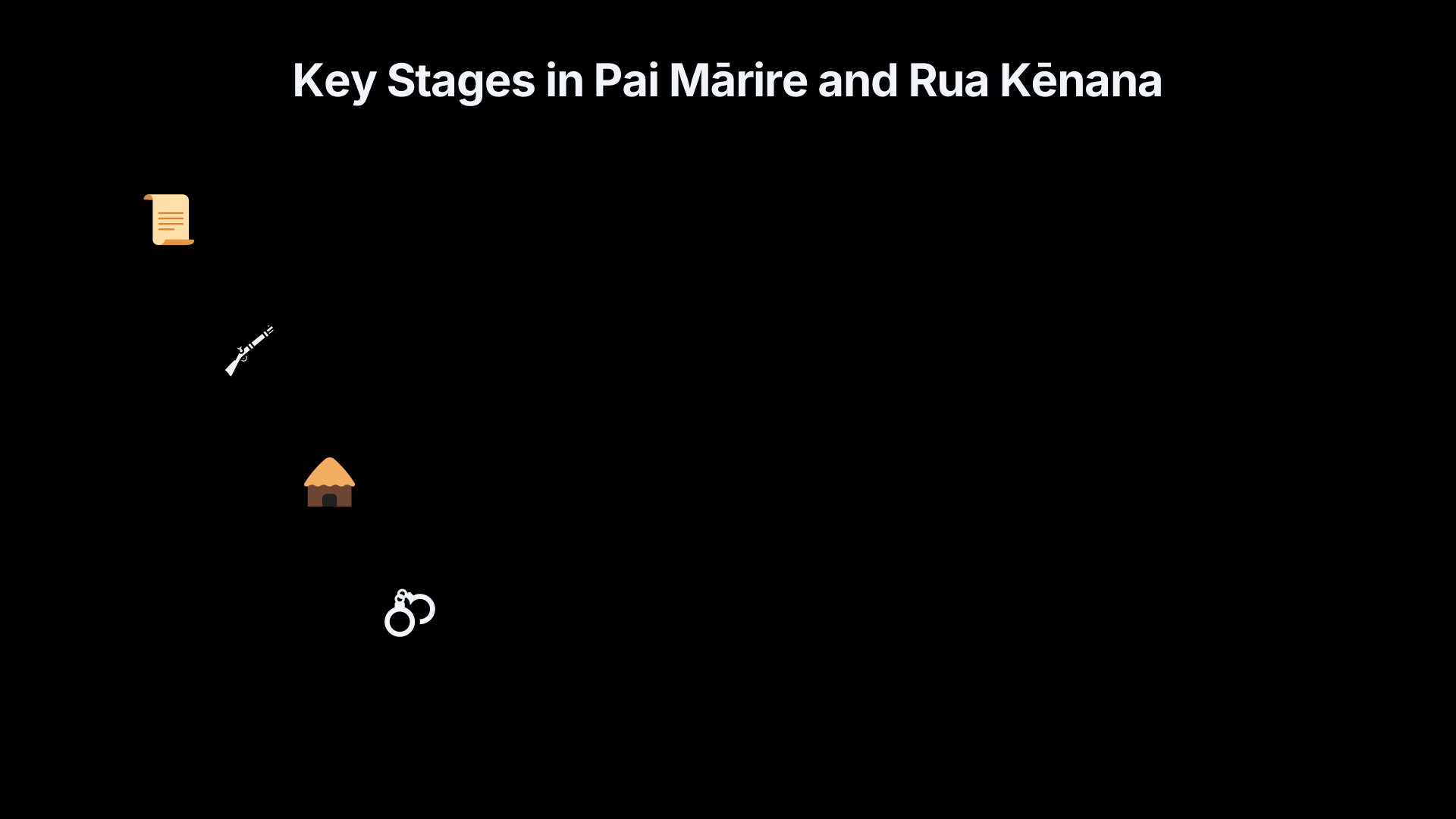
The clearest example was Pai Mārire, founded by Te Ua Haumēne in Taranaki in 1862. The movement emerged after years of warfare over disputed land purchases and confiscations. Te Ua described Pai Mārire as a religion of “goodness and peace”, combining Christian scripture with Māori prophecy and hopes for deliverance. It became the first organised expression of an independent Māori Christianity and later influenced other prophetic traditions.[NZHistory]nzhistory.govt.nzNZHistory Pai Mārire | NZ HistoryNZHistory Pai Mārire | NZ History
Yet the movement rapidly became associated with violence in settler opinion. Some Pai Mārire followers participated in military campaigns during the New Zealand Wars, including the ambush near Ōakura in April 1864 and later incidents such as the killing of missionary Carl Völkner in 1865. These events profoundly shaped colonial perceptions, allowing newspapers and politicians to portray the entire movement as irrational and barbaric.[NZHistory]nzhistory.govt.nzNZHistory Pai Mārire ambush in Taranaki | NZ HistoryPai Mārire ambush in Taranaki | NZ HistoryMay 24, 2024…
Modern scholarship presents a more complicated picture. Historians note that:
- Pai Mārire arose directly from the trauma of war and land confiscation.
- Te Ua originally preached peace, although some followers adopted increasingly militant interpretations.
- Many Māori rejected the movement, leading to conflicts between iwi as well as between Māori and colonial forces.
- Europeans increasingly used the label “Hauhau” as a catch-all term for Māori resistance, regardless of whether individuals actually belonged to Pai Mārire.
This broad use of “Hauhau” blurred important distinctions between religious belief, political opposition and armed resistance. It also helped create a colonial narrative in which Māori spirituality itself appeared inherently threatening.[NZHistory]nzhistory.govt.nzNZHistory Pai Mārire | NZ HistoryNZHistory Pai Mārire | NZ History
Rua Kēnana and Maungapōhatu
Half a century later, similar fears surrounded Rua Kēnana Hepetipa of Tūhoe.[teara.govt.nz]teara.govt.nzSource details in endnotes.
Rua founded a religious community at Maungapōhatu in the remote Urewera region after proclaiming himself a prophetic leader who would guide Māori towards spiritual renewal and political independence. His settlement combined religious practice with economic self-sufficiency, communal organisation and hopes for greater Māori autonomy. Although controversial, the community was not engaged in armed rebellion.
Colonial authorities nevertheless became increasingly suspicious. During the First World War, Rua’s refusal to support military recruitment and his independent authority reinforced official concerns that he represented a challenge to state control. In April 1916, an armed police expedition entered Maungapōhatu to arrest him. The confrontation ended in gunfire, the deaths of two Māori men and Rua’s arrest. He was later convicted on lesser charges after more serious allegations failed, and the raid became one of the most controversial police operations in New Zealand history.[Te Ara Encyclopedia of New Zealand]teara.govt.nzTe Ara Encyclopedia of New ZealandMāori prophetic movements – ngā poropiti | Te Ara Encyclopedia of New ZealandMay 5, 2011…
Historians increasingly interpret the raid as demonstrating how colonial governments could conflate religious independence with political sedition. Rather than seeing Maungapōhatu simply as an isolated religious settlement, officials viewed it through the lens of security, sovereignty and wartime loyalty.
Religion, sovereignty and colonial power
The fears surrounding Māori prophetic movements cannot be understood simply as reactions to unusual religious beliefs. They reflected deeper struggles over who possessed legitimate authority in New Zealand.
For many Māori followers, prophetic leaders offered:
- spiritual explanations for devastating social change;
- hope after military defeat and land confiscation;
- healing and communal solidarity;
- renewed confidence in Māori identity and leadership.
For many colonial officials, however, those same qualities threatened the state’s effort to establish exclusive political authority. Religious independence could strengthen resistance to government policies, especially where questions of land ownership, taxation or military service were involved.
This pattern was not unique to New Zealand. Across many colonial societies, indigenous prophetic movements were viewed with suspicion because spiritual authority often became a focus for political organisation. In New Zealand, however, the close connection between the New Zealand Wars, land confiscation and missionary Christianity gave these conflicts particular intensity.[Te Ara Encyclopedia of New Zealand]teara.govt.nzTe Ara Encyclopedia of New ZealandMāori prophetic movements – ngā poropiti | Te Ara Encyclopedia of New ZealandMay 5, 2011…
How historians have reinterpreted these movements
Older histories often accepted colonial descriptions of Māori prophets as fanatics, rebels or dangerous visionaries. More recent research has shifted attention towards the social conditions in which these movements emerged.
Several themes now dominate historical interpretation.
Colonial language shaped public fear. Words such as “Hauhau” frequently became political labels that obscured differences between peaceful believers, armed fighters and unrelated Māori communities.
Religion cannot be separated from dispossession. Prophetic movements developed amid warfare, confiscated land and rapid cultural disruption rather than in isolation from colonial events.
Violence did occur, but was not the whole story. Some followers participated in attacks and warfare, while other communities emphasised peace, healing and moral reform. Treating every prophetic movement as uniformly militant oversimplifies a far more varied history.
The state’s responses reflected wider colonial priorities. Military campaigns, surveillance and police action often targeted communities whose perceived threat rested as much on challenges to sovereignty as on specific criminal acts.[govt.nz]nzhistory.govt.nzNZHistory Pai Mārire | NZ HistoryNZHistory Pai Mārire | NZ History

Why these episodes remain important
The history of Māori prophetic movements illustrates how religious minorities can become the focus of collective fear when spiritual authority overlaps with political conflict. It also demonstrates the dangers of reducing complex indigenous movements to simplistic labels such as “cult” or “fanaticism”.
Today, Pai Mārire, Rua Kēnana and other Māori prophetic traditions are more commonly understood within the wider history of Māori resilience and adaptation under colonisation. Their stories remain central to debates about the New Zealand Wars, land confiscation, Crown–Māori relations and the ways governments have historically responded to religious movements that challenged established power. Rather than serving as straightforward examples of irrational belief, they reveal how religion, identity and sovereignty became inseparable during one of the most transformative periods in New Zealand’s history.[govt.nz]teara.govt.nzTe Ara Encyclopedia of New ZealandMāori prophetic movements – ngā poropiti | Te Ara Encyclopedia of New ZealandMay 5, 2011…
Amazon book picks
Further Reading
Books and field guides related to Why Were Maori Prophets Seen as Dangerous?. Use these as the next step if you want deeper reading beyond the article.

The Penguin History of New Zealand
Places prophetic movements within New Zealand history.

The Oxford illustrated history of New Zealand
Provides additional historical background on colonial New Zealand.
Ka whawhai tonu matou =
Provides essential context for Māori prophetic movements and colonial conflict.

Ask That Mountain
Explores religiously informed nonviolent resistance and colonial responses.
Endnotes
1.
Source: teara.govt.nz
Link:https://teara.govt.nz/en/maori-prophetic-movements-nga-poropiti
Source snippet
Te Ara Encyclopedia of New ZealandMāori prophetic movements – ngā poropiti | Te Ara Encyclopedia of New ZealandMay 5, 2011...
Published: May 5, 2011
2.
Source: nzhistory.govt.nz
Title: NZHistory Pai Mārire | NZ History
Link:https://nzhistory.govt.nz/page/pai-marire
3.
Source: nzhistory.govt.nz
Title: NZHistory Māori leadership | NZ History
Link:https://nzhistory.govt.nz/politics/maori-leadership
4.
Source: nzhistory.govt.nz
Title: NZHistory Pai Mārire ambush in Taranaki | NZ History
Link:https://nzhistory.govt.nz/pai-marire-ambush-at-oakura-taranaki
Source snippet
Pai Mārire ambush in Taranaki | NZ HistoryMay 24, 2024...
Published: May 24, 2024
5.
Source: nzhistory.govt.nz
Title: NZHistory Pai Marire | NZ History
Link:https://nzhistory.govt.nz/keyword/pai-marire
6.
Source: nzhistory.govt.nz
Title: NZHistory Pai Mārire defeated at Sentry Hill, Taranaki | NZ History
Link:https://nzhistory.govt.nz/pai-marire-defeated-at-sentry-hill-taranaki
Source snippet
1880s (Alexander Turnbull Library, PA1-q-183-31) In one of their first armed operations, several hundred Pai Mā...
7.
Source: nzhistory.govt.nz
Title: NZHistory Clashes of faith | NZ History
Link:https://nzhistory.govt.nz/page/clashes-faith
Source snippet
Clashes of faith | NZ HistorySeptember 3, 2025 — TE KOOTI'S WAR PAGE 2 – CLASHES OF FAITH Rāpata Wahawaha c1880 War came to eastern Bay o...
Published: September 3, 2025
8.
Source: teara.govt.nz
Link:https://teara.govt.nz/en/1966/maori-religious-movements
9.
Source: nzhistory.govt.nz
Title: Rua Kēnana | NZ History
Link:https://nzhistory.govt.nz/people/rua-kenana
Source snippet
When Te Kooti died in 1893 he claimed to be the successor named Hepetipa (Hephzibah) whom Te Kooti had prophesied would co...
10.
Source: nzhistory.govt.nz
Title: Te Ua Haumēne | NZ History
Link:https://nzhistory.govt.nz/war/pai-marire/te-ua-haumene
11.
Source: nzhistory.govt.nz
Title: Prophets and colonists | NZ History
Link:https://nzhistory.govt.nz/war/new-zealand-wars/prophets-and-colonists
12.
Source: nzhistory.govt.nz
Title: Arrest of Rua Kēnana | NZ History
Link:https://nzhistory.govt.nz/arrest-of-rua-kenana
13.
Source: nzhistory.govt.nz
Title: treaty events 1900 1949
Link:https://nzhistory.govt.nz/politics/treaty/treaty-timeline/treaty-events
14.
Source: beehive.govt.nz
Title: History made as Rua Kēnana vindicated | Beehive.govt.nz
Link:https://www.beehive.govt.nz/release/history-made-rua-k%C4%93nana-vindicated
15.
Source: beehive.govt.nz
Title: History rectified
Link:https://www.beehive.govt.nz/release/history-rectified-rua-k%C4%93nana-be-pardoned
16.
Source: nzhistory.govt.nz
Title: Rua Kēnana, resisting police | NZ History
Link:https://nzhistory.govt.nz/media/photo/rua-kenana-resisting-police
17.
Source: beehive.govt.nz
Title: Historic pardon to be agreed at Maungapōhatu | Beehive.govt.nz
Link:https://www.beehive.govt.nz/release/historic-pardon-be-agreed-maungap%C5%8Dhatu
18.
Source: teara.govt.nz
Title: page 8
Link:https://teara.govt.nz/en/new-zealand-wars/page-8
19.
Source: teara.govt.nz
Title: Te Ua Haumēne – Pai Mārire and Hauhau | Te Ara Encyclopedia of New Zealand
Link:https://teara.govt.nz/en/maori-prophetic-movements-nga-poropiti/page-2
20.
Source: waitangitribunal.govt.nz
Title: Wai 894: Te Urewera, Pre-publication Part IV Released | Waitangi Tribunal
Link:https://waitangitribunal.govt.nz/en/news/wai-894-te-urewera-pre-publication-part-iv-released
21.
Source: teara.govt.nz
Title: Pai Mārire | New Zealand Wars | Te Ara Encyclopedia of New Zealand
Link:https://teara.govt.nz/en/video/36928/pai-marire
22.
Source: teara.govt.nz
Title: rua kenana maungapohatu 1908
Link:https://teara.govt.nz/en/zoomify/27736/rua-kenana-maungapohatu-1908
23.
Source: nzhistory.govt.nz
Title: te ua haumene
Link:https://nzhistory.govt.nz/keyword/te-ua-haumene
24.
Source: nzhistory.govt.nz
Title: rua kenana 039 s arrest
Link:https://nzhistory.govt.nz/page/rua-kenana-039-s-arrest
25.
Source: teara.govt.nz
Link:https://teara.govt.nz/en/new-zealand-wars/print
26.
Source: teara.govt.nz
Link:https://teara.govt.nz/en/search/teara?keys=Pai+Marire
27.
Source: teara.govt.nz
Link:https://teara.govt.nz/en/biographies/3r32/rua-kenana-hepetipa
28.
Source: natlib.govt.nz
Link:https://natlib.govt.nz/records/38618680
29.
Source: natlib.govt.nz
Link:https://natlib.govt.nz/records/22801568
Additional References
30.
Source: bibbase.org
Link:https://bibbase.org/network/publication/rangiwai-maoripropheticmovementsassitesofpoliticalresistanceacriticalanalysis-2017
31.
Source: ojs.aut.ac.nz
Link:https://ojs.aut.ac.nz/te-kaharoa/index.php/tekaharoa/article/view/160
32.
Source: researchgate.net
Link:https://www.researchgate.net/publication/321037244_Maori_Prophetic_Movements_as_Sites_of_Political_Resistance_A_Critical_Analysis
33.
Source: youtube.com
Title: Whare Māori Ep05: Ringatu
Link:https://www.youtube.com/watch?v=zG7WUsGgWSw
Source snippet
Ngā toenga o ngā tamariki a iharaira ngā uri whakaheke o Maungapōhatu...
34.
Source: youtube.com
Title: NZ Wars: Stories of Waitara
Link:https://www.youtube.com/watch?v=fW20zpWlCC8
Source snippet
The invasion of Parihaka and why it needs to be remembered...
35.
Source: youtube.com
Title: The invasion of Parihaka and why it needs to be remembered
Link:https://www.youtube.com/watch?v=u-FsfNCaNYM
Source snippet
Whare Māori Ep05: Ringatu...
36.
Source: youtube.com
Title: Ngā toenga o ngā tamariki a iharaira ngā uri whakaheke o Maungapōhatu
Link:https://www.youtube.com/watch?v=PKlE_LL4scs
37.
Source: youtube.com
Title: The Prophets, Series 1 Episode 1
Link:https://www.youtube.com/watch?v=16q50MRCnNM
Source snippet
NZ Wars: Stories of Waitara...
38.
Source: parliament.nz
Link:https://www.parliament.nz/en/pb/hansard-debates/rhr/combined/HansD_20190912_20190912
Topic Tree