Within Belarus
Was There Ever a Belarusian Witch Craze?
Scattered trials show how illness, bad luck and damaged reputations could turn neighbourhood suspicion into legal persecution.
On this page
- Where the surviving trials took place
- How rumours became accusations
- Why persecution remained limited
Page outline Jump by section
Introduction
Was there ever a Belarusian witch craze comparable to the famous persecutions in Germany, Scotland or Salem? The surviving evidence suggests the answer is no. Early modern lands that now form Belarus experienced witchcraft accusations and occasional trials, but these were scattered local episodes rather than a single, expanding wave of panic. Most accusations arose from ordinary village conflicts: unexplained illness, dying livestock, failed harvests, damaged reputations or quarrels between neighbours. While some cases ended in severe punishment, the overall scale remained relatively limited compared with many parts of Western and Central Europe.[Springer]link.springer.comWitch Trials in the Grand Duchy of Lithuania in the Sixteenth to Eighteenth Centuries: Enchanted Borderlands | Springer Nature Li…
This makes the Belarusian experience historically important for a different reason. Instead of demonstrating how an entire society succumbed to mass hysteria, it shows how everyday fear could become legal persecution within individual communities. The surviving records reveal the social mechanics of suspicion, the importance of local courts and reputation, and the limits that prevented many accusations from growing into region-wide witch hunts.
Where the surviving trials took place
Modern Belarus did not exist as a political state during the principal era of European witch trials. Most documented cases occurred within the Grand Duchy of Lithuania, whose territory included much of present-day Belarus alongside lands in modern Lithuania and neighbouring countries. This mixed political and cultural setting means historians usually study these prosecutions as part of the wider history of the Grand Duchy rather than as exclusively Belarusian events.[Springer]link.springer.comWitch Trials in the Grand Duchy of Lithuania in the Sixteenth to Eighteenth Centuries: Enchanted Borderlands | Springer Nature Li…
The surviving records are uneven because many local court archives have disappeared. Even so, historians estimate that roughly several hundred witchcraft prosecutions are known across the entire Grand Duchy between the sixteenth and eighteenth centuries. Only a minority resulted in execution, while acquittals and abandoned proceedings also occurred. These figures contrast sharply with regions of Europe that experienced sustained waves of thousands of accusations.[ResearchGate]researchgate.netOpen source on researchgate.net.
The cases were dispersed rather than concentrated. Instead of one notorious centre producing dozens of interconnected prosecutions, accusations appeared sporadically in rural communities and small towns. This fragmented pattern is one reason historians reject the idea of a distinct “Belarusian witch craze”.[Springer]link.springer.comWitch Trials in the Grand Duchy of Lithuania in the Sixteenth to Eighteenth Centuries: Enchanted Borderlands | Springer Nature Li…
How rumours became accusations
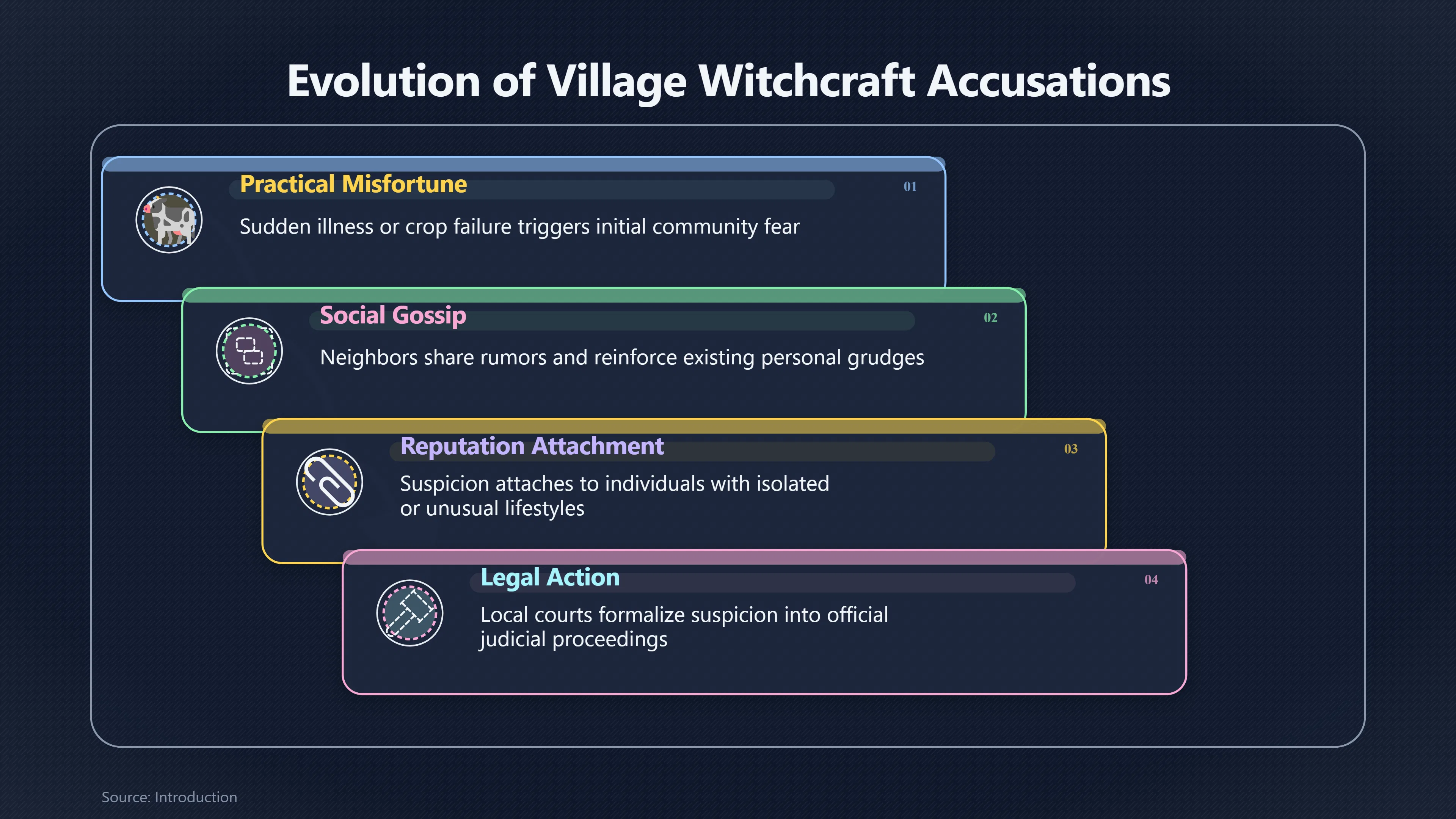
Most accusations began with practical misfortune rather than elaborate theories about organised devil worship.
Common triggers included:
- sudden illness affecting people or livestock;
- repeated crop failures or spoiled food;
- unexplained deaths within a household;
- disputes over land, inheritance or property;
- arguments between neighbours that damaged personal reputations.
Once suspicion attached itself to a particular individual, later events were often interpreted through that existing reputation. A neighbour already regarded as quarrelsome, isolated, unusually knowledgeable about healing, or associated with earlier rumours could become the obvious explanation for new disasters. The accusation therefore grew through social memory rather than physical evidence.[Springer]link.springer.comWitch Trials in the Grand Duchy of Lithuania in the Sixteenth to Eighteenth Centuries: Enchanted Borderlands | Springer Nature Li…
The process rarely required an organised conspiracy. Instead, fear spread through conversation within relatively small communities where everyone knew one another. Local gossip, family rivalries and longstanding grudges could reinforce one another until formal legal action appeared justified.
Why village fear did not become a nationwide panic
Several features of the Grand Duchy’s legal and political system helped prevent accusations from expanding into continent-scale persecutions.
First, witchcraft cases were handled by different kinds of secular courts rather than a single central institution. Procedures varied according to jurisdiction, and opportunities for appeal existed in some courts. Cases involving members of the nobility were often examined more carefully than those heard in village or patrimonial courts.[ResearchGate]researchgate.netOpen source on researchgate.net.
Second, the legal code itself contained no detailed programme for systematic witch-hunting. Harm allegedly caused through magic tended to be treated alongside other criminal offences rather than through a comprehensive body of anti-witchcraft legislation.[Orbis Lituaniae]ldkistorija.ltOrbis Lituaniae -Sorcery and Witchcraft in the Grand Duchy of LithuaniaOrbis Lituaniae…
Third, historians argue that the religious diversity of the Grand Duchy created a distinctive environment. Catholic, Orthodox, Protestant and other traditions coexisted across the region, producing a complex mixture of learned demonology and local folk beliefs. Imported Western European ideas about diabolical witchcraft certainly influenced some prosecutions, but they blended with older local understandings instead of generating a uniform campaign against supposed witches.[Springer]link.springer.comWitch Trials in the Grand Duchy of Lithuania in the Sixteenth to Eighteenth Centuries: Enchanted Borderlands | Springer Nature Li…
Village reputation mattered more than organised conspiracy
One of the clearest findings from modern scholarship is that accusations usually reflected neighbourhood relationships rather than fears of secret satanic organisations.
The surviving court records show recurring patterns:
- alleged witches were often people already viewed with suspicion;
- accusations frequently followed personal disputes;
- witnesses relied heavily on reputation and reported behaviour;
- magical harm was commonly linked to everyday events rather than spectacular supernatural claims.
This differs from some famous Western European witch panics, where authorities increasingly imagined continent-wide conspiracies involving pacts with the Devil and organised nocturnal gatherings. Such narratives appeared in parts of the Grand Duchy but generally remained less dominant than local concerns over harmful magic affecting neighbours and households.[Springer]link.springer.comWitch Trials in the Grand Duchy of Lithuania in the Sixteenth to Eighteenth Centuries: Enchanted Borderlands | Springer Nature Li…

What historians now conclude
Modern historians increasingly describe the lands of the Grand Duchy as an “enchanted borderland” where legal traditions, religious diversity and village beliefs interacted in distinctive ways. Rather than viewing Belarusian territories simply as an eastern extension of Western Europe’s great witch hunts, scholars emphasise local variation and caution against imposing modern national boundaries on early modern events.[Springer]link.springer.comWitch Trials in the Grand Duchy of Lithuania in the Sixteenth to Eighteenth Centuries: Enchanted Borderlands | Springer Nature Li…
The evidence also warns against exaggeration. Surviving records are incomplete, and new archival discoveries continue to refine estimates. Nevertheless, current research consistently supports several conclusions:
- witchcraft prosecutions certainly occurred in territories now belonging to Belarus;
- accusations were rooted mainly in local social tensions and everyday misfortune;
- persecution remained comparatively scattered rather than becoming a nationwide moral panic;
- legal practice varied considerably between different courts and jurisdictions;
- the Belarusian experience is best understood as part of the broader history of the Grand Duchy of Lithuania rather than as a separate national witch-hunt tradition.[springer.com]link.springer.comWitch Trials in the Grand Duchy of Lithuania in the Sixteenth to Eighteenth Centuries: Enchanted Borderlands | Springer Nature Li…
For readers interested in the history of collective fear, these cases illustrate how ordinary anxieties could become deadly without ever developing into the vast regional witch crazes seen elsewhere in Europe. They reveal communities trying to explain misfortune with the intellectual tools available to them, while legal institutions sometimes amplified suspicion and, at other times, placed practical limits upon it.
Amazon book picks
Further Reading
Books and field guides related to Was There Ever a Belarusian Witch Craze?. Use these as the next step if you want deeper reading beyond the article.
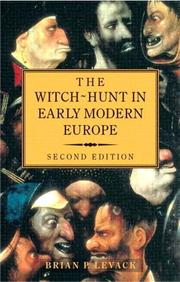
The witch-hunt in early modern Europe
Explains the mechanics of European witch trials.



Bloodlands
First published 2010. Subjects: Massacres, Genocide, World War, 1939-1945, Holocaust, Jewish (1939-1945), Atrocities.
Endnotes
1.
Source: link.springer.com
Link:https://link.springer.com/book/10.1007/978-3-032-00671-4
Source snippet
Witch Trials in the Grand Duchy of Lithuania in the Sixteenth to Eighteenth Centuries: Enchanted Borderlands | Springer Nature Li...
2.
Source: researchgate.net
Link:https://www.researchgate.net/publication/339503878_Witchcraft_Court_Cases_in_the_Grand_Duchy_of_Lithuania_in_the_Sixteenth_to_Eighteenth_Centuries
3.
Source: researchgate.net
Title: Research Gate Mosaic of (In)justice: Witch Trials in Particular Courts
Link:https://www.researchgate.net/publication/399337275_Mosaic_of_Injustice_Witch_Trials_in_Particular_Courts
4.
Source: link.springer.com
Link:https://link.springer.com/book/9783032006707
Source snippet
Trials in the Grand Duchy of Lithuania in the Sixteenth to Eighteenth Centuries: Enchanted Borderlands | Springer Nature LinkJanuary 1, 2...
5.
Source: researchgate.net
Link:https://www.researchgate.net/publication/275442215_A_1646_Case_of_Ordeal_by_Water_of_Individuals_Accused_of_Witchcraft_in_the_Grand_Duchy_of_Lithuania
6.
Source: ldkistorija.lt
Title: Orbis Lituaniae -Sorcery and Witchcraft in the Grand Duchy of Lithuania
Link:https://www.ldkistorija.lt/sorcery-and-witchcraft-in-the-grand-duchy-of-lithuania/
Source snippet
Orbis Lituaniae...
Additional References
7.
Source: drfrancisyoung.com
Link:https://drfrancisyoung.com/2026/07/03/review-witch-trials-in-the-grand-duchy-of-lithuania-in-the-sixteenth-to-eighteenth-centuries-by-vital-byl/
Source snippet
July 3, 2026 — REVIEW: ‘WITCH TRIALS IN THE GRAND DUCHY OF LITHUANIA IN THE SIXTEENTH TO EIGHTEENTH CENTURIES’ BY VITAL BYL Vital Byl, Wi...
Published: July 3, 2026
8.
Source: library.hrmtc.com
Link:https://library.hrmtc.com/2026/04/04/witch-trials-in-the-grand-duchy-of-lithuania-in-the-sixteenth-to-eighteenth-centuries/
Source snippet
Trials in the Grand Duchy of Lithuania in the Sixteenth to Eighteenth Centuries - The Hermetic Library BlogApril 4, 2026 — WITCH TRIALS I...
Published: April 4, 2026
9.
Source: lituanistika.lt
Title: Юрыдычны бок ведаўскіх працэсаў у Вялікім Княстве Літоўскім у XVI-XVIII стст
Link:https://www.lituanistika.lt/content/73636
Source snippet
Lituanistika | Юрыдычны бок ведаўскіх працэсаў у Вялікім Княстве Літоўскім у XVI-XVIII стст...
10.
Source: youtube.com
Title: The Witch-Hunt in Early Modern Europe: A Discussion with Brian Levack
Link:https://www.youtube.com/watch?v=eSvFMkcO2d4
Source snippet
"Witch-Hunting in European and World History - Ronald Hutton[https://www.youtube.com/watch?v=snAicO9WHGY..."](https://www.youtube.com/watch?v=snAicO9WHGY...")...
11.
Source: youtube.com
Title: Ukrainian Witchcraft Trials in the 17-18th Centuries
Link:https://www.youtube.com/watch?v=Lo-C26Qmck8
Source snippet
"Witchcraft Trials in Poland. What Did People Really Die For?[https://www.youtube.com/watch?v=ijfblWKGlSc..."](https://www.youtube.com/watch?v=ijfblWKGlSc...")...
12.
Source: youtube.com
Title: The Secret History of Witches | Witch Trials and Fear in History
Link:https://www.youtube.com/watch?v=HvNHzeM3EjU
Source snippet
The Witch-Hunt in Early Modern Europe: A Discussion with Brian Levack...
13.
Source: lituanistika.lt
Link:https://www.lituanistika.lt/content/102625
14.
Source: cambridge.org
Link:https://www.cambridge.org/core/services/aop-cambridge-core/content/view/7F56CE53D8984FE5DBD7CCA0593D4540/S0037677900004885a.pdf/the-witches-of-wilno-constant-litigation-and-conflict-resolution.pdf
15.
Source: barnesandnoble.com
Link:https://www.barnesandnoble.com/w/witch-trials-in-the-grand-duchy-of-lithuania-in-the-sixteenth-to-eighteenth-centuries-vital-byl/1147750740
16.
Source: lituanistika.lt
Link:https://www.lituanistika.lt/content/67632
Topic Tree