Within Portugal Belief Panics
Why Portugal Waited for a Lost King
The disappearance of King Sebastian became a lasting promise that a hidden ruler would return and reverse Portugal's decline.
On this page
- The king who vanished in Morocco
- Pretenders, prophecies and political resistance
- How Sebastianism became national folklore
Page outline Jump by section
Introduction
Sebastianism is one of Portugal’s most enduring traditions of collective hope. It centres on the belief that King Sebastian I, who disappeared during a disastrous military campaign in Morocco in 1578, did not truly die and would one day return to rescue Portugal in its darkest hour. What began as uncertainty over the fate of a young king developed into a powerful messianic belief that blended politics, religion, prophecy and folklore. Rather than functioning as a tightly organised movement or “cult”, Sebastianism became a flexible national myth that people adapted to different crises over several centuries. It helped many Portuguese make sense of military defeat, foreign rule and national decline while offering the promise that history itself could be reversed.[Brill]brill.comChapter 5 Sebastianism: A Portuguese Prophecy in: Early Modern Prophecies in Transnational, National and Regional Contexts (3 vols.)…
The king who vanished in Morocco
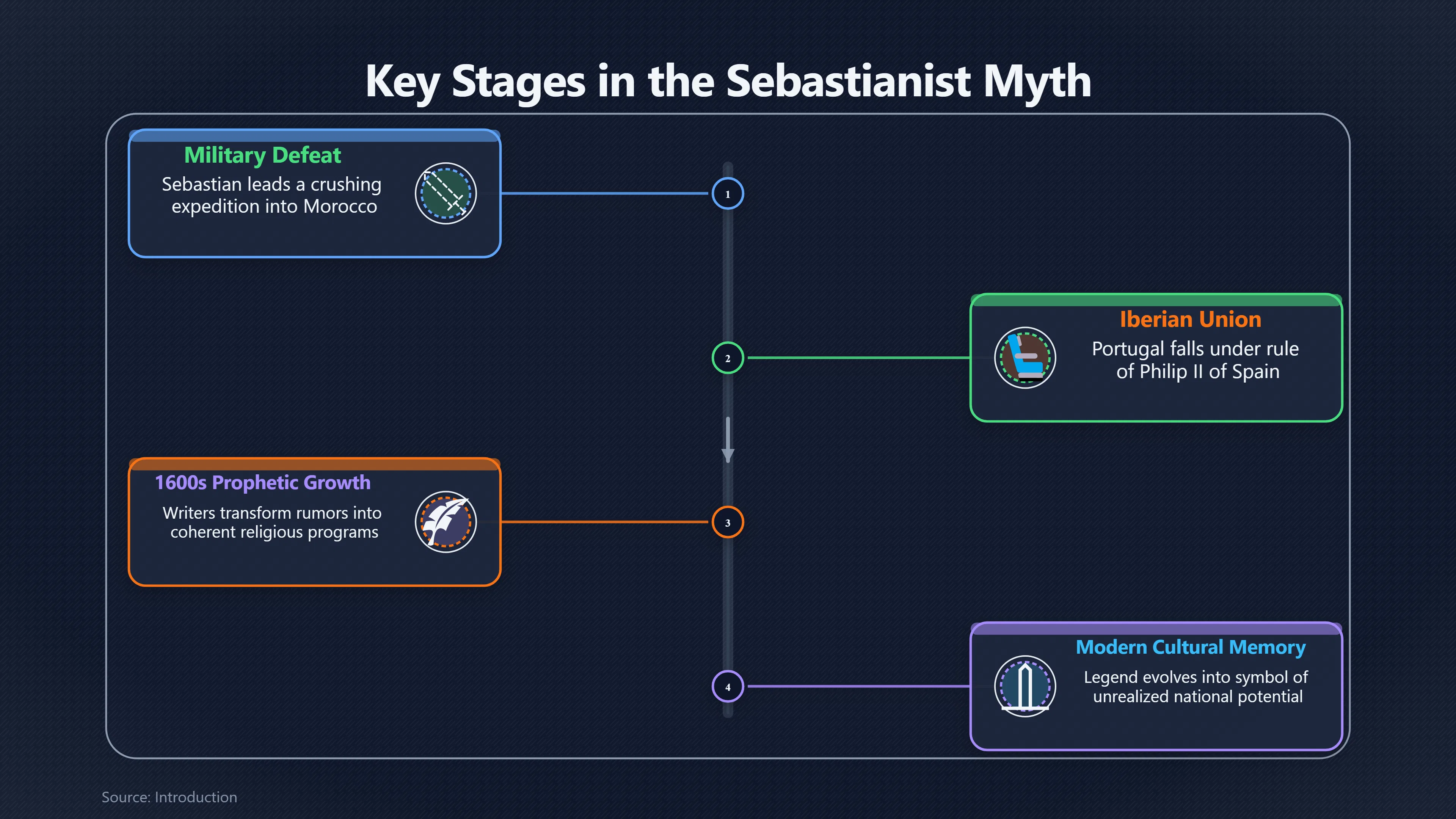
King Sebastian was only twenty-four when he led a crusading expedition into Morocco. On 4 August 1578, his army suffered a crushing defeat at the Battle of Alccer Quibir. Sebastian disappeared during the fighting and, although a body believed to be his was eventually recovered and reburied in Portugal, uncertainty over its identity persisted from the beginning. The absence of an immediately identifiable corpse proved crucial. In an age when rumours travelled faster than reliable information, many people preferred to believe that their king had survived.[Wikipedia]WikipediaBattle of Alccer QuibirBattle of Alccer Quibir
The political consequences magnified the emotional shock. Sebastian died without an heir. After a brief succession crisis, Portugal fell under the rule of Philip II of Spain in 1580, beginning the Iberian Union. For many Portuguese, military catastrophe and the loss of political independence seemed inseparable. The hope that Sebastian would return therefore became more than a personal story about one missing monarch: it became a promise that Portugal itself would be restored.[Brill]brill.comChapter 5 Sebastianism: A Portuguese Prophecy in: Early Modern Prophecies in Transnational, National and Regional Contexts (3 vols.)…
This combination of uncertain death, national humiliation and political upheaval created unusually fertile ground for collective belief. Historians generally see Sebastianism not as a spontaneous fantasy but as a response to profound social and political trauma.[Brill]brill.comChapter 5 Sebastianism: A Portuguese Prophecy in: Early Modern Prophecies in Transnational, National and Regional Contexts (3 vols.)…
Pretenders, prophecies and political resistance
Uncertainty encouraged action. Between the 1580s and the early seventeenth century, several men claimed to be the missing king. These pretenders attracted varying numbers of supporters before being exposed, imprisoned or executed. Their appearance demonstrated that belief in Sebastian’s survival was widespread enough for impostors to find genuine followers.[Encyclopedia.com]encyclopedia.comSebastianismo | Encyclopedia.comSebastianismo | Encyclopedia.com
The movement gained greater intellectual structure through writers rather than pretenders alone. Dom Joo de Castro transformed scattered rumours into a coherent prophetic programme by combining biblical interpretation with older Portuguese prophecies, particularly the verses attributed to the sixteenth-century shoemaker and visionary Gonalo Annes Bandarra. Instead of merely arguing that Sebastian had survived, Castro claimed that his return formed part of a divine plan for Portugal and for Christian history.[Brill]brill.comChapter 5 Sebastianism: A Portuguese Prophecy in: Early Modern Prophecies in Transnational, National and Regional Contexts (3 vols.)…
Several elements helped Sebastianism spread:
- Political frustration. Spanish rule encouraged hopes that a miraculous restoration would replace foreign domination.
- Religious expectation. Biblical prophecy offered believers a framework for interpreting current events as part of sacred history.
- Existing folklore. European traditions of the “hidden” or sleeping king, destined to return in a nation’s greatest need, gave Sebastian’s story familiar cultural patterns.
- Ambiguous evidence. Because definitive proof of Sebastian’s death never convinced everyone, rumours remained plausible for many ordinary people.[brill.com]brill.comChapter 5 Sebastianism: A Portuguese Prophecy in: Early Modern Prophecies in Transnational, National and Regional Contexts (3 vols.)…
Importantly, Sebastianism was not uniform. Some believers expected Sebastian’s literal physical return. Others interpreted him more symbolically as the ruler destined to restore Portuguese greatness. These differing interpretations allowed the tradition to survive even as historical circumstances changed.[Brill]brill.comChapter 5 Sebastianism: A Portuguese Prophecy in: Early Modern Prophecies in Transnational, National and Regional Contexts (3 vols.)…
Why the belief proved so resilient
Modern historians explain Sebastianism through several reinforcing mechanisms rather than a single cause.
First, it answered an emotional problem. Portugal’s sudden reversalfrom a leading maritime empire to a kingdom under foreign ruleseemed difficult to explain through ordinary politics alone. A returning king offered a narrative in which defeat was temporary rather than permanent.[Brill]brill.comChapter 5 Sebastianism: A Portuguese Prophecy in: Early Modern Prophecies in Transnational, National and Regional Contexts (3 vols.)…
Second, the belief remained deliberately open-ended. No date for Sebastian’s return could be conclusively disproved because each failed expectation could simply be postponed to another future crisis. This flexibility made the tradition unusually durable compared with movements tied to specific failed prophecies.[Brill]brill.comChapter 5 Sebastianism: A Portuguese Prophecy in: Early Modern Prophecies in Transnational, National and Regional Contexts (3 vols.)…
Third, Sebastianism served different political purposes over time. During the Iberian Union it symbolised resistance to Spanish rule. Later writers reshaped it into a broader vision of Portugal’s spiritual destiny rather than an immediate political programme. Because the core story could be reinterpreted, it survived long after the original historical circumstances had disappeared.[Brill]brill.comChapter 5 Sebastianism: A Portuguese Prophecy in: Early Modern Prophecies in Transnational, National and Regional Contexts (3 vols.)…
How Sebastianism became national folklore
Although the expectation that Sebastian would literally return gradually faded, the story became embedded in Portuguese cultural identity. Folk traditions imagined the king waiting in concealment until Portugal required him again, often associating his return with mist, hidden places or moments of national danger. The phrase that the king would come back “on a foggy morning” became one of Portugal’s best-known legendary motifs.[Encyclopedia.com]encyclopedia.comSebastianismo | Encyclopedia.comSebastianismo | Encyclopedia.com
Writers repeatedly reinterpreted the legend. In the seventeenth century, Father Antnio Vieira connected Sebastianist expectations to broader visions of Portugal’s future mission, including the idea of a “Fifth Empire” grounded in biblical prophecy. Centuries later, modern authors such as Fernando Pessoa treated Sebastian less as a literal missing monarch than as a symbol of unrealised national potential. The legend therefore moved from political expectation into literature, philosophy and cultural memory.[Wikipedia]WikipediaOpen source on wikipedia.org.
The tradition also crossed the Atlantic. Portuguese settlers carried Sebastianist ideas to Brazil, where they influenced several later messianic movements that adapted the returning-king motif to local conditions. These developments belong to the separate history of Brazilian millenarian movements but demonstrate how portable the core legend became.[Encyclopedia.com]encyclopedia.comSebastianismo | Encyclopedia.comSebastianismo | Encyclopedia.com
Was Sebastianism a form of mass hysteria?
Most historians would answer no. Sebastianism lasted for centuries, evolved across different social groups and took many forms. It was neither a brief episode of collective psychological contagion nor a single organised religious sect.
Instead, it is better understood as a messianic tradition that combined genuine political disappointment, religious symbolism and popular folklore. Individual episodessuch as enthusiasm for particular pretenderssometimes displayed features of rumour or collective excitement, but the wider phenomenon functioned as a long-lived cultural myth rather than a temporary panic.[Brill]brill.comChapter 5 Sebastianism: A Portuguese Prophecy in: Early Modern Prophecies in Transnational, National and Regional Contexts (3 vols.)…
Distinguishing these categories matters. Unlike a moral panic, Sebastianism did not revolve around identifying dangerous enemies. Unlike mass psychogenic illness, it did not spread through unexplained physical symptoms. And unlike many groups labelled as “cults”, it lacked a stable organisation or central leadership. Its influence lay instead in providing a shared story through which generations of Portuguese interpreted national misfortune and hoped for renewal.[Brill]brill.comChapter 5 Sebastianism: A Portuguese Prophecy in: Early Modern Prophecies in Transnational, National and Regional Contexts (3 vols.)…
Why the legend still matters
Today Sebastianism survives primarily as a cultural reference rather than a widespread literal belief. Yet it remains one of Europe’s most remarkable examples of how an unresolved historical event can develop into a lasting national mythology.
The disappearance of a king became a mechanism for expressing hopes that political decline could be reversed, independence restored and national purpose renewed. For historians of collective belief, Sebastianism illustrates how uncertainty, trauma and prophecy can reinforce one another without producing a conventional “cult” or a short-lived episode of mass hysteria. Its longevity demonstrates that powerful myths often endure not because they can be proved, but because they continue to offer meaning whenever societies face periods of crisis or uncertainty.[brill.com]brill.comChapter 5 Sebastianism: A Portuguese Prophecy in: Early Modern Prophecies in Transnational, National and Regional Contexts (3 vols.)…
Amazon book picks
Further Reading
Books and field guides related to Why Portugal Waited for a Lost King. Use these as the next step if you want deeper reading beyond the article.


The Portuguese: A Modern History
Discusses Portuguese identity shaped by historical myths.


Conquerors: How Portugal Forged the First Global Empire
Provides background on Portugal before Sebastian's disappearance.
Endnotes
1.
Source: brill.com
Link:https://brill.com/display/book/9789004443631/BP000007.pdf
Source snippet
Chapter 5 Sebastianism: A Portuguese Prophecy in: Early Modern Prophecies in Transnational, National and Regional Contexts (3 vols.)...
2.
Source: encyclopedia.com
Title: Sebastianismo | Encyclopedia.com
Link:https://www.encyclopedia.com/humanities/encyclopedias-almanacs-transcripts-and-maps/sebastianismo
3.
Source: Wikipedia
Title: Battle of Alccer Quibir
Link:https://en.wikipedia.org/wiki/Battle_of_Alc%C3%A1cer_Quibir
4.
Source: historiografia.com.br
Link:https://www.historiografia.com.br/tese/2636
Source snippet
Catlogo Histrico de Teses e Dissertaes de Histria (1942-2000)...
5.
Source: Wikipedia
Link:https://en.wikipedia.org/wiki/Sebastianism
6.
Source: portugal.com
Title: Six Popular Myths about Portugal: Fact or Fiction?
Link:https://www.portugal.com/history-and-culture/six-popular-myths-about-portugal-fact-or-fiction/
Source snippet
January 9, 2026 MYTH #5: KING DOM SEBASTIO, WHO DISAPPEARED IN BATTLE IN 1578, WILL RETURN TO SAVE PORTUGAL IN ITS DARKEST HOUR. LEGEN...
Published: January 9, 2026
7.
Source: youtube.com
Title: The Fifth Empire: When Portugal Tried to Rule the World
Link:https://www.youtube.com/watch?v=D81g33lrGK4
Source snippet
SEBASTIANISM...
8.
Source: youtube.com
Link:https://www.youtube.com/watch?v=onJLbr9YjRY
Source snippet
The King Who Never Died - Dom Sebastio...
Additional References
9.
Source: dekalist.com
Link:https://dekalist.com/our-world/people-and-personalities/king-sebastian-survived-alcacer-quibir/
Source snippet
10 Pieces of Evidence King Sebastian Survived the Battle of Alccer Quibir | DEKALISTMay 7, 2026 Image: A wide-angle, hyper-realistic b...
Published: May 7, 2026
10.
Source: kclpure.kcl.ac.uk
Title: kcl.ac.uk The Reverse of the Conquest
Link:https://kclpure.kcl.ac.uk/portal/en/publications/lenvers-de-la-conqu%C3%AAte-lanti-%C3%A9pique-dans-la-culture-portugaise-au/
Source snippet
The Anti-Epic in 16th and 17th Centuries Portuguese Culture - King's College LondonApril 1, 2026 LENVERS DE LA CONQUTE. LANTI-PIQUE...
Published: April 1, 2026
11.
Source: youtube.com
Link:https://www.youtube.com/watch?v=stnTkOfMQz0
Source snippet
The Fifth Empire: When Portugal Tried to Rule the World...
12.
Source: researchgate.net
Link:https://www.researchgate.net/publication/383579407_Testemunho_de_um_homem_africano_Reflexoes_sobre_um_relato_anonimo_da_batalha_de_Alcacer_Quibir
13.
Source: en-academic.com
Link:https://en-academic.com/dic.nsf/enwiki/344492
14.
Source: asphs.net
Link:https://asphs.net/article/the-tragedy-of-alcazarquivir-the-collapse-of-kingship-empire-and-narrative/
15.
Source: pressto.amu.edu.pl
Link:https://pressto.amu.edu.pl/index.php/srp/article/view/582
16.
Source: ualresearchonline.arts.ac.uk
Link:https://ualresearchonline.arts.ac.uk/id/eprint/18371/
17.
Source: periodicos.ufmg.br
Link:https://periodicos.ufmg.br/index.php/cesp/article/view/30754
18.
Source: revistas.usp.br
Link:https://revistas.usp.br/revhistoria/pt_BR/article/view/217811
Topic Tree