Within Kazakhstan Panics
How Did 'Destructive Sects' Become Public Enemies?
The label 'destructive sect' turned unfamiliar faiths into public threats, often blurring evidence of abuse with prejudice against minorities.
On this page
- Religious diversity after independence
- How media and officials framed the threat
- Where protection ended and moral panic began
Page outline Jump by section
Introduction
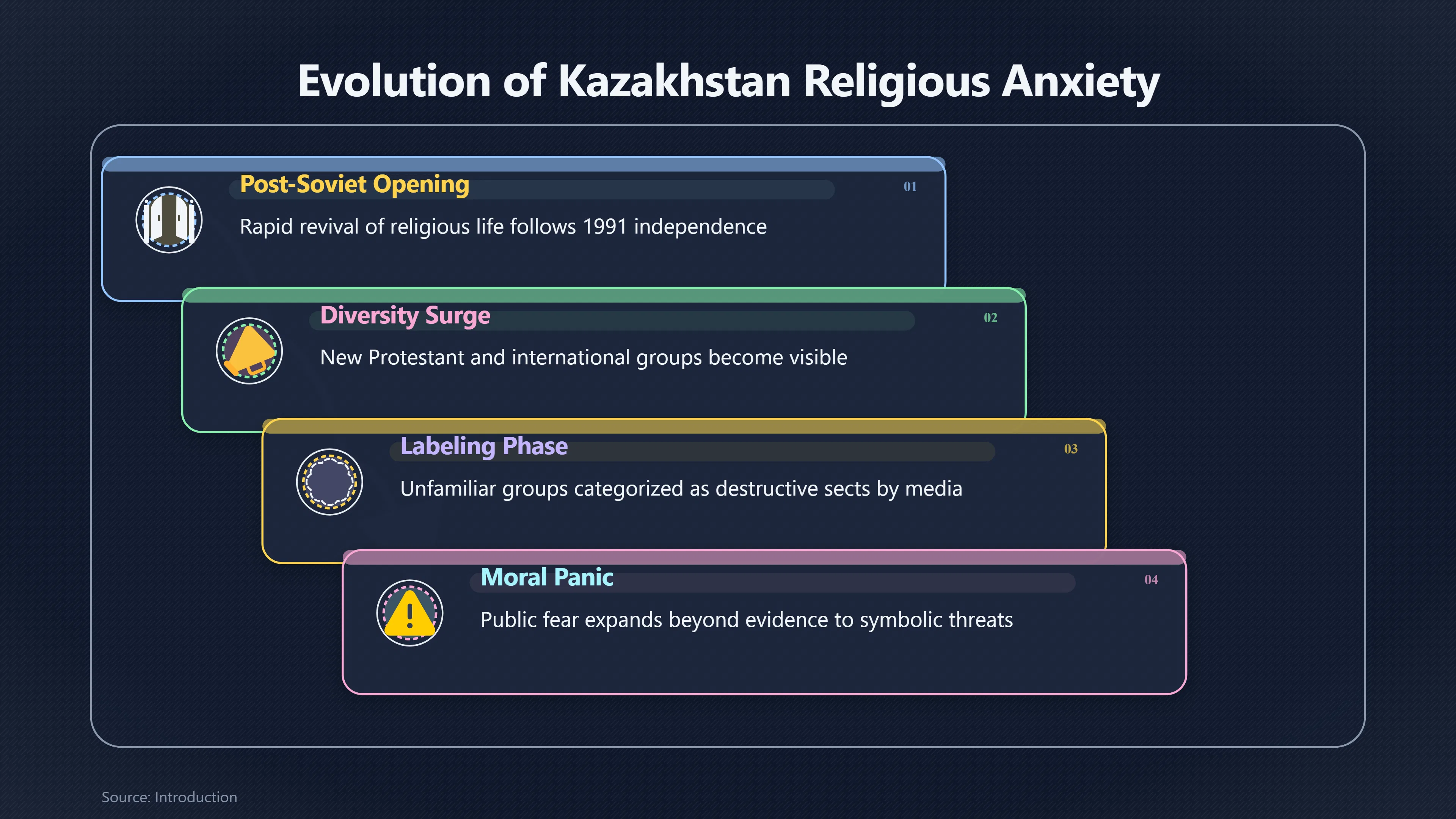
After Kazakhstan became independent in 1991, the country experienced a rapid revival of religious life. Mosques reopened, Christian missionaries arrived, new Protestant churches expanded, and a wide variety of international and local religious movements became visible for the first time in decades. Alongside this diversity came a powerful public narrative that many unfamiliar groups were not simply different religions but “destructive sects” that threatened families, national culture and public security. Although Kazakhstan has faced genuine problems with violent extremism, critics argue that official rhetoric and media coverage often blurred the distinction between peaceful religious minorities, unconventional beliefs and organisations involved in criminal or extremist activity. This created a climate in which suspicion could spread more quickly than evidence and in which the label “destructive sect” became a broad social warning rather than a precise description.[forum18.org]forum18.orgForum 18: KAZAKHSTAN: Religious freedom survey, September 2009 - 23 September 2009September 23, 2009…
Understanding this “sect scare” is important because it illustrates how moral panic can develop around unfamiliar religious communities. The debate was never simply about theology. It became intertwined with questions of national identity, post-Soviet uncertainty, foreign influence and state security.
How did religious diversity become a source of public anxiety?
Under Soviet rule, organised religion was tightly controlled. When those controls disappeared, Kazakhstan saw a rapid increase in visible religious activity. Established Sunni Muslim institutions and the Russian Orthodox Church remained influential, but they were joined by evangelical Protestant churches, Jehovah’s Witnesses, Hare Krishna communities, Baha’is, new Islamic study groups and numerous foreign missionaries.[forum18.org]forum18.orgForum 18: KAZAKHSTAN: Religious freedom survey, September 2009 - 23 September 2009September 23, 2009…
For many citizens this sudden diversity was unfamiliar. Newspapers, television programmes and local officials frequently described newer groups as “non-traditional” religions. Over time, another label became even more influential: “destructive sects”. The phrase suggested that certain religious movements manipulated followers, destroyed families or threatened society, yet it was often applied without clear legal or academic criteria. Human rights organisations argued that the category mixed together peaceful minority faiths, controversial religious organisations and genuine extremist groups, making meaningful distinctions difficult.[Human Rights Watch]hrw.orgOpen source on hrw.org.
This uncertainty reflected broader post-Soviet concerns. Kazakhstan was trying simultaneously to strengthen national identity, prevent ethnic conflict and avoid the growth of violent Islamist organisations operating elsewhere in Central Asia. These legitimate security concerns helped make broad warnings about unfamiliar religions politically attractive.
How media and officials framed the threat
Rather than focusing only on criminal behaviour, official campaigns often warned about supposedly dangerous religious influence in general. State agencies, educational events and publicly supported organisations presented “destructive sects” as a major social problem, sometimes without identifying objective standards for deciding which groups qualified.[forum18.org]forum18.orgForum 18: KAZAKHSTAN: Religious freedom survey, September 2009 - 23 September 2009September 23, 2009…
Several recurring themes appeared:
- Foreign influence. Minority churches and missionary organisations were frequently portrayed as outside forces attempting to weaken Kazakh culture.
- Family breakdown. Media stories often claimed that converts abandoned relatives or became psychologically dependent on religious leaders.
- Youth vulnerability. Students were presented as especially susceptible to manipulation by unfamiliar religious organisations.
- National security. Peaceful religious minorities were sometimes discussed in the same public conversations as violent extremism, encouraging readers to associate them with security threats despite major differences.
Forum 18 documented examples of state-funded “anti-sect” centres, educational programmes and official presentations that warned about “non-traditional” religions while providing little evidence that the targeted communities had committed crimes. It also recorded cases in which educational institutions showed strongly anti-sect films portraying peaceful religious movements in highly negative ways.[forum18.org]forum18.orgForum 18: KAZAKHSTAN: Religious freedom survey, September 2009 - 23 September 2009September 23, 2009…
This framing encouraged a simple public story: familiar religions belonged, while unfamiliar ones were potentially dangerous.
Where protection ended and moral panic began
Not every concern raised by the authorities lacked foundation. Kazakhstan has experienced genuine threats from violent Islamist organisations, and governments have a legitimate responsibility to respond to terrorism, coercive abuse and criminal exploitation committed in the name of religion.
The difficulty arose when these concerns expanded into much broader suspicion of minority religions.
Human Rights Watch observed that communities including Jehovah’s Witnesses, Hare Krishna devotees and some Protestant churches experienced increasing official scrutiny, registration obstacles, police inspections and hostile media treatment despite the absence of evidence linking them to violent extremism.[Human Rights Watch]hrw.orgOpen source on hrw.org.
This illustrates a common feature of moral panics:
- a real social problem exists—in this case violent extremism;
- the definition of the threat gradually expands;
- unrelated groups become associated with the danger through language rather than evidence;
- extraordinary restrictions become easier to justify because the public increasingly sees diverse groups as part of one problem.
Scholars of moral panic often describe this process as the creation of “folk devils”—groups portrayed as symbolic threats to society whose image becomes more frightening than the available evidence would support. While Kazakhstan’s experience was shaped by its own political and historical context, the mechanism resembles similar “cult scares” seen elsewhere.
How laws reinforced the perception of danger
Legal reforms also contributed to the public narrative.
Registration requirements became stricter, religious literature faced greater regulation and state oversight of religious activity increased. Officials frequently justified these measures by referring to the dangers posed by destructive or non-traditional religious movements. Critics argued that the legislation gave broad administrative powers while relying on vague concepts that lacked precise legal definition.[forum18.org]forum18.orgForum 18: KAZAKHSTAN: Legal amendmentsno text, no OSCE review - 30 May 2018…
One recurring criticism concerned the expression “destructive religious movement”. Draft legislation and public discussion referred to the concept without establishing a transparent, objective process for determining which organisations deserved the label. Forum 18 noted that proposed legal language described such movements in sweeping moral terms rather than through clearly defined criminal conduct, raising concerns about arbitrary enforcement.[forum18.org]forum18.orgForum 18: KAZAKHSTAN: Legal amendmentsno text, no OSCE review - 30 May 2018…
For many minority communities, the practical consequences included:
- increased inspections;
- registration difficulties;
- restrictions on distributing religious literature;
- fines for unregistered religious activity;
- greater public suspicion generated by official language.
These measures affected groups with very different beliefs, organisational structures and histories.
Why the label “destructive sect” became so influential
The phrase worked because it combined several powerful fears into a single image.
It suggested psychological manipulation, foreign interference, family conflict and hidden political danger at the same time. Once attached to a religious community, the label often shifted attention away from evidence about that specific group and towards assumptions about what “sects” supposedly do.
This is one reason human rights observers repeatedly criticised the terminology. Instead of asking whether particular organisations had committed fraud, abuse or violence, public discussion often began by asking whether they belonged to a suspicious category.[forum18.org]forum18.orgForum 18: KAZAKHSTAN: Religious freedom survey, September 2009 - 23 September 2009September 23, 2009…
The language also blurred several distinct issues:
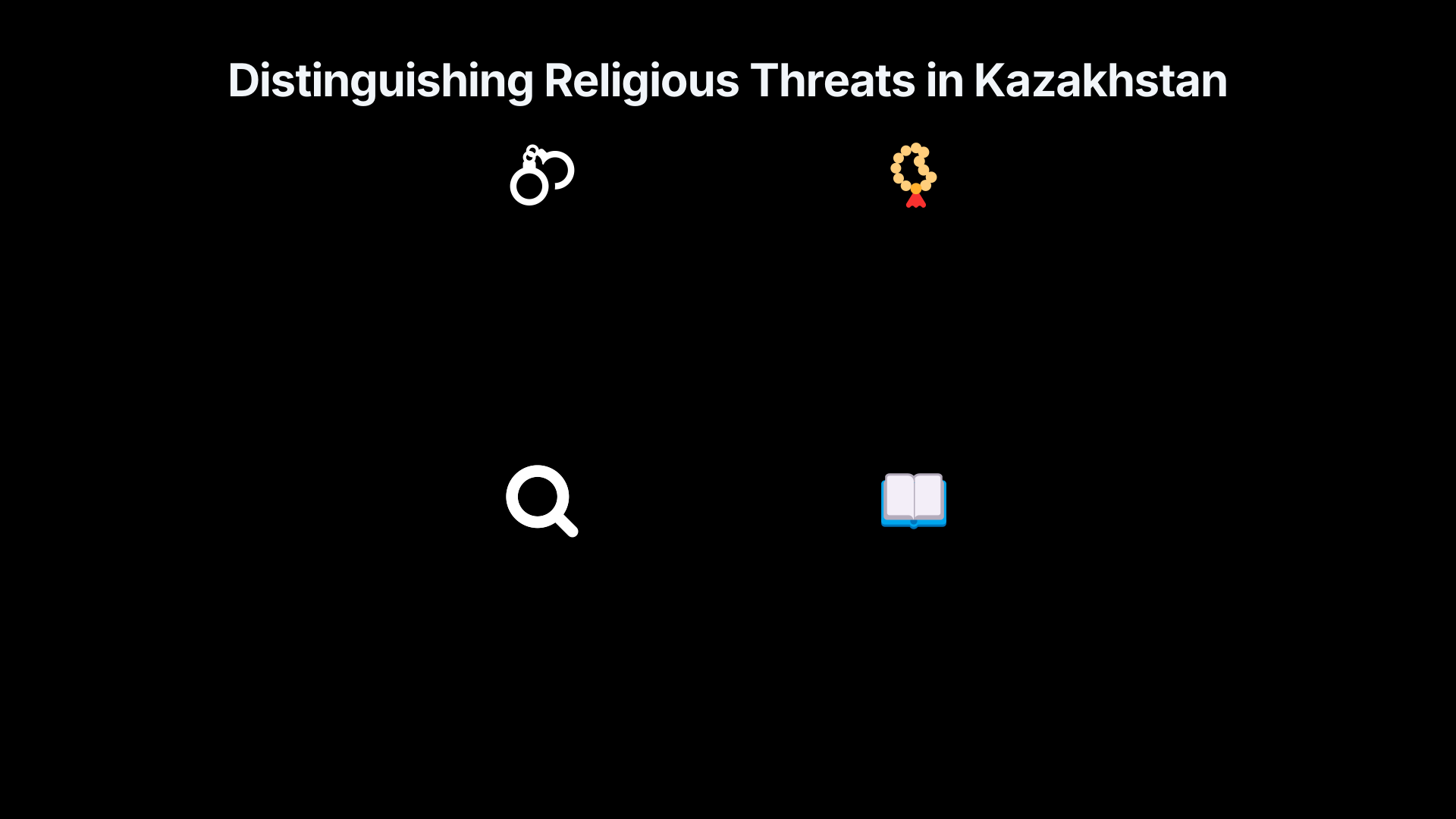
Genuine concernDifferent issue often merged with itTerrorist recruitmentPeaceful religious conversionFraud or coercive abuseMinority religious identityCriminal organisationsRegistered religious communitiesViolent extremismUnfamiliar theology
Keeping these distinctions separate is essential for understanding Kazakhstan’s religious landscape.

Why the debate remains important
The “destructive sect” scare remains significant because it demonstrates how public fear can grow from a mixture of genuine security concerns, limited public knowledge and politically powerful narratives.
Kazakhstan continues to balance competing priorities: preventing violent extremism, preserving social stability and protecting freedom of religion. Those goals do not always point in the same direction. The country’s experience shows how easily broad warnings about dangerous beliefs can expand beyond organisations engaged in criminal conduct and begin to shape public attitudes towards peaceful religious minorities.
For historians and sociologists, this episode is therefore less a story about hidden cults than about the social power of labels. Once “destructive sect” became a widely accepted category, it influenced media reporting, legislation and everyday perceptions, even though the groups placed within it often had little in common beyond being unfamiliar or outside officially favoured religious traditions.[forum18.org]forum18.orgForum 18: KAZAKHSTAN: Religious freedom survey, September 2009 - 23 September 2009September 23, 2009…
Amazon book picks
Further Reading
Books and field guides related to How Did 'Destructive Sects' Become Public Enemies?. Use these as the next step if you want deeper reading beyond the article.

Cults in Our Midst
Provides background on public perceptions of cults and new religions.

Combating cult mind control
Distinguishes genuine coercive control from broad social suspicion.
Endnotes
1.
Source: forum18.org
Link:https://www.forum18.org/archive.php?article_id=1352
Source snippet
Forum 18: KAZAKHSTAN: Religious freedom survey, September 2009 - 23 September 2009September 23, 2009...
Published: September 23, 2009
2.
Source: forum18.org
Title: Forum 18: KAZAKHSTAN: Legal amendments
Link:https://forum18.org/archive.php?article_id=2382
Source snippet
no text, no OSCE review - 30 May 2018...
Published: May 2018
3.
Source: wwrn.org
Link:https://wwrn.org/articles/24708/
Source snippet
KAZAKHSTAN: Officially-inspired intolerance of religious freedom steps up | WWRN - World-wide Religious News...
4.
Source: forum18.org
Title: Forum 18: KAZAKHSTAN: Senate approves more religious freedom restrictions
Link:https://www.forum18.org/archive.php?article_id=2419
Source snippet
28 September 2018...
Published: September 2018
5.
Source: forum18.org
Title: Forum 18 Analyses: Kazakhstan
Link:https://www.forum18.org/analyses.php?region=29
Source snippet
June 23, 2022 — The right to believe, to worship and witness The right to change one’s belief or religion The right to join together and...
Published: June 23, 2022
6.
Source: forum18.org
Title: Forum 18 Search/Archive
Link:https://forum18.org/archive.php/archive.php?article_id=921&printer=Y
7.
Source: forum18.org
Title: Forum 18: KAZAKHSTAN: More limits to religious freedom planned?
Link:https://www.forum18.org/archive.php?article_id=859
8.
Source: hrw.org
Link:https://www.hrw.org/news/2008/12/01/kazakhstan-fulfill-osce-commitments-human-rights
9.
Source: hrw.org
Link:https://www.hrw.org/news/2009/05/20/human-rights-kazakhstan-seven-months-osce-chairmanship
10.
Source: hrw.org
Title: freedom religion assembly and expression kazakhstan
Link:https://www.hrw.org/report/2008/12/01/atmosphere-quiet-repression/freedom-religion-assembly-and-expression-kazakhstan
Additional References
11.
Source: csce.gov
Title: Organization Profile: Forum 18
Link:https://www.csce.gov/articles/organization-profile-forum-18/
Source snippet
October 26, 2017 — The Helsinki Final Act of 1975 recognizes religious freedom as a “human right and fundamental freedom.” Participat...
Published: October 26, 2017
12.
Source: youtube.com
Link:https://www.youtube.com/watch?v=xcCpj68kk-g
Source snippet
Pope Francis in Kazakhstan 2022 | Top Speeches and highlights...
13.
Source: youtube.com
Title: LYNC Briefing Report
Link:https://www.youtube.com/watch?v=QG0VO0-SRS8
Source snippet
Meeting in the 'Mountains of God': Young Christian Leaders Unite for the Gospel in Dangerous Region...
14.
Source: youtube.com
Link:https://www.youtube.com/watch?v=0YhKqRePwgk
Source snippet
Hidden Holiness in Kazakhstan: The Story of Servant of God Gertruda Detzel...
15.
Source: youtube.com
Title: Hidden Holiness in Kazakhstan: The Story of Servant of God Gertruda Detzel
Link:https://www.youtube.com/watch?v=C7dr3QCODdU
Source snippet
Kazakhstan's Old Believers Keep the Faith...
16.
Source: ecoi.net
Link:https://www.ecoi.net/en/document/1215012.html
Source snippet
Forum 18 (Author): “"To prepare the public for a discriminatory new law"”, Document #1215012 - ecoi.net...
17.
Source: youtube.com
Title: Kazakhstan’s Old Believers Keep the Faith
Link:https://www.youtube.com/watch?v=NmqkPdHfkk8
Topic Tree