Within Bhutan Panics
How Digital Rumours Gain Trust in Bhutan
Trusted personal networks and fast-moving social media can make unsupported claims feel urgent before verification arrives.
On this page
- Personal trust and small social distance
- Why visible fear can confirm false claims
- Media literacy and the struggle to correct rumours
Page outline Jump by section
Introduction
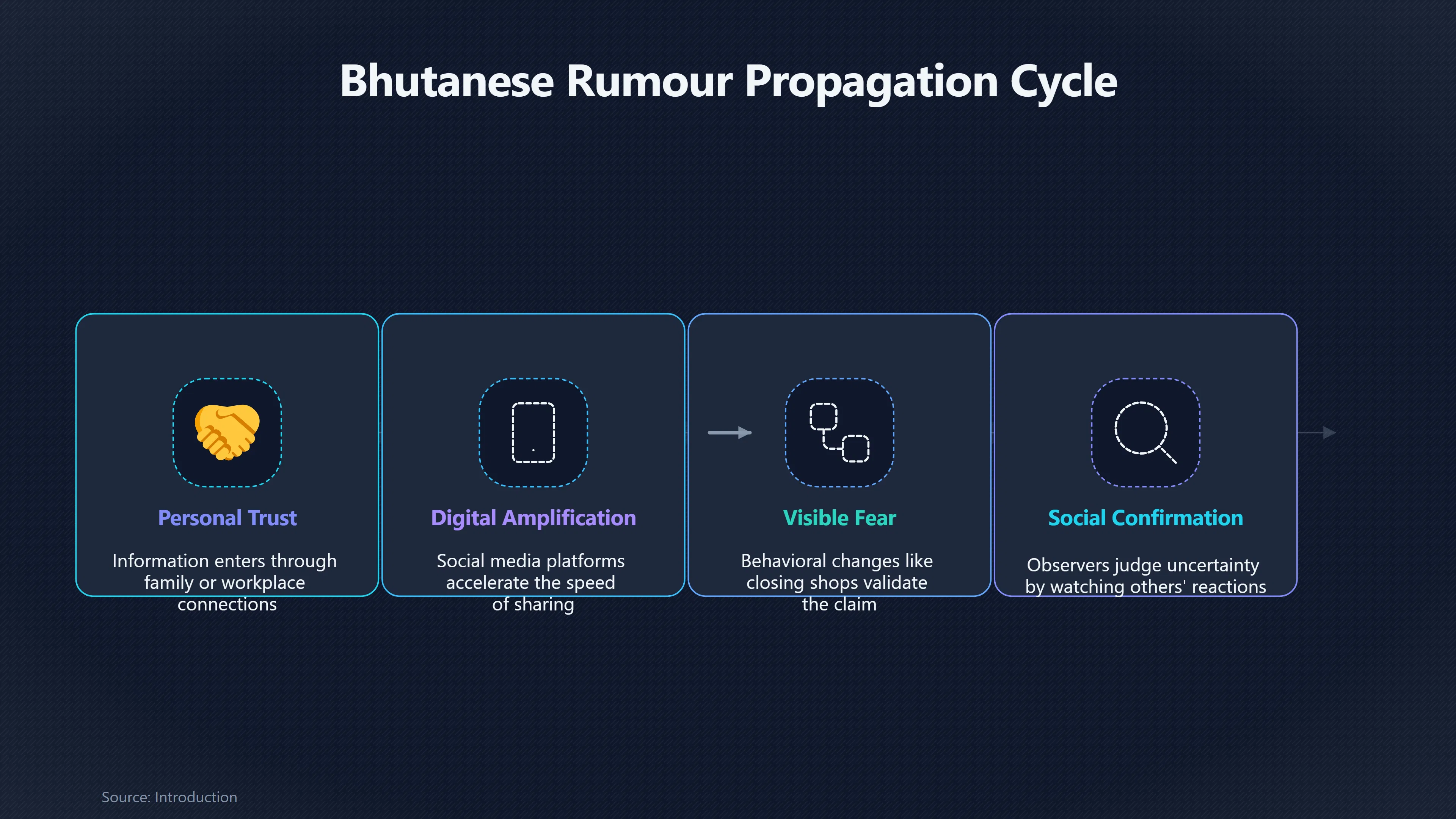
Bhutan’s rumour networks have changed rapidly over the past decade. Mobile internet, smartphones and social media have dramatically accelerated the speed at which warnings, fears and unverified stories travel, but they have not replaced older forms of trust. Instead, digital platforms have become layered onto the country’s close-knit family, village, workplace and school networks. A message forwarded by a relative, colleague or respected community member can appear more trustworthy than an anonymous post, even when neither has been verified.
This combination of high interpersonal trust and instant communication helps explain why some rumours spread so quickly. In Bhutan, the issue is rarely anonymous internet misinformation alone. Rather, digital platforms amplify messages that already carry the weight of personal relationships. The result can be temporary waves of fear, changes in everyday behaviour and significant challenges for officials attempting to correct false claims before they become accepted as fact.
Personal trust and small social distance
Bhutan’s relatively small population means that many people are connected through overlapping family, educational and professional networks. Information often reaches individuals through someone they know personally rather than through strangers.
This creates an important difference from larger countries. A warning that appears in a neighbourhood WhatsApp group or is forwarded by a respected family member may be interpreted as a genuine attempt to protect others rather than as unverified gossip. The emotional logic becomes: “Someone I trust would not send this unless it mattered.”
Digital communication therefore reinforces existing patterns of social trust instead of replacing them. Social media platforms such as Facebook, WhatsApp and, increasingly, Telegram and TikTok act as extensions of already established community relationships rather than entirely new information environments. During the COVID-19 pandemic, surveys found that Bhutanese adults commonly relied on friends, family members and social media alongside television for health information, illustrating how official and informal channels coexist rather than compete completely.[PLOS]journals.plos.orgKnowledge, attitude and practices towards COVID-19 preventive measures among adults in Bhutan: A cross-sectional study | PLOS OneDece…
This does not mean Bhutanese society is unusually prone to believing false information. Similar mechanisms appear worldwide. However, in a country where social distance between people is often small, rumours can spread rapidly because each person trusts the individual who forwarded the message, not necessarily the original source.
Why visible fear can confirm false claims
Rumours become especially persuasive when they appear to produce visible evidence.
The 2018 headhunter scare in eastern Bhutan illustrates this mechanism. Stories circulated claiming that strangers were collecting human heads for ritual purposes connected with construction projects. Authorities found no verified attacks, yet the rumour altered behaviour. Shops closed early, streets emptied and people avoided travelling after dark.
These behavioural changes then appeared to validate the original claim. Empty streets and anxious neighbours looked like proof that something dangerous must be happening, even though the changing behaviour itself had been caused by the rumour. Fear became self-reinforcing.
Social media intensified this feedback loop. Repeated warnings, screenshots and forwarded messages created the impression that many independent people had confirmed the same threat. In reality, many messages originated from the same unverified claims being copied across multiple groups.
Psychologists describe this as social confirmation: people often judge uncertain information by observing how others respond. When everyone else appears concerned, the rumour gains credibility even without direct evidence. This mechanism helps explain why authorities sometimes struggle to calm public fears simply by issuing denials.
Social media during public health emergencies
The COVID-19 pandemic demonstrated both the risks and advantages of Bhutan’s digital communication networks.
Health authorities encountered a steady stream of misleading claims, including rumours linking COVID-19 infections to seasonal influenza vaccinations and other unsupported medical advice circulating online. Rather than relying solely on traditional broadcasting, the Ministry of Health created a National COVID-19 Media Response Team that actively used Facebook, WhatsApp, Instagram and WeChat to distribute verified information, answer questions and counter misinformation. Daily press briefings and coordinated messaging aimed to establish a clear “single source of truth” before rumours could dominate public discussion.[PMC]pmc.ncbi.nlm.nih.govMarch 12, 2025…
Researchers examining Bhutan’s pandemic communication have argued that the strategy succeeded partly because officials recognised that people were already using social media extensively. Instead of treating digital platforms simply as sources of misinformation, they became tools for rapid correction, public engagement and behavioural guidance. Between early 2020 and early 2022, the Ministry of Health’s social media reach expanded dramatically as official accounts became trusted destinations for verified updates.[PMC]pmc.ncbi.nlm.nih.govMarch 12, 2025…
The experience also showed that misinformation could not simply be removed. It had to be answered quickly, repeatedly and through channels people already used.

Why correcting rumours is often harder than starting them
False claims frequently spread faster than corrections because they appeal to emotion rather than uncertainty.
A forwarded warning usually demands immediate action: avoid travelling, protect children, distrust a vaccine or expect an imminent danger. Official corrections often arrive later and contain more cautious language, acknowledging uncertainty while presenting evidence.
By the time verification appears, many people have already adjusted their behaviour. Correcting the factual error does not immediately remove the emotional impression created by the original story.
International research on online rumours consistently finds that emotionally engaging content spreads more readily than careful explanations, particularly during periods of uncertainty. Rumour belief is also influenced by people’s confidence in information sources and their willingness to compare competing claims rather than relying on a single social network.[sciencedirect.com]sciencedirect.comFighting rumors to fight COVID-19: Investigating rumor belief and sharing on social media during the pandemic - ScienceDirect…
Bhutan’s experience broadly reflects these wider findings while demonstrating how interpersonal trust gives local rumours additional momentum.
Media literacy and the struggle to correct rumours
Bhutan has increasingly treated media literacy as a practical civic skill rather than simply a concern for journalists.
During the pandemic, officials repeatedly encouraged citizens to verify information before forwarding it and to rely on recognised public sources for health advice. Government briefings explicitly warned against sharing unverified social media posts and urged people to question where information originated before passing it on.[The Bhutanese]thebhutanese.btThe Bhutanese Tackling fake news during the COVID-19 Lockdown – The BhutaneseThe Bhutanese Tackling fake news during the COVID-19 Lockdown – The Bhutanese
More recently, training programmes supported by international organisations have expanded this approach beyond COVID-19. Workshops for Bhutanese civil servants have included practical exercises in identifying manipulated images, recognising deepfakes and applying the simple principle of “Pause, verify, share” before distributing digital content.[UNESCO]unesco.orgAI Meets Governance: Bhutan Civil Servants Trained in AI and MediaAI Meets Governance: Bhutan Civil Servants Trained in AI and MediaAugust 20, 2025…
At the same time, Bhutan’s media environment continues to evolve. Citizen surveys indicate that social media has become the country’s dominant source of everyday information, even though people generally report lower levels of trust in social media news than in established news organisations. This gap suggests that convenience and constant availability often outweigh concerns about reliability.[The Bhutanese]thebhutanese.btThe BhutaneseBhutan’s media landscape in transition: First citizen survey reveals high public trust amidst digital shift – The BhutaneseA…
What Bhutan’s rumour networks reveal
Bhutan’s experience shows that digital misinformation is best understood as a social process rather than simply a technological problem.
Rumours succeed when they fit existing anxieties, travel through trusted relationships and become reinforced by visible changes in behaviour. Social media accelerates these processes, but it does not create them from nothing.
For historians and social scientists studying collective fear, Bhutan offers a useful example of how modern communication technologies interact with longstanding patterns of community trust. Rather than producing entirely new forms of panic, digital platforms have largely intensified familiar mechanisms through which people decide whom to believe when reliable information is scarce.
Amazon book picks
Further Reading
Books and field guides related to How Digital Rumours Gain Trust in Bhutan. Use these as the next step if you want deeper reading beyond the article.
The influential mind
First published 2017. Subjects: Attitude change, Social influence, Neuropsychology, Influence (Psychology).
Endnotes
1.
Source: journals.plos.org
Link:https://journals.plos.org/plosone/article?id=10.1371%2Fjournal.pone.0278535
Source snippet
Knowledge, attitude and practices towards COVID-19 preventive measures among adults in Bhutan: A cross-sectional study | PLOS OneDece...
2.
Source: pmc.ncbi.nlm.nih.gov
Link:https://pmc.ncbi.nlm.nih.gov/articles/PMC9744288/
3.
Source: pmc.ncbi.nlm.nih.gov
Link:https://pmc.ncbi.nlm.nih.gov/articles/PMC12039344/
Source snippet
March 12, 2025...
Published: March 12, 2025
4.
Source: sciencedirect.com
Link:https://www.sciencedirect.com/science/article/pii/S0747563222003417
Source snippet
Fighting rumors to fight COVID-19: Investigating rumor belief and sharing on social media during the pandemic - ScienceDirect...
5.
Source: arxiv.org
Title: arXiv Detection and Resolution of Rumours in Social Media: A Survey
Link:https://arxiv.org/abs/1704.00656
6.
Source: arxiv.org
Link:https://arxiv.org/abs/2202.03590
7.
Source: unesco.org
Title: AI Meets Governance: Bhutan Civil Servants Trained in AI and Media
Link:https://www.unesco.org/en/articles/ai-meets-governance-bhutan-civil-servants-trained-ai-and-media-information-literacy
Source snippet
AI Meets Governance: Bhutan Civil Servants Trained in AI and MediaAugust 20, 2025...
Published: August 20, 2025
8.
Source: unesco.org
Title: press provides antidote fake news epidemic
Link:https://www.unesco.org/en/articles/press-provides-antidote-fake-news-epidemic
9.
Source: unesco.org
Title: New handbook for journalism education and training published to fight
Link:https://www.unesco.org/en/articles/new-handbook-journalism-education-and-training-published-fight-fake-news-and-disinformation
10.
Source: unesco.org
Title: developing critical mind against fake news
Link:https://www.unesco.org/en/articles/developing-critical-mind-against-fake-news
11.
Source: thebhutanese.bt
Title: The Bhutanese Tackling fake news during the COVID-19 Lockdown – The Bhutanese
Link:https://thebhutanese.bt/tackling-fake-news-during-the-covid-19-lockdown/
12.
Source: thebhutanese.bt
Link:https://thebhutanese.bt/bhutans-media-landscape-in-transition-first-citizen-survey-reveals-high-public-trust-amidst-digital-shift/
Source snippet
The BhutaneseBhutan’s media landscape in transition: First citizen survey reveals high public trust amidst digital shift – The BhutaneseA...
13.
Source: pmc.ncbi.nlm.nih.gov
Link:https://pmc.ncbi.nlm.nih.gov/articles/PMC9957525/
14.
Source: pmc.ncbi.nlm.nih.gov
Link:https://pmc.ncbi.nlm.nih.gov/articles/PMC7298098/
15.
Source: thebhutanese.bt
Title: Fake news – The Bhutanese
Link:https://thebhutanese.bt/fake-news/
16.
Source: samsn.ifj.org
Link:https://samsn.ifj.org/SAPFR21-22/bhutan/
17.
Source: samsn.ifj.org
Link:https://samsn.ifj.org/press-freedom-report-2018/bhutan/
Additional References
18.
Source: defindia.org
Link:https://defindia.org/glimpses-of-digital-change-in-bhutan/
19.
Source: bhutanwiki.org
Link:https://www.bhutanwiki.org/articles/internet-social-media-bhutan
20.
Source: unicef.org
Link:https://www.unicef.org/esa/documents/managing-rumours-guidance-country-offices
21.
Source: youtube.com
Title: Media Literacy Bhutan 1
Link:https://www.youtube.com/watch?v=XN0IC5cmYN4
Source snippet
The AI Enabled Women Era: Reframing Bias and Inclusion for a More Equitable Future...
22.
Source: youtube.com
Link:https://www.youtube.com/watch?v=HPIJYDaN8iM
Source snippet
Bhutan Democracy Forum 2023...
23.
Source: youtube.com
Link:https://www.youtube.com/watch?v=PlmNTfyGfA4
24.
Source: bbs.bt
Link:https://www.bbs.bt/232597/
25.
Source: bhutanwatch.org
Title: Struggle for Survival | The Bhutan Watch
Link:https://bhutanwatch.org/struggle-for-survival/
26.
Source: bbs.bt
Title: RB P investigating social media rumour
Link:https://www.bbs.bt/132445/
27.
Source: youtube.com
Title: Bhutan Centre for Media and Democracy
Link:https://www.youtube.com/watch?v=V8466X2gDzA
Source snippet
Media Literacy Bhutan 1...
Topic Tree