Within Malaysia
Why Spirits Appeared on Malaysia's Factory Floors
Possession outbreaks among young factory workers reveal how labour discipline, gender expectations and familiar spirit beliefs shaped distress.
On this page
- Young women in Malaysia's industrial workforce
- How workplace pressure became possession
- Medical, managerial and ritual responses
Page outline Jump by section
Introduction
During Malaysia’s rapid industrialisation in the 1970s and 1980s, some of the country’s most striking episodes of apparent spirit possession took place not in villages or religious settings but inside modern electronics factories. Groups of young Malay women suddenly screamed, fainted, entered trance-like states or behaved as though controlled by unseen forces, forcing production lines to stop. To managers these incidents threatened productivity; to many workers they reflected genuine encounters with spirits. Researchers have since argued that these episodes are best understood as the meeting point of cultural belief, gender expectations and the pressures of industrial labour, rather than as either simple superstition or deliberate protest. They have become one of the world’s best-known case studies of how social stress can take culturally meaningful forms.[AnthroSource]anthrosource.onlinelibrary.wiley.comthe production of possession: spirits and the multinational corporation in Malaysia - ONG - 1988 - American Ethnologist - Wil…
Young women in Malaysia’s industrial workforce
The possession outbreaks emerged during a period when Malaysia’s export-oriented manufacturing sector expanded rapidly through free trade zones that attracted multinational electronics firms. Factories recruited large numbers of young, unmarried Malay women from rural communities because they were considered careful, disciplined and willing to perform repetitive assembly work.[Anthropology]anthropology.berkeley.eduOpen source on berkeley.edu.
For many workers, factory employment brought opportunities alongside profound disruption. Waged work offered income and greater personal independence, yet it also meant:
- leaving close-knit rural communities;
- adapting to regimented industrial schedules;
- living in hostels or urban boarding arrangements;
- balancing new consumer lifestyles with family expectations of modesty and obedience;
- working under predominantly male supervisors within tightly controlled production systems.
Rather than viewing these women simply as victims or as symbols of modernisation, anthropologist Aihwa Ong showed that they occupied an uneasy position between village traditions and global industrial capitalism. Their experiences combined new freedoms with new forms of surveillance and discipline.[berkeley.edu]anthropology.berkeley.eduOpen source on berkeley.edu.
How workplace pressure became possession
The factory incidents usually involved sudden collective episodes. One worker might begin screaming or collapsing, after which others nearby developed similar symptoms. Production stopped while affected workers were removed from the assembly line.
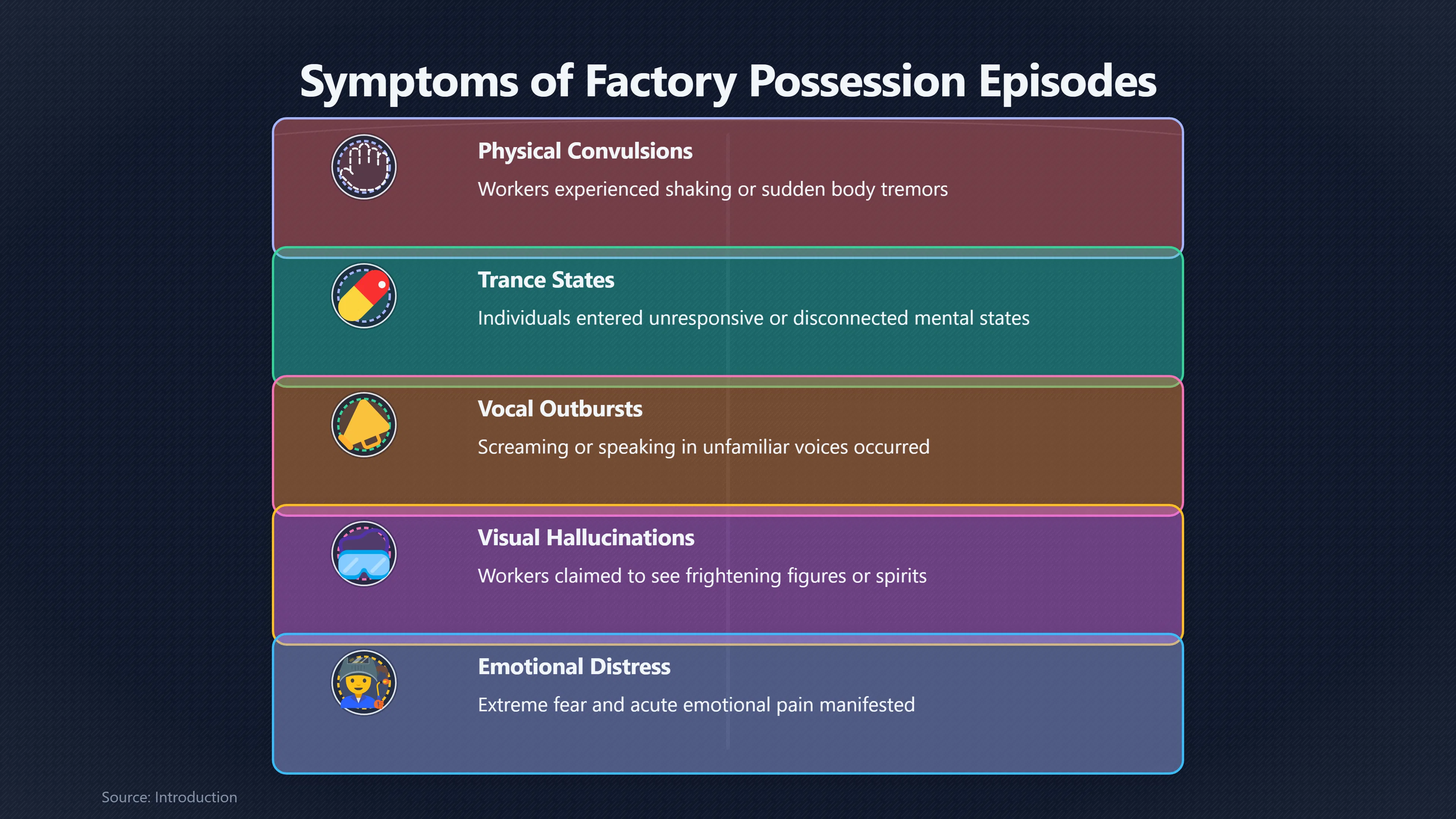
Observers described behaviours including:
- fainting;
- shaking or convulsions;
- trance-like states;
- shouting or speaking in unfamiliar voices;
- claiming to see frightening figures or spirits;
- extreme fear and emotional distress.
Medical investigations generally failed to identify poisoning, infectious disease or another physical cause that could explain the outbreaks. This pattern resembles what psychologists today often classify as mass psychogenic illness or culturally shaped dissociative episodes, where genuine involuntary symptoms spread within closely connected groups experiencing intense stress.[AnthroSource]anthrosource.onlinelibrary.wiley.comthe production of possession: spirits and the multinational corporation in Malaysia - ONG - 1988 - American Ethnologist - Wil…
The distinctive feature in Malaysia was that many participants interpreted the events through established beliefs about spirits. Instead of expressing distress through symptoms that might appear in another culture, workers understood frightening experiences as possession because that framework already existed within their communities and religious worldviews. The symptoms were real even though different observers disagreed about their cause.[AnthroSource]anthrosource.onlinelibrary.wiley.comthe production of possession: spirits and the multinational corporation in Malaysia - ONG - 1988 - American Ethnologist - Wil…
Why gender mattered
The overwhelming majority of reported factory possession cases involved young women rather than male workers. Researchers argue that this was not accidental.
Ong suggested that young Malay women experienced multiple, overlapping pressures:
- strict factory discipline that demanded speed, precision and emotional restraint;
- expectations to remain respectful and sexually respectable;
- limited opportunities to challenge supervisors directly;
- rapid movement from agricultural life into unfamiliar industrial environments.
Within this context, possession could become a culturally recognised way for unbearable strain to emerge when open confrontation was difficult or socially unacceptable. Ong did not argue that workers consciously staged possession. Instead, she proposed that deeply felt distress took a form that was meaningful within local understandings of the body, morality and spiritual danger.[wiley.com]anthrosource.onlinelibrary.wiley.comthe production of possession: spirits and the multinational corporation in Malaysia - ONG - 1988 - American Ethnologist - Wil…
Her interpretation also challenged explanations that blamed industrial workers for becoming “immoral” or excessively influenced by urban life. Rather than locating the problem in individual behaviour, she examined how gender relations, labour discipline and cultural expectations interacted.[AnthroSource]anthrosource.onlinelibrary.wiley.comthe production of possession: spirits and the multinational corporation in Malaysia - ONG - 1988 - American Ethnologist - Wil…

Medical, managerial and ritual responses
Factory managers often found themselves balancing several competing explanations at once.
Medical responses included removing affected workers from production lines, arranging clinical examinations and, in some cases, administering sedatives before sending employees home. From a managerial perspective, the priority was restoring production and preventing further disruption.[SciSpace]scispace.comthe production of possession spirits and the multinational 2sh7byd69aSciSpace(PDF) The Production of Possession: Spirits and the Multinational Corporation in Malaysia (1988) | Aihwa Ong | 207 Citations…
At the same time, many employers recognised that purely medical explanations did not reassure workers. Factories therefore sometimes invited religious officials or traditional healers to conduct cleansing rituals or prayers within factory buildings. These ceremonies aimed to remove offending spirits and restore workers’ confidence that the workplace had become safe again.[SciSpace]scispace.comthe production of possession spirits and the multinational 2sh7byd69aSciSpace(PDF) The Production of Possession: Spirits and the Multinational Corporation in Malaysia (1988) | Aihwa Ong | 207 Citations…
These dual responses illustrate an important feature of Malaysian industrial life. Modern corporations operating highly advanced manufacturing facilities frequently accepted that spiritual interpretations remained socially significant, even if management officially preferred medical or psychological explanations.
Competing explanations
The Malaysian factory episodes continue to attract discussion because no single explanation fully captures every aspect of what occurred.
Psychological interpretation. Clinicians generally regard the outbreaks as examples of mass psychogenic illness or dissociative distress. Symptoms spread socially without evidence of a toxic exposure, while remaining entirely genuine for those experiencing them.[SciSpace]scispace.comthe production of possession spirits and the multinational 2sh7byd69aSciSpace(PDF) The Production of Possession: Spirits and the Multinational Corporation in Malaysia (1988) | Aihwa Ong | 207 Citations…
Anthropological interpretation. Ong argued that the possession narratives expressed conflicts produced by industrialisation, changing gender roles and the demands of multinational manufacturing. The spirit language itself reflected existing cultural beliefs, while the underlying tensions arose from rapid social transformation.[AnthroSource]anthrosource.onlinelibrary.wiley.comthe production of possession: spirits and the multinational corporation in Malaysia - ONG - 1988 - American Ethnologist - Wil…
Religious interpretation. Many workers and local communities regarded the incidents as authentic spiritual attacks rather than psychological disorders. From this perspective, ritual specialists addressed a genuine spiritual problem rather than providing symbolic reassurance.[AnthroSource]anthrosource.onlinelibrary.wiley.comthe production of possession: spirits and the multinational corporation in Malaysia - ONG - 1988 - American Ethnologist - Wil…
These explanations need not be mutually exclusive. Researchers increasingly note that cultural beliefs shape how distress is experienced and expressed without implying that sufferers are pretending or that symptoms are imaginary.
Why the factory cases remain important
Malaysia’s factory possession outbreaks have become a landmark example in anthropology, labour studies and the study of mass psychogenic illness because they demonstrate that workplace distress is never experienced in a cultural vacuum.
The episodes challenged several common assumptions:
- that industrial modernisation automatically replaces older belief systems;
- that workplace stress always appears as medically recognisable anxiety or depression;
- that supernatural interpretations simply disappear inside technologically advanced industries.
Instead, the Malaysian experience showed that global manufacturing could coexist with deeply rooted local understandings of illness and spirituality. The outbreaks also drew attention to how gender, migration, labour discipline and cultural identity influence the forms that psychological distress can take.[degruyterbrill.com]degruyterbrill.comDe Gruyter Brill Spirits of Resistance and Capitalist DisciplineDe Gruyter Brill Spirits of Resistance and Capitalist Discipline
The factory possession cases therefore remain central to understanding Malaysia’s wider history of collective belief and mass psychogenic episodes. They reveal not merely a conflict between tradition and modernity, but the complex ways in which rapid economic change, women’s work and cultural expectations combined to shape one of the country’s most distinctive forms of collective distress.[berkeley.edu]anthropology.berkeley.eduOpen source on berkeley.edu.




Endnotes
1.
Source: anthrosource.onlinelibrary.wiley.com
Link:https://anthrosource.onlinelibrary.wiley.com/doi/10.1525/ae.1988.15.1.02a00030
Source snippet
the production of possession: spirits and the multinational corporation in Malaysia - ONG - 1988 - American Ethnologist - Wil...
2.
Source: anthropology.berkeley.edu
Link:https://anthropology.berkeley.edu/spirits-resistance-and-capitalist-discipline-factory-women-malaysia
3.
Source: degruyterbrill.com
Title: De Gruyter Brill Spirits of Resistance and Capitalist Discipline
Link:https://www.degruyterbrill.com/document/doi/10.1515/9781438433561/html
4.
Source: scispace.com
Title: the production of possession spirits and the multinational 2sh7byd69a
Link:https://scispace.com/papers/the-production-of-possession-spirits-and-the-multinational-2sh7byd69a
Source snippet
SciSpace(PDF) The Production of Possession: Spirits and the Multinational Corporation in Malaysia (1988) | Aihwa Ong | 207 Citations...
5.
Source: ejournal.um.edu.my
Link:https://ejournal.um.edu.my/index.php/MOJC/article/view/67039
Source snippet
HEALTH OF FEMALE EMPLOYEES ACROSS INDUSTRIES: A SYSTEMATIC REVIEW OF PSYCHOLOGICAL CHALLENGES AND RESILIENCE FACTORS | MOJPC: Malaysia On...
6.
Source: publisher.uthm.edu.my
Link:https://publisher.uthm.edu.my/ojs/index.php/oj-tp/article/view/6053
Source snippet
Elemen Kesihatan Mental Pekerja Wanita Sektor Perusahaan Kecil & Sederhana Malaysia melalui Kaedah Analisis Matrik | Online Journal for T...
7.
Source: irep.iium.edu.my
Link:https://irep.iium.edu.my/77768/
8.
Source: degruyterbrill.com
Link:https://www.degruyterbrill.com/document/isbn/9781438415147/html?lang=en
9.
Source: degruyterbrill.com
Link:https://www.degruyterbrill.com/document/isbn/9781438415147/html
10.
Source: degruyterbrill.com
Link:https://www.degruyterbrill.com/document/isbn/9781438415147/html?lang=de
11.
Source: anthrosource.onlinelibrary.wiley.com
Link:https://anthrosource.onlinelibrary.wiley.com/doi/pdf/10.1525/ae.1988.15.1.02a00030
12.
Source: bpspsychub.onlinelibrary.wiley.com
Title: j.2044 8325.1979.tb00444.x
Link:https://bpspsychub.onlinelibrary.wiley.com/doi/pdf/10.1111/j.2044-8325.1979.tb00444.x
13.
Source: ejournals.ukm.edu.my
Link:https://ejournals.ukm.edu.my/akademika/article/view/680/0
Additional References
14.
Source: imphalreviews.in
Link:https://imphalreviews.in/an-intimate-account-of-how-women-in-rural-malaysia-coped-with-the-countrys-transition-to-capitalism/
Source snippet
August 24, 2024 — Image Cover of pirits of Resistance and Capitalist Discipline: Factory Women in Malaysia, a book by Aihwa Ong * August...
Published: August 24, 2024
15.
Source: pmc.ncbi.nlm.nih.gov
Link:https://pmc.ncbi.nlm.nih.gov/articles/PMC9904905/
Source snippet
MATERIALS AND METHODS A thematic review uses the basic concept of any systematic literature search by constructing a set of keywords for...
16.
Source: youtube.com
Title: Power Relations in a Society-views of James Scott & Aihwa Ong
Link:https://www.youtube.com/watch?v=3N_fH7quHP4
Source snippet
100 Students And Teachers "POSSESSED" In Malaysia | Mysteries Of Asia...
17.
Source: youtube.com
Title: SSRC Fellow Lecture
Link:https://www.youtube.com/watch?v=_AHEUoZzk8o
Source snippet
ANTHRO DAY 2-22-2022 Aihwa Ong, Leo Chavez, Megan Baker, Keng Vang, Robin Nelson...
18.
Source: researchgate.net
Link:https://www.researchgate.net/publication/324633644_Spirits_of_Resistance_and_Capitalist_Discipline_Factory_Women_in_Malaysia
19.
Source: seasia.yale.edu
Link:https://seasia.yale.edu/spirits-resistance-and-capitalist-discipline-factory-women-malaysia
20.
Source: cambridge.org
Link:https://www.cambridge.org/core/journals/psychological-medicine/article/abs/tarantism-dancing-mania-and-demonopathy-the-anthropolitical-aspects-of-mass-psychogenic-illness/A2C2EF387B94BC12E4BBB526B5443534
21.
Source: researchgate.net
Link:https://www.researchgate.net/publication/227768459_The_Production_of_Possession_Spirits_and_the_Multinational_Corporation_in_Malaysia
22.
Source: researchgate.net
Link:https://www.researchgate.net/publication/313006556_The_Production_of_Possession_Spirits_and_the_Multinational_Corporation_in_Malaysia
23.
Source: youtube.com
Link:https://www.youtube.com/watch?v=2UOyFBUW4S0
Source snippet
Laia Abril – On Mass Hysteria...
Topic Tree