Within Tanzania
How Popobawa Turned Night Terror Into Panic
Reports of nocturnal assault became a public panic shaped by sleep paralysis, rumour, vigilance and political tension.
On this page
- What People Reported During the 1995 Scare
- Sleep Paralysis, Storytelling and Rising Vigilance
- Political Tension, Mob Violence and Later Recurrences
Page outline Jump by section
Introduction
The 1995 Popobawa panic in Zanzibar is one of the best-documented examples of a rumour-driven supernatural scare in modern East Africa. During several weeks of fear, hundreds of people reported terrifying night-time attacks by an unseen being known as Popobawa. Many described waking unable to move, feeling intense pressure on the chest, sensing a threatening presence, or believing they had been physically or sexually assaulted. As stories spread from household to household, neighbours began sleeping outdoors in groups, vigilante patrols formed, and several innocent people were attacked after being suspected of being the mysterious visitor. Rather than being explained by a single cause, historians and social scientists view the panic as the result of several forces acting together: frightening sleep experiences, rapidly circulating rumours, cultural beliefs about spirits, and the tense political atmosphere before Tanzania’s first multiparty elections.[ResearchGate]researchgate.netResearchGate(PDF) The politicisation of Popobawa: changing explanations of a collective panic in ZanzibarJanuary 1, 2009…
What People Reported During the 1995 Scare
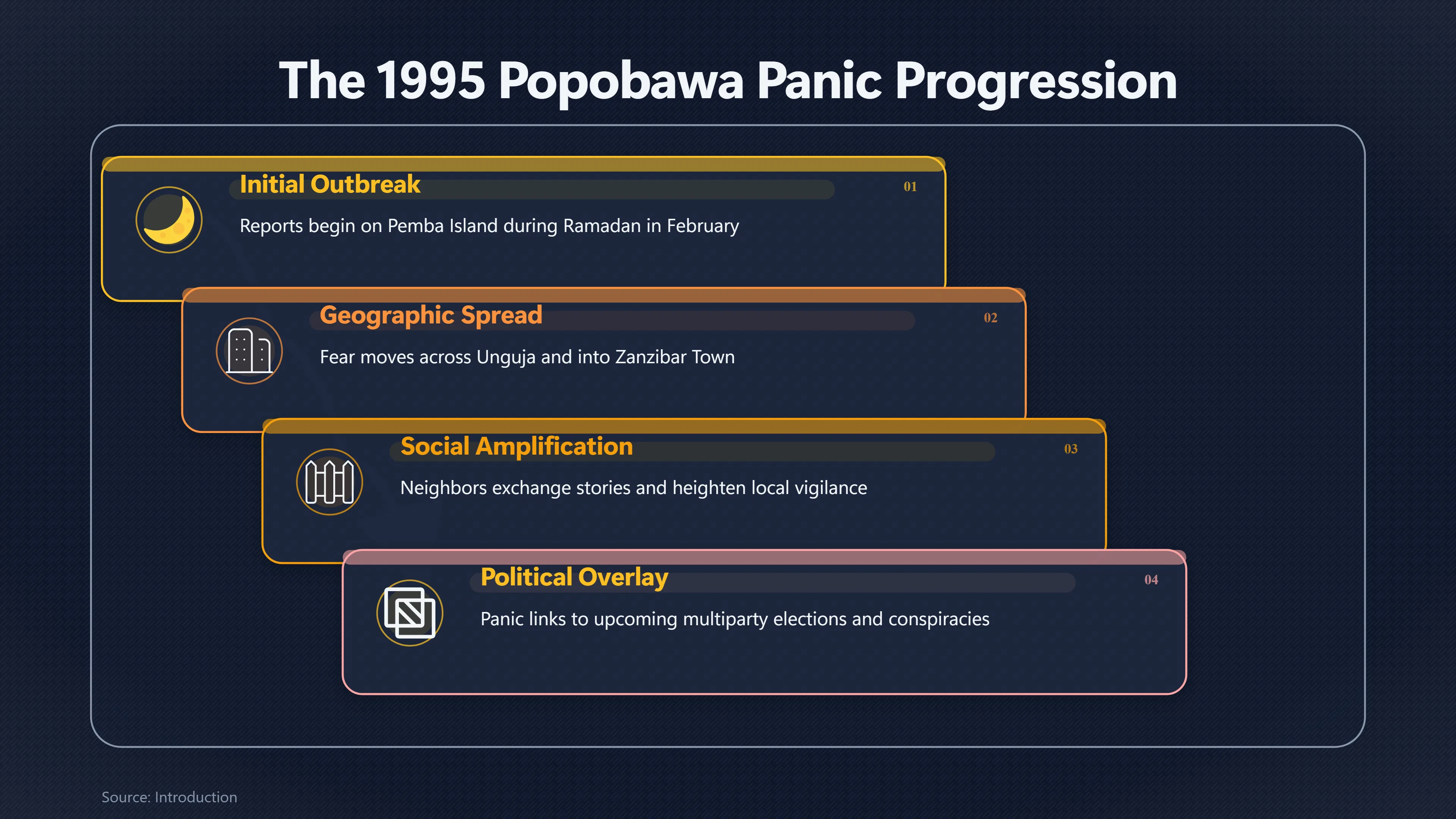
The modern Popobawa tradition had appeared before the 1990s, but the 1995 outbreak was by far the largest. It began on Pemba Island during Ramadan in February before spreading across Unguja, including Zanzibar Town, and eventually reaching parts of mainland Tanzania. Reports followed a recognisable pattern, with people claiming that an invisible or shape-shifting spirit entered homes during the night.[ResearchGate]researchgate.netResearchGate(PDF) The politicisation of Popobawa: changing explanations of a collective panic in ZanzibarJanuary 1, 2009…
Victims commonly described experiences that included:
- Waking suddenly while unable to move or cry out.
- Feeling crushing pressure on the chest or body.
- Sensing a hostile presence in the room.
- Believing they had been physically or sexually assaulted.
- Detecting an unpleasant smell said to announce the creature’s arrival.
- Feeling compelled to tell others about the attack because the spirit supposedly threatened to return if the experience remained secret.[ResearchGate]researchgate.netResearchGate(PDF) The politicisation of Popobawa: changing explanations of a collective panic in ZanzibarJanuary 1, 2009…
The reports affected both men and women, although the alleged sexual assaults on men attracted particular public attention because they challenged local expectations about masculinity and sexuality. Many accounts were deeply distressing to those involved regardless of whether an external attacker could be verified. Researchers stress that the fear itself was genuine even if different explanations are offered for what people experienced.[ResearchGate]researchgate.netResearchGate(PDF) The politicisation of Popobawa: changing explanations of a collective panic in ZanzibarJanuary 1, 2009…
Sleep Paralysis, Storytelling and Rising Vigilance
One reason the Popobawa panic has attracted scientific interest is that many reported experiences closely resemble sleep paralysis. During sleep paralysis, a person becomes partly awake while the body’s normal dream-related muscle paralysis continues briefly. This can produce vivid sensations of an intruder, pressure on the chest, inability to speak, intense fear and highly convincing hallucinations. Such episodes occur across many cultures but are interpreted through local beliefs.[arXiv]arxiv.orgarXiv Sleep Paralysis: phenomenology, neurophysiology and treatmentSleep Paralysis: phenomenology, neurophysiology and treatmentApril 7, 2017…
Researchers do not argue that every Popobawa report was simply an instance of sleep paralysis. Instead, they suggest that frightening sleep experiences formed one important ingredient within a wider social process. Once neighbours exchanged stories, ordinary night-time disturbances could be interpreted through the Popobawa narrative. Expectation heightened vigilance, while each fresh report reinforced the belief that attacks were spreading through nearby communities.[ResearchGate]researchgate.netResearchGate(PDF) The politicisation of Popobawa: changing explanations of a collective panic in ZanzibarJanuary 1, 2009…
This feedback loop helps explain why outbreaks appeared to move geographically. News of attacks often travelled ahead of the reports themselves, creating communities in which people were already alert to unusual sensations during the night. Shared discussions, local media coverage and repeated testimony gave the impression of an expanding wave of attacks even though no physical attacker was identified.[ResearchGate]researchgate.netResearchGate(PDF) The politicisation of Popobawa: changing explanations of a collective panic in ZanzibarJanuary 1, 2009…

Political Tension, Mob Violence and Later Recurrences
The timing of the 1995 panic mattered. It unfolded only months before Tanzania’s first competitive multiparty elections after decades of one-party rule. Many islanders interpreted Popobawa through a political lens, linking the spirit to rival parties, hidden conspiracies or the troubled legacy of Zanzibar’s political history. Martin Walsh’s detailed reconstruction shows that explicitly political explanations became more prominent as the panic developed rather than existing from the outset.[ResearchGate]researchgate.netResearchGate(PDF) The politicisation of Popobawa: changing explanations of a collective panic in ZanzibarJanuary 1, 2009…
Fear did not remain confined to stories. Communities organised night watches, families slept together outdoors around fires, and strangers became objects of suspicion. Several innocent men were assaulted by crowds after being mistaken for manifestations of Popobawa, with evidence suggesting that some victims died during these attacks. Outsiders, travellers and people without strong local social ties proved especially vulnerable because they could not easily be identified or defended by neighbours.[ResearchGate]researchgate.netResearch Gate(PDF) Killing Popobawa: collective panic and violence in ZanzibarResearch Gate(PDF) Killing Popobawa: collective panic and violence in Zanzibar
The panic eventually subsided, but Popobawa reports have reappeared periodically, including during later election periods. These recurrences have encouraged researchers to examine how collective memory, political uncertainty and established folklore interact. Rather than treating each outbreak as an isolated mystery, they view successive episodes as drawing upon an already familiar narrative that communities recognise and reinterpret in changing circumstances.[ResearchGate]researchgate.netResearchGate(PDF) The politicisation of Popobawa: changing explanations of a collective panic in ZanzibarJanuary 1, 2009…
Why Popobawa Became So Convincing
The Popobawa panic illustrates how several different mechanisms can reinforce one another without requiring deliberate deception.
Frightening personal experiences. Sleep paralysis and other vivid night-time experiences are memorable and emotionally powerful. People often seek explanations that fit their cultural environment.[arXiv]arxiv.orgarXiv Sleep Paralysis: phenomenology, neurophysiology and treatmentSleep Paralysis: phenomenology, neurophysiology and treatmentApril 7, 2017…
Shared testimony. Hearing neighbours describe similar attacks can make unusual personal experiences seem part of a wider pattern rather than isolated events.[ResearchGate]researchgate.netResearchGate(PDF) The politicisation of Popobawa: changing explanations of a collective panic in ZanzibarJanuary 1, 2009…
Existing supernatural traditions. Belief in spirits already formed part of local religious and cultural life, giving people a familiar framework for interpreting frightening events.[ResearchGate]researchgate.netResearchGate(PDF) The politicisation of Popobawa: changing explanations of a collective panic in ZanzibarJanuary 1, 2009…
Heightened social tension. Political uncertainty, rumours and widespread anxiety increased the readiness of communities to connect separate incidents into a single unfolding crisis.[ResearchGate]researchgate.netResearchGate(PDF) The politicisation of Popobawa: changing explanations of a collective panic in ZanzibarJanuary 1, 2009…
Together, these mechanisms created a self-reinforcing cycle in which fear, expectation and testimony amplified one another.
Why the 1995 Panic Still Matters
The Popobawa scare remains significant because it cannot be reduced to a simple ghost story or dismissed as irrational behaviour. It demonstrates how real psychological experiences, sincerely held supernatural beliefs, rumour networks and political conflict can combine to produce episodes of collective fear with tangible consequences.
For historians, it provides insight into Zanzibar’s political and social climate during a period of major change. For psychologists, it offers an example of how sleep paralysis may be interpreted differently across cultures. For sociologists and scholars of religion, it shows how folklore can shape public behaviour, influence collective memory and, in moments of heightened tension, contribute to violence against innocent people. The lasting importance of the Popobawa panic lies not in proving whether a supernatural being existed, but in understanding why so many people became convinced that it did, and how those convictions reshaped everyday life across Zanzibar.[ResearchGate]researchgate.netResearchGate(PDF) The politicisation of Popobawa: changing explanations of a collective panic in ZanzibarJanuary 1, 2009…
Amazon book picks
Further Reading
Books and field guides related to How Popobawa Turned Night Terror Into Panic. Use these as the next step if you want deeper reading beyond the article.
Extraordinary Popular Delusions and the Madness of Crowds
Rating: 4.0/5 from 5 Google Books ratings
Illustrates how collective fears spread.
The terror that comes in the night
Directly addresses sleep paralysis experiences linked to supernatural beliefs.
African religions and philosophy
Places spirit beliefs within African religious traditions.
Endnotes
1.
Source: researchgate.net
Link:https://www.researchgate.net/publication/272202097_The_politicisation_of_Popobawa_changing_explanations_of_a_collective_panic_in_Zanzibar
Source snippet
ResearchGate(PDF) The politicisation of Popobawa: changing explanations of a collective panic in ZanzibarJanuary 1, 2009...
Published: January 1, 2009
2.
Source: researchgate.net
Title: Research Gate(PDF) Killing Popobawa: collective panic and violence in Zanzibar
Link:https://www.researchgate.net/publication/270393629_Killing_Popobawa_collective_panic_and_violence_in_Zanzibar
3.
Source: arxiv.org
Title: arXiv Sleep Paralysis: phenomenology, neurophysiology and treatment
Link:https://arxiv.org/abs/1704.02342
Source snippet
Sleep Paralysis: phenomenology, neurophysiology and treatmentApril 7, 2017...
Published: April 7, 2017
4.
Source: researchgate.net
Link:https://www.researchgate.net/publication/349766037_Chapter_Four_In_the_Nature_of_the_Human_Landscape_Provenances_in_the_Making_of_Zanzibar_Politics
5.
Source: researchgate.net
Title: (PDF) Zanzibar’s turbulent transition
Link:https://www.researchgate.net/publication/228870663_Zanzibar%27s_turbulent_transition
6.
Source: researchgate.net
Link:https://www.researchgate.net/publication/35438661_Wazee_Wakijua_MamboElders_used_to_know_things_occult_powers_and_revolutionary_history_in_Pemba_Zanzibar
7.
Source: researchgate.net
Title: Chronology of the 1995 panic tbl2 272202097
Link:https://www.researchgate.net/figure/Chronology-of-the-1995-panic_tbl2_272202097
8.
Source: youtube.com
Title: Popobawa Explored
Link:https://www.youtube.com/watch?v=FEI4AzsIxws
Source snippet
SLEEP PARALYSIS - with Medical Anthropology Researcher Samantha Treasure #TheExplorersCLUB...
9.
Source: youtube.com
Title: SLEEP PARALYSIS
Link:https://www.youtube.com/watch?v=yEHApzrmIBk
Source snippet
Myth Monsters Podcast - S3 Episode 7: Popobawa...
10.
Source: Wikipedia
Link:https://en.wikipedia.org/wiki/Popobawa
Additional References
11.
Source: brokenenglishbooks.com
Title: What are the origins of sleep paralysis in folklore?
Link:https://brokenenglishbooks.com/what-are-the-origins-of-sleep-paralysis-in-folklore/?currency=USD
Source snippet
Broken English BooksNovember 20, 2025 — THE BAT-MAN OF ZANZIBAR The legend of Popobawa (Swahili for “bat wing”) has origins as recent as...
Published: November 20, 2025
12.
Source: handwiki.org
Title: In the article Nickell compared the exp
Link:https://handwiki.org/wiki/Unsolved%3APopobawa
Source snippet
Unsolved:Popobawa - HandWikiFebruary 5, 2024 — ^{[5]} After the incidents involving Popobawa in 1995 were reported an article was publish...
Published: February 5, 2024
13.
Source: internazionale.it
Title: Presenze notturne
Link:https://www.internazionale.it/magazine/2024/01/11/presenze-notturne
Source snippet
January 12, 2024 — PRESENZE NOTTURNE Il fotografo Lorenzo Maccotta è stato a Zanzibar per raccontare la storia del popobawa...
Published: January 12, 2024
14.
Source: youtube.com
Title: Myth Monsters Podcast
Link:https://www.youtube.com/watch?v=2SImt0SOmuQ
Source snippet
Every Horrifying Mythical Creatures You've Never Heard Of...
15.
Source: skepticalinquirer.org
Link:https://skepticalinquirer.org/authors/joe-nickell/page/9/
16.
Source: skepticalinquirer.org
Link:https://skepticalinquirer.org/exclusive/that-time-a-raping-demon-appeared-on-cartoon-network-the-popobawa/
17.
Source: ifes.org
Title: republic transition 1995 elections tanzania and zanzibar ifes observation report
Link:https://www.ifes.org/publications/republic-transition-1995-elections-tanzania-and-zanzibar-ifes-observation-report
18.
Source: skepticalinquirer.org
Title: Skeptical Inquirer The Skeptic-raping Demon of Zanzibar | Skeptical Inquirer
Link:https://skepticalinquirer.org/newsletter/skeptic-raping-demon-of-zanzibar/
19.
Source: journal-d-une-demonologue.fr
Title: Les démons de la paralysie du sommeil | Journal d’une démonologue
Link:https://journal-d-une-demonologue.fr/les-demons-de-la-paralysie-du-sommeil
20.
Source: vice.com
Title: What is Sleep Paralysis? An Inescapable Walking Nightmare
Link:https://www.vice.com/en/article/sleep-paralysis-is-an-inescapable-waking-nightmare/
Topic Tree