When Belief Became a Public Crisis
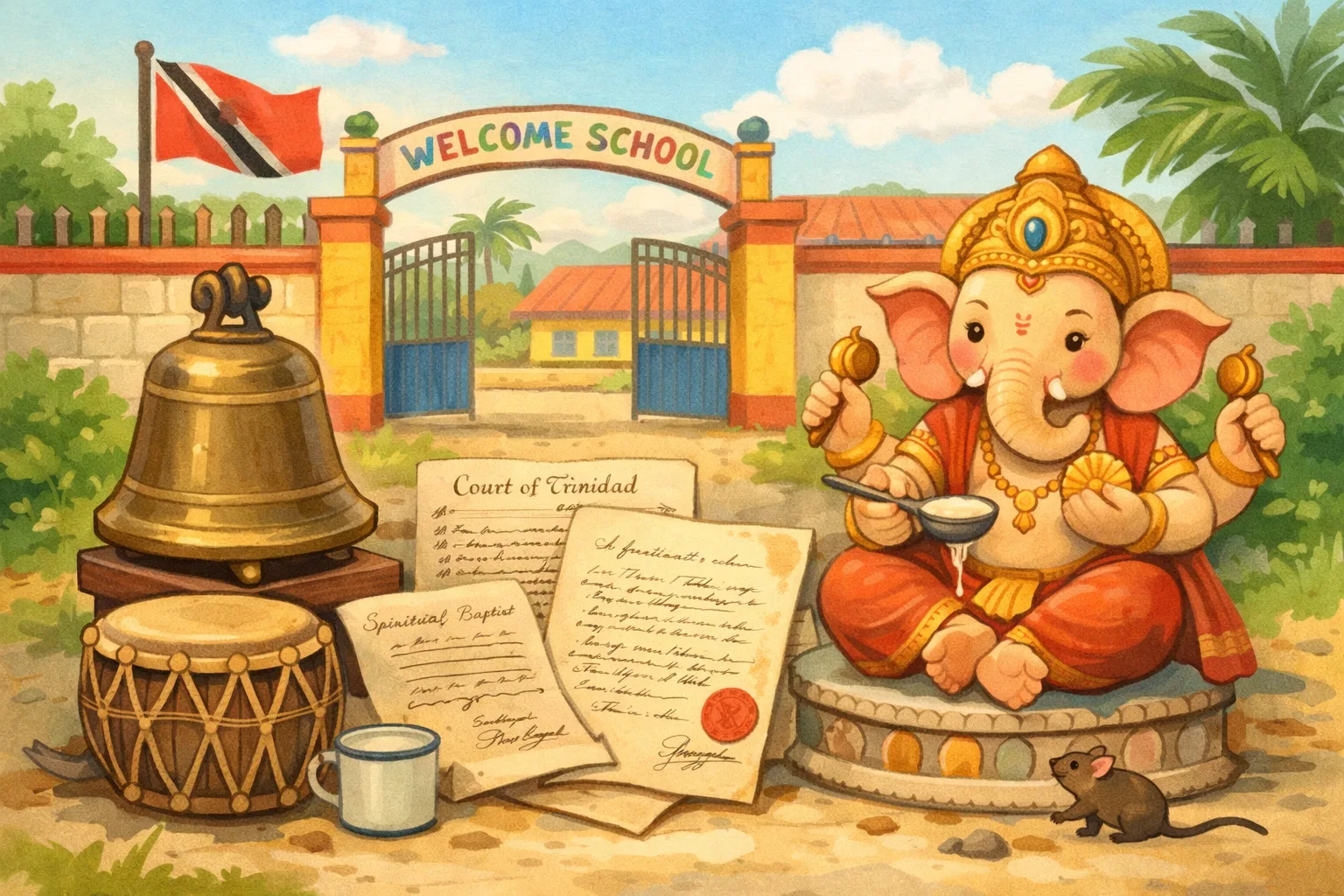
Trinidad and Tobago does not have a single defining history of “mass hysteria” or cult activity. Its most revealing cases instead form a spectrum: colonial persecution of African-derived religions, school episodes interpreted as spirit possession, globally transmitted miracle claims, and the violent rise of a tightly organised religious-political movement.
Page outline Jump by section
Introduction
The clearest lesson is that collective belief in Trinidad and Tobago has usually grown where spiritual traditions, social inequality, political distrust and fast-moving rumour meet. Authorities have alternately criminalised unfamiliar worship, summoned medical investigators, invited clergy, controlled broadcasting or used armed force. Later interpretations often reveal as much about class, race and colonial power as they do about the beliefs themselves.
When religion was treated as a public danger
Any history of panics and contested belief in Trinidad and Tobago must begin with colonial rule. British officials and socially dominant churches frequently viewed African-derived practices not simply as religious alternatives but as threats to public order, morality and political control.
The broad label obeah was especially powerful. It did not describe one organised church or a single, agreed body of doctrine. Historians use it for a shifting range of healing, protective, divinatory and harmful spiritual practices. Colonial law helped create the impression that these diverse activities belonged to one sinister category. In post-emancipation Trinidad, officials increasingly framed obeah as fraud, manipulation or dangerous superstition, while prosecutions helped determine which practices would be recognised as religion and which would be pushed outside respectable society.[cambridge.org]cambridge.orgUniversity Press & Assessment4Cambridge University Press & Assessment4 - Obeah and its meanings in the post-emancipation eraObeah laws were remade in the late nineteen…
This matters because a “witch panic” does not always take the form of villagers hunting an alleged sorcerer. It can also operate through courts, policing and public language. When a government defines loosely connected spiritual customs as one criminal menace, fear becomes institutional rather than merely contagious.
Trinidad and Tobago removed explicit references to obeah and witchcraft from its laws through reforms enacted in 2000. The change did not make fraud or exploitation lawful; it removed a religiously and racially loaded category while retaining ordinary offences that could cover obtaining money through deception. Scholars therefore treat decriminalisation as an important shift from policing a supposed supernatural practice towards policing demonstrable conduct.[ttparliament.org]ttparliament.orgTT ParliamentThe Miscellaneous Laws Act, 2000In the marginal note, delete the words “in obeah and witchcraft” religious head or official”…
The Spiritual Baptists and a manufactured moral panic
The persecution of the Spiritual Baptist faith provides an even clearer example of a religious minority being turned into a social scare. Spiritual Baptist worship developed from Christian traditions but included ecstatic prayer, rhythmic movement, bell-ringing, singing, visions and experiences of possession by the Holy Spirit. Opponents called adherents “Shouters”, a term many believers regarded as insulting.
In 1917, the colonial government passed the Shouters Prohibition Ordinance. Officials publicly justified the measure by claiming that noisy services disturbed the peace. Yet the law also reflected deeper prejudices against working-class African-descended worship, especially forms of religion that did not conform to European expectations of orderly, restrained Christianity. Police interrupted meetings, worshippers were prosecuted, and communities sometimes practised secretly.[nalis.gov.tt]nalis.gov.ttSpiritual Baptist Liberation DayDuring their fight to have the Shouters Prohibition Ordinance repealed, the Baptists decided to use the t…
This was not a panic because Spiritual Baptists were collectively deluded. It was a moral panic directed against them. Their worship was portrayed as backward, unruly or spiritually suspect, allowing colonial authority to present repression as the protection of civilisation and public order. Similar language has continued to affect perceptions of Spiritual Baptist and Orisha traditions, which some Trinidadians have associated with superstition or even devil worship despite their status as established religions.[journals.sta.uwi.edu]journals.sta.uwi.eduTEACHIN G ABOUT RELIGIONSTEACHIN G ABOUT RELIGIONS
Campaigners, including religious leaders and labour activists, eventually secured repeal of the ordinance on 30 March 1951. In 1996, the state made 30 March a public holiday, Spiritual Baptist/Shouter Liberation Day. The transformation is striking: practices once treated as a menace are now commemorated as part of the nation’s struggle for religious freedom.[otp.tt]otp.ttmessage on spiritual baptist liberation shouter day 2023message on spiritual baptist liberation shouter day 2023
The episode remains culturally important partly through Earl Lovelace’s novel The Wine of Astonishment, which dramatises how prohibition affected an ordinary Baptist community. The novel has helped preserve the human meaning of the law: fear was not only an idea circulating among officials, but something that entered homes, worship and community relationships.
The Moruga school “possession” episode
The best-known modern case resembling mass psychogenic illness occurred at Moruga Composite School in southern Trinidad in November 2010. Reports described groups of students, mainly girls, screaming, collapsing, behaving strangely or appearing to struggle against unseen forces. Some pupils and relatives interpreted the events as attacks by evil spirits or demonic possession. The reports produced alarm among parents, disrupted classes and drew clergy and religious observers to the school.[globaltimes.cn]globaltimes.cnOpen source on globaltimes.cn.
The language used in coverage varied sharply. Some accounts presented possession as a plausible supernatural event. Others described the behaviour as panic, emotional contagion or “hysterical teenage behaviour”. Medical examination apparently did not establish a physical cause that accounted for the cluster, although the surviving public record is too limited to support a definitive retrospective diagnosis.[Global Times]globaltimes.cnOpen source on globaltimes.cn.
Mass psychogenic illness is one possible interpretation. The term describes real physical or behavioural symptoms that spread through a group without an identified toxic, infectious or structural cause sufficient to explain the pattern. It does not mean that those affected are pretending. Fear, expectation, close observation of other sufferers and social stress can produce genuine fainting, trembling, breathlessness, pain, trance-like behaviour or loss of control.
Schools are particularly vulnerable because pupils share space, rumours and authority structures. An initial disturbing episode can acquire a recognised script: one student collapses or cries out, others watch closely, adults propose explanations, and subsequent sensations are interpreted through the same framework. Once a supernatural attack becomes the dominant explanation, ordinary anxiety or bodily distress may be experienced as evidence that the attack is continuing.
Moruga also demonstrates why purely medical explanations may fail to settle such cases. In a society where Christianity, Spiritual Baptist practice, Orisha traditions, Hinduism and beliefs about harmful spiritual power coexist, possession is not merely an exotic story imposed by newspapers. For some families it is an available and meaningful explanation of frightening behaviour. Religious intervention may therefore feel more credible or compassionate than being told that symptoms are caused by stress.
At the same time, public talk of demons can amplify an outbreak. Media repetition, crowds at the school, emotionally charged prayer and speculation about cursed objects or hidden wrongdoing can strengthen expectations of further incidents. The healthiest response is neither to mock religious interpretation nor to endorse an unverified supernatural cause. It is to protect affected pupils, rule out environmental and medical hazards, reduce spectacle, provide psychological support and communicate calmly.
The case is sometimes retold online with increasingly dramatic details. That later folklore should not be confused with the more limited contemporary evidence. What can be said confidently is that a cluster of disturbing behaviours occurred, supernatural explanations circulated widely, school activity was disrupted, and no publicly documented physical cause resolved the controversy.
Miracles carried by telephone, television and migration
Not every contagious belief is frightening. Some spread through wonder and hope. On 21 September 1995, reports circulated internationally that statues of the Hindu deity Ganesha and other sacred images were accepting or “drinking” spoonfuls of milk. The claim began in India and travelled rapidly through telephone calls, news reports and Hindu networks across several continents. Trinidad and Tobago, with its large Hindu population and long-established temples, became part of the global event.[Wikipedia]WikipediaGanesha drinking milk miracleGanesha drinking milk miracle
Devotees offered milk to sacred statues in temples and homes. To believers, the disappearing liquid could be understood as divine acceptance or a miracle. Scientific investigators elsewhere showed that surface tension and capillary action could draw thin films of milk along statues, after which the liquid ran down or collected out of immediate sight. The effect was physical, but its interpretation depended on expectation and religious meaning.
The episode is better described as a collective miracle claim than as mass hysteria. Participants were not necessarily panicked, ill or behaving irrationally. Many were testing a report for themselves within a devotional setting. What made the event socially remarkable was its speed. A claim that would once have travelled slowly between communities reached a global religious diaspora within hours.
Reports of milk-accepting statues resurfaced in Trinidad in 2010, including at a temple in Princes Town. Recurrence illustrates how a remembered miracle can supply a ready-made script for interpreting a familiar physical effect. Once people know what they expect to see, each successful demonstration becomes both personal evidence and a message to pass onwards.[Wikipedia]WikipediaGanesha drinking milk miracleGanesha drinking milk miracle
The Ganesha milk phenomenon also complicates easy distinctions between belief and scepticism. A natural mechanism can explain where the milk went without explaining why millions found the moment emotionally compelling. For diaspora communities, participation linked Trinidadian Hindu practice to events in India and across the world. The episode was therefore simultaneously a physical demonstration, a media event and an expression of religious belonging.
The Jamaat al Muslimeen and the danger of the “cult” label
The most consequential religious movement in modern Trinidad and Tobago was Jamaat al Muslimeen, led in 1990 by Yasin Abu Bakr. On 27 July that year, armed members attacked the Red House, police headquarters and the state television station. Prime Minister A. N. R. Robinson, cabinet members, parliamentarians and media workers were held hostage. Abu Bakr appeared on television and announced that the government had been overthrown. The insurrection ended with surrender on 1 August after six days of violence, hostage-taking, fires and looting. Twenty-four people were reported killed.[ttparliament.org]ttparliament.orgreport of the commission of enquiry into the 1990 attempted coupreport of the commission of enquiry into the 1990 attempted coup
This was not an imagined danger or a media-created panic. It was an organised armed attempt to seize state power. Yet the group’s history still belongs within the study of charismatic movements, apocalyptic certainty and collective belief because its members accepted a radical account of national corruption, divine legitimacy and revolutionary action.
Jamaat al Muslimeen emerged among Afro-Trinidadian Muslims and gained support in some marginalised communities by providing discipline, welfare and a sense of belonging. Its conflict with the state involved land disputes, accusations of police abuse, racial inequality, austerity and intense distrust of political institutions. Reducing the movement to religious fanaticism therefore misses the social grievances that helped it recruit and maintain loyalty.[jstor.org]jstor.orgThe Jamaat al Muslimeen of Trinidad and TobagoThe Jamaat al Muslimeen of Trinidad and Tobago
Calling the organisation a “cult” adds little clarity. The term can draw attention to authoritarian leadership or intense group loyalty, but it can also turn an explanation into a label. Jamaat al Muslimeen was a militant religious-political organisation with a charismatic leader; it was not representative of Trinidad and Tobago’s wider Muslim population. Treating the coup as evidence of a general Muslim threat would reproduce the logic of moral panic by transferring responsibility from specific armed actors to an entire faith.
Television played an unusual role in the crisis. The attackers seized the country’s principal television broadcaster because control of the screen offered a way to create political reality. Abu Bakr’s announcement was designed to persuade viewers, security forces and officials that the government had already fallen. The claim was false, but in a confused information environment it had immediate power. Rumours of military collapse, impending violence and political change circulated while citizens tried to determine who was in control.
The state’s later Commission of Enquiry found that no official public investigation had been held for two decades. That delay encouraged competing narratives about responsibility, amnesty, security failures and political complicity. The coup consequently remains both a documented historical event and a source of unresolved public suspicion.[TT Parliament]ttparliament.orgreport of the commission of enquiry into the 1990 attempted coupreport of the commission of enquiry into the 1990 attempted coup
Why rumours take hold
Across these episodes, collective belief did not spread because Trinidadians were unusually credulous. It spread through mechanisms found in many societies, shaped by the country’s particular history.
Religious plurality provides several explanatory languages. A collapse at school may be described medically, psychologically or spiritually. A disappearing spoonful of milk may be capillary action, a sacred sign or both. People choose among explanations according to experience, trust and community tradition.
Colonial categories still influence respectability. African-derived worship was historically labelled noisy, fraudulent or dangerous, while European forms of religion were treated as normal. Modern talk of “black magic”, possession or devil worship can carry traces of that hierarchy.
Distrust creates space for alternative accounts. When authorities are slow, secretive or dismissive, rumours become more persuasive. This was particularly damaging during and after the 1990 coup, when uncertainty about institutions mixed with memories of political and economic conflict.
Small, connected communities transmit stories quickly. Schools, temples, churches, neighbourhoods and family networks allow eyewitness claims to travel with personal authority. Digital media now accelerate the same process and preserve dramatic retellings long after contemporary reporting has disappeared.
Media framing can either calm or magnify. Describing unexplained behaviour as a “demonic attack” supplies a memorable cause before evidence is available. Conversely, calling sufferers hysterical can humiliate them and deepen mistrust. Responsible coverage distinguishes observed behaviour from proposed explanation.

What the evidence does and does not show
The strongest documented cases are not interchangeable. The persecution of Spiritual Baptists and the criminalisation of obeah were exercises of legal and colonial power. The Jamaat al Muslimeen coup was a real armed insurrection. The Ganesha milk event was an internationally transmitted miracle claim with a known physical mechanism. The Moruga school episode is the closest fit for a possible outbreak of mass psychogenic illness, but the available medical record is too fragmented for certainty.
That distinction is essential. “Mass hysteria” has often been used as a dismissive label, especially for women, children, poor communities and religious minorities. It can conceal genuine illness, environmental danger or coercion. Even where psychogenic processes are likely, symptoms remain real and deserve care.
Trinidad and Tobago’s history is therefore most useful not as a collection of strange tales, but as a study of who receives the authority to define reality. Colonial officials once decided that Spiritual Baptist worship was dangerous noise. Devotees interpreted moving milk as divine action. Parents and clergy interpreted distressed pupils through spiritual warfare. Armed insurgents tried to transform a television announcement into a change of government.
In each case, belief became socially powerful when supported by an institution, a crowd, a trusted network or a compelling story. The lasting question is not simply whether a claim was true or false. It is how one explanation gained authority, whose voices were discredited, and what happened when fear, faith or certainty moved from private conviction into public life.
Amazon book picks
Further Reading
Books and field guides related to When Belief Became a Public Crisis. Use these as the next step if you want deeper reading beyond the article.
The Serpent and the Rainbow
Introduces wider Caribbean discussions of supernatural belief.
Obeah, Race and Racism: Caribbean Witchcraft in the English I...
Explains obeah, colonial fears and persecution.
Endnotes
1.
Source: cambridge.org
Title: University Press & Assessment4
Link:https://www.cambridge.org/core/books/cultural-politics-of-obeah/obeah-and-its-meanings-in-the-postemancipation-era/6A7F011F3389E7AB4E0211657CE0545C
Source snippet
Cambridge University Press & Assessment4 - Obeah and its meanings in the post-emancipation eraObeah laws were remade in the late nineteen...
2.
Source: library.oapen.org
Link:https://library.oapen.org/bitstream/handle/20.500.12657/62546/9781478092780.pdf?isAllowed=y&sequence=1
Source snippet
Legal ordinances in postemancipation Trinidad deepened the prohibitions against the formerly enslaved...Read more...
3.
Source: jstor.org
Link:https://www.jstor.org/stable/26855622
Source snippet
obeah, vagrancy, and the boundaries of religious freedomby DN BOAZ · 2017 · Cited by 26 — Trinidad and Tobago, obeah laws were recen...
4.
Source: nalis.gov.tt
Link:https://www.nalis.gov.tt/resources/tt-content-guide/baptist-liberation-day/
Source snippet
Spiritual Baptist Liberation DayDuring their fight to have the Shouters Prohibition Ordinance repealed, the Baptists decided to use the t...
5.
Source: guardian.co.tt
Title: spiritual baptist liberation day 6.2.2268418.4a6fadd86e
Link:https://www.guardian.co.tt/article/spiritual-baptist-liberation-day-6.2.2268418.4a6fadd86e
6.
Source: journals.sta.uwi.edu
Title: TEACHIN G ABOUT RELIGIONS
Link:https://journals.sta.uwi.edu/ojs/index.php/cc/article/download/800/711/1841
7.
Source: otp.tt
Title: message on spiritual baptist liberation shouter day 2023
Link:https://otp.tt/message-on-spiritual-baptist-liberation-shouter-day-2023/
8.
Source: guardian.co.tt
Link:https://www.guardian.co.tt/news/second-batch-of-students-falls-ill-6.2.345815.a9593a950e
9.
Source: guardian.co.tt
Link:https://www.guardian.co.tt/news/but-things-back-to-normal-at-school-6.2.345886.c6ce3defd9
10.
Source: Wikipedia
Title: Ganesha drinking [milk miracle]({{ ‘milk-miracle/’ | relative_url }})
Link:https://en.wikipedia.org/wiki/Ganesha_drinking_milk_miracle
11.
Source: nalis.gov.tt
Link:https://www.nalis.gov.tt/resources/tt-content-guide/muslimeen-uprising/
12.
Source: Wikipedia
Title: Jamaat al Muslimeen coup attempt
Link:https://en.wikipedia.org/wiki/Jamaat_al_Muslimeen_coup_attempt
13.
Source: jstor.org
Title: The Jamaat al Muslimeen of Trinidad and Tobago
Link:https://www.jstor.org/stable/23639968
14.
Source: jamestown.org
Link:https://jamestown.org/jamaat-al-muslimeen-the-growth-and-decline-of-islamist-militancy-in-trinidad-and-tobago/
15.
Source: Wikipedia
Link:https://en.wikipedia.org/wiki/Obeah
16.
Source: Wikipedia
Title: Mass psychogenic illness
Link:https://en.wikipedia.org/wiki/Mass_psychogenic_illness
17.
Source: Wikipedia
Title: Shouter Liberation Day
Link:https://en.wikipedia.org/wiki/Spiritual_Baptist/Shouter_Liberation_Day
18.
Source: uwispace.sta.uwi.edu
Link:https://uwispace.sta.uwi.edu/bitstreams/b1548521-f9a0-4f81-8eb5-0bf314bdc770/download
19.
Source: journals.sta.uwi.edu
Link:https://journals.sta.uwi.edu/ojs/index.php/slr/article/download/5369/5147/6807
20.
Source: journals.sta.uwi.edu
Link:https://journals.sta.uwi.edu/ojs/index.php/cc/article/download/802/713/1845
21.
Source: nalis.gov.tt
Link:https://www.nalis.gov.tt/wp-content/uploads/2024/03/Bibliography_of_African_Caribbean_Religions.pdf
22.
Source: library2.nalis.gov.tt
Link:https://library2.nalis.gov.tt/gsdl/cgi-bin/library.cgi?a=d&cl=CL2.19&e=d-01000-00—off-0news3–00-1—-01-10-00—0—0direct-10—-4——-0-1l–11-en-50—20-help—00-3-1-00-00–4–0–0-0-11-10-0utfZz
23.
Source: nalis.gov.tt
Link:https://www.nalis.gov.tt/portfolio-types/2010-1/
24.
Source: youtube.com
Title: Author Dianne M. Stewart | Obeah, Orisa, and Religious Identity in Trinidad
Link:https://www.youtube.com/watch?v=3P_Wy4DTmkY
Source snippet
The 1990 Coup - CCN TV6 Special Presentation...
25.
Source: youtube.com
Link:https://www.youtube.com/watch?v=nftxFFStrSs
Source snippet
Spiritual Baptist Liberation Day: Trinidad & Tobago's Story of Faith, Freedom & Resistance...
26.
Source: ttparliament.org
Link:https://www.ttparliament.org/wp-content/uploads/2022/01/a2000-85.pdf
Source snippet
TT ParliamentThe Miscellaneous Laws Act, 2000In the marginal note, delete the words “in obeah and witchcraft” religious head or official”...
27.
Source: warwick.ac.uk
Title: paton trevor
Link:https://warwick.ac.uk/fac/arts/english/events/warvan-copy/prog/paton_trevor.pdf
Source snippet
University of WarwickObeah Acts: Producing and Policing the Boundaries of...by D Paton · 2009 · Cited by 136 — nalization of obeah, in T...
28.
Source: obeahhistories.org
Title: shouters prohibition ordinance
Link:https://obeahhistories.org/shouters-prohibition-ordinance/
29.
Source: globaltimes.cn
Link:https://www.globaltimes.cn/content/596791.shtml
30.
Source: ttparliament.org
Title: report of the commission of enquiry into the 1990 attempted coup
Link:https://www.ttparliament.org/report-of-the-commission-of-enquiry-into-the-1990-attempted-coup/
31.
Source: facebook.com
Link:https://www.facebook.com/groups/191766699268/posts/10161621702544269/
32.
Source: facebook.com
Link:https://www.facebook.com/groups/100201460136254/posts/2036260119863702/
33.
Source: obeahhistories.org
Title: 1898 jamaica law
Link:https://obeahhistories.org/1898-jamaica-law/
34.
Source: youtube.com
Link:https://www.youtube.com/watch?v=HtdacBkoY08
Additional References
35.
Source: historyworkshop.org.uk
Title: the racist history of jamaicas obeah laws
Link:https://www.historyworkshop.org.uk/empire-decolonisation/the-racist-history-of-jamaicas-obeah-laws/
Source snippet
History WorkshopThe Racist History of Jamaica's Obeah Laws21 Jan 2023 — Obeah was decriminalised in. Trinidad and Tobago in 2000, and St...
36.
Source: youtube.com
Title: The Spirit of Obeah in Trinidad and Tobago
Link:https://www.youtube.com/watch?v=M_qit3Cf5N0
Source snippet
This documentary on the Shouter Baptist religion is highly relevant as it details the historical, state-sponsored persecution of African...
37.
Source: youtube.com
Link:https://www.youtube.com/watch?v=VM91ZI4bZ-g
Source snippet
The Spirit of Obeah in Trinidad and Tobago...
38.
Source: facebook.com
Link:https://www.facebook.com/standardkenya/posts/fear-and-panic-has-gripped-parents-and-pupils-of-kamwangi-primary-school-in-gatu/10159765935169430/
39.
Source: socialscienceresearch.org
Link:https://socialscienceresearch.org/index.php/GJHSS/article/view/3085/1-Indian-Idols-Drinking-Milk_html
40.
Source: facebook.com
Link:https://www.facebook.com/gleanerjamaica/posts/for-more-than-a-century-the-practice-of-obeah-has-been-illegal-under-jamaican-la/1332853643536404/?locale=hi_IN
41.
Source: instagram.com
Link:https://www.instagram.com/reel/DavM5EdJ5lb/
42.
Source: facebook.com
Link:https://www.facebook.com/groups/191766699268/posts/10163950954589269/
43.
Source: facebook.com
Link:https://www.facebook.com/vanguardngr/posts/demons-in-school-panic-as-suspected-voices-of-evil-spirit-forced-school-to-close/6326754457349597/
44.
Source: researchgate.net
Link:https://www.researchgate.net/publication/290329333_The_cultural_politics_of_Obeah
Topic Tree
Follow this branch
Related pages 192
- Antigua and Barbuda
- Argentina Belief Scares
- Azerbaijan Belief
- Bahrain Beliefs
- North Korea
- +187 more in sidebar