Within Indonesia Panics
Why Did Mass Trance Spread So Quickly?
Shared trance episodes among pupils and women workers reveal how distress can spread through tightly controlled institutions.
On this page
- What witnesses saw during an outbreak
- Stress, gender and institutional pressure
- Possession beliefs, media and medical caution
Page outline Jump by section
Introduction
From the mid-2000s onwards, Indonesia experienced a series of widely reported mass trance outbreaks in schools and factories. Groups of pupils or workers would suddenly scream, cry, shake, faint, become rigid or appear to enter altered states of consciousness, often within minutes of seeing colleagues display similar behaviour. These episodes attracted intense media attention because they were frequently interpreted as cases of spirit possession. At the same time, psychologists, psychiatrists and public health researchers pointed to a different, though not necessarily incompatible, explanation: many outbreaks closely resembled mass psychogenic illness (also called mass sociogenic illness), in which genuine physical and emotional symptoms spread through a closely connected group without evidence of poisoning or infectious disease.[PubMed]pubmed.ncbi.nlm.nih.govFactors related to the occurrence of mass psychogenic illness in schools: a systematic review - PubMedJune 19, 2025…
Rather than representing a single mysterious phenomenon, Indonesia’s school and factory outbreaks reveal how cultural beliefs, institutional pressure, gender, media coverage and emotional contagion can reinforce one another. They remain one of the country’s best documented examples of collective behaviour developing within tightly regulated environments.
Why Did Mass Trance Spread So Quickly?
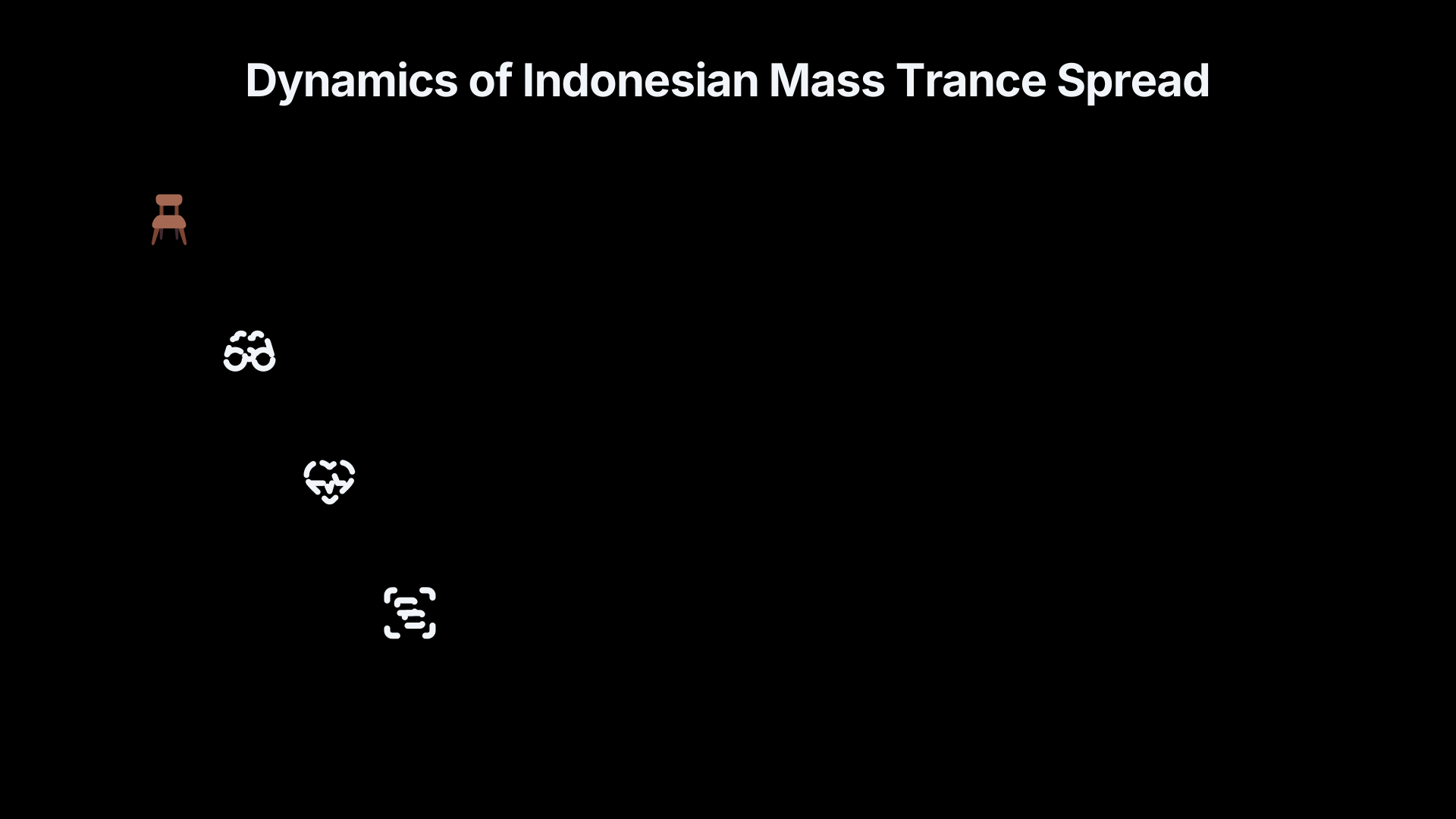
A striking feature of Indonesian outbreaks was their speed. Witnesses often described one student or worker collapsing or screaming before others nearby began displaying similar symptoms. The spread usually depended on people seeing, hearing or learning about earlier cases, making classrooms, dormitories and factory floors especially vulnerable.
Researchers tracing outbreaks between late 2005 and early 2008 identified repeated incidents involving schoolgirls and women working in manufacturing industries across several provinces. Indonesian television and newspapers carried dramatic footage, including a widely reported 2008 incident at a school on Sumbawa, further increasing public awareness of similar events elsewhere. Contemporary reporting also described outbreaks in cigarette, garment and electronics factories employing large numbers of young women.[ResearchGate]researchgate.netResearchGate(PDF) Understanding the Mass Trance Phenomenon in Indonesia: Between Traditional Beliefs and Community Mental HealthJuly 1, 2008…
Medical research on mass psychogenic illness worldwide describes almost the same pattern. Episodes frequently begin with an apparent trigger, spread through observation and expectation rather than physical contact, and are most likely where people share close social ties and common sources of stress. Rumours, uncertainty and intensive media attention can amplify the process.[PubMed]pubmed.ncbi.nlm.nih.govFactors related to the occurrence of mass psychogenic illness in schools: a systematic review - PubMedJune 19, 2025…
What Witnesses Saw During an Outbreak
Although individual cases differed, reports showed a remarkably consistent cluster of behaviours:
- sudden screaming or crying;
- fainting or collapse;
- shaking or jerking movements;
- rigid posture or apparent paralysis;
- unusual speech or voices interpreted as possession;
- confusion, panic or temporary loss of awareness.
Many participants later recovered without lasting physical injury. Medical investigations generally failed to identify toxins, infectious disease or other environmental causes affecting everyone involved. That absence of a shared physical cause does not mean the symptoms were imagined. Modern understanding of mass psychogenic illness emphasises that distress is experienced as real even when psychological and social mechanisms explain how it spreads.[New England Journal of Medicine]nejm.orgOpen source on nejm.org.
Indonesian reports also noted that outbreaks often ceased after affected people were separated from the group, taken home or reassured, another feature commonly observed in documented episodes of mass psychogenic illness internationally.[New England Journal of Medicine]nejm.orgOpen source on nejm.org.
Stress, Gender and Institutional Pressure
One of the most consistent patterns was who became affected. Most reported cases involved adolescent girls in secondary schools or young women employed in factories.
Researchers caution against treating this simply as a biological difference. Instead, they point to the social environments shared by many of those affected:
- highly structured institutions with limited personal autonomy;
- long hours of study or repetitive industrial work;
- pressure to conform;
- homesickness among boarding students;
- fatigue and emotional strain;
- restricted opportunities to express conflict openly.
Factory outbreaks attracted particular attention because many workers were migrants living away from home while performing repetitive work under production targets. Journalists interviewing workers found that some themselves linked episodes to exhaustion, poor sleep and emotional pressure, even while interpreting the experience through local beliefs about spirits.[ResearchGate]researchgate.netResearchGate(PDF) Understanding the Mass Trance Phenomenon in Indonesia: Between Traditional Beliefs and Community Mental HealthJuly 1, 2008…
Psychologists studying Indonesian school cases likewise argue that outbreaks cannot be understood purely as individual psychiatric disorders. Instead, they emerge through interaction within a group, where emotional reactions, observation and imitation reinforce one another.[eJournal of Sunan Gunung Djati]journal.uinsgd.ac.ideJournal of Sunan Gunung DjatiKesurupan Massal di Sekolah Menengah: Kerasukan Roh Jahat atau Emotional Contagion? | Psympathic: Jurnal I…
Possession Beliefs, Media and Medical Caution
The distinctive Indonesian feature is that many communities already possessed a familiar cultural framework for interpreting unusual behaviour. Rather than describing the events as panic attacks or stress reactions, teachers, parents and neighbours frequently understood them as episodes of spirit possession.
For many participants, these explanations were not irrational inventions but meaningful interpretations rooted in local religious and cultural traditions. Belief in spirits shaped expectations about what symptoms looked like, how they spread and who should respond. Religious figures were therefore often called alongside medical personnel.
Mental health specialists have generally urged caution against treating either explanation as sufficient on its own. Medical teams are expected first to exclude poisoning, infection or other physical hazards before considering a diagnosis of mass psychogenic illness. At the same time, dismissing local beliefs outright can increase fear and reduce trust in health authorities. Effective responses often combine medical assessment, reassurance and culturally sensitive communication.[New England Journal of Medicine]nejm.orgOpen source on nejm.org.

How Researchers Explain the Outbreaks Today
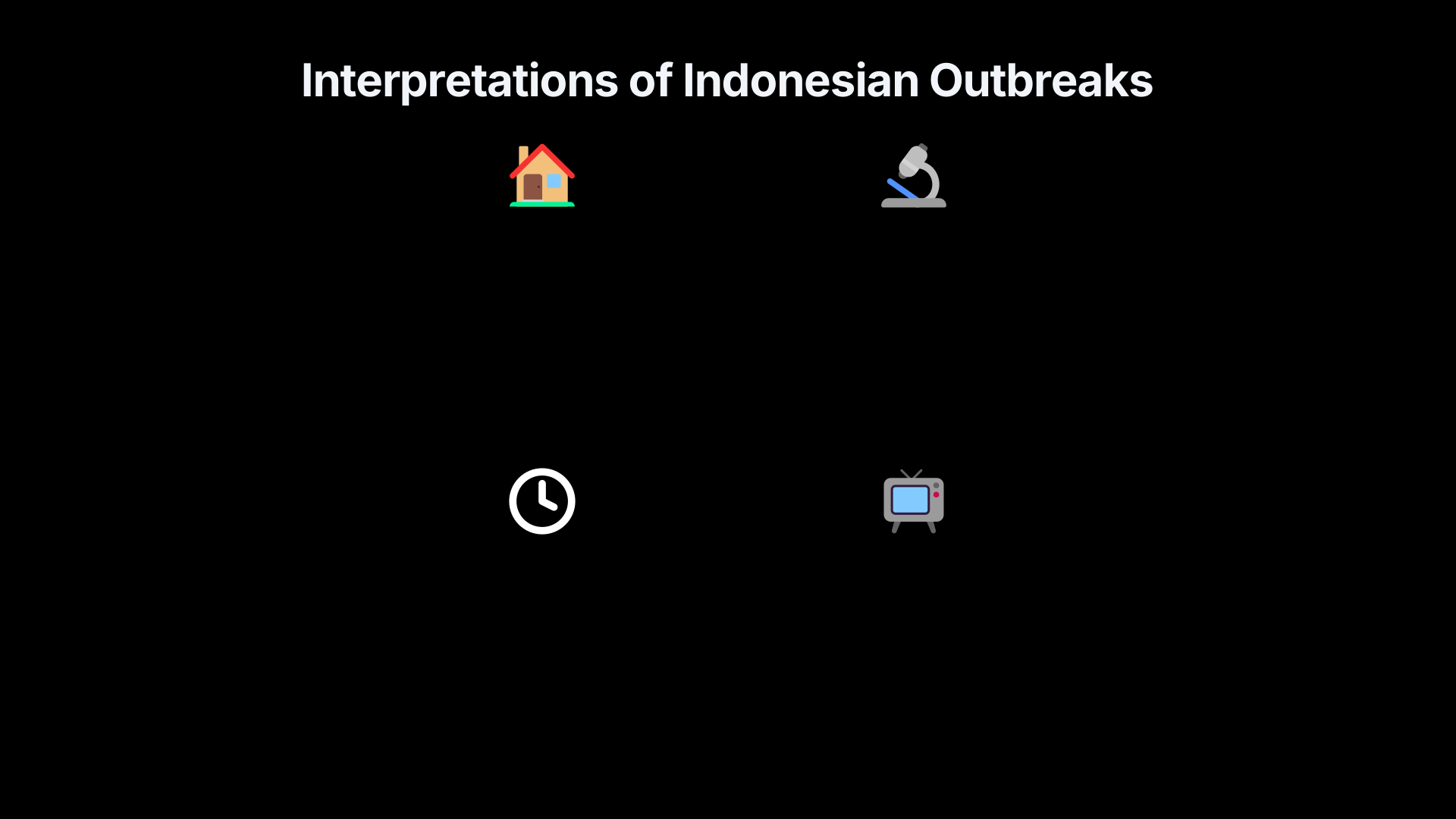
Recent Indonesian research has moved beyond the simple opposition between “real possession” and “mass hysteria”. Studies of schools experiencing repeated outbreaks identify several interacting factors:
- emotional stress within the group;
- strong belief in supernatural explanations;
- suggestibility and expectation;
- emotional contagion through observation;[journal.uinsgd.ac.id]journal.uinsgd.ac.ideJournal of Sunan Gunung DjatiKesurupan Massal di Sekolah Menengah: Kerasukan Roh Jahat atau Emotional Contagion? | Psympathic: Jurnal I…
- imitation of visible symptoms;
- previous mystical experiences among participants;
- reinforcement through discussion and media reporting.
Rather than viewing these as competing explanations, researchers argue that cultural beliefs influence how psychological distress is expressed. A community that interprets unusual behaviour as possession may experience genuine episodes that spread through shared expectation and emotional contagion, even without any identifiable environmental cause.[eJournal of Sunan Gunung Djati]journal.uinsgd.ac.ideJournal of Sunan Gunung DjatiKesurupan Massal di Sekolah Menengah: Kerasukan Roh Jahat atau Emotional Contagion? | Psympathic: Jurnal I…
International reviews of school outbreaks reach similar conclusions. Rumours, community anxiety, lack of trust in official explanations, media attention, psychological stress and close physical proximity repeatedly appear as factors that help outbreaks expand after the first case occurs.[PubMed]pubmed.ncbi.nlm.nih.govFactors related to the occurrence of mass psychogenic illness in schools: a systematic review - PubMedJune 19, 2025…
Why These Episodes Still Matter
Indonesia’s mass trance outbreaks remain important because they illustrate how collective behaviour can emerge where cultural belief, institutional pressure and social psychology intersect. They are neither simply evidence of supernatural belief nor merely examples of irrational panic.
The episodes also demonstrate why careful investigation matters. Public health officials must first rule out environmental dangers, while educators and employers need to recognise how chronic stress, uncertainty and group dynamics can produce genuine distress. For historians and social scientists, these outbreaks offer a window into the ways communities make sense of suffering, especially when emotional strain is expressed through culturally familiar ideas about possession rather than clinical language.
Within Indonesia’s wider history of collective fears and contagious beliefs, the school and factory trance episodes stand apart because they are best understood not as campaigns against an imagined enemy, but as recurring expressions of shared distress inside demanding institutions, shaped as much by social conditions as by the beliefs through which participants interpreted their experiences.
Amazon book picks
Further Reading
Books and field guides related to Why Did Mass Trance Spread So Quickly?. Use these as the next step if you want deeper reading beyond the article.
Extraordinary Popular Delusions and the Madness of Crowds
Rating: 4.0/5 from 5 Google Books ratings
Classic exploration of contagious collective behaviour.

The Psychology of Pandemics
Explains psychological contagion and collective responses to perceived threats.


Endnotes
1.
Source: researchgate.net
Link:https://www.researchgate.net/publication/398363171_Understanding_the_Mass_Trance_Phenomenon_in_Indonesia_Between_Traditional_Beliefs_and_Community_Mental_Health
Source snippet
ResearchGate(PDF) Understanding the Mass Trance Phenomenon in Indonesia: Between Traditional Beliefs and Community Mental HealthJuly 1, 2008...
Published: July 1, 2008
2.
Source: researchgate.net
Link:https://www.researchgate.net/publication/237774917_KUDA_LUMPING_DAN_FENOMENA_KESURUPAN_MASSAL_DUA_STUDI_KASUS_TENTANG_KESURUPAN_DALAM_KEBUDAYAAN_JAWA
3.
Source: researchgate.net
Title: (PDF) Industrial mass psychogenic illness: The unfashionable diagnosis
Link:https://www.researchgate.net/publication/12320945_Industrial_mass_psychogenic_illness_The_unfashionable_diagnosis
4.
Source: pubmed.ncbi.nlm.nih.gov
Link:https://pubmed.ncbi.nlm.nih.gov/40537604/
Source snippet
Factors related to the occurrence of mass psychogenic illness in schools: a systematic review - PubMedJune 19, 2025...
Published: June 19, 2025
5.
Source: nejm.org
Link:https://www.nejm.org/doi/full/10.1056/NEJM200001133420206
6.
Source: nejm.org
Link:https://www.nejm.org/doi/abs/10.1056/NEJM200001133420206
7.
Source: journal.uinsgd.ac.id
Link:https://journal.uinsgd.ac.id/index.php/psy/article/view/7940
Source snippet
eJournal of Sunan Gunung DjatiKesurupan Massal di Sekolah Menengah: Kerasukan Roh Jahat atau Emotional Contagion? | Psympathic: Jurnal I...
8.
Source: pmc.ncbi.nlm.nih.gov
Link:https://pmc.ncbi.nlm.nih.gov/articles/PMC4884863/
Source snippet
DISCUSSION Every year, an estimated four to six separate outbreaks of mass psychogenic illness reach public attention, but the actual fre...
9.
Source: pmc.ncbi.nlm.nih.gov
Link:https://pmc.ncbi.nlm.nih.gov/articles/PMC3536509/
Source snippet
December 1, 2012 —. 2012 Dec;105(12):509–512. doi: 10.1258/jrsm.2012.120053 MASS PSYCHOGENIC ILLNESS AND THE SOCIAL NETWORK: IS IT CH...
Published: December 1, 2012
10.
Source: pmc.ncbi.nlm.nih.gov
Link:https://pmc.ncbi.nlm.nih.gov/articles/PMC543940/
11.
Source: pubmed.ncbi.nlm.nih.gov
Link:https://pubmed.ncbi.nlm.nih.gov/15632400/
12.
Source: pubmed.ncbi.nlm.nih.gov
Link:https://pubmed.ncbi.nlm.nih.gov/19806834/
13.
Source: pubmed.ncbi.nlm.nih.gov
Link:https://pubmed.ncbi.nlm.nih.gov/18387030/
Additional References
14.
Source: garuda.kemdiktisaintek.go.id
Title: kemdiktisaintek.go.id Garuda
Link:https://garuda.kemdiktisaintek.go.id/documents/detail/4970736
Source snippet
Garba Rujukan DigitalMarch 22, 2024 — Journal of Educational, Health and Community Psychology * * * Vol 13 No 1 March 2024 DISSOCIATIVE S...
Published: March 22, 2024
15.
Source: youtube.com
Title: Episode 71. Frenzy – The Turmoil of Mass Psychogenic Illness
Link:https://www.youtube.com/watch?v=e2AdorYLDF8
Source snippet
The Razor-Thin Line Between Contagion and Connection | Dan Taberski | TED...
16.
Source: youtube.com
Title: The Razor-Thin Line Between Contagion and Connection | Dan Taberski | TED
Link:https://www.youtube.com/watch?v=u0fFIJapsRY
Source snippet
History's Most Incredible Cases Of Mass Hysteria...
17.
Source: youtube.com
Title: Collective Behavior & Social Movements: Key Concepts Explained
Link:https://www.youtube.com/watch?v=8oMm893Yk7Q
Source snippet
MASS PSYCHOSIS: How an Entire Society Becomes MENTALLY ILL...
18.
Source: cambridge.org
Link:https://www.cambridge.org/core/journals/the-british-journal-of-psychiatry/article/protean-nature-of-mass-sociogenic-illness/2BDC2262E104B8A33F3DD49773DA0D8B
Source snippet
Protean nature of mass sociogenic illness | The British Journal of Psychiatry | Cambridge CoreJanuary 2, 2018 — PROTEAN NATURE OF MASS SO...
Published: January 2, 2018
19.
Source: youtube.com
Title: History’s Most Incredible Cases Of Mass Hysteria
Link:https://www.youtube.com/watch?v=Js8pYoFJZj0
Source snippet
Collective Behavior & Social Movements: Key Concepts Explained...
20.
Source: youtube.com
Title: MASS PSYCHOSIS: How an Entire Society Becomes MENTALLY ILL
Link:https://www.youtube.com/watch?v=PItjfYd_j80
Source snippet
Mass Hysteria (Social Psychology Primer)...
21.
Source: ojs.unud.ac.id
Title: unud.ac.id POSSESSIO N, REVIEW FROM CULTURAL AND PSYCHIATRY | Medicina
Link:https://ojs.unud.ac.id/index.php/medicina/article/view/4949
22.
Source: namibian.com.na
Title: Mass trance afflicts women, factory workers
Link:https://www.namibian.com.na/mass-trance-afflicts-women-factory-workers/
23.
Source: theguardian.com
Title: Falling down | Psychology | The Guardian
Link:https://www.theguardian.com/science/2008/sep/18/psychology
Topic Tree