Within Ethiopia
Was Zar Possession Illness, Religion or Healing?
Zar traditions gave some Ethiopians a recognised way to interpret suffering, seek ritual help and gain social support without simply expelling the spirit.
On this page
- How spirits were linked to illness and misfortune
- What music, movement and ritual obligation achieved
- Why later scholars challenged older psychiatric labels
Page outline Jump by section
Introduction
Zar possession in Ethiopia is best understood not as a simple belief in evil spirits, nor as a form of mass hysteria, but as a culturally recognised way of making sense of persistent suffering. For many Ethiopians, especially in communities where Zar traditions were established, unexplained illness, infertility, emotional distress or repeated misfortune could be interpreted as the work of a spirit that demanded recognition rather than destruction. Instead of treating the affected person as irrational or dangerous, families often sought ritual specialists who used music, dancing, offerings and communal ceremonies to negotiate with the spirit and restore the person’s place within society. Anthropologists and cultural psychiatrists increasingly argue that these practices functioned not only as religious rituals but also as forms of social support, emotional expression and identity-building, challenging older attempts to dismiss Zar simply as mental illness.[PMC]pmc.ncbi.nlm.nih.govOpen source on nih.gov.

How spirits became linked to illness and misfortune
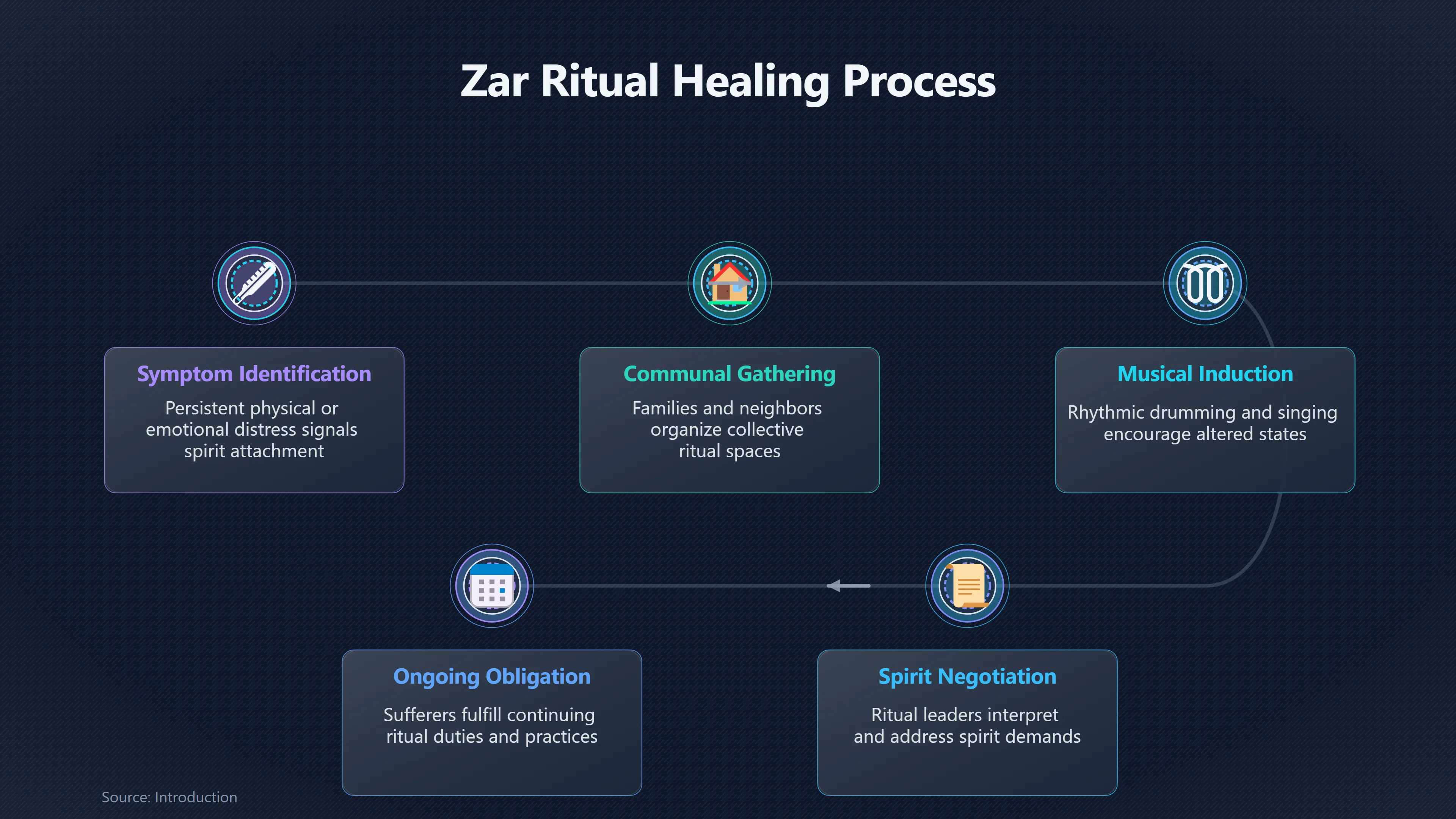
In Ethiopian Zar traditions, illness was not always viewed as a purely physical problem. When headaches, exhaustion, infertility, chronic pain or dramatic behavioural changes resisted ordinary treatment, some communities interpreted these conditions as signs that a Zar spirit had attached itself to a person. The spirit was believed to have its own personality, preferences and demands, and healing depended on learning how to live with it rather than simply forcing it to leave.[PMC]pmc.ncbi.nlm.nih.govOpen source on nih.gov.
This interpretation served several social purposes. It gave an understandable explanation for suffering that otherwise seemed arbitrary, while also creating a recognised pathway for help. Rather than isolating someone whose behaviour had become frightening or difficult to explain, relatives could organise rituals that acknowledged both the person’s distress and the wider community’s responsibility to respond.
Anthropologist Allan Young, whose fieldwork examined Amhara Zar communities, argued that possession should not be reduced to superstition. Different Ethiopian regions maintained distinct rituals and beliefs, and possession reflected local social relationships as much as religious ideas. He also noted that Ethiopia differed from several neighbouring countries because men as well as women could become recognised Zar sufferers in significant numbers, demonstrating that the tradition cannot simply be explained as a women’s phenomenon.[PMC]pmc.ncbi.nlm.nih.govOpen source on nih.gov.
What music, movement and ritual obligation achieved
Healing ceremonies centred on collective participation rather than private treatment. Music, rhythmic drumming, singing and prolonged dancing encouraged altered states in which the possessing spirit could be identified and addressed. Ritual leaders interpreted the spirit’s wishes, while family members and neighbours took part in supporting the afflicted person.
From an outside perspective these ceremonies could appear dramatic, but participants generally understood them as structured and purposeful. The aim was rarely a complete exorcism. Instead, rituals sought an accommodation between the spirit and the individual. Once the spirit’s identity and expectations had been recognised, sufferers were often expected to fulfil continuing ritual obligations, attend future ceremonies or observe particular practices that maintained the relationship.[PMC]pmc.ncbi.nlm.nih.govOpen source on nih.gov.
These gatherings also created an important social space. People experiencing chronic distress were surrounded by others with similar experiences, reducing isolation and providing a shared language for suffering. Anthropologists have therefore compared some aspects of Zar ceremonies to group support or group psychotherapy, although the comparison should not erase their religious meaning for participants. The healing depended on the entire cultural system of beliefs, relationships and ritual authority rather than on psychological techniques alone.[ResearchGate]researchgate.netResearch Gate Group Therapy and Social Status in the Zar Cult of EthiopiaResearch Gate Group Therapy and Social Status in the Zar Cult of Ethiopia
More than illness: identity and social belonging
One reason Zar traditions endured is that they offered sufferers a recognised social identity instead of simple exclusion. A person experiencing repeated episodes of possession was not necessarily regarded as permanently mad. Instead, they became someone living with a particular spiritual condition that required care, ritual knowledge and community involvement.
This distinction mattered because it could preserve family relationships and social status. Instead of defining an individual solely through disability or unexplained behaviour, Zar beliefs located suffering within a wider moral and spiritual world that relatives already understood. The rituals also strengthened networks among participants who shared similar experiences, reinforcing a sense of belonging even while acknowledging continuing vulnerability.[ResearchGate]researchgate.netResearch Gate Group Therapy and Social Status in the Zar Cult of EthiopiaResearch Gate Group Therapy and Social Status in the Zar Cult of Ethiopia
At the same time, Zar traditions were not universally accepted across Ethiopia. Different religious communities interpreted possession differently, and many Orthodox Christian, Muslim and later Protestant groups developed their own explanations and healing practices. The existence of Zar therefore reflects Ethiopia’s religious diversity rather than a single national belief.
Why later scholars challenged older psychiatric labels
Twentieth-century psychiatry often classified spirit possession as evidence of psychosis, hysteria or other psychiatric disorders. Researchers working with Ethiopian migrants later showed why this approach could be misleading.
Studies of Ethiopian immigrants in Israel documented cases in which Zar possession was initially mistaken for severe mental illness because patients displayed altered consciousness, involuntary movements, mutism or unfamiliar speech. Once clinicians understood the cultural background, many recognised that these behaviours belonged to a well-established possession tradition rather than automatically indicating schizophrenia or another major psychiatric disorder. Misunderstanding the cultural context had sometimes resulted in unnecessary psychiatric admissions and inappropriate treatment.[PubMed]pubmed.ncbi.nlm.nih.govThe 'Zar' possession syndrome among Ethiopian immigrants to Israel: cultural and clinical aspects - PubMed…
As cultural psychiatry developed, scholars increasingly argued that Zar should be understood as a culturally shaped expression of distress rather than dismissed as irrational belief. This shift also influenced international diagnostic thinking. Modern psychiatric frameworks emphasise the importance of recognising “cultural concepts of distress” so that clinicians distinguish between culturally meaningful practices and mental disorders requiring different forms of intervention.[PMC]pmc.ncbi.nlm.nih.govOpen source on nih.gov.
This does not mean every reported possession experience is free from mental illness. People participating in Zar rituals may also experience depression, trauma, anxiety or neurological disorders. The key insight is that cultural interpretation affects how symptoms are expressed, understood and treated. Good clinical practice therefore requires attention to both medical evidence and cultural meaning rather than assuming one excludes the other.[PMC]pmc.ncbi.nlm.nih.govOpen source on nih.gov.
Why Zar remains historically important
Within Ethiopia’s wider history of collective belief, Zar stands apart from moral panics or episodes of collective fear because it was primarily a recognised system of healing rather than a campaign against supposed enemies. Instead of identifying witches or spreading rumours that threatened outsiders, Zar traditions created rituals through which communities interpreted suffering, negotiated identity and provided practical support.
For historians, anthropologists and psychologists, Zar demonstrates that beliefs about spirits cannot be understood solely as mistaken explanations of disease. They also organise care, define social roles and offer culturally meaningful responses to experiences that modern medicine alone may not fully explain. This makes Zar one of Ethiopia’s most important examples of how religion, emotional distress and communal healing became intertwined without fitting neatly into either the category of mental illness or that of simple folklore.
Amazon book picks
Further Reading
Books and field guides related to Was Zar Possession Illness, Religion or Healing?. Use these as the next step if you want deeper reading beyond the article.

The Spirit Catches You and You Fall Down
Examines culturally grounded healing traditions.
Endnotes
1.
Source: researchgate.net
Title: Research Gate Group Therapy and Social Status in the Zar Cult of Ethiopia
Link:https://www.researchgate.net/publication/229720337_Group_Therapy_and_Social_Status_in_the_Zar_Cult_of_Ethiopia
2.
Source: pmc.ncbi.nlm.nih.gov
Link:https://pmc.ncbi.nlm.nih.gov/articles/PMC10889902/
Source snippet
oach study - PMC...
3.
Source: pmc.ncbi.nlm.nih.gov
Link:https://pmc.ncbi.nlm.nih.gov/articles/PMC4801492/
4.
Source: pubmed.ncbi.nlm.nih.gov
Link:https://pubmed.ncbi.nlm.nih.gov/8883974/
Source snippet
The 'Zar' possession syndrome among Ethiopian immigrants to Israel: cultural and clinical aspects - PubMed...
5.
Source: pmc.ncbi.nlm.nih.gov
Link:https://pmc.ncbi.nlm.nih.gov/articles/PMC3416742/
Source snippet
2012 Jul 12;12:79. doi: 10.1186/1471-244X-12-79 PERCEIVED CAUSES OF SEVERE MENTAL DISTURBANCE AND PREFERRED INTERVENTIONS BY THE BORANA S...
Additional References
6.
Source: karger.com
Link:https://karger.com/psp/article-abstract/30/4/223/283781/Possession-by-the-Zar-among-Ethiopian-Immigrants?redirectedFrom=PDF
Source snippet
Psychopathology | Karger PublishersFebruary 10, 2010 — Case Reports| February 10 2010 POSSESSION BY THE ‘ZAR’ AMONG ETHIOPIAN IMMIGRANT...
Published: February 10, 2010
7.
Source: sciencedirect.com
Title: ScienceDirect Health and the holy in African and Afro-American spirit possession
Link:https://www.sciencedirect.com/science/article/pii/027795368790133X
Source snippet
Health and the holy in African and Afro-American spirit possession - ScienceDirect...
8.
Source: youtube.com
Title: Music as Medicine in African Spirit Possession Rituals
Link:https://www.youtube.com/watch?v=yoEjbqfxWg0
Source snippet
Traditional Healing and Social Support Systems in Ethiopia...
9.
Source: youtube.com
Title: The Cultural Concept of Distress: Zar Spirit Possession
Link:https://www.youtube.com/watch?v=sbBuqrW6BHw
Source snippet
Music as Medicine in African Spirit Possession Rituals...
10.
Source: youtube.com
Title: Adorcism and Spiritual Negotiation in Zar Cults
Link:https://www.youtube.com/watch?v=u9OSmiUyu14
Source snippet
The Cultural Concept of Distress: Zar Spirit Possession...
11.
Source: karger.com
Link:https://karger.com/psp/article-abstract/30/4/223/283781/Possession-by-the-Zar-among-Ethiopian-Immigrants
12.
Source: karger.com
Link:https://karger.com/psp/article/30/4/223/283781/Possession-by-the-Zar-among-Ethiopian-Immigrants
13.
Source: eurekamag.com
Link:https://eurekamag.com/research/009/527/009527980.php
14.
Source: cris.bgu.ac.il
Link:https://cris.bgu.ac.il/en/publications/possession-by-the-zar-among-ethiopian-immigrants-to-israel-psycho/
15.
Source: cris.bgu.ac.il
Link:https://cris.bgu.ac.il/en/publications/the-zar-possession-syndrome-among-ethiopian-immigrants-to-israel–2/
Topic Tree