Within Guyana
Why Jonestown Was Not Mass Hysteria
Jonestown grew from idealism into an isolated system of coercion that ended in murder and forced death.
On this page
- Why the Peoples Temple moved to Guyana
- How isolation and coercion reshaped the settlement
- What happened on 18 November 1978
Page outline Jump by section
Introduction
Jonestown is often remembered as a shocking episode of “mass suicide”, but that description is incomplete and, in many respects, misleading. On 18 November 1978, 918 people died in north-west Guyana and nearby Georgetown in events connected to the Peoples Temple led by Jim Jones. Many of those who died were children who had no capacity to consent. Others were elderly, ill, or trapped in an armed settlement where escape had become extremely difficult. Survivors, investigators and many historians therefore describe Jonestown as a case of mass murder carried out within a system of coercive control rather than an example of spontaneous mass hysteria.[FBI]fbi.govJonestown — FBIJonestown — FBI…
Understanding why this distinction matters changes how the tragedy is interpreted. Jonestown was not the result of a crowd suddenly losing touch with reality. It developed over years through increasing isolation, authoritarian leadership, surveillance, punishment, rehearsals for collective death, and the gradual destruction of members’ ability to make free choices. Guyana provided the physical setting in which these processes reached their most extreme form.
Why Jonestown was not mass hysteria
The phrase “mass hysteria” suggests that large numbers of people independently succumbed to contagious irrational belief or emotional panic. That does not fit the evidence from Jonestown.
Instead, investigators and scholars point to a structured system of coercion. Jim Jones exercised almost complete authority over housing, food, work, medical care, communication and information. Armed guards patrolled the settlement, residents’ passports were held by Temple leaders, criticism was punished, and leaving became increasingly difficult. The community did not descend into chaos overnight; it was reshaped over several years into an environment where resistance carried severe risks.[FBI]fbi.govJonestown — FBIJonestown — FBI…
Several features distinguish Jonestown from episodes usually described as mass psychogenic illness or collective panic:
- Authority flowed from one dominant leader rather than from contagious rumours among equals.
- The settlement relied on surveillance, discipline and punishment rather than spontaneous emotional contagion.
- Many victims lacked meaningful freedom to refuse orders.
- Hundreds of children were killed by adults acting under organisational command.
- Violence against outsiders, including the murders at Port Kaituma airstrip, formed part of the same chain of events.
For these reasons, historians increasingly describe Jonestown as a case of coercive control culminating in organised mass murder, even though some adults may have accepted Jones’s final arguments or believed they had no alternative.
Why the Peoples Temple moved to Guyana
Guyana was not chosen by chance. By the mid-1970s the Peoples Temple faced growing media scrutiny, legal investigations and criticism from former members in California.
Jones wanted a location where he could create a self-contained agricultural community beyond the reach of hostile journalists and dissatisfied relatives. Guyana offered several advantages. It was English-speaking, its government promoted co-operative socialist development, and the proposed settlement lay in a remote area near the Venezuelan border where the Temple could present itself as contributing to agricultural development.[HISTORY]history.comJonestown - Massacre, Guyana & Cult | HISTORY…
Isolation served practical and psychological purposes simultaneously.
Physically, the distance made visits difficult, communications unreliable and departures expensive. Psychologically, Jones increasingly portrayed the outside world as racist, fascist and determined to destroy the Temple. Every disagreement with American authorities or journalists became evidence, in his telling, that persecution was inevitable. Distance from the United States therefore reinforced his narrative that only complete loyalty could ensure survival.
How isolation and coercion reshaped the settlement
When many members first arrived, Jonestown was promoted as a co-operative farming community dedicated to racial equality and social justice. Conditions rapidly deteriorated.
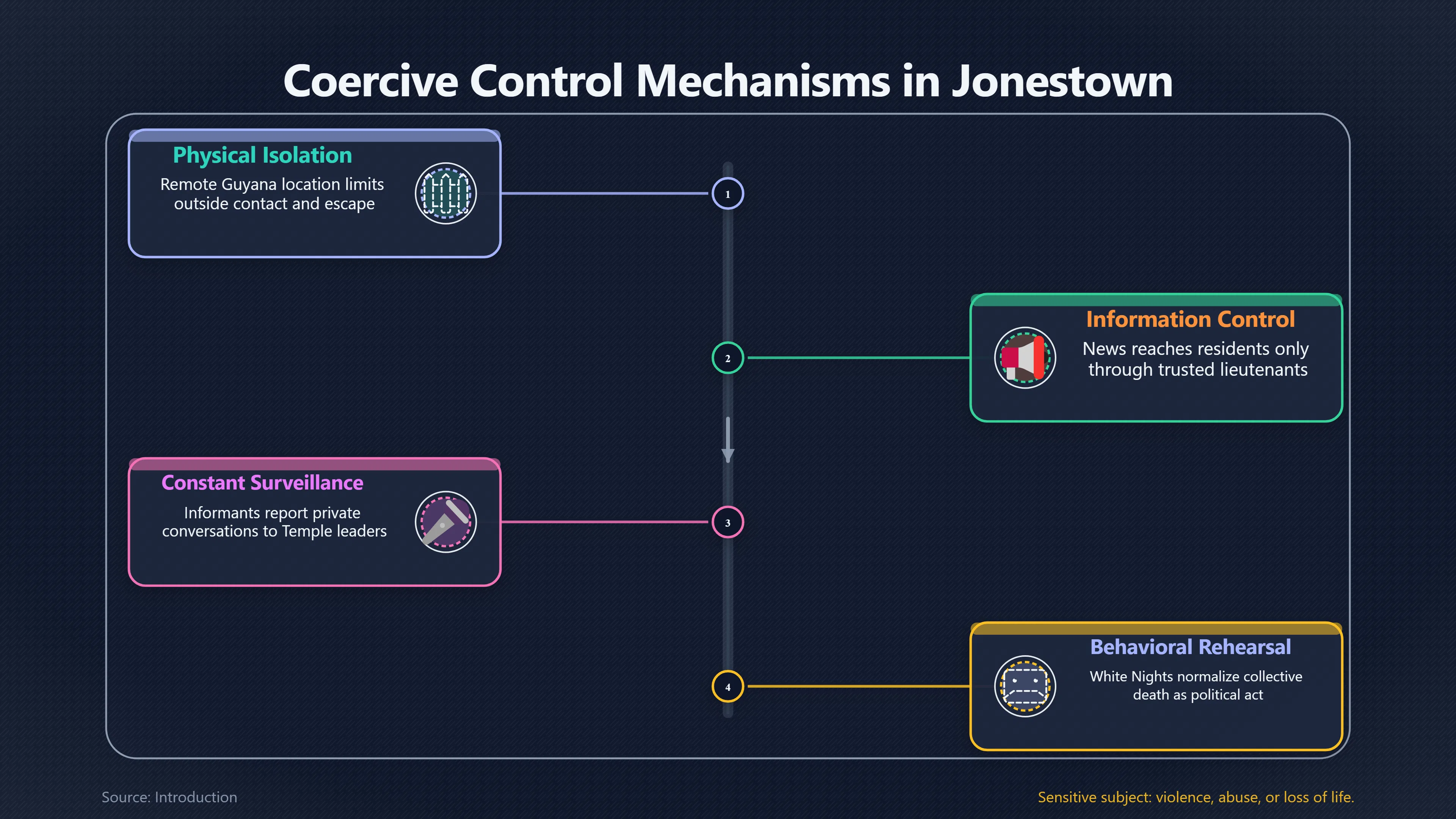
Residents worked long hours in difficult tropical conditions while receiving limited food and medical care. Loudspeakers broadcast Jones’s speeches throughout the settlement day and night. Mail and radio communications were monitored, visitors carefully managed and criticism discouraged. Informants reported conversations to Temple leaders, creating an atmosphere in which private disagreement became dangerous.[HISTORY]history.comJonestown - Massacre, Guyana & Cult | HISTORY…
Isolation alone did not produce mass killing. Rather, it enabled several reinforcing mechanisms:
- Dependence: the Temple controlled housing, employment, healthcare and supplies.
- Information control: outside news reached residents only through Jones or trusted lieutenants.
- Fear: members were repeatedly warned that enemies planned torture, imprisonment or racist violence.
- Punishment: dissenters could face public humiliation, confinement or physical abuse.
- Exhaustion: long working days and interrupted sleep reduced opportunities for independent reflection.
These conditions made it progressively harder for residents to compare Jones’s claims with reality or organise collective resistance.
The role of “White Nights”
One of the most revealing features of Jonestown was the repeated rehearsal known as a “White Night”.
Residents were summoned without warning and told they faced imminent destruction by outside enemies. Some rehearsals involved loyalty tests in which members believed they were consuming poison before being told it was harmless. Others required public declarations of willingness to die for the community. Surviving recordings show Jones using these events to reinforce obedience and portray death as preferable to capture.[archives.sdsu.edu]archives.sdsu.eduPeoples Temple Collection; Box 18, Virtual Item 18, Q635Part 2, White Night, berating Stanley Clayton (April 12, 1978) | Special Collections & University Archives Finding Aid DatabaseApril 12…
These rehearsals mattered because they normalised extraordinary behaviour long before the final day. By repeatedly framing collective death as an honourable political act, Jones reduced the psychological barrier to later violence while identifying anyone reluctant to comply.
What happened on 18 November 1978
The immediate trigger came after United States Congressman Leo Ryan visited Jonestown to investigate allegations of abuse.
Although Jones initially presented the settlement as harmonious, several residents secretly asked to leave with Ryan’s delegation. As the group prepared to depart from Port Kaituma airstrip on 18 November, Temple gunmen attacked, killing Ryan, three journalists and Temple member Patricia Parks while seriously wounding others.[FBI]fbi.govJonestown — FBIJonestown — FBI…
Back at Jonestown, Jones announced that retaliation by American authorities was inevitable. An audio recording recovered afterwards—the so-called “death tape”—captures his final address, discussions among senior followers and the organised killing that followed. The recording shows that not everyone agreed with Jones, and that objections were voiced before being overridden.[FBI]fbi.govJonestown — FBIJonestown — FBI…
Children were killed first, generally by poison administered by parents or nurses under Temple direction. Adults then died from poison, while armed guards surrounded the gathering. Some victims appear to have been injected rather than drinking voluntarily, and the presence of weapons, coercion and prior rehearsals has led many researchers to reject the simple description of the event as voluntary mass suicide.[HISTORY]history.comJonestown - Massacre, Guyana & Cult | HISTORY…
The final death toll reached 918 across Jonestown and Georgetown, making it one of the deadliest incidents involving an American-led religious movement in history.
Why some people stayed while others tried to escape
A persistent misconception is that everyone in Jonestown believed equally in Jones’s ideology until the end.
The historical record shows a much more complicated picture. Some residents remained loyal. Others feared punishment. Some believed escape through the surrounding jungle was impossible. Many had surrendered their finances and had nowhere obvious to return to in the United States. Families were deeply intertwined, making individual departure emotionally difficult even before physical barriers were considered.[FBI]fbi.govJonestown — FBIJonestown — FBI…
At the same time, evidence demonstrates that dissatisfaction was growing. Several residents defected during Ryan’s visit despite knowing the risks. Others escaped into the jungle during the final hours and survived. Their testimony helped investigators reconstruct the system of intimidation operating inside the settlement.[FBI]fbi.govJonestown — FBIJonestown — FBI…
How Jonestown changed the understanding of destructive movements
Jonestown profoundly altered public discussion of charismatic leadership and new religious movements.
Initially, media coverage often reduced the tragedy to a bizarre story about fanatical believers. Later scholarship has shifted attention towards coercive environments, psychological dependence and organisational control. Researchers increasingly examine how ordinary people can become trapped in abusive systems without assuming they were irrational from the beginning.
The case also encouraged greater attention to warning signs including:
- concentration of unchecked authority in one leader;
- increasing isolation from relatives and independent information;
- demands for total loyalty;
- punishment of dissent;
- rehearsals or rhetoric normalising violence or collective death;
- control over members’ movement, finances and identity documents.
These features have informed later studies of coercive organisations across religious, political and secular settings.
Why Jonestown remains culturally important
Jonestown continues to shape public language, but often inaccurately. Expressions such as “drinking the Kool-Aid” reduce an event involving hundreds of murdered children and many coerced adults to a casual metaphor for blind loyalty. Historians, survivors and relatives have increasingly criticised this phrase because it obscures the violence, coercion and human suffering involved.[Time]time.comThe Story of the Jonestown Massacre Is About Much More Than Jim JonesWe've Been Fighting to Tell It for DecadesThe Jonestown Massacre, which occurred on November 18, 1978, resulted in the death of 918 Ameri…
Within Guyana, Jonestown occupies an unusual place in national history. The settlement was created by an American movement, yet the killings occurred on Guyanese soil and drew the country’s authorities into one of the twentieth century’s most notorious crimes. For Guyana, the tragedy remains part of its history without defining the wider story of the nation.
The enduring lesson is not that large groups inevitably succumb to irrational panic. Rather, Jonestown demonstrates how charismatic authority, isolation, fear and coercive control can gradually dismantle individual judgement and collective resistance until organised violence becomes possible. Understanding that process is more historically accurate—and more useful—than treating the tragedy as an inexplicable episode of mass hysteria.
Amazon book picks
Further Reading
Books and field guides related to Why Jonestown Was Not Mass Hysteria. Use these as the next step if you want deeper reading beyond the article.

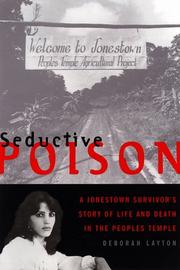
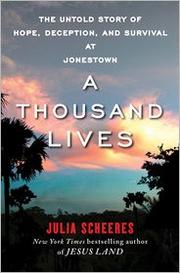
A Thousand Lives
Shows why many victims were trapped rather than willing participants.
Endnotes
1.
Source: fbi.gov
Title: Jonestown — FBI
Link:https://www.fbi.gov/history/cases-and-criminals/jonestown
Source snippet
Jonestown — FBI...
2.
Source: time.com
Title: The Story of the Jonestown Massacre Is About Much More Than Jim Jones
Link:https://time.com/6120017/jonestown-massacre-survivors/
Source snippet
We've Been Fighting to Tell It for DecadesThe Jonestown Massacre, which occurred on November 18, 1978, resulted in the death of 918 Ameri...
Published: November 18, 1978
3.
Source: history.com
Link:https://www.history.com/articles/jonestown
Source snippet
Jonestown - Massacre, Guyana & Cult | HISTORY...
4.
Source: archives.sdsu.edu
Title: Peoples Temple Collection; Box 18, Virtual Item 18, Q635
Link:https://archives.sdsu.edu/repositories/2/digital_objects/1321
Source snippet
Part 2, White Night, berating Stanley Clayton (April 12, 1978) | Special Collections & University Archives Finding Aid DatabaseApril 12...
Published: April 12, 1978
5.
Source: vault.fbi.gov
Title: — Federal Bureau of Investigation
Link:https://vault.fbi.gov/jonestown
Source snippet
FBI — Federal Bureau of Investigation...
6.
Source: history.com
Title: jonestown jim jones mass murder suicide
Link:https://www.history.com/articles/jonestown-jim-jones-mass-murder-suicide?linkId=59818646
7.
Source: jonestown.sdsu.edu
Link:https://jonestown.sdsu.edu/?page_id=33230
8.
Source: archives.fbi.gov
Title: jonestown 111607
Link:https://archives.fbi.gov/archives/news/stories/2007/november/jonestown_111607
9.
Source: archives.sdsu.edu
Title: digital objects
Link:https://archives.sdsu.edu/repositories/2/digital_objects/1288
10.
Source: vault.fbi.gov
Link:https://vault.fbi.gov/jonestown?b_start%3Aint=100
11.
Source: vault.fbi.gov
Link:https://vault.fbi.gov/jonestown?b_start%3Aint=150
12.
Source: vault.fbi.gov
Link:https://vault.fbi.gov/jonestown?b_start%3Aint=250
13.
Source: vault.fbi.gov
Link:https://vault.fbi.gov/jonestown?b_start%3Aint=50
14.
Source: vault.fbi.gov
Link:https://vault.fbi.gov/jonestown?b_start%3Aint=200
15.
Source: vault.fbi.gov
Title: atct topic view
Link:https://vault.fbi.gov/jonestown/jonestown/atct_topic_view?b_start%3Aint=250
16.
Source: youtube.com
Link:https://www.youtube.com/watch?v=qx5PadQkuOk
17.
Source: openlibrary.org
Title: White night
Link:https://openlibrary.org/books/OL4431170M/White_night
18.
Source: encyclopedia.com
Link:https://www.encyclopedia.com/social-sciences/encyclopedias-almanacs-transcripts-and-maps/jonestown
Additional References
19.
Source: researchportal.bath.ac.uk
Link:https://researchportal.bath.ac.uk/en/publications/leadership-and-discursive-mobilizing-of-collective-action-in-the-/
Source snippet
and discursive mobilizing of collective action in the Jonestown mass killing - the University of Bath's research portalJune 19, 2024 — LE...
Published: June 19, 2024
20.
Source: youtube.com
Link:https://www.youtube.com/watch?v=2acHb0yRhAQ
Source snippet
4 An Eyewitness Account | Cult Massacre: One Day in Jonestown | National Geographic UK...
21.
Source: theguardian.com
Title: The Guardian’It wasn’t suicide
Link:https://www.theguardian.com/tv-and-radio/article/2024/jun/18/cult-massacre-jonestown-review
Source snippet
they were murdered': inside the Jonestown cult massacreThe Jonestown massacre, led by Jim Jones, is highlighted in a new documentary seri...
22.
Source: youtube.com
Link:https://www.youtube.com/watch?v=AqKpA_3KQRc
Source snippet
5 Jonestown - The Terrible Fate of the People's Temple | Free Documentary History...
23.
Source: pubmed.ncbi.nlm.nih.gov
Link:https://pubmed.ncbi.nlm.nih.gov/38894692/
Source snippet
2024 Oct;63(4):2121-2134. doi: 10.1111/bjso.12772. Epub 2024 Jun 19. AUTHORS Kevin Durrheim...
24.
Source: bpspsychub.onlinelibrary.wiley.com
Link:https://bpspsychub.onlinelibrary.wiley.com/doi/abs/10.1111/bjso.12772
Source snippet
and discursive mobilizing of collective action in the Jonestown mass killing - Durrheim - 2024 - British Journal of Social Psychology - W...
25.
Source: youtube.com
Title: Jim Jones’ Son Tells the Inside Story of the Peoples Temple Cult
Link:https://www.youtube.com/watch?v=FQa68cir1mU
Source snippet
2 Inside Jim Jones' Cult | Jonestown...
26.
Source: pubmed.ncbi.nlm.nih.gov
Link:https://pubmed.ncbi.nlm.nih.gov/2087766/
27.
Source: openlibrary.org
Link:https://openlibrary.org/books/OL4102145M
Topic Tree