Within Philippine Belief Crises
Were Millenarian Believers Really Just Fanatics?
Philippine renewal movements mixed prophecy, folk Catholicism and demands for land, dignity and national liberation.
On this page
- How prophecy became a language of justice
- Rizal centred movements and rural political hopes
- Why the label 'cult' distorted public understanding
Page outline Jump by section
Introduction
Religious movements in the Philippines have often been described as outbreaks of irrational fanaticism. Yet historians increasingly argue that many so-called millenarian movements were also political movements that expressed demands for land, justice, dignity and national self-determination when formal institutions offered little hope. Rather than separating religion from politics, these communities blended prophecy, Catholic symbolism, indigenous traditions and anti-colonial nationalism into a language that ordinary rural people understood. Their expectations of a transformed world were not simply fantasies about the end of history; they were often practical responses to colonial domination, economic inequality and social exclusion.[google.com]books.google.comPasyon and RevolutionGoogle BooksPasyon and Revolution: Popular Movements in the Philippines, 1840-1910 - Reynaldo Clemeña Ileto - Google Books…
Understanding these movements therefore requires moving beyond the stereotype of the “fanatical cult”. Some groups became involved in violent confrontation, while others remained peaceful devotional communities. Their beliefs varied enormously, but they shared a conviction that spiritual renewal and social justice belonged together.
Were Millenarian Believers Really Just Fanatics?
For much of the twentieth century, colonial officials and some early scholars explained Philippine millenarian movements as evidence of peasant irrationality or social disorientation. Such interpretations drew heavily on theories of “revitalisation movements” and tended to portray rural believers as reacting emotionally to rapid change rather than making conscious political choices.[Philippine Social Science Council]pssc.org.phPhilippine Social Science Council•A CRITIQUE OF PRESENT SCHOLARSIDP ON RIZAUST CUL…
Later historians challenged this picture. Reynaldo Ileto’s influential Pasyon and Revolution argued that revolutionary politics cannot be understood without recognising how ordinary Filipinos interpreted Christian stories, especially the pasyon—the popular narrative of Christ’s suffering, death and resurrection. Rather than merely borrowing religious language, many anti-colonial activists understood liberation itself through these familiar sacred narratives. Religious symbolism helped communicate ideas of sacrifice, redemption and freedom to people excluded from elite political discourse.[Google Books]books.google.comPasyon and RevolutionGoogle BooksPasyon and Revolution: Popular Movements in the Philippines, 1840-1910 - Reynaldo Clemeña Ileto - Google Books…
Floro Quibuyen extended this criticism by arguing that describing these movements simply as “cults” ignored class conflict, colonial power and the participants’ own political reasoning. Labelling them irrational often reflected the assumptions of outside observers more than the beliefs of the movements themselves.[Philippine Social Science Council]pssc.org.phPhilippine Social Science Council•A CRITIQUE OF PRESENT SCHOLARSIDP ON RIZAUST CUL…
How Prophecy Became a Language of Justice
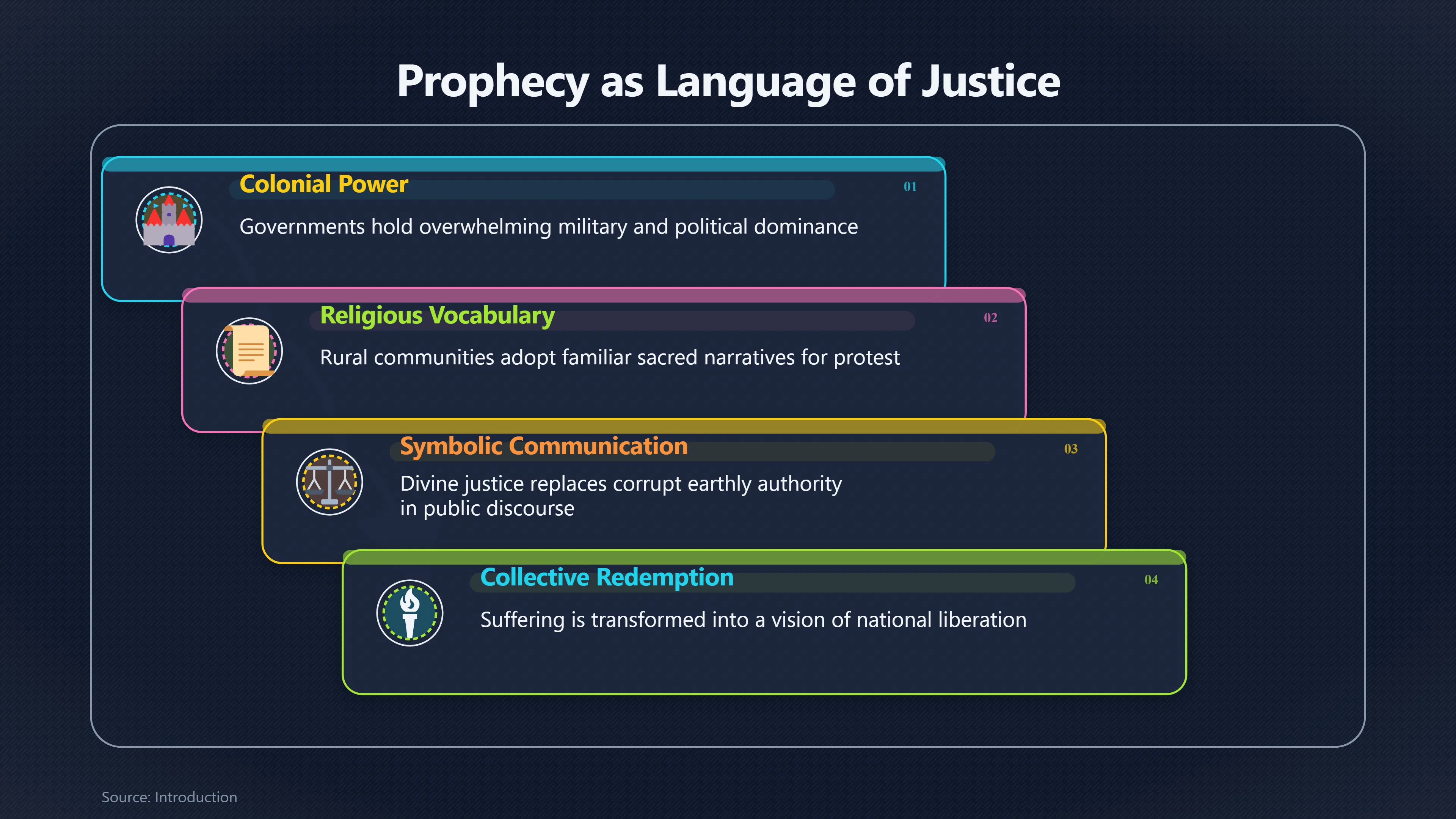
Colonial and later postcolonial governments frequently possessed overwhelming military and political power. Rural communities possessed few peaceful ways to challenge landlords, colonial officials or economic inequality. Religious prophecy therefore became a powerful form of political communication.
Instead of presenting social protest in modern ideological language, many movements expressed hopes through familiar religious images:
- divine justice replacing corrupt earthly authority;
- the arrival of a morally renewed society;
- sacred protection for oppressed communities;
- the belief that national liberation formed part of God’s plan;
- expectations that suffering would eventually be transformed into collective redemption.
This did not mean participants rejected politics. Rather, religious belief provided the vocabulary through which political demands could be understood by communities shaped by centuries of Catholic practice alongside older indigenous traditions. Scholars increasingly view prophecy as one cultural language among several through which rural Filipinos organised resistance.[google.com]books.google.comPasyon and RevolutionGoogle BooksPasyon and Revolution: Popular Movements in the Philippines, 1840-1910 - Reynaldo Clemeña Ileto - Google Books…
The connection between faith and protest also reflected everyday experience. Churches, pilgrimage sites and devotional networks already linked villages across large regions. These existing religious communities could become channels through which new political hopes travelled.
Rizal-Centred Movements and Rural Political Hopes
No figure illustrates the blending of religion and nationalism more clearly than José Rizal.
After his execution by the Spanish colonial government in 1896, Rizal became not only the country’s foremost nationalist hero but, for some independent religious movements, a sacred figure whose death carried redemptive meaning. Different Rizalist communities developed distinct beliefs. Some honoured him as an inspired prophet, others regarded him as a divine agent or even identified him with Christ within uniquely Filipino religious cosmologies. These interpretations varied widely and should not be treated as a single movement.[MDPI]mdpi.comUnderstanding Folk Religiosity in the PhilippinesUnderstanding Folk Religiosity in the Philippines…
Many Rizalist organisations also carried political aspirations.
Their communities frequently appealed to:
- moral regeneration of the nation;
- greater dignity for rural Filipinos;
- resistance to foreign domination;
- protection from economic exploitation;
- hopes for a more equal social order.
Mount Banahaw became especially important for several of these movements as a sacred landscape where spiritual renewal and national destiny were believed to intersect. Pilgrimage, healing rituals and nationalist symbolism reinforced one another rather than existing as separate spheres of belief.[MDPI]mdpi.comUnderstanding Folk Religiosity in the PhilippinesUnderstanding Folk Religiosity in the Philippines…
Importantly, not every Rizalist organisation pursued confrontation with the state. Some functioned primarily as devotional or healing communities, while others became associated with political mobilisation. Treating all Rizalist groups as identical obscures considerable diversity.
Sacred Protest Beyond Rizal
The wider history of Philippine millenarianism stretches far beyond Rizalist communities.
Historians often trace a continuing tradition linking movements such as the Cofradía de San José led by Hermano Pule in the nineteenth century, later revolutionary brotherhoods, the resistance associated with Felipe Salvador’s Santa Iglesia, and numerous regional peasant movements. While their doctrines differed, they repeatedly fused religious authority with demands for political justice.[Google Books]books.google.comPasyon and RevolutionGoogle BooksPasyon and Revolution: Popular Movements in the Philippines, 1840-1910 - Reynaldo Clemeña Ileto - Google Books…
Similar patterns appeared elsewhere in the archipelago. Studies of Negros, for example, show recurring religio-political movements that combined Catholic symbolism, local traditions, nationalism and agrarian protest. Rather than appearing randomly, these movements tended to emerge during periods marked by poverty, unequal land ownership and political instability.[serp-p.pids.gov.ph]serp-p.pids.gov.phSER P-P: Socioeconomic Research Portal for the PhilippinesSER P-P: Socioeconomic Research Portal for the Philippines
The recurrence of such movements suggests that millenarian belief functioned less as an isolated psychological phenomenon than as a recurring social response to structural injustice.
Why the Label “Cult” Distorted Public Understanding
The word “cult” has frequently been applied to Philippine independent religious movements, but historians caution that the label often conceals more than it explains.
Colonial governments used language such as “fanatic”, “superstitious” or “religious disturbance” to delegitimise resistance. American colonial authorities similarly described some armed rural movements as “colorums”, a term that gradually became associated with illegal or subversive religious organisations. These labels could justify military suppression while avoiding engagement with the underlying grievances driving popular support.[Google Books]books.google.comPasyon and RevolutionGoogle BooksPasyon and Revolution: Popular Movements in the Philippines, 1840-1910 - Reynaldo Clemeña Ileto - Google Books…
Modern scholarship instead asks different questions:
- What social problems encouraged people to join?
- Which beliefs were genuinely religious, and which expressed political demands?
- How much violence came from the movement itself, and how much resulted from state repression?
- Did participants understand themselves primarily as creating a new religion, pursuing justice, or both?
These questions produce more nuanced histories than simply categorising movements as irrational sects.
Why These Movements Still Matter
Millenarian movements remain significant because they challenge familiar assumptions about religion and politics.
Their history shows that faith can become a language through which marginalised communities express demands for justice when conventional political participation seems ineffective. It also demonstrates how official labels influence historical memory. Movements dismissed as fanaticism during one period may later be recognised as expressions of anti-colonial nationalism, rural protest or struggles over social equality.
The Philippine experience therefore illustrates a broader historical lesson. Religious belief and political aspiration are not always competing forces. Under conditions of colonial rule, economic inequality and limited political representation, they often became inseparable. Understanding these movements requires taking both their spiritual convictions and their social ambitions seriously, rather than reducing either to mere superstition or disguising political conflict beneath the language of religious extremism.[google.com]books.google.comPasyon and RevolutionGoogle BooksPasyon and Revolution: Popular Movements in the Philippines, 1840-1910 - Reynaldo Clemeña Ileto - Google Books…
Amazon book picks
Further Reading
Books and field guides related to Were Millenarian Believers Really Just Fanatics?. Use these as the next step if you want deeper reading beyond the article.

The True Believer:Thoughts on the Nature of Mass Movements
Helps readers compare theories of committed social movements.
Imagined communities
Explains nationalism and identity relevant to prophetic political movements.
Endnotes
1.
Source: books.google.com
Title: Pasyon and Revolution
Link:https://books.google.com/books/about/Pasyon_and_Revolution.html?id=pEYKAQAAIAAJ
Source snippet
Google BooksPasyon and Revolution: Popular Movements in the Philippines, 1840-1910 - Reynaldo Clemeña Ileto - Google Books...
2.
Source: mdpi.com
Title: Understanding Folk Religiosity in the Philippines
Link:https://www.mdpi.com/2077-1444/12/10/800
Source snippet
Understanding Folk Religiosity in the Philippines...
3.
Source: serp-p.pids.gov.ph
Title: SER P-P: Socioeconomic Research Portal for the Philippines
Link:https://serp-p.pids.gov.ph/publication/public/view?slug=the-negros-millenarian-movements
4.
Source: books.google.com
Title: Pasyon and Revolution
Link:https://books.google.com/books/about/Pasyon_and_Revolution.html?id=wGO_EQAAQBAJ
Source snippet
and Revolution: Popular Movements in the Philippines, 1840 - 1910 - Reynaldo Clemeña Ileto - Google BooksJanuary 22, 2026 — PASYON AND RE...
Published: January 22, 2026
5.
Source: mdpi.com
Link:https://www.mdpi.com/2077-1444/16/4/471
Source snippet
April 7, 2025 — Open Access Article NEW RELIGIOUS MOVEMENTS IN THE PHILIPPINES: THEIR DEVELOPMENT, POLITICAL PARTICIPATION, AND IMPACT by...
Published: April 7, 2025
6.
Source: books.google.com
Title: Pasyon and Revolution
Link:https://books.google.com/books/about/Pasyon_and_Revolution.html?id=dWmQzwEACAAJ
7.
Source: books.google.com
Title: Pasyon and Revolution
Link:https://books.google.com/books/about/Pasyon_and_Revolution.html?id=s3lCAAAAYAAJ
8.
Source: books.google.com
Title: Pasyon and Revolution
Link:https://books.google.com/books/about/Pasyon_and_Revolution.html?id=VHlZVJQ9BEkC
9.
Source: pssc.org.ph
Title: Philippine Social Science Council•
Link:https://pssc.org.ph/wp-content/pssc-archives/Aghamtao/1981/06A%20Critique%20of%20Present%20Scholarship%20on%20Rizalist%20Cults%20and%20Millenarian%20Movements%20Towards%20a%20Radic.pdf
Source snippet
A CRITIQUE OF PRESENT SCHOLARSIDP ON RIZAUST CUL...
10.
Source: Wikipedia
Title: Reynaldo Ileto
Link:https://en.wikipedia.org/wiki/Reynaldo_Ileto
11.
Source: unipress.ateneo.edu
Title: pasyon and revolution
Link:https://unipress.ateneo.edu/product/pasyon-and-revolution
12.
Source: philippinebooks.com
Title: pasyon and revolution
Link:https://www.philippinebooks.com/products/pasyon-and-revolution
13.
Source: anu-au.academia.edu
Link:https://anu-au.academia.edu/ReynaldoILETO/Books
Additional References
14.
Source: unipress.ateneo.edu
Link:https://unipress.ateneo.edu/product/e-book-pasyon-and-revolution
Source snippet
Ateneo de Manila University Press(E-BOOK) Pasyon and Revolution | Ateneo de Manila University Press...
15.
Source: youtube.com
Link:https://www.youtube.com/watch?v=YMtladv8dYE
Source snippet
Lecture of Dr. Reynaldo C Ileto: "Writing Philippine History in the American Century" part 1...
16.
Source: youtube.com
Link:https://www.youtube.com/watch?v=RrvF2B9Xhac
Source snippet
What's the Big Idea? Rey Ileto: History and Duterte through un-Americanized eyes...
17.
Source: onlinelibrary.wiley.com
Link:https://onlinelibrary.wiley.com/doi/full/10.1111/dech.12872
Source snippet
the Land: Filipina Activists amidst Authoritarian Rule in the Philippines - Zimmermann - 2025 - Development and Change - Wiley Online Lib...
18.
Source: researchgate.net
Link:https://www.researchgate.net/publication/325169188_Reynaldo_Ileto%27s_Pasyon_and_Revolution_Revisited_a_Critique
19.
Source: researchgate.net
Link:https://www.researchgate.net/publication/387079454_The_Other_Treatises_An_Examination-Ideation_of_Other_Religions_and_Other_Philosophies
20.
Source: encyclopedia.com
Link:https://www.encyclopedia.com/religion/dictionaries-thesauruses-pictures-and-press-releases/rizalistas
21.
Source: cambridge.org
Link:https://www.cambridge.org/core/journals/journal-of-asian-studies/article/abs/sakdalism-and-philippine-radicalism/A751ECFC46DDD4B401C5E0F6A7949505
22.
Source: youtube.com
Title: What’s the Big Idea? Rey Ileto: History and Duterte through un-Americanized eyes
Link:https://www.youtube.com/watch?v=00xKg2rytjs
Source snippet
Rizalista: The Cults of Rizal...
23.
Source: scholars.hkbu.edu.hk
Title: hkbu.edu.hk Reynaldo Ileto’s >Pasyon and Revolution> Revisited, a Critique
Link:https://scholars.hkbu.edu.hk/en/publications/reynaldo-iletos-ipasyon-and-revolutioni-revisited-a-critique/
Topic Tree