Within Sweden's Scares
What Finally Broke Sweden's Witch Panic?
The persecution ended when Stockholm courts separated witnesses, exposed contradictions and stopped rewarding repeated stories as proof.
On this page
- How children learned and repeated accusation stories
- Rewards, pressure and leading interrogation
- Stockholm's evidentiary reversal and official retreat
Page outline Jump by section
Introduction
Sweden’s great witch panic did not end because belief in witchcraft suddenly disappeared. It ended because the legal process changed. During the Stockholm witch trials of 1676, judges stopped treating children’s earlier accusations as fixed truths and instead tested them more carefully. When child witnesses were separated, required to repeat their stories in full, and questioned independently, contradictions quickly emerged. Confessions of false testimony followed, confidence in the prosecutions collapsed, and the government abandoned the self-reinforcing system that had fuelled the panic for years. This episode remains one of the clearest historical examples of how courtroom procedures can either amplify or dismantle a chain of collective accusations.[Wikipedia]WikipediaWitch trials in SwedenWitch trials in Sweden
How children learned and repeated accusation stories
By the mid-1670s, many Swedish witch trials revolved around children’s descriptions of being carried to the mythical gathering place known as Blåkulla. The stories often shared remarkably similar details: nocturnal journeys, feasts with the Devil, and named neighbours who supposedly acted as witches. Rather than proving the accounts were independently true, later research suggests they reflected powerful social learning.
Psychiatrist Rickard Sjöberg’s analysis of more than 800 child testimonies from Rättvik found that children’s statements became increasingly stereotyped through age, peer influence and the way adults questioned them. Older children often shaped the narratives of younger ones, while investigators themselves influenced what children reported. The study does not argue that every child deliberately lied; instead, it shows how suggestion, expectation and repeated storytelling can produce strikingly similar testimony even when memories are unreliable.[PubMed]pubmed.ncbi.nlm.nih.govChild testimonies during an outbreak of witch hysteria: Sweden 1670-1671 - PubMed…
By the time the panic reached Stockholm, children already knew the accepted script. Testimony circulated between families, churches and earlier trials, making it easier for new accusations to resemble old ones. Similarity itself was then treated as evidence of truth, creating a feedback loop in which repeated stories appeared to confirm one another.[Smithsonian Folklife Center]folklife.si.eduSmithsonian Folklife CenterThe Swedish Witch Trials: How to Confront Dark Heritage | Smithsonian Center for Folklife and Cultural Heritag…
Rewards, pressure and leading interrogation
The child witnesses were not acting in a social vacuum. Adults regarded them as victims of a satanic conspiracy, and their stories attracted unusual attention from clergy, magistrates and neighbours. Some children received gifts, food or other rewards for providing testimony, while others gained status through their role as recognised witnesses. At the same time, refusing to confirm accusations could expose children to suspicion or intense questioning.[Smithsonian Folklife Center]folklife.si.eduSmithsonian Folklife CenterThe Swedish Witch Trials: How to Confront Dark Heritage | Smithsonian Center for Folklife and Cultural Heritag…
The structure of the investigations also mattered. Rather than beginning with open-ended questions, interrogators often sought confirmation of previous statements. Once a child had accused a particular neighbour, later hearings frequently focused on reaffirming that account instead of testing whether it remained consistent. Modern legal systems recognise this as a serious problem because repeated, leading questioning can reinforce memories, encourage conformity and blur the distinction between remembered experience and socially expected answers. Sjöberg’s research likewise found evidence that investigators influenced children’s testimony rather than merely recording it.[PubMed]pubmed.ncbi.nlm.nih.govChild testimonies during an outbreak of witch hysteria: Sweden 1670-1671 - PubMed…
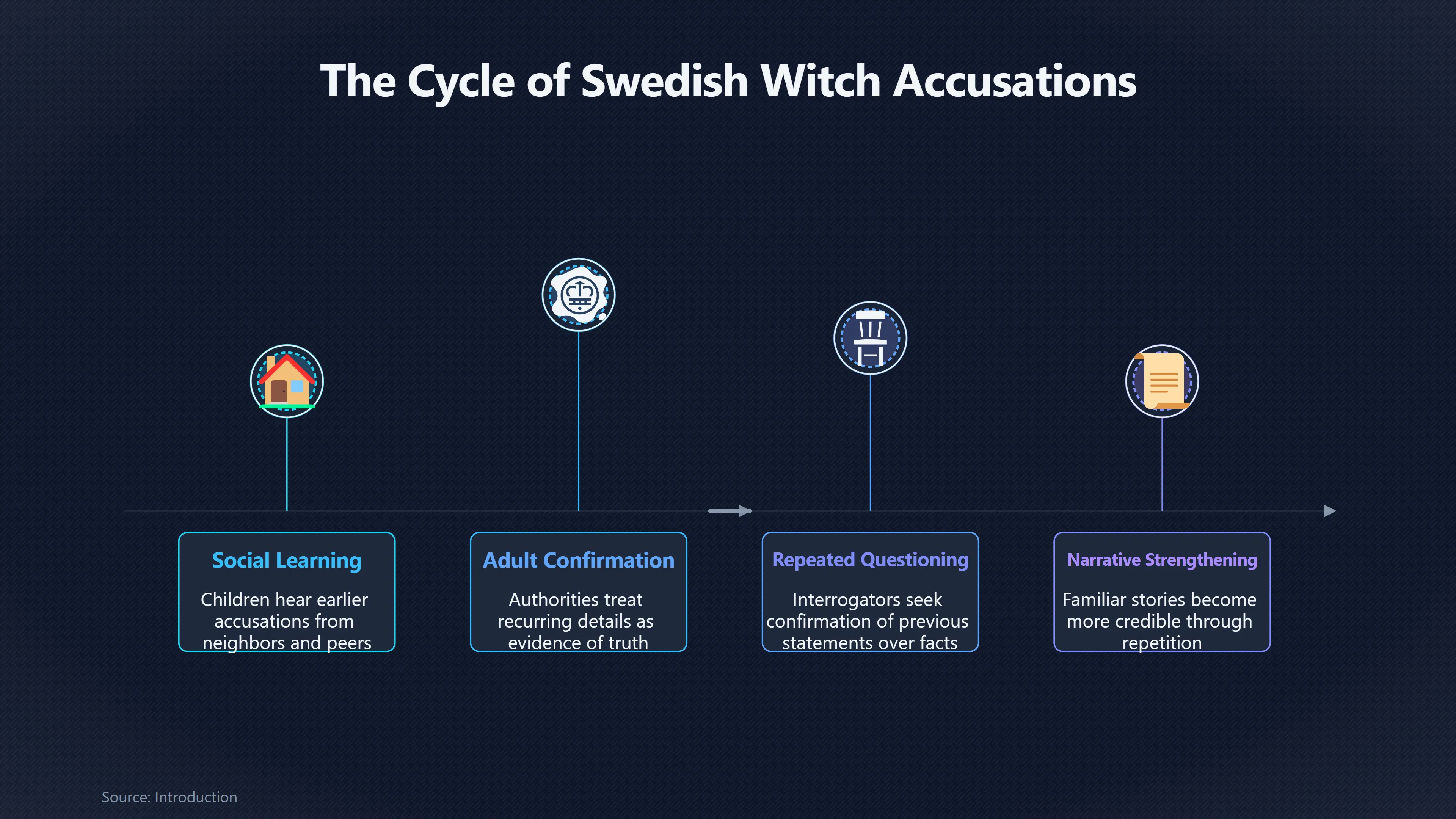
The result was a classic self-reinforcing cycle:
- Children heard earlier accusations from other witnesses.
- Adults treated recurring details as confirmation.
- Repeated questioning strengthened familiar narratives.
- New accusations appeared increasingly credible because they resembled previous ones.
Each stage made it harder for courts to distinguish genuine memory from learned storytelling.[PubMed]pubmed.ncbi.nlm.nih.govChild testimonies during an outbreak of witch hysteria: Sweden 1670-1671 - PubMed…
Stockholm’s evidentiary reversal
The decisive change came during the Katarina witch trials in Stockholm in September 1676. Members of the Royal Witchcraft Commission had become increasingly uneasy about convictions resting largely on children’s statements. Instead of allowing witnesses simply to confirm earlier testimony, the court required them to repeat their stories independently before the judges.[Wikipedia]WikipediaWitch trials in SwedenWitch trials in Sweden
This procedural shift exposed weaknesses that had previously been hidden. Several children could no longer reproduce consistent accounts. On 11 September 1676, one child admitted to giving false testimony. The confession triggered a cascade: numerous other child witnesses acknowledged that they had lied or had been coached by older children and leading witnesses. Investigators identified a small number of particularly influential young accusers whose stories had shaped many of the others.[Wikipedia]WikipediaKatarina witch trialsKatarina witch trials
What changed was not the public’s theology but the court’s treatment of evidence. Once judges demanded internally consistent testimony rather than accepting repeated allegations at face value, the network of accusations rapidly unravelled. The apparent agreement between witnesses had depended on continual reinforcement rather than independent corroboration.[Wikipedia]WikipediaKatarina witch trialsKatarina witch trials
Why the trials collapsed so quickly
The Stockholm proceedings revealed that the witch panic had become institutionally self-sustaining. Earlier investigations had interpreted agreement between children as powerful evidence. The new approach instead asked whether those agreements survived independent examination.
When they did not, confidence in the prosecutions evaporated. The Witchcraft Commission halted the Stockholm trials, released many remaining suspects and informed courts elsewhere that child accusations of this kind could no longer be accepted without far stronger evidence. In 1677 the authorities even instructed clergy to give thanks publicly that the witch panic had ended, signalling an official retreat from the assumptions that had driven the persecutions.[wikipedia.org]WikipediaWitch trials in SwedenWitch trials in Sweden
Although a few isolated witchcraft cases appeared later, the nationwide chain reaction known as the Great Noise was over. The collapse was therefore less the result of a sudden change in popular belief than of a change in legal method and evidentiary standards.[Wikipedia]WikipediaWitch trials in SwedenWitch trials in Sweden
Why this episode still matters
Historians often point to Stockholm in 1676 as an early demonstration of how investigative procedures influence the reliability of testimony. The episode illustrates several principles that remain central to modern justice:
- Witnesses should be questioned independently rather than allowed to reinforce one another.
- Open-ended questioning is generally more reliable than leading or repetitive interrogation.
- Consistency alone is not proof when witnesses may have shared information.
- Courts must distinguish between sincere belief and reliable evidence.
The importance of the Stockholm trials lies not only in ending Sweden’s deadliest witch panic but also in showing how institutional scepticism can interrupt a contagious pattern of accusation. The same mechanisms that had spread the panic—social influence, repeated narratives and confirmation by authority—were exposed once judges deliberately changed the way evidence was tested.[nih.gov]pubmed.ncbi.nlm.nih.govChild testimonies during an outbreak of witch hysteria: Sweden 1670-1671 - PubMed…
Amazon book picks
Further Reading
Books and field guides related to What Finally Broke Sweden's Witch Panic?. Use these as the next step if you want deeper reading beyond the article.
Extraordinary Popular Delusions and the Madness of Crowds
Rating: 4.0/5 from 5 Google Books ratings
Illustrates mechanisms behind collective belief.



Endnotes
1.
Source: Wikipedia
Title: Witch trials in Sweden
Link:https://en.wikipedia.org/wiki/Witch_trials_in_Sweden
2.
Source: Wikipedia
Title: Katarina witch trials
Link:https://en.wikipedia.org/wiki/Katarina_witch_trials
3.
Source: stockholmskallan.stockholm.se
Title: haxprocesserna i slutet av 1600 talets stockholm
Link:https://stockholmskallan.stockholm.se/teman/De-skriver-om-Stockholm/samfundet-sankt-eriks-uppsatstavling/haxprocesserna-i-slutet-av-1600-talets-stockholm/
Source snippet
skällanHäxprocesserna i slutet av 1600-talets Stockholm - Stockholmskällan...
4.
Source: stockholmskallan.stockholm.se
Title: haxprocesserna 1676
Link:https://stockholmskallan.stockholm.se/teman/stockholmshandelser/haxprocesserna-1676/
Source snippet
stockholm.seHäxprocesserna 1676 - StockholmskällanApril 3, 2025 — Image: Teckning över Katarina kyrka med människor i förgrunden Katarina...
Published: April 3, 2025
5.
Source: stockholmskallan.stockholm.se
Link:https://stockholmskallan.stockholm.se/post/29703
6.
Source: stockholmskallan.stockholm.se
Title: se Britta brändes till döds / text: Anna Seidevall-Byström
Link:https://stockholmskallan.stockholm.se/post/32117
7.
Source: pubmed.ncbi.nlm.nih.gov
Link:https://pubmed.ncbi.nlm.nih.gov/7593397/
Source snippet
Child testimonies during an outbreak of witch hysteria: Sweden 1670-1671 - PubMed...
8.
Source: folklife.si.edu
Link:https://folklife.si.edu/magazine/swedish-witch-trials-dark-heritage
Source snippet
Smithsonian Folklife CenterThe Swedish Witch Trials: How to Confront Dark Heritage | Smithsonian Center for Folklife and Cultural Heritag...
Additional References
9.
Source: blogs.loc.gov
Link:https://blogs.loc.gov/law/2026/04/on-this-day-swedish-witches-flying-to-blakulla-350-years-of-myth-and-caselaw/
Source snippet
Berryman, C. K. 1909 or 1...
9
1
- Library of Congress, Prints and Photographs Division. https://hdl.loc.gov/loc.pnp/acd.2a06808 ON THIS DAY
10.
Source: cambridge.org
Link:https://www.cambridge.org/core/journals/continuity-and-change/article/children-juveniles-and-crime-in-early-modern-london-old-bailey-trials-16741750/25C044DCA8BD9F982ED745BE7809B36C
Source snippet
Children, juveniles, and crime in early modern London: Old Bailey trials, 1674–1750 | Continuity and Change | Cambridge CoreNovember 15...
11.
Source: acamh.onlinelibrary.wiley.com
Title: j.1469 7610.1995.tb01349.x
Link:https://acamh.onlinelibrary.wiley.com/doi/abs/10.1111/j.1469-7610.1995.tb01349.x
Source snippet
Child Testimonies During an Outbreak of Witch Hysteria: Sweden 1670–1671 - Sjöberg - 1995 - Journal of Child Psychology and Psychiat...
12.
Source: youtube.com
Title: Malin Matsdotter: The Condemned Witch (Occult History Explained)
Link:https://www.youtube.com/watch?v=WfEess9HC64
Source snippet
Sweden's Witch Trials: Uncovering the Great Noise...
13.
Source: youtube.com
Title: The Torsåker Witch Trials: Sweden’s Witchcraft Tragedy
Link:https://www.youtube.com/watch?v=dAIjUhn3eS4
Source snippet
Malin Matsdotter: The Condemned Witch (Occult History Explained)...
14.
Source: youtube.com
Link:https://www.youtube.com/watch?v=8uK2N5n3DMA
Source snippet
The Witch Hunts That Turned Europe Into a Continent of Fear...
15.
Source: researchgate.net
Link:https://www.researchgate.net/publication/14190366_Adults%27_understanding_of_young_children%27s_testimony
16.
Source: su.se
Link:https://www.su.se/english/research/research-catalogue/research-projects/a/true-story-childrens-roles-and-voices-during-the-witchcraft-trials-in-angermanland
17.
Source: youtube.com
Title: Sweden’s Witch Trials: Uncovering the Great Noise
Link:https://www.youtube.com/watch?v=JiqkHy2sDZw
Source snippet
The Hysteric Witch Trials of Sweden (1600) Pt. 1...
18.
Source: sciencedirect.com
Title: Investigative interviews of child witnesses in Sweden
Link:https://www.sciencedirect.com/science/article/pii/S0145213400001836
Topic Tree