Within Ghana Panics
Why Anti Witchcraft Movements Swept the Gold Coast
Movements such as Aberewa and Tigare spread by offering protection, moral order and explanations for illness, death and inequality.
On this page
- How Aberewa, Tigare and related movements worked
- Why illness, inequality and rapid change made them persuasive
- How colonial officials tried to regulate spiritual justice
Page outline Jump by section
Introduction
From the late nineteenth century into the colonial era, a series of anti-witchcraft movements spread across the Gold Coast and Asante, attracting thousands of followers. Rather than simply reflecting fear of witchcraft, these movements offered practical ways to explain misfortune, restore social order and cope with the profound upheavals of colonial rule. Shrines such as Aberewa and, later, Tigare promised protection against hidden spiritual attacks, identified suspected witches through ritual procedures, and provided medicines, oaths and cleansing ceremonies that many people regarded as more effective than the distant colonial legal system. Their popularity reveals how rapid political, economic and social change reshaped religious life in what is now Ghana, while also exposing growing tensions between African systems of spiritual justice and British colonial law.[Cambridge University Press & Assessment]cambridge.orgCambridge University Press & AssessmentWITCHCRAFT, ANTI-WITCHCRAFT AND TRANS-REGIONAL RITUAL INNOVATION IN EARLY COLONIAL GHANA: SAKRABUN…
Why anti-witchcraft movements spread so rapidly
The expansion of anti-witchcraft movements cannot be understood simply as a continuation of older religious traditions. Historians increasingly argue that they were responses to a society undergoing unusually rapid transformation.
The British conquest of Asante in 1901 dismantled long-established political structures, introduced new taxation and administrative systems, expanded long-distance trade and labour migration, and altered patterns of wealth and authority. Some individuals accumulated unexpected prosperity while others experienced poverty, disease or family breakdown. Such unequal outcomes often demanded explanation within local moral frameworks, where hidden spiritual aggression offered one possible answer.[Cambridge University Press & Assessment]cambridge.orgCambridge University Press & AssessmentWITCHCRAFT, ANTI-WITCHCRAFT AND TRANS-REGIONAL RITUAL INNOVATION IN EARLY COLONIAL GHANA: SAKRABUN…
Anti-witchcraft movements answered several practical questions at once:
- Why had an apparently healthy person died?
- Why had one household prospered while another suffered?
- Why had infertility, crop failure or illness struck without an obvious cause?
- How could hidden enemies be identified without provoking endless revenge?
Instead of encouraging indiscriminate violence, many movements claimed to channel suspicion into regulated ritual investigations supervised by recognised shrine authorities. That promise of orderly spiritual justice made them particularly persuasive during periods of uncertainty.[Cambridge University Press & Assessment]cambridge.orgCambridge University Press & AssessmentWITCHCRAFT, ANTI-WITCHCRAFT AND TRANS-REGIONAL RITUAL INNOVATION IN EARLY COLONIAL GHANA: SAKRABUN…
How Aberewa, Tigare and related movements worked
Aberewa and the reinvention of ritual authority
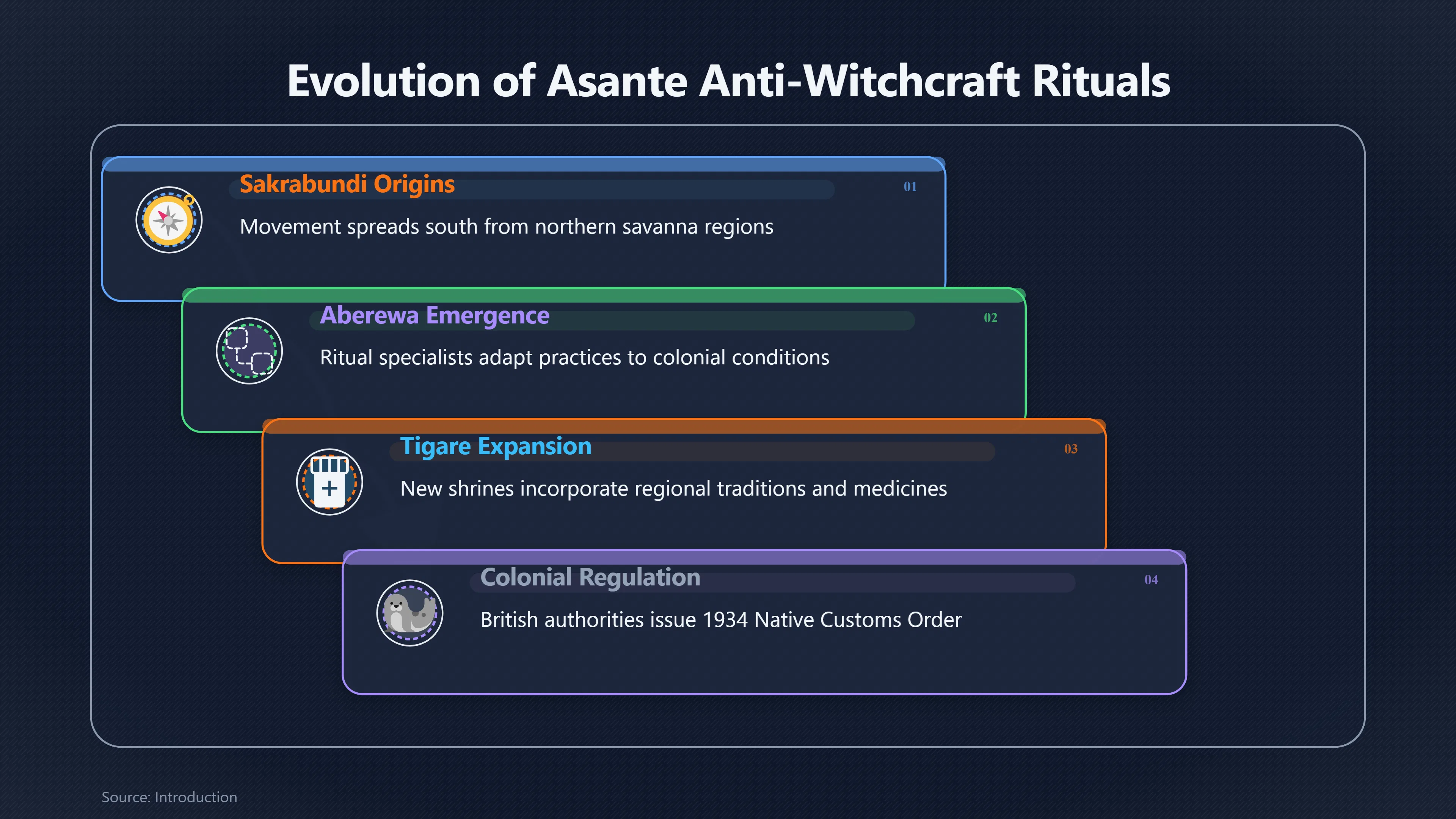
Aberewa emerged as the most influential anti-witchcraft movement in Asante between about 1906 and 1910. Although it appeared suddenly to colonial observers, historians have shown that it developed from an earlier movement known as Sakrabundi, which had gradually spread southwards from the northern savanna regions during the late nineteenth century.
Rather than being an isolated local cult, Aberewa represented an example of religious innovation moving across ecological zones and ethnic boundaries. Ritual specialists adapted older protective practices to new colonial conditions, creating ceremonies that appealed to communities experiencing political disruption and growing social inequality.[Cambridge University Press & Assessment]cambridge.orgCambridge University Press & AssessmentWITCHCRAFT, ANTI-WITCHCRAFT AND TRANS-REGIONAL RITUAL INNOVATION IN EARLY COLONIAL GHANA: SAKRABUN…
Followers typically visited shrines seeking:
- protective medicines against occult attack;
- ritual cleansing after suspected witchcraft;
- divination to explain persistent misfortune;
- public oaths designed to expose hidden wrongdoing;
- reconciliation after accusations had divided families.
Participation often involved voluntary submission to ritual tests or declarations of innocence before shrine officials rather than formal criminal proceedings. Colonial reports sometimes described these practices as “witch-finding”, but modern historians stress that they combined healing, protection, moral discipline and conflict resolution rather than serving solely as systems for identifying alleged witches.[Cambridge University Press & Assessment]cambridge.orgCambridge University Press & AssessmentWITCHCRAFT, ANTI-WITCHCRAFT AND TRANS-REGIONAL RITUAL INNOVATION IN EARLY COLONIAL GHANA: SAKRABUN…
The rise of Tigare
After Aberewa declined, other movements—including Tigare—spread widely through the Gold Coast during the interwar years. Like its predecessor, Tigare claimed power to detect spiritual threats, expose harmful magic and provide ritual protection.
Its popularity reflected the same underlying anxieties but also demonstrated that anti-witchcraft movements continually adapted to changing circumstances. New shrines incorporated different medicines, ritual techniques and regional traditions while maintaining the broader promise that hidden dangers could be made visible and controlled. Colonial officials repeatedly found that suppressing one movement rarely eliminated demand; instead, another emerged with modified practices and a different ritual centre.[ResearchGate]researchgate.netResearchGate(PDF) A Historical narrative of the British Colonial Administration's Clamp down on Witch finding Shrines among the Asante Pe…
Why illness, inequality and rapid change made these movements persuasive
Anti-witchcraft movements became attractive because they addressed problems that neither biomedical knowledge nor colonial administration could adequately explain for many rural communities.
Epidemics, high child mortality, infertility and sudden deaths remained common. At the same time, cash-crop production, wage labour and expanding trade created striking differences in wealth. Individuals who became unexpectedly successful might attract admiration but also suspicion that prosperity had been gained through hidden spiritual means.
Within this setting, anti-witchcraft movements offered a coherent moral explanation. Misfortune was rarely presented as random. Instead, suffering could be interpreted as the result of damaged relationships, jealousy, broken obligations or concealed spiritual aggression. Ritual intervention therefore promised not merely physical healing but restoration of social harmony.
Importantly, these explanations should not be understood as evidence that colonial subjects simply rejected modernity. Historians instead argue that the movements were themselves modern responses to colonial transformation, combining older ritual ideas with new forms of organisation, mobility and communication. They spread along expanding transport routes, commercial networks and migrant communities that were themselves products of colonial change.[cambridge.org]cambridge.orgCambridge University Press & AssessmentWITCHCRAFT, ANTI-WITCHCRAFT AND TRANS-REGIONAL RITUAL INNOVATION IN EARLY COLONIAL GHANA: SAKRABUN…
Why colonial officials tried to regulate spiritual justice
British administrators viewed anti-witchcraft movements with growing concern, although their objections were often inconsistent.
Officials recognised that accusations of witchcraft were socially significant for many communities, yet colonial courts could not accept supernatural evidence as proof of criminal guilt. Administrators also worried that shrine operators sometimes demanded fees, encouraged confessions under pressure or provoked public disorder through accusations against respected individuals.
Missionaries added another layer of criticism, portraying many anti-witchcraft shrines as incompatible with Christianity and as obstacles to conversion. Together, colonial administrators and missionaries increasingly sought to reduce the influence of shrine specialists throughout the early twentieth century.[ResearchGate]researchgate.netResearchGate(PDF) A Historical narrative of the British Colonial Administration's Clamp down on Witch finding Shrines among the Asante Pe…
Colonial responses included:
- police investigations into prominent shrines;
- restrictions on ritual activities regarded as coercive;
- prosecutions where fraud or intimidation could be demonstrated;
- administrative orders limiting witch-finding ceremonies;
- attempts to replace shrine authority with colonial courts.
These measures culminated in regulations such as the 1934 Native Customs (Witch and Wizard Finding) Order, which prohibited organised witch-finding ceremonies in Asante. Nevertheless, official correspondence shows that such practices continued despite repeated suppression because many communities still regarded them as legitimate ways of addressing persistent fears.[ResearchGate]researchgate.netResearchGate(PDF) A Historical narrative of the British Colonial Administration's Clamp down on Witch finding Shrines among the Asante Pe…
What these movements reveal about colonial Ghana
Earlier colonial writing often portrayed anti-witchcraft movements simply as irrational superstition. More recent scholarship presents a far more complex picture.
Researchers argue that movements such as Aberewa and Tigare should be understood as religious innovations that emerged from specific historical pressures rather than timeless survivals from an unchanging African past. Their success reflected people’s efforts to reconcile older moral ideas with unprecedented political conquest, economic inequality and changing forms of authority.
They also demonstrate an important contradiction within colonial government. British rule claimed to establish impartial justice based on evidence, yet many Africans continued to experience illness, bereavement and social conflict through moral and spiritual frameworks that colonial courts neither recognised nor resolved. Anti-witchcraft shrines filled part of that gap by offering explanations and remedies that official institutions could not provide.[Cambridge University Press & Assessment]cambridge.orgCambridge University Press & AssessmentWITCHCRAFT, ANTI-WITCHCRAFT AND TRANS-REGIONAL RITUAL INNOVATION IN EARLY COLONIAL GHANA: SAKRABUN…
Lasting significance
Although the colonial administration suppressed many organised anti-witchcraft movements, the questions they addressed did not disappear. Concerns about hidden harm, unexplained misfortune and spiritual protection continued to shape religious life in Ghana throughout the twentieth century and remain visible today in debates over witchcraft accusations, deliverance ministries and the treatment of alleged witches.
The history of Aberewa, Tigare and related movements therefore illustrates more than changing religious beliefs. It shows how communities adapted creatively to colonial disruption, using new forms of ritual authority to negotiate uncertainty, inequality and the search for justice in a rapidly changing society.[cambridge.org]cambridge.orgCambridge University Press & AssessmentWITCHCRAFT, ANTI-WITCHCRAFT AND TRANS-REGIONAL RITUAL INNOVATION IN EARLY COLONIAL GHANA: SAKRABUN…

Amazon book picks
Further Reading
Books and field guides related to Why Anti-Witchcraft Movements Swept the Gold Coast. Use these as the next step if you want deeper reading beyond the article.

Purity and danger
Explains symbolic systems surrounding danger, pollution and social order.

Witchcraft, Violence, and Democracy in South Africa
Directly relevant to anti-witchcraft movements and community responses.

African religions and philosophy
Explains indigenous religious ideas underpinning anti-witchcraft movements.

Endnotes
1.
Source: cambridge.org
Link:https://www.cambridge.org/core/journals/journal-of-african-history/article/abs/witchcraft-antiwitchcraft-and-transregional-ritual-innovation-in-early-colonial-ghana-sakrabundi-and-aberewa-18891910/FE5B4DD01E1FF23EC9F839BDAC3BF0F6
Source snippet
Cambridge University Press & AssessmentWITCHCRAFT, ANTI-WITCHCRAFT AND TRANS-REGIONAL RITUAL INNOVATION IN EARLY COLONIAL GHANA: SAKRABUN...
2.
Source: researchgate.net
Link:https://www.researchgate.net/publication/279447812_A_Historical_narrative_of_the_British_Colonial_Administration%27s_Clamp_down_on_Witch_finding_Shrines_among_the_Asante_People_of_the_Gold_Coast
Source snippet
ResearchGate(PDF) A Historical narrative of the British Colonial Administration's Clamp down on Witch finding Shrines among the Asante Pe...
3.
Source: cambridge.org
Link:https://www.cambridge.org/core/journals/history-in-africa/article/empire-strikes-back-colonial-discipline-and-the-creation-of-civil-society-in-asante-19061940/B6919B27F6A5A83D91750B05D133A61D
Source snippet
Cambridge University Press & AssessmentThe Empire Strikes Back: Colonial “Discipline” and the Creation of Civil Society in Asante, 1906–1...
4.
Source: eprints.soas.ac.uk
Title: Witchcraft Anti Witchcraft
Link:https://eprints.soas.ac.uk/4142/1/WitchcraftAntiWitchcraft.pdf
Source snippet
Eprints SOASJournal of African History, 45 (2004), pp. 393–420...
5.
Source: researchgate.net
Title: 379545850 Antiwitchcraft Movements in Colonial Asante
Link:https://www.researchgate.net/publication/379545850_Antiwitchcraft_Movements_in_Colonial_Asante
Source snippet
Antiwitchcraft Movements in Colonial Asante | Request PDFSeptember 1, 2023 — View Show abstract Independent Spirits: the Politics of Poli...
Published: September 1, 2023
6.
Source: cambridge.org
Title: Olsen Show author deta
Link:https://www.cambridge.org/core/journals/history-in-africa/article/abs/empire-strikes-back-colonial-discipline-and-the-creation-of-civil-society-in-asante-19061940/B6919B27F6A5A83D91750B05D133A61D
Source snippet
The Empire Strikes Back: Colonial “Discipline” and the Creation of Civil Society in Asante, 1906–1940 | History in Africa | Cambridge Cor...
7.
Source: cambridge.org
Link:https://www.cambridge.org/core/services/aop-cambridge-core/content/view/FE5B4DD01E1FF23EC9F839BDAC3BF0F6/S002185370400951Xa.pdf/witchcraft_antiwitchcraft_and_transregional_ritual_innovation_in_early_colonial_ghana_sakrabundi_and_aberewa_18891910.pdf
8.
Source: researchgate.net
Link:https://www.researchgate.net/publication/231979854_Witchcraft_anti-witchcraft_and_trans-regional_ritual_innovation_in_early_colonial_Ghana_Sakrabundi_and_Aberewa
9.
Source: cambridge.org
Title: The Journal of African History: Volume 45
Link:https://www.cambridge.org/core/journals/journal-of-african-history/volume/C3380A05186562A48CE602A017BA7989
Additional References
10.
Source: grafiati.com
Title: Journal articles: ‘Political aspects of Witchcraft’ – Grafiati
Link:https://www.grafiati.com/en/literature-selections/political-aspects-of-witchcraft/journal/
Source snippet
"WITCHCRAFT, ANTI-WITCHCRAFT AND TRANS-REGIONAL RITUAL INNOVATION IN EARLY COLONIAL GHANA: SAKRABUNDI AND ABEREWA...
11.
Source: eajournals.org
Title: EA Journals DO WITCHES ONLY FLY?
Link:https://eajournals.org/ijhphr/vol-1-issue-1-september-2013/witches-fly-historical-narrative-british-colonial-administrations-clamp-witch-finding-shrines-amongst-asante-people-gold-coast-1907-1940/
Source snippet
A HISTORICAL NARRATIVE OF THE BRITISH COLONIAL ADMINISTRATION’S CLAMP DOWN ON WITCH FINDING SHRINES AMONGST THE ASANTE PEOPLE OF THE GOLD...
12.
Source: youtube.com
Title: Ghana’s Secret Shrines: Why Locals Never Go Back Twice
Link:https://www.youtube.com/watch?v=aG8M6N9Sp9Q
Source snippet
Unveiling Yendi: Ghana's Forgotten Kingdom & Ancient Traditions...
13.
Source: youtube.com
Link:https://www.youtube.com/watch?v=R5ZMy0geS5g
Source snippet
Witchcraft Act Was Used to Suppress Traditional Healers | Gogo Dineo Explains...
14.
Source: youtube.com
Title: Unveiling Yendi: Ghana’s Forgotten Kingdom & Ancient Traditions
Link:https://www.youtube.com/watch?v=xUw-dH0ivjE
Source snippet
TONGO - A town of Rocks, caves and shrines...
15.
Source: youtube.com
Title: History of The Ashanti Empire of Ghana
Link:https://www.youtube.com/watch?v=pgWesX2ikP4
Source snippet
Ghana's Secret Shrines: Why Locals Never Go Back Twice...
16.
Source: taylorfrancis.com
Title: On The Spread of Anti-Witchcraft Cults in Modern Asante | 6 | Changing
Link:https://www.taylorfrancis.com/chapters/edit/10.4324/9780429489068-6/spread-anti-witchcraft-cults-modern-asante-malcolm-mcleod
17.
Source: youtube.com
Title: Witchcraft Act Was Used to Suppress Traditional Healers | Gogo Dineo Explains
Link:https://www.youtube.com/watch?v=nImfi58BeyI
18.
Source: docslib.org
Title: sakrabundi and aberewa 1889 8211
Link:https://docslib.org/doc/6529745/sakrabundi-and-aberewa
19.
Source: africabib.org
Link:https://africabib.org/rec.php?DB=p&RID=280503075
Topic Tree