When Fear Became a Public Force in Tunisia
Tunisia does not have a well-documented history of spectacular witch trials, doomsday sects or nationwide outbreaks of mass psychogenic illness comparable with famous cases elsewhere.
Page outline Jump by section
Introduction
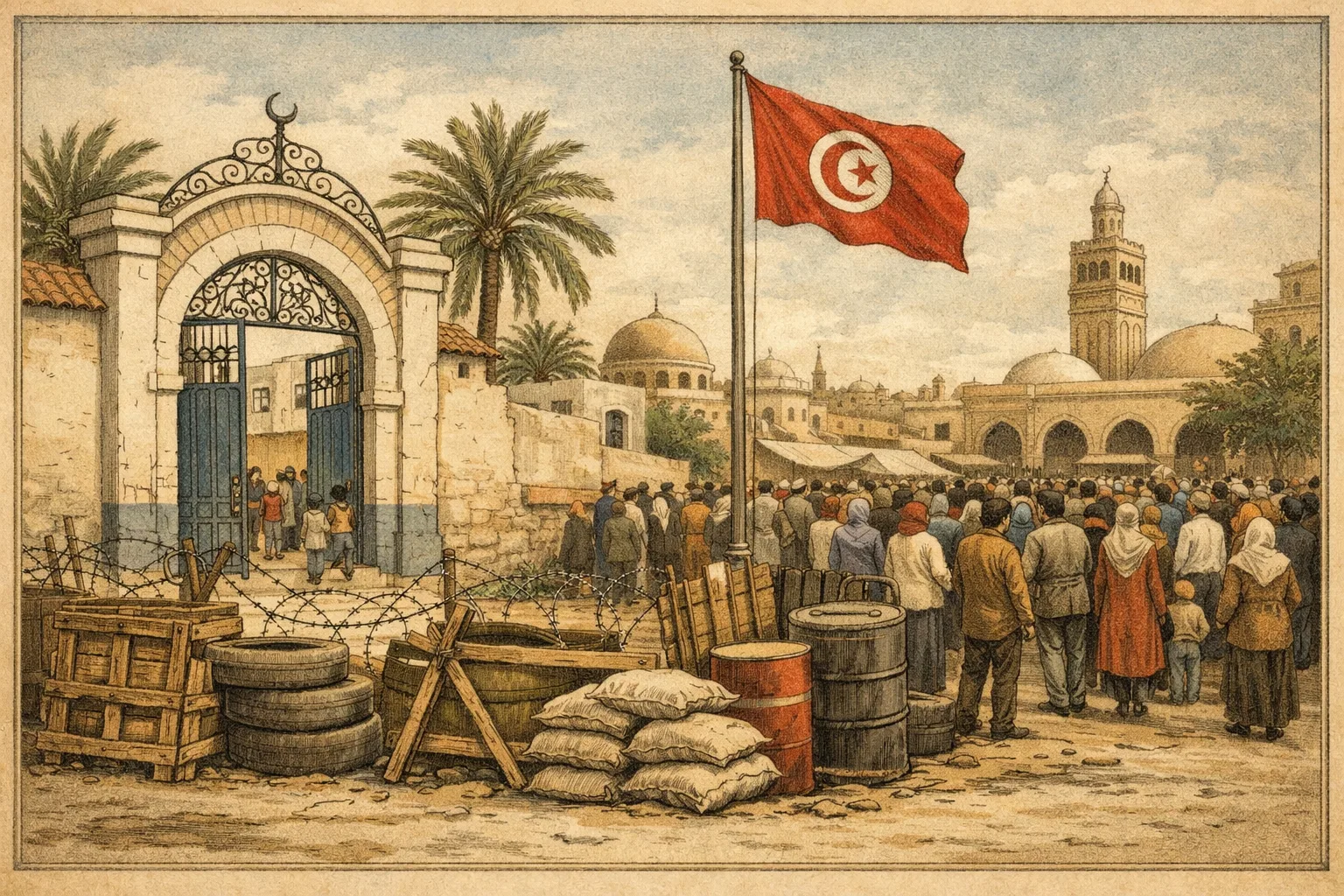
Four themes stand out. A schoolteacher in Sfax was driven from her classroom in 2017 after inflammatory claims spread among parents and religious activists. During the 2011 revolution, genuine violence became entangled with rumours about snipers, escaped prisoners and hidden loyalists. In 2023, a demographic conspiracy theory about Black African migrants helped turn economic and political anxiety into discrimination and attacks. Meanwhile, Tunisian traditions involving healing trance and spirit possession show why unfamiliar religious practices should not automatically be described as hysteria or cult activity. Together, these cases reveal how collective fear in Tunisia has usually grown where uncertainty, social pressure and struggles over authority meet.
Why Tunisia’s evidence needs careful handling
The phrase “mass hysteria” has often been used too loosely. It can refer to several very different things: medically unexplained symptoms spreading through a group, a rumour-driven public scare, a campaign against a supposed moral enemy, or simply behaviour that an observer considers irrational. These are not interchangeable.
For Tunisia, the distinction is particularly important. Reliable published evidence for classic mass psychogenic illness — an outbreak of real physical symptoms with no identified toxic or infectious cause — is sparse. There are occasional local reports of collective fainting, distress or supposed possession, but many lack the medical investigation needed to exclude environmental illness, poisoning or other physical causes. Specialists therefore advise investigating possible hazards first rather than treating “hysteria” as a convenient diagnosis. Mass psychogenic symptoms are real bodily experiences, not deliberate play-acting, and usually emerge within groups already experiencing fear or prolonged stress.[PMC]pmc.ncbi.nlm.nih.govby D Kokota · 2011 · Cited by 39 — Before long, dozens are vomiting, fainting and screaming. The strain of exams is a common trigger…
Tunisia’s stronger evidence concerns moral panics and rumour panics. A moral panic develops when a person or group is presented as a serious threat to society’s values, often through exaggerated or poorly tested claims. A rumour panic is more immediate: uncertain information spreads during danger, and people act before anyone can establish what is true. Neither concept means that every underlying concern is imaginary. Crime, political violence, economic distress and religious disagreement may all be real. The question is whether fear becomes disproportionate, targets a symbolic enemy or outruns the available evidence.
This approach also guards against another mistake: treating traditional healing or minority religious practice as proof of primitiveness. Tunisian beliefs concerning spirits, harmful magic and the evil eye have long coexisted with modern medicine, formal religion and secular education. Their social importance cannot be understood by sorting people into “rational” and “superstitious” camps.
The Sfax school scare: how a teacher became a symbolic threat
One of Tunisia’s clearest modern moral-panic episodes began at a primary school in Sfax in September 2017. Teacher Faiza Souissi arrived for the new school year to find an angry crowd of parents and activists outside. She was accused of atheism, hostility to Islam and corrupting children. Reports said that some pupils had earlier raised questions about whether she was a witch, while further accusations circulated that she had insulted the call to prayer or deliberately prevented children from hearing it. Souissi denied the claims.[com.tn]leaders.com.tn23078 la sorciere de sfaxUn procès en sorcellerie dans une école de Sfax18 Sept 2017 — Scène d hystérie collective, hommes femmes, parents d'élèves, et ac…
The disturbance did not remain a private disagreement between a teacher and a few families. Protesters gathered in the school grounds, colleagues sheltered Souissi inside, and police eventually escorted her away. Tunisian education campaigners and teachers’ groups treated the confrontation as an attack on the school system and on a woman targeted through religious denunciation. Several participants in the protest were later detained or prosecuted.[thearabweekly.com]thearabweekly.comtunisian teacher becomes symbol resistance bigotryAWTunisian teacher becomes symbol of resistance to bigotry24 Sept 2017 — Souissi, who had been a teacher at the Sfax school in southern T…
Calling this a “witch trial” is tempting but potentially misleading. There was no formal prosecution for supernatural crime, and the word “witch” was only one part of a wider set of accusations. The more important pattern was the transformation of an ordinary authority dispute into a struggle over religion, children and national identity. Claims that the teacher was an atheist or enemy of Islam made her appear not merely unpopular but morally dangerous.
Several features helped the episode spread:
- Children were presented as vulnerable victims. Alleged threats to pupils often produce stronger reactions than disputes involving adults.
- The accusations were difficult to disprove quickly. Claims about tone, private classroom remarks or concealed beliefs could circulate without documentary evidence.
- Religious identity raised the stakes. A dispute over teaching practice became a test of loyalty to the faith.
- Group reinforcement replaced direct knowledge. Some protesters had never personally dealt with the teacher, yet repeated allegations as established fact.[AW]thearabweekly.comtunisian teacher becomes symbol resistance bigotryAWTunisian teacher becomes symbol of resistance to bigotry24 Sept 2017 — Souissi, who had been a teacher at the Sfax school in southern T…
The Sfax case matters because it resembles older witch scares without requiring literal belief in supernatural powers. The accused woman was portrayed as secretly contaminating children and undermining the moral order. Once that image took hold, evidence about her actual teaching became secondary to what she symbolised.
It also demonstrates that moral panics are not produced solely by traditional belief. They can emerge from modern institutions — schools, television, online networks and organised activism — and can involve highly political arguments about secularism, religious freedom and who has the right to define acceptable education.
The revolution and the nights of rumour
Tunisia’s 2010–11 revolution was a real political uprising shaped by police violence, corruption, unemployment and years of authoritarian rule. It should not be reduced to collective delusion. Yet the chaotic days following President Zine El Abidine Ben Ali’s departure on 14 January 2011 created ideal conditions for rumour panic: institutions were distrusted, reliable information was scarce, weapons were heard in residential areas, prisons were opened or breached, and nobody knew which security forces remained loyal to the former regime.[ias.edu]ias.eduInstitute for Advanced Study“Spontaneous Revolution” in Tunisia | IdeasJanuary 18, 2012 — The Tunisian revolution of 2011 (al-thawra al-tunisiya) was the result of a series of protests and insurrectional demo…
Stories circulated about mysterious snipers, armed gangs, foreign infiltrators and members of the old security apparatus preparing counter-attacks. Some reports rested on genuine events. There was shooting, looting and violence; prison escapes occurred; and plain-clothes security personnel had been used under the dictatorship. The problem was that verified incidents mixed with speculation, repetition and political accusation. The resulting atmosphere made even plausible claims difficult to evaluate.
Residents formed neighbourhood watches, erected makeshift barriers and challenged strangers. These groups provided practical protection where police authority had collapsed, but they also illustrate how fear can reorganise social life. Suspicion became a civic duty. An unfamiliar car, an outsider’s accent or an unverified message could be interpreted as evidence of an approaching attack. At protest camps, volunteers recorded names and searched participants because of fears that secret-police agents were infiltrating demonstrations.[The New Yorker]newyorker.comOpen source on newyorker.com.
This episode fits the pattern of a rumour crisis, not a conventional mass hallucination. People did not collectively imagine a single impossible event. Instead, they were trying to interpret fragmented evidence in a rapidly changing and genuinely dangerous situation. Under such conditions, rumours serve several purposes at once: they warn, explain, accuse and help communities decide how to act.
The post-revolution panic also grew from the legacy of authoritarian secrecy. For decades, state media had concealed abuses and presented government statements as unquestionable truth. Once the regime fell, official reassurance carried little weight. Tunisians had good reason to distrust the authorities, but that distrust also left space for unsupported stories to flourish.
The lasting lesson is that rumour is not simply false information circulating among gullible people. It thrives when trustworthy institutions fail, when danger is partly real and when the public lacks a shared method for distinguishing warning from manipulation.
The migrant “replacement” scare
Tunisia’s most consequential recent moral panic concerned migrants and refugees from sub-Saharan Africa. On 21 February 2023, President Kaïs Saïed alleged that irregular migration formed part of a criminal plan to alter Tunisia’s demographic character. He connected migrants with violence and insecurity and presented their presence as an organised threat rather than primarily as a complex humanitarian, labour and migration issue. Rights organisations described the claim as conspiratorial and racist.[Human Rights Watch]hrw.orgHuman Rights Watch Tunisian Terror and “Team Europe”Human Rights Watch Tunisian Terror and “Team Europe”
The speech gave presidential authority to ideas that had already circulated in nationalist and online spaces. Economic hardship, unemployment, housing pressure and frustration with European border policy created a receptive environment. Migrants became a visible group onto whom broader insecurities could be projected.
The consequences were not confined to rhetoric. Human Rights Watch and other organisations documented assaults, evictions, arbitrary arrests, loss of employment and other abuses against Black African migrants, refugees and students. In Sfax and elsewhere, tensions escalated into street violence and collective expulsions. Some people were transported towards remote border areas, where they faced severe danger.[Human Rights Watch]hrw.orgHuman Rights Watch Tunisia: No Safe Haven for Black African Migrants, RefugeesHuman Rights Watch Tunisia: No Safe Haven for Black African Migrants, Refugees
This episode closely matches the structure of a moral panic:
- A complicated social problem was given a single hidden cause. Migration was framed as a deliberate demographic plot.
- A diverse population was treated as one coordinated group. Students, workers, refugees and undocumented travellers were blurred together.
- Individual crimes or neighbourhood disputes were generalised. The conduct of particular people became evidence against an entire racialised category.
- Urgency weakened demands for proof. Once the issue was described as an existential threat, harsh action appeared easier to justify.
- State language legitimised public hostility. Claims voiced at the highest level could be repeated as official confirmation.
The term “panic” must not obscure the real conflicts involved. Tunisia has faced substantial migration pressures, smuggling networks, strained public services and difficult relations with the European Union. Residents of coastal cities have experienced genuine insecurity. But these conditions do not substantiate a coordinated plan to replace the Tunisian population. The conspiracy claim transformed governable policy problems into a struggle for national survival.
The episode also shows how modern panics can move in both directions between state and public. Online rumours and prejudices may influence political rhetoric; official rhetoric then returns to social media with greater authority, intensifying discrimination. The target group is harmed not because everyone accepts every detail of the theory, but because the theory creates permission for suspicion and collective punishment.
Possession and trance are not automatically hysteria
Tunisia’s religious landscape includes practices in which music, spirits, trance and healing are closely connected. The best studied is Stambeli, a tradition developed among Black Tunisians whose ancestors were brought across the Sahara through slavery and forced displacement. Its ceremonies combine music, dance, saint veneration, spirit relationships and therapeutic aims. Participants may enter altered states interpreted within the tradition as possession or contact with spirits.[scholarlypublishingcollective.org]scholarlypublishingcollective.orgBlack Spirits White Saints Music Spirit PossessionBlack Spirits White Saints Music Spirit Possession
Ethnomusicologist Richard Jankowsky argues that Stambeli does more than treat individual suffering. Its music and ritual preserve memories of sub-Saharan ancestry while negotiating the place of Black communities within Tunisian society. The tradition joins African spirit practices with North African Islamic sacred geography rather than fitting neatly into either category.[Academia]academia.eduOpen source on academia.edu.
From outside the tradition, shaking, trance or apparent personality change can be described as hysteria, dissociation, possession or performance. Each label carries assumptions. A psychiatric description may illuminate how altered states relate to trauma, expectation and social setting, but it cannot by itself explain the ceremony’s religious meaning. Conversely, accepting that participants understand an experience spiritually does not prove that a supernatural being caused it.
Stambeli should therefore not be classed as a Tunisian “cult panic”. It is better understood as a historically rooted healing and devotional system that has sometimes been marginalised because of racism, changing religious norms and the preference of modern institutions for sharply separated categories such as religion, medicine and entertainment. Recent scholarship on related Tunisian trance traditions continues to emphasise their roles in identity, memory and community healing.[eScholarship]escholarship.orgOpen source on escholarship.org.
This distinction is culturally important. When outsiders treat any collective trance as evidence of contagion or irrationality, they may erase the difference between:
- an involuntary outbreak of unexplained symptoms;
- a recognised ritual with trained musicians and shared expectations;
- an individual mental-health crisis;
- a fraudulent healer exploiting clients;
- and an accusation of possession used to control or stigmatise someone.
Tunisia contains examples of all these possibilities, but they require different kinds of evidence and different responses.
Sorcery, healing and exploitation
Belief in harmful magic remains part of everyday explanation for some Tunisians, particularly in matters involving illness, marriage, infertility, family conflict or unexplained misfortune. Ethnographic work describes a field containing religious healers, diviners, herbal practitioners and people selling supposed magical interventions. These activities exist across social classes rather than belonging exclusively to rural or poorly educated communities.[Sultan Qaboos University]squ.elsevierpure.comthe anthropology of magic and sorcery in tunisian society an ethnthe anthropology of magic and sorcery in tunisian society an ethn
The presence of such beliefs does not by itself amount to panic. Many consultations are private attempts to make sense of suffering. Trouble arises when fear of sorcery is exploited financially or sexually, when an accused person is attacked, or when medical treatment is delayed. Tunisian media have reported cases in which self-proclaimed healers allegedly used promises of removing magic or solving intimate problems to manipulate and blackmail clients.[Alestiklal]alestiklal.netOpen source on alestiklal.net.
Public discussion often turns these abuses into sweeping claims about national irrationality. Large estimates of the number of “sorcerers” or “charlatans” circulate in the press, but their methods and definitions are not always clear. A healer offering herbs, a religious practitioner reciting scripture and a fraudster threatening clients may all be placed in the same category. The result can be a secondary moral panic in which concern about genuine abuse becomes an attack on broad areas of popular culture.
A more useful distinction focuses on harm. Authorities have a clear reason to intervene where there is assault, coercion, fraud, sexual exploitation, blackmail or medical deception. They should be more cautious about criminalising belief or ritual merely because it appears unscientific or religiously unorthodox.
When fighting rumours becomes a tool of power
Tunisia’s experience also reveals a paradox: fear of rumours can itself support an authoritarian response. In September 2022, the government issued Decree-Law 54, officially aimed at offences involving information and communication systems. Article 24 criminalised the deliberate online production or circulation of broadly defined “false news”, “false information” or “rumours” in circumstances said to threaten public safety, harm others or spread fear. Penalties could reach five years in prison and were doubled when the person concerned was a public official.[International Commission of Jurists]icj.orgOpen source on icj.org.
The law addresses a real problem. Tunisia has experienced online defamation, fabricated reports, conspiracy theories and viral scares. Yet journalists’ organisations and human-rights groups argued that the decree’s vague language made it possible to punish legitimate criticism. Rather than requiring a tightly defined and demonstrable public harm, it gave prosecutors broad discretion to decide what counted as false.[mediasupport.org]mediasupport.orgIMSTunisia fake news law threatens digital freedomsIMSTunisia fake news law threatens digital freedoms
Those concerns were borne out by prosecutions of journalists, lawyers and commentators. Courts used the decree in cases involving criticism of the president, public institutions and Tunisia’s treatment of migrants. The boundary between countering dangerous disinformation and suppressing inconvenient opinion became increasingly difficult to see.[AP News]apnews.comOpen source on apnews.com.
This matters to the history of collective fear because states do not merely respond to panics; they define them. A government may present rumours as threats to national security, describe critics as agents of chaos and claim exceptional powers to restore certainty. The official campaign against fear then creates another fear: that uncontrolled speech will destroy order.
Tunisia’s cases show that the healthiest response to public scares is neither credulous acceptance nor blanket censorship. It is rapid factual investigation, transparent communication, protection for people targeted by accusations and legal action aimed at demonstrable harm rather than disputed belief. The central historical pattern is not that Tunisians are unusually susceptible to superstition. It is that, as elsewhere, collective fear becomes most powerful when trusted information is scarce, social tensions are already high and influential figures supply a simple enemy who can be blamed.

Amazon book picks
Further Reading
Books and field guides related to When Fear Became a Public Force in Tunisia. Use these as the next step if you want deeper reading beyond the article.
Extraordinary Popular Delusions and the Madness of Crowds
Rating: 4.0/5 from 5 Google Books ratings
General framework for collective fears.


Endnotes
1.
Source: pmc.ncbi.nlm.nih.gov
Link:https://pmc.ncbi.nlm.nih.gov/articles/PMC3588562/
Source snippet
by D Kokota · 2011 · Cited by 39 — Before long, dozens are vomiting, fainting and screaming. The strain of exams is a common trigger...
2.
Source: kapitalis.com
Title: affaire faiza souissi mandat de depot contre 3 individus
Link:https://kapitalis.com/tunisie/2017/09/21/affaire-faiza-souissi-mandat-de-depot-contre-3-individus/
Source snippet
Affaire Faiza Souissi: Mandat de dépôt contre 3 individus21 Sept 2017 — Le tribunal de 1ère instance de Sfax 2 a émis des manda...
3.
Source: justiceinfo.net
Title: 25416 remembering january 2011 with light on tunisia army abuses
Link:https://www.justiceinfo.net/en/25416-remembering-january-2011-with-light-on-tunisia-army-abuses.html
Published: january 2011
4.
Source: stambeli.com
Title: Black spirits, white saints
Link:https://stambeli.com/the-stambeli/
5.
Source: academia.edu
Link:https://www.academia.edu/30336143/Black_Spirits_White_Saints_Music_Spirit_Possession_and_Sub_Saharans_in_Tunisia
6.
Source: escholarship.org
Link:https://escholarship.org/uc/item/9vk8g1g3
7.
Source: alestiklal.net
Link:https://www.alestiklal.net/en/article/why-highly-educated-females-still-believe-in-sorcery
8.
Source: mediasupport.org
Title: IMSTunisia fake news law threatens digital freedoms
Link:https://www.mediasupport.org/news/tunisia-president-must-scrap-law-undermining-free-expression-and-the-press/
9.
Source: academia.edu
Title: La sorcellerie à l ère des médias 2015
Link:https://www.academia.edu/9109042/La_sorcellerie_%C3%A0l%C3%A8re_des_m%C3%A9dias_2015_
10.
Source: leaders.com.tn
Title: 23078 la sorciere de sfax
Link:https://www.leaders.com.tn/article/23078-la-sorciere-de-sfax
Source snippet
Un procès en sorcellerie dans une école de Sfax18 Sept 2017 — Scène d hystérie collective, hommes femmes, parents d'élèves, et ac...
11.
Source: thearabweekly.com
Title: tunisian teacher becomes symbol resistance bigotry
Link:https://thearabweekly.com/tunisian-teacher-becomes-symbol-resistance-bigotry
Source snippet
AWTunisian teacher becomes symbol of resistance to bigotry24 Sept 2017 — Souissi, who had been a teacher at the Sfax school in southern T...
12.
Source: ias.edu
Title: Institute for Advanced Study“Spontaneous Revolution” in Tunisia | Ideas
Link:https://www.ias.edu/ideas/2011/nachi-tunisia-revolution
Source snippet
January 18, 2012 — The Tunisian revolution of 2011 (al-thawra al-tunisiya) was the result of a series of protests and insurrectional demo...
Published: January 18, 2012
13.
Source: newyorker.com
Link:https://www.newyorker.com/magazine/2011/04/04/the-casbah-coalition
14.
Source: hrw.org
Title: Human Rights Watch Tunisian Terror and “Team Europe”
Link:https://www.hrw.org/the-day-in-human-rights/2023/07/19
15.
Source: hrw.org
Title: the day in human rights
Link:https://www.hrw.org/the-day-in-human-rights/2023/03/13
16.
Source: hrw.org
Title: Human Rights Watch Tunisia: No Safe Haven for Black African Migrants, Refugees
Link:https://www.hrw.org/news/2023/07/19/tunisia-no-safe-haven-black-african-migrants-refugees
17.
Source: hrw.org
Title: tunisia authoritarian drift erodes rights
Link:https://www.hrw.org/news/2024/01/11/tunisia-authoritarian-drift-erodes-rights
18.
Source: scholarlypublishingcollective.org
Title: Black Spirits White Saints Music Spirit Possession
Link:https://scholarlypublishingcollective.org/uip/etm/article/50/3/373/234593/Black-Spirits-White-Saints-Music-Spirit-Possession
19.
Source: si.edu
Link:https://www.si.edu/object/stambeli-music-trance-and-alterity-tunisia-richard-c-jankowsky%3Asiris_sil_1010737
20.
Source: squ.elsevierpure.com
Title: the anthropology of magic and sorcery in tunisian society an ethn
Link:https://squ.elsevierpure.com/en/publications/the-anthropology-of-magic-and-sorcery-in-tunisian-society-an-ethn/
21.
Source: icj.org
Link:https://www.icj.org/wp-content/uploads/2023/07/Tunisia-Silencing-Free-Voices-_compressed-1.pdf
22.
Source: accessnow.org
Title: a new blow to freedom of expression in tunisia
Link:https://www.accessnow.org/a-new-blow-to-freedom-of-expression-in-tunisia/
23.
Source: apnews.com
Link:https://apnews.com/article/5d1cd879bb081796439a469db744014e
24.
Source: apnews.com
Link:https://apnews.com/article/152e2fd902cde4a0390f776929a834bb
25.
Source: apnews.com
Link:https://apnews.com/article/b917deb59abca4aa3c5f4d8871c14b52
26.
Source: Wikipedia
Title: Mass psychogenic illness
Link:https://en.wikipedia.org/wiki/Mass_psychogenic_illness
27.
Source: hrw.org
Link:https://www.hrw.org/world-report/2024/country-chapters/tunisia
28.
Source: hrw.org
Link:https://www.hrw.org/news/2026/06/14/submission-to-the-royal-commission-on-antisemitism-and-social-cohesion-in-australia
29.
Source: hrw.org
Title: the day in human rights
Link:https://www.hrw.org/the-day-in-human-rights/2023/07/13
30.
Source: hrw.org
Link:https://www.hrw.org/world-report/2024/country-chapters/nicaragua
31.
Source: hrw.org
Link:https://www.hrw.org/world-report/2023/country-chapters/belarus
32.
Source: hrw.org
Title: new churches show path to religious tolerance
Link:https://www.hrw.org/news/2025/12/13/new-churches-show-path-to-religious-tolerance
33.
Source: pmc.ncbi.nlm.nih.gov
Link:https://pmc.ncbi.nlm.nih.gov/articles/PMC12860665/
34.
Source: pmc.ncbi.nlm.nih.gov
Link:https://pmc.ncbi.nlm.nih.gov/articles/PMC11023688/
35.
Source: pmc.ncbi.nlm.nih.gov
Link:https://pmc.ncbi.nlm.nih.gov/articles/PMC7396040/
36.
Source: pmc.ncbi.nlm.nih.gov
Link:https://pmc.ncbi.nlm.nih.gov/articles/PMC3536509/
37.
Source: thearabweekly.com
Title: tunisia after 2011 revolution target attacks and exporter jihadists
Link:https://thearabweekly.com/tunisia-after-2011-revolution-target-attacks-and-exporter-jihadists
Additional References
38.
Source: theguardian.com
Link:https://www.theguardian.com/uk-news/2025/sep/09/mass-psychogenic-illness-caused-toxic-substance-alert-at-heathrow-says-scientist
Source snippet
Despite initial concerns, investigations by emergency services found no trace of any toxic agent. Experts now suggest the incident may be...
39.
Source: youtube.com
Link:https://www.youtube.com/watch?v=xJzrYeqb-tA
Source snippet
Tijani Sufi Dhikr in Tunisia – 30 Mins Of La Ilaha Illallah & Allah...
40.
Source: youtube.com
Title: Stambeli, the spirits’ last dance I Pilgrimage
Link:https://www.youtube.com/watch?v=mvAU-6OBTvI
Source snippet
Growing tensions in Sfax sparked by Tunisian govt's inflammatory rhetoric targeting African migrants...
41.
Source: youtube.com
Title: Tijani Sufi Dhikr in Tunisia – 30 Mins Of La Ilaha Illallah & Allah
Link:https://www.youtube.com/watch?v=e_xZbKVr7G8
Source snippet
Tunisian Revolution: Ten Years of Hope and Disillusionment...
42.
Source: youtube.com
Title: Tunisian Revolution: Ten Years of Hope and Disillusionment
Link:https://www.youtube.com/watch?v=5RGYIHrOL0I
Source snippet
Migrants forced out of Tunisian city as racial tensions rise...
43.
Source: directinfo.webmanagercenter.com
Link:https://directinfo.webmanagercenter.com/2017/09/19/affaire-faiza-souissi-appel-de-solidarite-pour-soutenir-lenseignante/
Source snippet
L'information en continueAffaire Faiza Souissi: Appel de solidarité pour soutenir l...19 Sept 2017 — L'Instance administratif de l'Asso...
44.
Source: facebook.com
Link:https://www.facebook.com/primature.congobz/posts/hysterie-collective-dans-certains-%C3%A9tablissements-scolaires-%C3%A0-brazzaville-plusieu/1720157514773739/
45.
Source: lequotidien.com.tn
Link:https://www.lequotidien.com.tn/fr/societe/10467-charlatanisme-en-tunisie-145000-escrocs-pratiquent-la-sorcellerie-au-vu-et-au-su-des-autorites
46.
Source: researchgate.net
Link:https://www.researchgate.net/publication/271759288_Mass_hysteria_among_South_African_primary_school_learners_in_Kwa-Dukuza_KwaZulu-Natal
47.
Source: instagram.com
Link:https://www.instagram.com/reel/DapWh5_PxcL/
Topic Tree
Follow this branch
Related pages 192
- Antigua and Barbuda
- Argentina Belief Scares
- Azerbaijan Belief
- Bahrain Beliefs
- North Korea
- +187 more in sidebar