Within Belgian Belief Scares
How Belgian Witch Accusations Became State Violence
Belgium's witch panics became deadly when courts, torture and local reputations turned suspicion into legal proof.
On this page
- Where accusations began
- How courts and torture widened panics
- Why prosecutions varied and declined
Page outline Jump by section
Introduction
The witch trials in the territories that now make up Belgium were not simply outbreaks of popular superstition. They became deadly because local suspicions were transformed into criminal prosecutions by courts that accepted witchcraft as a real offence. Once a formal accusation entered the legal system, interrogation, witness testimony, torture and forced confessions could turn rumour into what judges regarded as proof. The result was a series of local persecutions between the fifteenth and late seventeenth centuries that claimed hundreds of lives, although the scale varied enormously from one district to another. Modern historians increasingly describe these episodes as examples of state persecution: fear alone did not kill people, but legal institutions did.[Brill]brill.comSix Centuries of Criminal Law – History of Criminal Law in the Southern Netherlands and Belgium (1400-2000) | BrillJune 19, 2014…
Where accusations began
Most witchcraft accusations started far from courtrooms. They emerged from everyday tensions within villages and small towns, where unexplained illness, failed harvests, livestock deaths, sudden infant mortality or longstanding personal quarrels demanded an explanation. A neighbour who already had a reputation for quarrels, healing practices, fortune telling or unusual behaviour could become an obvious suspect.
Reputation mattered enormously. Once someone became known as a possible witch, almost any later misfortune could reinforce that image. Witnesses often described years of gossip rather than a single dramatic event. In many cases there was no physical evidence in the modern sense. Instead, courts heard stories of curses, strange coincidences and alleged supernatural harm.
The famous case of Cathelyne Van den Bulcke, executed in Lier in 1590, illustrates this process. She entered court already burdened by village rumours, testimony from neighbours and the fact that her mother had previously been executed for witchcraft. During torture she confessed, although she consistently denied the accusations beforehand and did not implicate large numbers of others. Her case shows how inherited suspicion and local reputation could become powerful legal liabilities.[Canon van Vlaanderen]canonvanvlaanderen.beCanon van Vlaanderen Cathelyne Van den BulckeCanon van VlaanderenCathelyne Van den Bulcke - Canon van Vlaanderen…
How courts turned suspicion into state violence
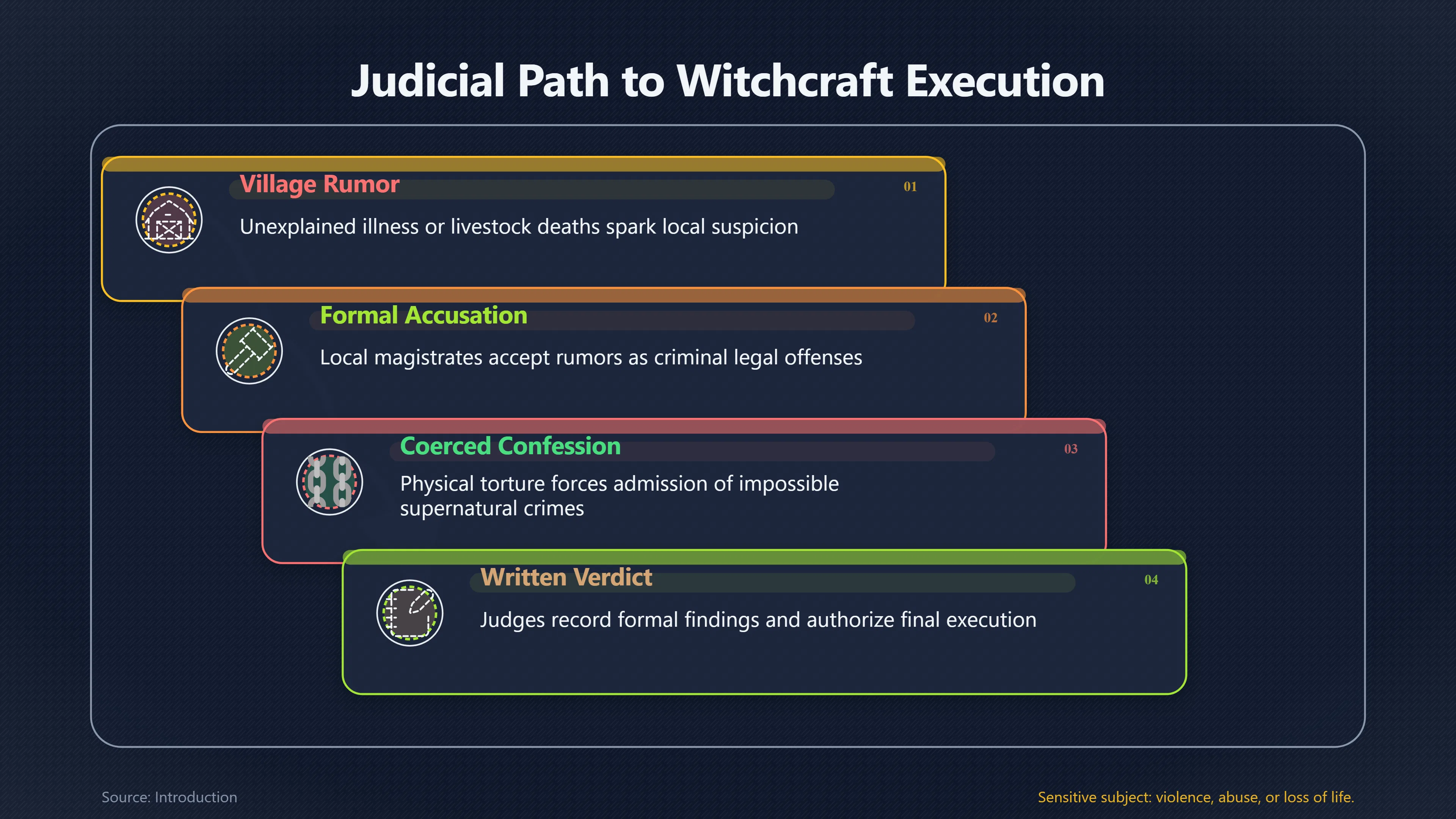
The decisive step was not the accusation itself but its acceptance by judicial authorities. In the Southern Netherlands, witchcraft was treated as a criminal offence that threatened both society and religion. Local magistrates could arrest suspects, collect testimony and, where permitted, authorise torture.
Torture fundamentally altered the course of many prosecutions. Early modern legal systems often regarded a confession as the strongest form of evidence. Under extreme physical pressure, accused people frequently admitted impossible crimes such as attending gatherings with the Devil or causing storms through magic. Confessions extracted under torture could then be used to justify execution.
Unlike spontaneous crowd violence, these deaths followed recognised legal procedures. Records reveal indictments, examinations of witnesses, written verdicts and formal executions. From the perspective of modern history, this makes the persecutions examples of state violence carried out through ordinary institutions of criminal justice rather than uncontrolled mob action.[Brill]brill.comSix Centuries of Criminal Law – History of Criminal Law in the Southern Netherlands and Belgium (1400-2000) | BrillJune 19, 2014…
Why persecution differed across Belgian regions
One of the most striking features of witch persecution in the Southern Netherlands is how uneven it was. Modern Belgium did not exist, and the region was divided among multiple principalities, counties and jurisdictions with different legal traditions and levels of judicial supervision.
The County of Flanders experienced substantial persecution. Surviving records indicate that at least 200 people were executed there between roughly 1450 and 1680, although the true total is impossible to establish because many archives have disappeared. Some districts saw repeated waves of prosecutions, while neighbouring areas experienced relatively few.[Canon van Vlaanderen]canonvanvlaanderen.beCanon van Vlaanderen Cathelyne Van den BulckeCanon van VlaanderenCathelyne Van den Bulcke - Canon van Vlaanderen…
Historians have identified several reasons for these differences:
- Judicial independence: Small rural courts often operated with less oversight than major urban courts, allowing local fears to develop into extensive prosecutions.
- Local officials: Individual magistrates and prosecutors varied greatly in their willingness to pursue witchcraft cases.
- Regional politics: Different rulers and legal traditions shaped how readily courts accepted accusations.
- Religious conflict: The upheavals of the Reformation and Counter-Reformation heightened concerns about hidden enemies and diabolical influence in some regions more than others.
- Record survival: Some apparent regional differences may partly reflect the loss of court archives rather than genuine absence of prosecutions.[canonvanvlaanderen.be]canonvanvlaanderen.beCanon van Vlaanderen Cathelyne Van den BulckeCanon van VlaanderenCathelyne Van den Bulcke - Canon van Vlaanderen…
Large commercial cities could also behave differently from rural districts. Antwerp, despite its size and importance, witnessed remarkably few executions compared with many smaller communities. Meanwhile, parts of what is now West Flanders experienced repeated local panics where limited judicial oversight allowed prosecutions to multiply.[Wikipedia]WikipediaWitch trials in the Spanish NetherlandsWitch trials in the Spanish Netherlands
Torture widened the panic
Witch trials often expanded because confessions rarely ended with one accused person. Interrogators commonly demanded the names of accomplices, producing chains of accusation.
Under torture, suspects sometimes named neighbours, relatives or acquaintances simply to end their suffering. Each new accusation generated further arrests, creating self-reinforcing cycles that could engulf entire communities.
This explains why historians caution against describing witch hunts purely as episodes of irrational public fear. Popular belief created the initial suspicion, but legal procedures amplified it. Without the authority of courts willing to accept coerced confessions and testimony about supernatural events, many accusations would probably have remained local gossip rather than capital cases.[Brill]brill.comSix Centuries of Criminal Law – History of Criminal Law in the Southern Netherlands and Belgium (1400-2000) | BrillJune 19, 2014…
Who became the targets?
Women formed the overwhelming majority of those executed, broadly matching patterns across early modern Europe. Nevertheless, men were also prosecuted, and even children occasionally became entangled in witchcraft investigations.
Many victims occupied socially vulnerable positions. Widows, poorer women, healers and people with difficult relationships inside their communities appeared disproportionately among the accused. Yet there was no single victim profile. Wealthier individuals and respected householders could also fall under suspicion if local conflicts intensified.
The surviving figures demonstrate this complexity. In Flanders around four-fifths of those executed were women, but the proportion varied across different jurisdictions, reminding historians that local circumstances often mattered more than simple gender stereotypes.[Wikipedia]WikipediaWitch trials in the Spanish NetherlandsWitch trials in the Spanish Netherlands
Why prosecutions eventually declined
The decline of Belgian witch trials did not occur because belief in witchcraft suddenly disappeared. Belief persisted long after executions became rare.
Instead, legal practice gradually changed. Higher courts became more cautious, judges increasingly questioned unreliable testimony, and confessions obtained under torture attracted greater scepticism. Better supervision of local courts also limited the ability of individual magistrates to launch large prosecutions.
The timing differed by region. Flanders carried out executions later than many neighbouring areas. Martha van Wetteren, executed in Belsele in 1684, is generally regarded as the last person executed for witchcraft in Flanders, while the Duchy of Brabant still recorded executions in Leuven in 1692 and 1695. Even after formal witch hunts had effectively ended, isolated accusations continued into the eighteenth century, demonstrating that popular belief outlived official persecution.[canonvanvlaanderen.be]canonvanvlaanderen.beCanon van Vlaanderen Cathelyne Van den BulckeCanon van VlaanderenCathelyne Van den Bulcke - Canon van Vlaanderen…
Why the Belgian witch trials still matter
The Belgian experience illustrates that persecution depended on institutions as much as beliefs. Villagers might suspect neighbours of harmful magic, but executions required magistrates, courts and legal procedures willing to validate those suspicions.
For that reason, historians increasingly interpret the witch trials as failures of criminal justice rather than simply episodes of mass hysteria. They reveal how ordinary legal systems can legitimise fear when accepted standards of evidence collapse and coercive interrogation replaces reliable investigation.
Modern memorials, rehabilitations and local historical projects reflect this shift in understanding. Rather than celebrating folklore about witches, they commemorate people who were prosecuted under legal systems that transformed rumour into criminal guilt. The story therefore remains important not only as part of Belgium’s history of collective fear, but also as a warning about the power of state institutions to magnify and legitimise social panic.[canonvanvlaanderen.be]canonvanvlaanderen.beCanon van Vlaanderen Cathelyne Van den BulckeCanon van VlaanderenCathelyne Van den Bulcke - Canon van Vlaanderen…

Amazon book picks
Further Reading
Books and field guides related to How Belgian Witch Accusations Became State Violence. Use these as the next step if you want deeper reading beyond the article.
The witch-hunt in early modern Europe
Explains legal and social mechanisms behind prosecutions.


Endnotes
1.
Source: brill.com
Link:https://brill.com/display/title/25259
Source snippet
Six Centuries of Criminal Law – History of Criminal Law in the Southern Netherlands and Belgium (1400-2000) | BrillJune 19, 2014...
Published: June 19, 2014
2.
Source: belgischeheksen.be
Title: Belgische Heksen Geschiedenis | Belgische Heksen
Link:https://www.belgischeheksen.be/geschiedenis
Source snippet
Het huidige Duitsland telde de meeste terechtstellingen. Ook in...
3.
Source: Wikipedia
Title: Witch trials in the Spanish Netherlands
Link:https://en.wikipedia.org/wiki/Witch_trials_in_the_Spanish_Netherlands
4.
Source: canonvanvlaanderen.be
Title: Canon van Vlaanderen Cathelyne Van den Bulcke
Link:https://www.canonvanvlaanderen.be/en/events/cathelyne-van-den-bulcke/
Source snippet
Canon van VlaanderenCathelyne Van den Bulcke - Canon van Vlaanderen...
5.
Source: canonvanvlaanderen.be
Title: Cathelyne Van den Bulcke
Link:https://www.canonvanvlaanderen.be/events/cathelyne-van-den-bulcke/
6.
Source: canonvanvlaanderen.be
Title: Cathelyne Van den Bulcke
Link:https://www.canonvanvlaanderen.be/fr/events/cathelyne-van-den-bulcke/
Additional References
7.
Source: thenewscholar.nl
Link:https://www.thenewscholar.nl/index.php/tns/article/view/witchcraft
Source snippet
September 3, 2025 — TWO SPANISH SEVENTEENTH-CENTURY WITCHCRAFT TRIALS IN A FRONTIER CONTEXT AUTHORS * Claudia Moreira Calzadilla Leiden U...
Published: September 3, 2025
8.
Source: aup-online.com
Title: ‘Door tooverije ofte anderssints’ | Amsterdam University Press Journals Online
Link:https://www.aup-online.com/content/journals/10.5117/TvG2025.3.003.ROEL
Source snippet
September 1, 2025 — (Open Access Content) ‘Door tooverije ofte anderssints’ KINDEREN EN HEKSERIJ IN DE VROEGMODERNE ZUIDELIJKE NEDERLANDE...
Published: September 1, 2025
9.
Source: brusselstimes.com
Title: Belgium’s bloody witch-hunting history
Link:https://www.brusselstimes.com/belgium-unlocked/1289066/belgiums-bloody-witch-hunting-history
Source snippet
October 31, 2024 — Belgium's bloody witch-hunting history BELGIUM'S BLOODY WITCH-HUNTING HISTORY Witch-hunts in the region that would bec...
Published: October 31, 2024
10.
Source: biblio.ugent.be
Title: 138(3). p.231-252 Author Jonas Roelen
Link:https://biblio.ugent.be/publication/01K65DAW5KWAEHF5KAR9WE25JH
Source snippet
ugent.be‘Door tooverije ofte anderssints’: kinderen en hekserij in de vroegmoderne Zuidelijke Nederlanden‘DOOR TOOVERIJE OFTE ANDERSSINT...
11.
Source: youtube.com
Title: The Secret History of Witches | Witch Trials and Fear in History
Link:https://www.youtube.com/watch?v=HvNHzeM3EjU
Source snippet
This Witchcraft Museum Made Me Cry | Bruges, Belgium Travel Vlog...
12.
Source: youtube.com
Title: This Witchcraft Museum Made Me Cry | Bruges, Belgium Travel Vlog
Link:https://www.youtube.com/watch?v=lPc8Mqx0oPo
Source snippet
I Investigated the WITCH HUNTS in Belgium...
13.
Source: persee.fr
Link:https://www.persee.fr/doc/rnord_0035-2624_1971_num_53_208_3104_t1
14.
Source: kulak.kuleuven.be
Link:https://kulak.kuleuven.be/facult/rechten/Monballyu/Preprints/preprints/HexereiWeingartenMonballyuDefinitief.htm
15.
Source: historischehuizen.stad.gent
Link:https://historischehuizen.stad.gent/nl/eerherstel-voor-gentse-slachtoffers-van-heksenvervolging
16.
Source: youtube.com
Title: Europe’s Witch Trials: Context for Salem Part 1
Link:https://www.youtube.com/watch?v=oY–nodAvU8
Source snippet
WIRED Witch Expert Said WHAT About The Witch Trials?...
Topic Tree