Within Swiss Collective Fears
How Switzerland Turned Suspicion Into Witch Trials
Swiss courts turned local suspicions into one of Europe's most intense campaigns of witch prosecution and execution.
On this page
- Why persecution became so intense
- How accusations and torture spread the conspiracy
- Anna Goldi and the long afterlife of witch belief
Page outline Jump by section
Introduction
Switzerland experienced one of the most sustained and intensive waves of witch persecution in Europe. From the first large-scale prosecutions in Valais in 1428 to the execution of Anna Göldi in Glarus in 1782, Swiss courts helped transform local quarrels, rumours and fears into organised campaigns of prosecution. What made the Swiss experience distinctive was not simply the number of trials, but the way legal institutions, torture, religious belief and local politics combined to create a self-reinforcing system in which accusations generated further accusations.
Modern historians do not regard these trials as examples of irrational crowds acting alone. Instead, they show how ordinary suspicions became deadly when courts accepted the idea that witches belonged to a hidden conspiracy against Christian society. Judicial procedures, rather than spontaneous panic, became the machinery that kept persecution alive.[SWI swissinfo.ch]swissinfo.chSWI swissinfo.ch Uncovering myths and truths behind Swiss witchcraft trialsSWI swissinfo.chUncovering myths and truths behind Swiss witchcraft trials - SWI swissinfo.chOctober 20, 2023…
Why persecution became so intense
Switzerland was not a unified state during the height of the witch hunts but a patchwork of cantons, bishoprics, subject territories and local lordships. Justice was highly decentralised, allowing many courts to pursue witchcraft cases with limited oversight. Historians argue that this fragmentation was one of the main reasons persecution reached such extraordinary levels.
Estimates vary because surviving records are incomplete, but researchers generally agree that around 10,000 people were prosecuted across the territories of present-day Switzerland, with a large proportion executed. Women formed the majority of victims, although Swiss records also contain an unusually high proportion of accused men compared with some neighbouring regions. Rates of persecution differed sharply between cantons, showing that local legal culture mattered as much as religious belief.[swissinfo.ch]swissinfo.chSWI swissinfo.ch Uncovering myths and truths behind Swiss witchcraft trialsSWI swissinfo.chUncovering myths and truths behind Swiss witchcraft trials - SWI swissinfo.chOctober 20, 2023…
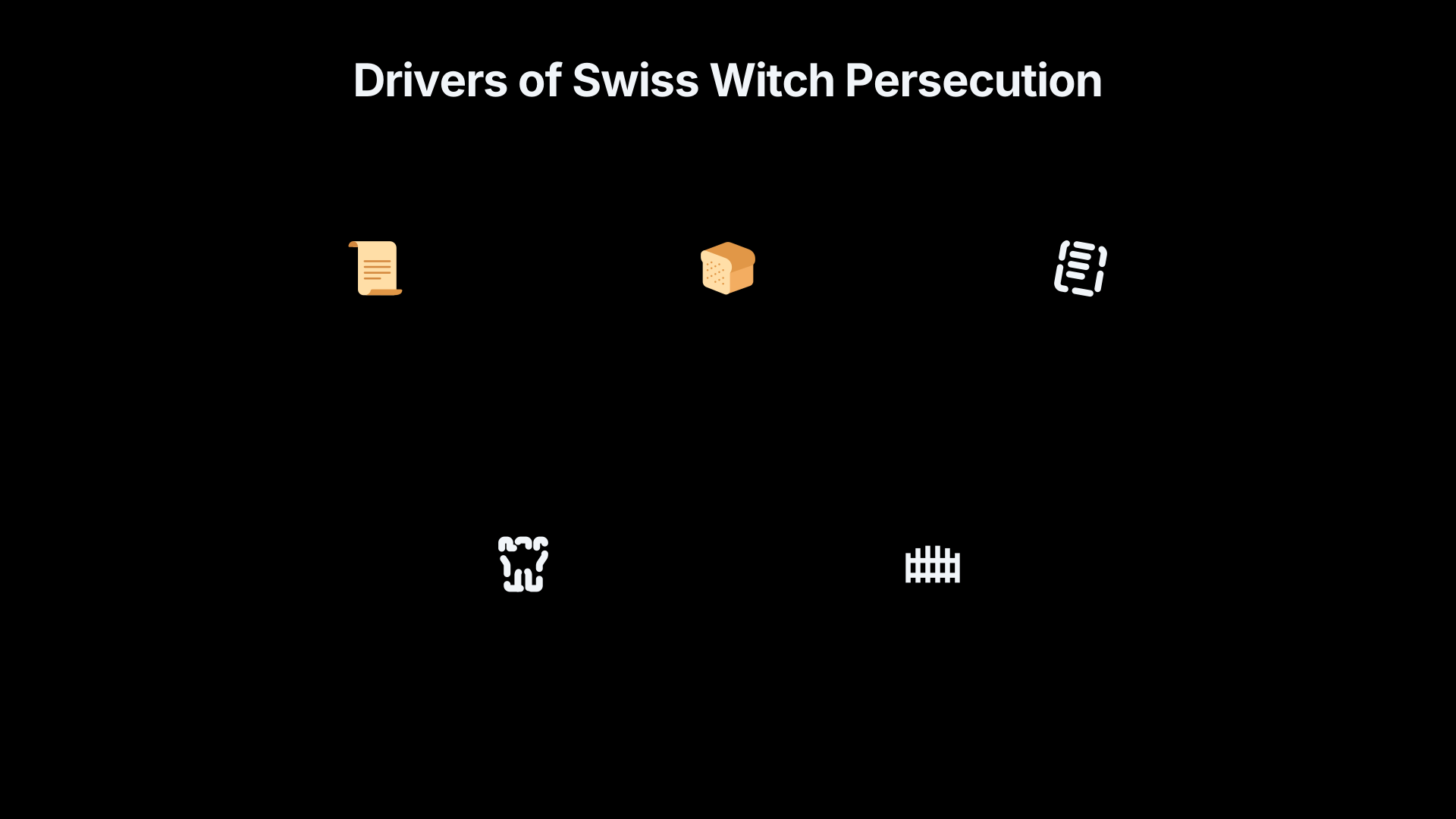
Several pressures repeatedly appeared where prosecutions flourished:
- fragmented political authority and numerous local courts;
- disputes over land, inheritance and village status;
- periods of war, famine, epidemic disease and economic insecurity;
- religious conflict before and after the Reformation;
- judicial acceptance of torture as a means of obtaining confessions.
Rather than a single nationwide panic, Switzerland experienced many overlapping local waves of persecution that shared similar legal methods.
Valais and the birth of the organised witch conspiracy
The Valais prosecutions beginning in 1428 occupy a special place in European history because they helped shape the stereotype of the organised satanic witch conspiracy that later spread across much of western Europe.
Earlier accusations of harmful magic usually centred on individual acts such as causing illness or damaging crops. In Valais, investigators increasingly claimed that witches belonged to secret assemblies, renounced Christianity, worshipped the Devil and plotted against society as a whole. This transformed isolated suspicions into evidence of membership in a vast hidden network.[Wikipedia]WikipediaValais witch trialsValais witch trials
The political situation also mattered. Valais had recently experienced conflicts between local elites and the House of Savoy, creating an unstable environment in which accusations could become tools in wider struggles over authority. Modern historians caution against reducing the trials to political conflict alone, but many see these tensions as an important condition that allowed persecution to expand.[SWI swissinfo.ch]swissinfo.chSWI swissinfo.ch Spell check: the Swiss origins of the European witch crazeSWI swissinfo.chSpell check: the Swiss origins of the European witch craze - SWI swissinfo.ch…
How accusations and torture created a self-expanding conspiracy
The most striking feature of the Swiss witch hunts was not the initial accusation but the legal process that followed.
In Valais, officials formally established procedures that allowed arrests based largely on neighbourhood reputation. According to the 1428 regulations issued at Leuk, accusations from several apparently trustworthy neighbours could justify imprisonment, while testimony extracted from previously convicted suspects became evidence against others. Torture was authorised once investigators believed sufficient suspicion existed.[Wikipedia]WikipediaValais witch trialsValais witch trials
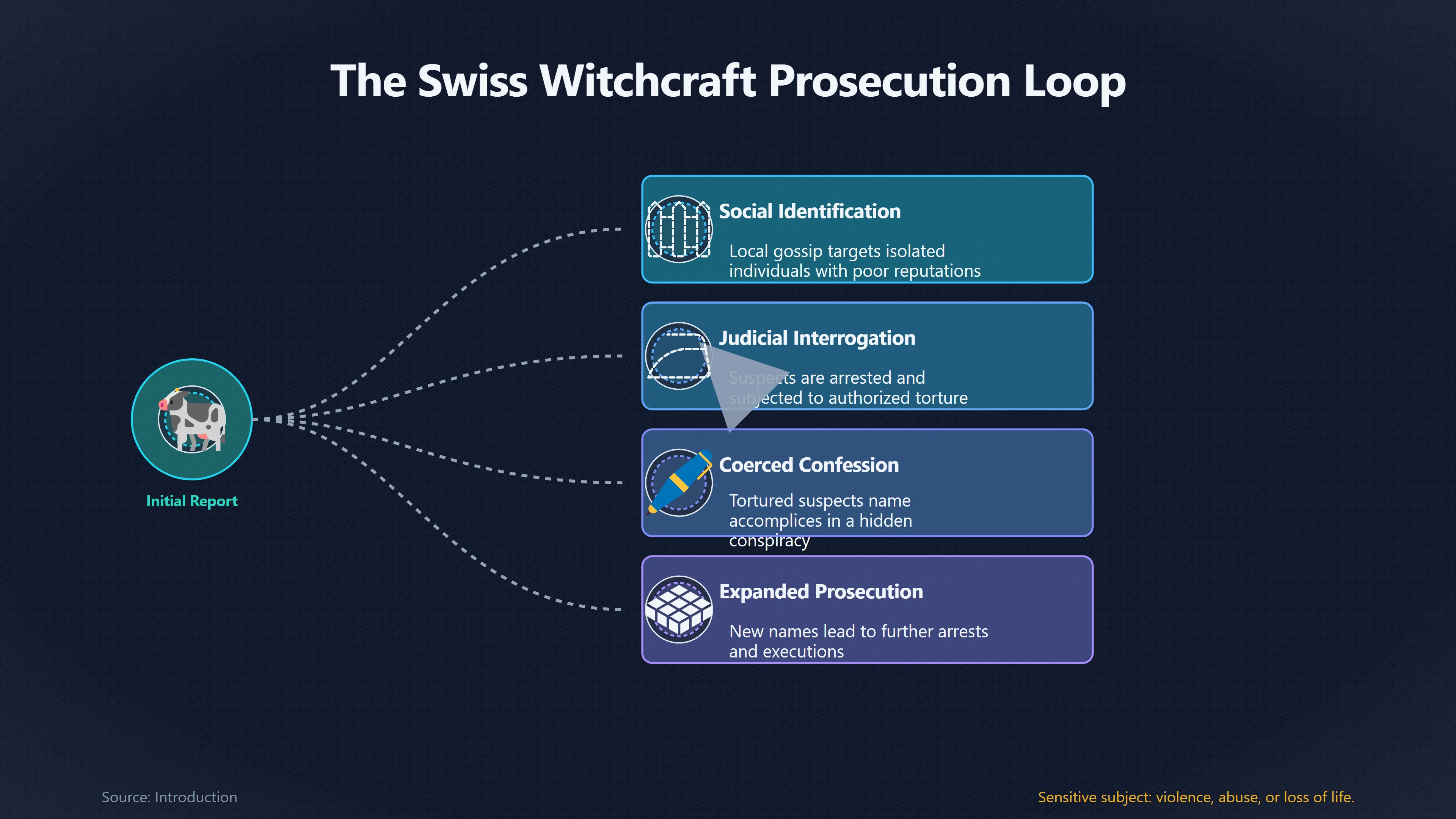
This created a powerful feedback loop.
A typical sequence looked like this:
- A neighbour reported illness, livestock deaths or unexplained misfortune.
- Local gossip identified someone with a poor reputation, social isolation or existing conflicts.
- The suspect was arrested and interrogated.
- Under torture, many confessed and named supposed accomplices.
- Those new names produced further arrests, confessions and executions.
Each confession appeared to confirm the existence of a hidden conspiracy. In reality, the conspiracy largely emerged through the investigative process itself. Modern historians therefore describe witch hunting as a judicial system capable of generating its own evidence rather than uncovering an independently verified criminal organisation.[wikipedia.org]WikipediaValais witch trialsValais witch trials
The role of demonology
Swiss courts did not invent every element of European witch belief, but they played a major role in spreading it.
Contemporary reports from Valais were discussed during the Council of Basel in the 1430s. Scholars such as Johannes Nider incorporated these accounts into influential writings that helped standardise ideas about the witches’ sabbath, pacts with the Devil, nocturnal gatherings and organised anti-Christian sects. These concepts later appeared across Europe and influenced later demonological works, including ideas that eventually fed into the Malleus Maleficarum tradition.[Wikipedia]WikipediaValais witch trialsValais witch trials
This mattered because courts increasingly interpreted confessions according to an established script. Once investigators expected suspects to describe meetings with the Devil or secret assemblies, interrogations naturally tended to produce those narratives.
Who was accused?
Women accounted for most of the accused, but Swiss records show a more complex picture than simple misogyny alone.
Widows, servants, healers and women living on the margins of village society often proved especially vulnerable because they lacked influential defenders. At the same time, men also faced prosecution in significant numbers, particularly during the earlier phases of persecution and in some Alpine regions. Family feuds, political rivalries, disputes over property and struggles between neighbouring communities frequently shaped who came under suspicion.[swissinfo.ch]swissinfo.chSWI swissinfo.ch Uncovering myths and truths behind Swiss witchcraft trialsSWI swissinfo.chUncovering myths and truths behind Swiss witchcraft trials - SWI swissinfo.chOctober 20, 2023…
The stereotype of the solitary old woman therefore captures only part of the Swiss experience. Witchcraft accusations often reflected existing social fractures rather than random fear.
Anna Göldi and the long afterlife of witch belief
Anna Göldi’s execution in Glarus in 1782 stands at the end of the Swiss story, long after the main European witch hunts had faded.
A domestic servant, Göldi was accused after the child of her employer allegedly produced needles from food and suffered mysterious symptoms. Under torture she confessed to a pact with the Devil before withdrawing the confession. The authorities avoided explicitly charging her with witchcraft, instead framing the case as poisoning because formal witchcraft prosecutions had become increasingly difficult to justify legally. Nevertheless, the allegations and evidence clearly relied upon traditional witch beliefs.[Wikipedia]WikipediaAnna GöldiAnna Göldi
The case has attracted continuing historical debate. Some researchers argue that personal relationships, social inequality and attempts to suppress scandal surrounding her employer played important roles alongside supernatural accusations. Whatever the precise combination of motives, historians broadly agree that the proceedings represented a profound miscarriage of justice rather than a legitimate criminal investigation.[Wikipedia]WikipediaAnna GöldiAnna Göldi
In 2008 the canton of Glarus formally acknowledged that Anna Göldi had been the victim of judicial murder and overturned the historic verdict. Rather than celebrating her as a “witch”, modern memorials present her as a victim of legal persecution and abuse of judicial power.[SWI swissinfo.ch]swissinfo.chSWI swissinfo.ch"Last witch" to be declared innocentSWI swissinfo.ch…
Why the Swiss witch hunts still matter
The Swiss witch hunts remain important because they demonstrate how persecution can become embedded in legal institutions rather than emerging solely from popular fear.
Neighbourly suspicion alone did not produce thousands of prosecutions. The decisive factor was a judicial system that accepted invisible conspiracies as real, relied on coerced confessions and treated accusations as evidence that more accusations must also be true. Courts, officials, clergy and local communities all contributed to different stages of this process, although their roles varied from one canton to another.
For historians, Switzerland illustrates that witch hunting was neither a simple outbreak of collective madness nor merely an expression of medieval superstition. It was a system in which law, politics, religion and local conflict reinforced one another, allowing ordinary disputes to escalate into organised persecution. The eventual rehabilitation of victims such as Anna Göldi reflects a broader effort to recognise how legal institutions themselves can perpetuate injustice when extraordinary beliefs are accepted without reliable evidence.[swissinfo.ch]swissinfo.chSWI swissinfo.ch Uncovering myths and truths behind Swiss witchcraft trialsSWI swissinfo.chUncovering myths and truths behind Swiss witchcraft trials - SWI swissinfo.chOctober 20, 2023…
Amazon book picks
Further Reading
Books and field guides related to How Switzerland Turned Suspicion Into Witch Trials. Use these as the next step if you want deeper reading beyond the article.
The witch-hunt in early modern Europe
Authoritative treatment of European witch trials.

Endnotes
1.
Source: swissinfo.ch
Title: SWI swissinfo.ch Uncovering myths and truths behind Swiss witchcraft trials
Link:https://www.swissinfo.ch/eng/culture/uncovering-the-truth-behind-swiss-witchcraft-trials/48902644
Source snippet
SWI swissinfo.chUncovering myths and truths behind Swiss witchcraft trials - SWI swissinfo.chOctober 20, 2023...
Published: October 20, 2023
2.
Source: swissinfo.ch
Title: SWI swissinfo.ch Spell check: the Swiss origins of the European witch craze
Link:https://www.swissinfo.ch/eng/swiss-oddities/the-swiss-origins-of-the-european-witch-craze/88856908
Source snippet
SWI swissinfo.chSpell check: the Swiss origins of the European witch craze - SWI swissinfo.ch...
3.
Source: Wikipedia
Title: Valais witch trials
Link:https://en.wikipedia.org/wiki/Valais_witch_trials
4.
Source: Wikipedia
Title: Witch trials in the Holy Roman Empire
Link:https://en.wikipedia.org/wiki/Witch_trials_in_the_Holy_Roman_Empire
5.
Source: swissinfo.ch
Title: SWI swissinfo.ch”Last witch” to be declared innocent
Link:https://www.swissinfo.ch/eng/culture/last-witch-to-be-declared-innocent/662094
Source snippet
SWI swissinfo.ch...
6.
Source: Wikipedia
Title: Anna Göldi
Link:https://en.wikipedia.org/wiki/Anna_G%C3%B6ldi
7.
Source: swissinfo.ch
Title: Spell check: the Swiss origins of the European witch craze
Link:https://www.swissinfo.ch/eng/swiss-abroad/the-swiss-origins-of-the-european-witch-craze/88856908
Source snippet
SWI swissinfo.chFebruary 15, 2025 — MORE History UNCOVERING MYTHS AND TRUTHS BEHIND SWISS WITCHCRAFT TRIALS This content was published on...
Published: February 15, 2025
8.
Source: swissinfo.ch
Title: No one tortured witches like the Swiss
Link:https://www.swissinfo.ch/eng/culture/no-one-tortured-witches-like-the-swiss/32908
Additional References
9.
Source: rsi.ch
Title: Processi e torture: le donne dannate delle Alpi
Link:https://www.rsi.ch/cultura/storia/Processi-e-torture-le-donne-dannate-delle-Alpi–3461001.html
Source snippet
February 6, 2026 — PROCESSI E TORTURE: LE DONNE DANNATE DELLE ALPI TRA IL 1631 E IL 1753, LA VAL POSCHIAVO FU TEATRO DI 130 PROCESSI P...
Published: February 6, 2026
10.
Source: witchcraftandwitches.com
Title: trials valais
Link:https://witchcraftandwitches.com/witchcraft/trials-valais/
Source snippet
Valais Witch Trials (France/Switzerland, 1428 - 1447) - WitchcraftDecember 15, 2018 — THE WITCH TRIALS – VALAIS WITCH TRIALS (FRANCE/SWIT...
Published: December 15, 2018
11.
Source: youtube.com
Title: The Valais Witch Trials: The Trials That Changed The World
Link:https://www.youtube.com/watch?v=TbB-s6dqwTs
Source snippet
The Prince-Bishops of Sion & The Spark of the Pyre...
12.
Source: kaweah.freedombox.rocks
Link:https://kaweah.freedombox.rocks/kiwix/content/wikipedia_en_all_maxi_2023-10/A/Valais_witch_trials
13.
Source: everything.explained.today
Link:https://everything.explained.today/Valais_witch_trials/
14.
Source: youtube.com
Title: The Prince-Bishops of Sion & The Spark of the Pyre
Link:https://www.youtube.com/watch?v=8ehEvmJya_0
Source snippet
Witch hunt history of Western Switzerland...
15.
Source: youtube.com
Title: WITCH TRIAL! The Story of Anna Göldi
Link:https://www.youtube.com/watch?v=PM-GRnmFvho
Source snippet
The Valais Witch Trials: The Trials That Changed The World...
16.
Source: blog.nationalmuseum.ch
Title: ch Im Hexenwahn – Blog zur Schweizer Geschichte
Link:https://blog.nationalmuseum.ch/2017/06/im-hexenwahn/
17.
Source: youtube.com
Title: Witch hunt history of Western Switzerland
Link:https://www.youtube.com/watch?v=otKUMO6nSps
Source snippet
The Valais Witch Trials...
18.
Source: vs.ch
Title: Histoire de la Justice en Valais
Link:https://www.vs.ch/fr/web/tribunaux/historie-de-la-justice-en-valais
Topic Tree