Within Morocco
How Bou Hmara Turned Miracles Into Power
Bou Hmara used royal impersonation, sacred reputation and real political grievances to build a rebellion that lasted for years.
On this page
- The Pretender and His Royal Identity
- Why Miracles Made the Claim Convincing
- Grievance, Warfare and the Limits of Belief
Page outline Jump by section
Introduction
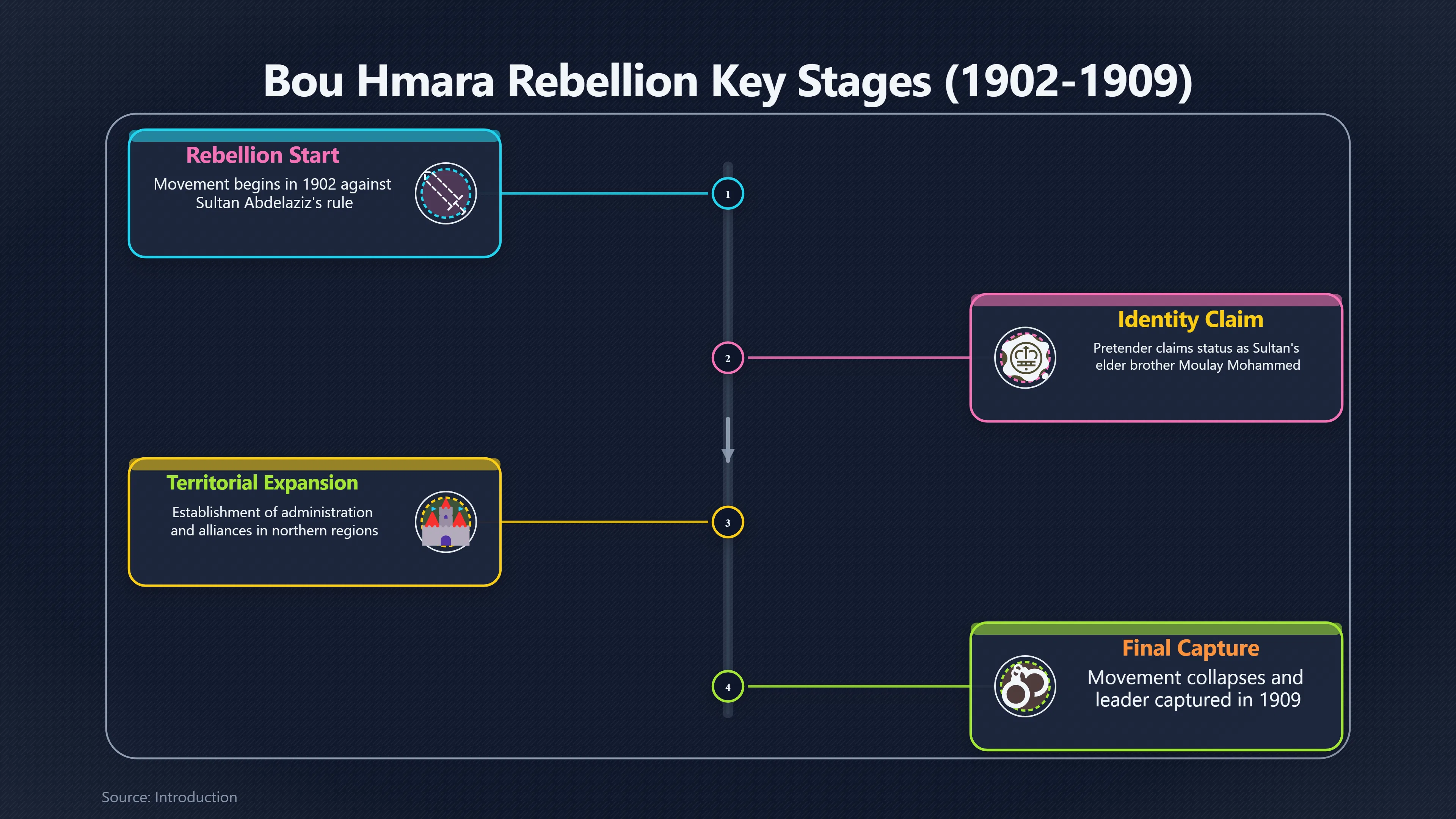
Bou Hmara’s rebellion was not sustained by military force alone. Between 1902 and 1909, the pretender combined a carefully crafted royal identity with stories of miraculous powers and saintly favour to persuade many tribes that he was the rightful ruler of Morocco. His movement succeeded because it drew on genuine political grievances while presenting him as a man chosen by God rather than simply another rebel. Understanding this blend of politics, religion and popular belief helps explain why his challenge endured for seven years and became one of the greatest crises faced by the late Moroccan sultanate before the French Protectorate.[Cambridge University Press & Assessment]cambridge.orgCambridge University Press & AssessmentBū Himāra's European connexion: the commercial relations of a Moroccan warlord | The Journal of Af…
The Pretender and His Royal Identity
Bou Hmara was born Jilali ibn Idris al-Yusufi al-Zarhuni, an educated Moroccan who had studied religion and served in government circles before falling from favour. Unlike an ordinary tribal leader, he understood both the machinery of the state and the symbolic foundations of royal authority.[Wikipedia]WikipediaBou HmaraBou Hmara
His most important political move was to claim that he was not Jilali at all but Moulay Mohammed, an elder brother of Sultan Abdelaziz. This impersonation was unusually effective because the real prince lived largely out of public view and already enjoyed a reputation for exceptional piety. Many ordinary Moroccans had never seen him. In a society where dynastic descent, religious legitimacy and public reputation were closely linked, the claim could not simply be dismissed as absurd.[wikipedia.org]WikipediaBou HmaraBou Hmara
The rebellion therefore rested on more than deception. Bou Hmara presented himself as the restoration of the rightful order rather than the creator of a new one. He claimed continuity with Morocco’s ruling dynasty while accusing the existing government of failing in its religious and political duties. That distinction mattered because many supporters believed they were defending legitimate monarchy rather than overthrowing it.[Cambridge University Press & Assessment]cambridge.orgCambridge University Press & AssessmentBū Himāra's European connexion: the commercial relations of a Moroccan warlord | The Journal of Af…
Why Miracles Made the Claim Convincing
Royal blood alone was unlikely to persuade thousands of followers during years of warfare. Bou Hmara’s movement also cultivated a reputation for miraculous abilities and divine favour.
Contemporary reports and later historical accounts describe stories that he possessed unusual knowledge, could perform astonishing feats, interpreted celestial signs and inspired prophetic expectations among supporters. Some hostile observers dismissed these as tricks, while others described him as a gifted wonder-worker whose reputation spread rapidly through oral networks. Whatever their factual basis, such stories enhanced his authority by portraying him as someone favoured by God rather than merely ambitious.[encyclopedia.com]encyclopedia.comAbu Himara | Encyclopedia.comAbu Himara | Encyclopedia.com
This reputation worked because religious authority already played a central role in Moroccan political culture. A successful sultan was expected not only to govern but also to defend Islam, maintain justice and embody sacred legitimacy through descent from the Prophet’s family. Claims of extraordinary spiritual gifts therefore reinforced an existing understanding of kingship rather than introducing an unfamiliar idea.[Cambridge University Press & Assessment]cambridge.orgCambridge University Press & AssessmentBū Himāra's European connexion: the commercial relations of a Moroccan warlord | The Journal of Af…
Miracle stories also helped solve a practical political problem. Many supporters would never meet Bou Hmara personally. Accounts of visions, remarkable escapes, supernatural protection or exceptional wisdom circulated through tribal and commercial networks, allowing belief in his special status to travel faster than he could. In this way, reputation became a political resource.
Importantly, historians do not treat these miracle stories as objective evidence that supernatural events occurred. Instead, they examine how such narratives functioned socially—building trust, strengthening loyalty and making an otherwise risky political choice appear divinely sanctioned.[Cambridge University Press & Assessment]cambridge.orgCambridge University Press & AssessmentBū Himāra's European connexion: the commercial relations of a Moroccan warlord | The Journal of Af…
Grievance, Warfare and the Limits of Belief
Miracles alone cannot explain why Bou Hmara survived repeated military campaigns.
His rebellion flourished during a period of deep dissatisfaction with Sultan Abdelaziz’s government. Heavy taxation, insecurity in parts of north-eastern Morocco, struggles within the royal court and growing European influence all undermined confidence in the central authorities. Many tribes were looking for stronger leadership long before Bou Hmara appeared.[Cambridge University Press & Assessment]cambridge.orgCambridge University Press & AssessmentBū Himāra's European connexion: the commercial relations of a Moroccan warlord | The Journal of Af…
Bou Hmara also demonstrated considerable political skill. He built alliances with tribes, established an administration in territory under his control and maintained military resistance for years. His authority therefore rested on governance as well as charisma. European commercial interests, especially mining concessions negotiated in areas under his control, further complicated the conflict by providing resources while also damaging his reputation among some supporters.[Cambridge University Press & Assessment]cambridge.orgCambridge University Press & AssessmentBū Himāra's European connexion: the commercial relations of a Moroccan warlord | The Journal of Af…
The eventual collapse of the movement illustrates the limits of sacred reputation. As his territory expanded, tribal alliances became harder to maintain. Some supporters objected to his dealings with foreign interests, while Sultan Abdelhafid proved a more determined opponent than Abdelaziz. Military defeats and political fragmentation gradually eroded the authority that miracle stories had helped create. When Bou Hmara was finally captured in 1909, claims of divine favour could no longer compensate for strategic and political failures.[cambridge.org]cambridge.orgCambridge University Press & AssessmentBū Himāra's European connexion: the commercial relations of a Moroccan warlord | The Journal of Af…
Why the Rebellion Matters Today
Bou Hmara’s career is sometimes described simply as an episode of imposture or popular credulity, but that interpretation is too narrow.
His success shows how collective belief often emerges where political institutions lose credibility. Stories of miracles became persuasive because they resonated with existing ideas about legitimate rule and because many communities already distrusted the government. Belief was reinforced by practical experience: each military victory and each failed government campaign seemed to confirm that the pretender enjoyed exceptional protection.
For historians of Morocco, the rebellion demonstrates that sacred authority and political legitimacy were deeply intertwined in the early twentieth century. It is therefore better understood as a case of charismatic politics during a crisis of state authority than as an example of simple mass delusion. The movement reveals how religious symbolism, royal identity and genuine social grievances could combine to produce one of the most serious challenges to the Moroccan monarchy before colonial rule reshaped the country’s political landscape.[cambridge.org]cambridge.orgCambridge University Press & AssessmentBū Himāra's European connexion: the commercial relations of a Moroccan warlord | The Journal of Af…

Amazon book picks
Further Reading
Books and field guides related to How Bou Hmara Turned Miracles Into Power. Use these as the next step if you want deeper reading beyond the article.


Morocco: From Empire to Independence
Provides wider background for Bou Hmara's revolt.
The commander of the faithful: the Moroccan political elite
Helps explain legitimacy and royal authority.
Endnotes
1.
Source: cambridge.org
Link:https://www.cambridge.org/core/services/aop-cambridge-core/content/view/2D52AC9A483C7D5B42AE6476898484EA/S0021853700018193a.pdf/bu-himaras-european-connexion-the-commercial-relations-of-a-moroccan-warlord.pdf
Source snippet
Cambridge University Press & AssessmentBū Himāra's European connexion: the commercial relations of a Moroccan warlord | The Journal of Af...
2.
Source: Wikipedia
Title: Bou Hmara
Link:https://en.wikipedia.org/wiki/Bou_Hmara
3.
Source: encyclopedia.com
Title: Abu Himara | Encyclopedia.com
Link:https://www.encyclopedia.com/humanities/encyclopedias-almanacs-transcripts-and-maps/abu-himara
4.
Source: cambridge.org
Link:https://www.cambridge.org/core/journals/journal-of-african-history/article/abs/bu-himaras-european-connexion-the-commercial-relations-of-a-moroccan-warlord/2D52AC9A483C7D5B42AE6476898484EA
Source snippet
Afr. Hist., 12 (1971), 173–184.CrossRefGoogle Scholar 25 ^{25} Quoted in Brown, Kenneth L., People of Salé: Tradition and Change...
5.
Source: cbej.uomustansiriyah.edu.iq
Link:https://cbej.uomustansiriyah.edu.iq/index.php/cbej/article/view/6235
Source snippet
Hamara movement and its impact on the history of Al-Aqsa Morocco (1902-1909) | Journal of the College of Basic EducationDecember 8, 2022...
Published: December 8, 2022
Additional References
6.
Source: researchgate.net
Link:https://www.researchgate.net/publication/384883320_qbylt_bny_msaart_wthwrt_bwhmart_mjlt_alhwar_almtwsty_ysdrha_mkhbr_albhwth_waldrasat_alastshraqyt_fy_hdart_almghrb_alaslamy_jamt_aljylaly_lyabs_sydy_blbas_aljzayr_almjld_08_aldd_2_dysmbr_2017
7.
Source: researchgate.net
Link:https://www.researchgate.net/publication/380952703_hrkt_bw_hmart_wathrha_fy_tarykh_almghrb_alaqsy_1902-1909Bou_Hamara_movement_and_its_impact_on_the_history_of_Al-Aqsa_Morocco
8.
Source: jstor.org
Link:https://www.jstor.org/stable/j.ctv371cfw0
9.
Source: youtube.com
Title: Morocco’s History and Royal Legitimacy Explained
Link:https://www.youtube.com/watch?v=DFrf5OyNWzM
Source snippet
How Islam and Royal Authority Interact in Morocco...
10.
Source: youtube.com
Title: The First Moroccan Crisis (Andrew Morris)
Link:https://www.youtube.com/watch?v=nnscTi-QleY
Source snippet
How Morocco's Internal Crises Contributed to WW1...
11.
Source: youtube.com
Link:https://www.youtube.com/watch?v=biBS38tTICU
Source snippet
The First Moroccan Crisis (Andrew Morris)...
12.
Source: youtube.com
Link:https://www.youtube.com/watch?v=OeCBS2p0Hz0
Source snippet
Morocco's History and Royal Legitimacy Explained...
13.
Source: ddl.ae
Link:https://ddl.ae/book/7032618
Source snippet
(2017-12-31). قبيلة بني مسَّارة وثورة بوحمارةAlgeria: Universite Ibn Khaldoun de Tiaret. `Chicago` >...
Published: December 31, 2017
14.
Source: youtube.com
Title: How Islam and Royal Authority Interact in Morocco
Link:https://www.youtube.com/watch?v=viQPuZeKiAk
Source snippet
Understanding the Agadir Crisis, 1911...
15.
Source: asjp.cerist.dz
Title: ASJPقبيلة بني مسَّارة وثورة بوحمارة
Link:https://asjp.cerist.dz/en/article/32618
Topic Tree