Within Latvia's Strange Beliefs
Who Drove Latvia's Witch Trials?
Latvia's witch trials grew from local grudges, crop fears and courts that forced village suspicions into Christian demonology.
On this page
- How accusations began in villages
- Courts, coercion and Baltic German power
- What the surviving records can prove
Page outline Jump by section
Introduction
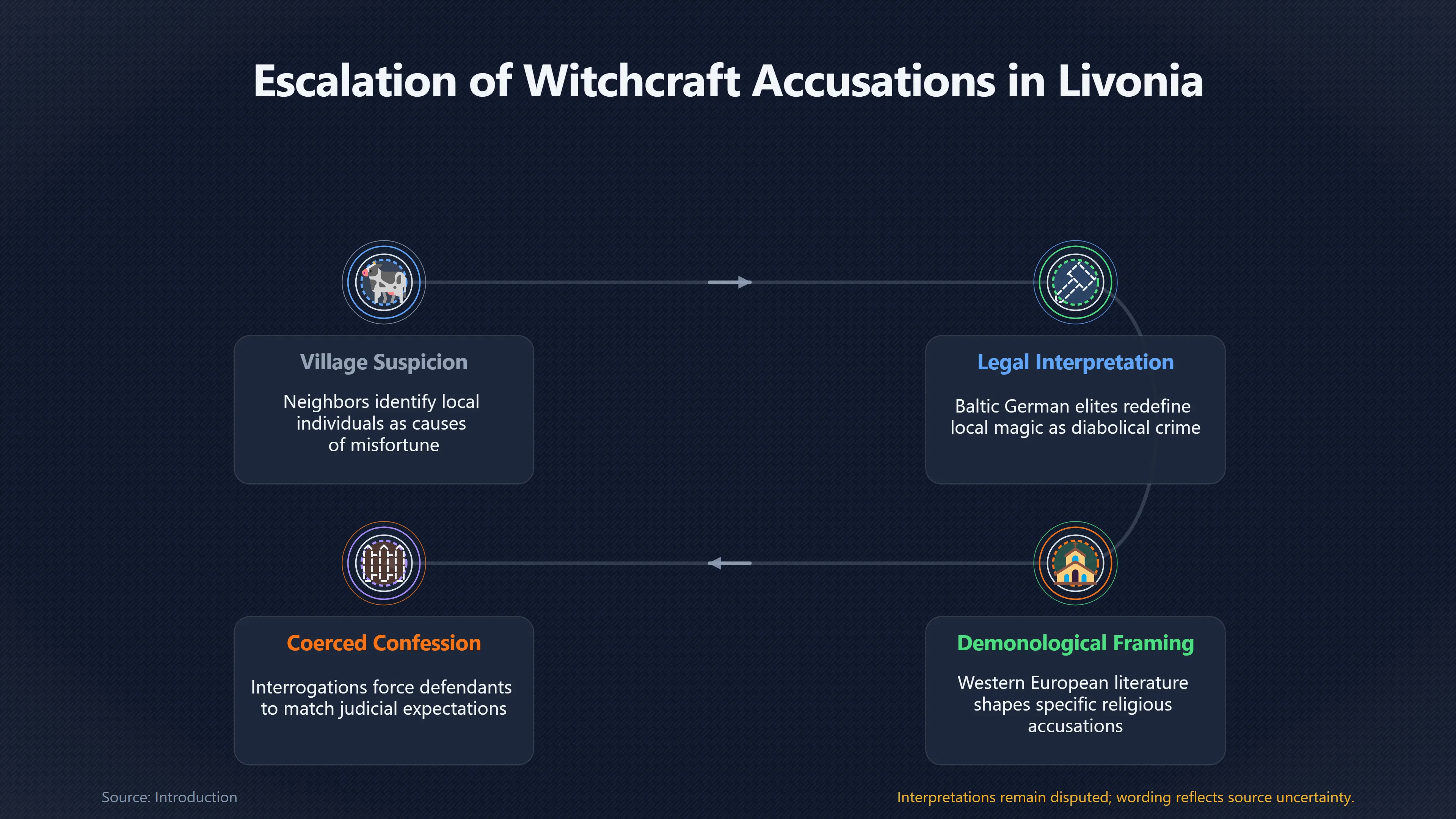
Witch trials in the territory of modern Latvia were not driven simply by widespread superstition. They emerged from the interaction of village suspicion, unequal social power and legal systems controlled largely by Baltic German elites. Most accusations began with everyday conflicts over illness, livestock, failed harvests or damaged reputations, but once they entered the courts they were often transformed into cases about the Devil, organised witchcraft and threats to Christian society. The surviving records from sixteenth- and seventeenth-century Livonia show that the most powerful force behind many prosecutions was not spontaneous panic alone, but the ability of judges, clergy and estate authorities to redefine local disputes as serious religious crimes.[ResearchGate]researchgate.netResearchGate(PDF) Research of Witch Persecution in Latvia: A Shared Field of History and FolkloristicsJanuary 1, 2017…

How accusations began in villages
Most people accused of witchcraft were first suspected by neighbours rather than by the state. Villagers explained sudden misfortune through personal relationships. If a cow stopped producing milk after an argument, a child died unexpectedly, or crops failed following a quarrel, suspicion could settle on someone already regarded as troublesome, isolated or unusually knowledgeable about healing and charms.
These accusations reflected practical concerns rather than elaborate ideas about Satan. Rural communities often believed harmful magic could damage health, livestock or harvests, but they did not necessarily imagine organised gatherings of Devil-worshippers. Many accusations grew from:
- disputes between neighbours over land, animals or property;
- repeated family feuds that made ordinary accidents appear deliberate;
- fear of crop failure or animal disease in communities dependent on successful harvests;
- suspicion of healers, charm-users or people with unusual local reputations.
Because many villages lived close to subsistence, even a modest run of bad luck demanded explanation. Witchcraft provided a way to identify a human cause behind otherwise unpredictable disasters.[ResearchGate]researchgate.netResearchGate(PDF) Research of Witch Persecution in Latvia: A Shared Field of History and FolkloristicsJanuary 1, 2017…
Importantly, accusations did not always target women. Although women formed a substantial proportion of defendants, Livonian records also contain many accused men, particularly individuals associated with folk healing, magical practices or beliefs about werewolves. This distinguishes the region from the simplified popular image of European witch hunts as exclusively female persecution.[Wikipedia]WikipediaWitch trials in Latvia and EstoniaWitch trials in Latvia and Estonia
Courts, coercion and Baltic German power
Once an accusation entered the legal system, its meaning often changed dramatically.
Early modern Latvia formed part of Livonia and neighbouring political territories where courts, churches and large estates were dominated by Baltic German elites. Most Latvian-speaking peasants had little influence over legal proceedings and, in many places, lived under forms of serfdom. The imbalance of power meant village suspicions were interpreted through legal and religious ideas imported from western and central Europe.[ResearchGate]researchgate.netResearchGate(PDF) Research of Witch Persecution in Latvia: A Shared Field of History and FolkloristicsJanuary 1, 2017…
Judges and clergy increasingly expected to find evidence of crimes such as:
- making a pact with the Devil;
- attending secret nocturnal gatherings;
- flying to witches’ meetings;
- belonging to organised networks attacking Christian society.
These concepts came from learned demonological literature rather than everyday Latvian folk belief. A significant turning point came after the publication in Riga of a German-language witchcraft handbook in 1625, which helped spread western European demonological ideas among educated church leaders and officials. The result was that local accusations about harmful magic could be reshaped into much broader religious offences deserving severe punishment.[Wikipedia]WikipediaWitch trials in Latvia and EstoniaWitch trials in Latvia and Estonia
The legal process itself strengthened accusations. Under questioning—and sometimes under coercive interrogation familiar across early modern Europe—defendants could be pushed towards confessions that matched judicial expectations more than local belief. Instead of recording what villagers originally feared, court documents often reveal what magistrates expected to hear.

Why authority mattered more than numbers
Modern readers often imagine witch hunts as enormous public frenzies. The surviving Latvian evidence suggests something more complicated.
Many documented Livonian prosecutions involved only one defendant or a small number of accused individuals rather than mass trials. Their importance lies less in their scale than in how legal authority amplified relatively ordinary disputes.
Several factors repeatedly reinforced accusations:
- estate courts possessed legal power over largely dependent peasant populations;
- clergy sought to suppress practices regarded as incompatible with official Christianity;
- confessions carried exceptional weight once recorded in court;
- earlier accusations made later suspicions appear increasingly believable.
Rather than large crowds collectively losing touch with reality, prosecutions usually combined local grievance with institutional authority. Fear became deadly because courts gave it legal force.[Wikipedia]WikipediaWitch trials in Latvia and EstoniaWitch trials in Latvia and Estonia
What the surviving records can prove
One challenge for historians is that the documentary record is incomplete.
Many witch cases were handled by private estate courts whose records have been lost or were never systematically preserved. As a result, historians cannot reliably calculate how many people were accused or executed across the territory that became modern Latvia. They can identify documented cases, but broad numerical estimates remain uncertain.[ResearchGate]researchgate.netResearchGate(PDF) Research of Witch Persecution in Latvia: A Shared Field of History and FolkloristicsJanuary 1, 2017…
Research by Latvian folklorist and historian Sandis Laime also shows that knowledge of witch trials comes from several overlapping traditions:
- surviving court documents;
- nineteenth- and early twentieth-century historical publications;
- folklore collected generations after the events;
- linguistic and ethnographic studies.
These sources illuminate different aspects of the past but cannot always be treated equally. Legends often preserve genuine historical memories while reshaping them through storytelling. Separating documented events from later folklore therefore remains an essential part of interpreting Latvian witch trials.[researchgate.net]researchgate.netResearchGate(PDF) Research of Witch Persecution in Latvia: A Shared Field of History and FolkloristicsJanuary 1, 2017…
Fear, class and belief reinforced one another
The Latvian evidence shows that witch trials were not simply irrational eruptions of collective fear. They reflected a society divided by language, class and legal authority.
Peasant communities supplied many of the initial accusations because they sought explanations for misfortune close to home. Estate officials and clergy then interpreted those accusations within a Christian demonological framework that was often far more elaborate than local belief itself. The unequal relationship between rural populations and Baltic German institutions gave these interpretations exceptional power.
Seen this way, the trials reveal how persecution developed through the interaction of three forces rather than one:
- local suspicion, rooted in neighbourly conflict and economic insecurity;
- religious ideology, which transformed harmful magic into diabolical conspiracy;
- judicial authority, which converted suspicion into criminal conviction.
This combination helps explain why witch prosecutions in Latvia belong not only to the history of popular belief but also to the history of power. They demonstrate how legal institutions could magnify everyday fears into capital offences, leaving records that reveal as much about the structure of early modern society as about belief in witchcraft itself.[researchgate.net]researchgate.netResearchGate(PDF) Research of Witch Persecution in Latvia: A Shared Field of History and FolkloristicsJanuary 1, 2017…


Endnotes
1.
Source: researchgate.net
Link:https://www.researchgate.net/publication/331647153_Research_of_Witch_Persecution_in_Latvia_A_Shared_Field_of_History_and_Folkloristics
Source snippet
ResearchGate(PDF) Research of Witch Persecution in Latvia: A Shared Field of History and FolkloristicsJanuary 1, 2017...
Published: January 1, 2017
2.
Source: Wikipedia
Title: Witch trials in Latvia and Estonia
Link:https://en.wikipedia.org/wiki/Witch_trials_in_Latvia_and_Estonia
3.
Source: researchgate.net
Title: Research Gate(PDF) Some Notes on the Possible Origins of Livonian Werewolves
Link:https://www.researchgate.net/publication/331646417_Some_Notes_on_the_Possible_Origins_of_Livonian_Werewolves
4.
Source: researchgate.net
Title: (PDF) Latvian Laumas: Reflections on the Witchisation of Tradition
Link:https://www.researchgate.net/publication/365386590_Latvian_Laumas_Reflections_on_the_Witchisation_of_Tradition
5.
Source: researchgate.net
Link:https://www.researchgate.net/publication/259746827_The_Werewolves_of_Livonia_Lycanthropy_and_Shape-Changing_in_Scholarly_Texts
6.
Source: research.lu.lv
Link:https://research.lu.lv/en/publications/reflections-of-historical-witch-trials-in-latvian-folklore-vecku%C5%A1/
Source snippet
University of LatviaReflections of Historical Witch Trials in Latvian Folklore: Veckušķis Legend Cycle - University of Latvia...
7.
Source: research.lu.lv
Link:https://research.lu.lv/en/publications/latvian-laumas-reflections-on-the-witchisation-of-tradition/
Source snippet
University of LatviaLatvian Laumas: Reflections on the Witchisation of Tradition - University of Latvia...
Additional References
8.
Source: lvia.archyvai.lrv.lt
Link:https://lvia.archyvai.lrv.lt/en/news/newly-discovered-castle-court-record-books-of-the-duchy-of-livonia-from-16791694-in-the-lithuanian-state-historical-archives-vWD/
Source snippet
Discovered Castle Court Record Books of the Duchy of Livonia from 1679–1694 in the Lithuanian State Historical Archives - Lithuanian Stat...
9.
Source: youtube.com
Title: The Dark Truth Behind Real Werewolf Witch Trials | What Really Happened
Link:https://www.youtube.com/watch?v=9VuRIiPDbA0
Source snippet
Malleus Maleficarum: The Book That Sent Thousands to Their Deaths | The Dark Truth of the Inquisi...
10.
Source: youtube.com
Title: Werewolf For God: The Turbulent Trial of [Thiess]({{ ‘thiess/’ | relative_url }}) of Kaltenbrunn
Link:https://www.youtube.com/watch?v=B5Bpbmf0Dgw
Source snippet
The Dark Truth Behind Real Werewolf Witch Trials | What Really Happened...
11.
Source: youtube.com
Link:https://www.youtube.com/watch?v=3S_UW27Cjfk
Source snippet
The Chilling Werewolf Trials of Europe...
12.
Source: link.springer.com
Link:https://link.springer.com/book/9783032006707
Source snippet
Trials in the Grand Duchy of Lithuania in the Sixteenth to Eighteenth Centuries: Enchanted Borderlands | Springer Nature LinkJanuary 1, 2...
13.
Source: youtube.com
Title: Witches and Their Secrets in Latvian Folklore
Link:https://www.youtube.com/watch?v=BBKN3g2SDIU
Source snippet
Werewolf For God: The Turbulent Trial of Thiess of Kaltenbrunn...
14.
Source: ejournals.vdu.lt
Link:https://ejournals.vdu.lt/index.php/istorijoszurnalas/en/article/view/242
Source snippet
Discovered Court Records of the Duchy of Livonia(1679–1694) in the Lithuanian State Historical Archives | History / IstorijaMay 20, 2026...
Published: May 20, 2026
15.
Source: arhivi.gov.lv
Link:https://www.arhivi.gov.lv/en/department/latvian-state-historical-archives
16.
Source: etalpykla.lituanistika.lt
Link:https://etalpykla.lituanistika.lt/object/LT-LDB-0001%3AJ.04~2021~1648040562757/
17.
Source: research.lu.lv
Link:https://research.lu.lv/lv/publications/reflections-of-historical-witch-trials-in-latvian-folklore-vecku%C5%A1/
Topic Tree