Within Bahamas Strange Beliefs
How Obeah Became The Bahamas' Great Supernatural Fear
Obeah became feared not as one fixed religion, but as a broad colonial label for healing, protection, divination and harmful magic.
On this page
- What Bahamians meant by obeah
- How slavery and colonial rule shaped the label
- Why fear survived after emancipation
Page outline Jump by section
Introduction
Obeah became The Bahamas’ great supernatural fear not because it was a single, organised religion, but because colonial governments, churches and wider society gradually turned a wide range of African-derived spiritual practices into one suspicious category. Healing, protection, herbal knowledge, divination and harmful magic were increasingly grouped together under the same label. Over time, “obeah” came to mean not simply a set of practices but an imagined hidden threat that could explain illness, bad luck, crime, rebellion or social disorder.
This process mattered far beyond religion. The colonial definition of obeah shaped policing, law and public opinion, and its influence survived long after slavery ended. In The Bahamas, as elsewhere in the British Caribbean, fear of obeah became embedded in legislation, Christian preaching and everyday conversation, helping to create one of the country’s longest-lasting moral and supernatural scares.
What Bahamians meant by obeah
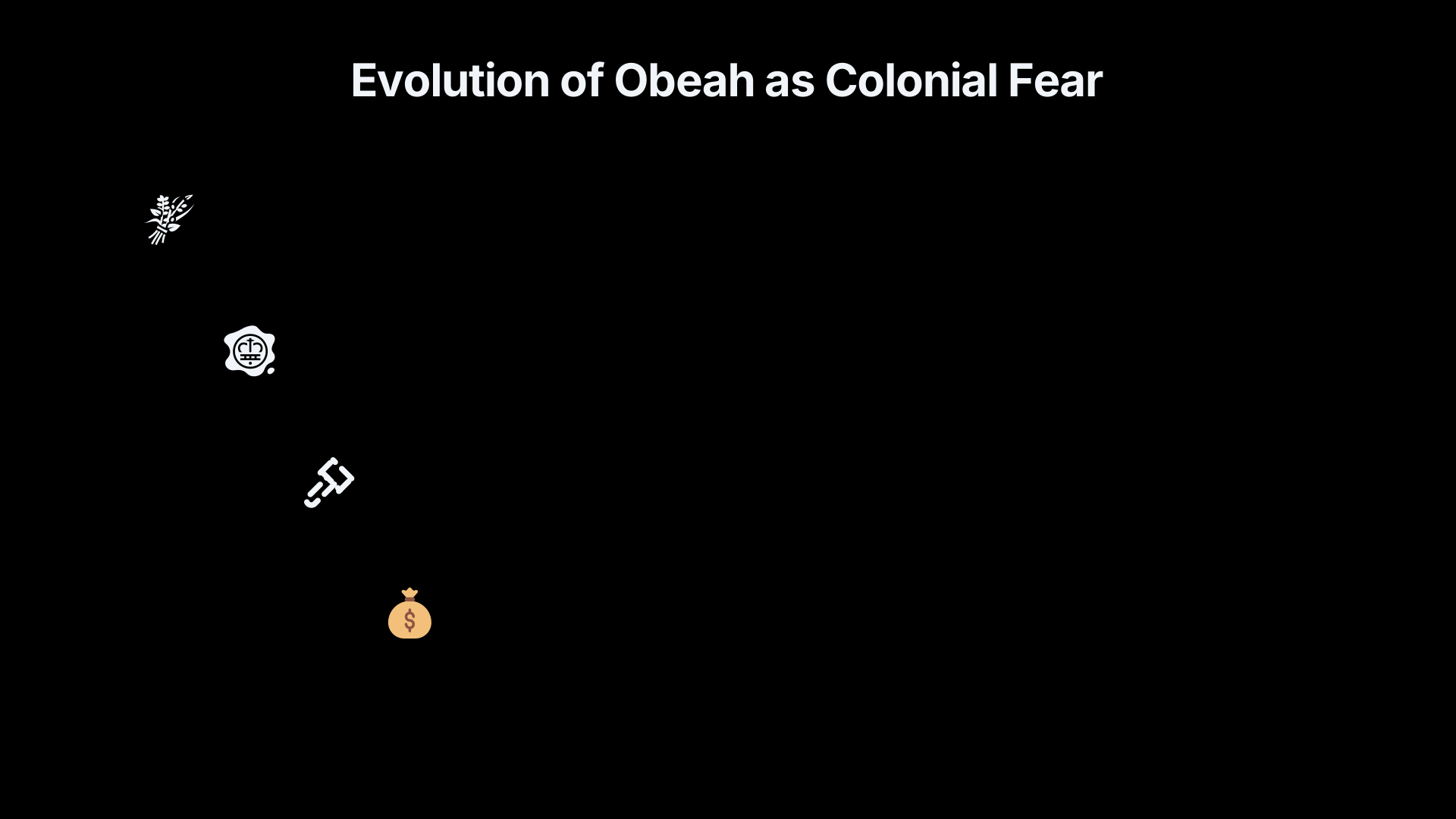
One reason obeah became such a powerful source of fear is that nobody ever agreed on exactly what it was. In everyday Bahamian speech, the word could refer to very different activities:
- Herbal healing and traditional medicine.
- Protective charms against misfortune.
- Divination or attempts to discover hidden information.
- Rituals intended to influence relationships or prosperity.
- Acts believed to bring illness, bad luck or death through supernatural means.
These practices were not necessarily part of a single belief system. Different islands, families and communities understood them differently, while many practitioners combined African traditions with Christian beliefs and local folklore. Historians therefore warn against describing obeah as a fixed religion comparable to churches or organised faiths. Instead, it functioned as a flexible colonial label that absorbed many unrelated practices.[Edinburgh Research]research.ed.ac.ukinburgh ResearchObeah acts: Producing and policing the boundaries of religion in the Caribbean - University of Edinburgh Research Explorer…
That flexibility made the term especially useful for colonial authorities. Because the boundaries were vague, almost any unfamiliar African-derived spiritual activity could be described as obeah.
How slavery and colonial rule shaped the label
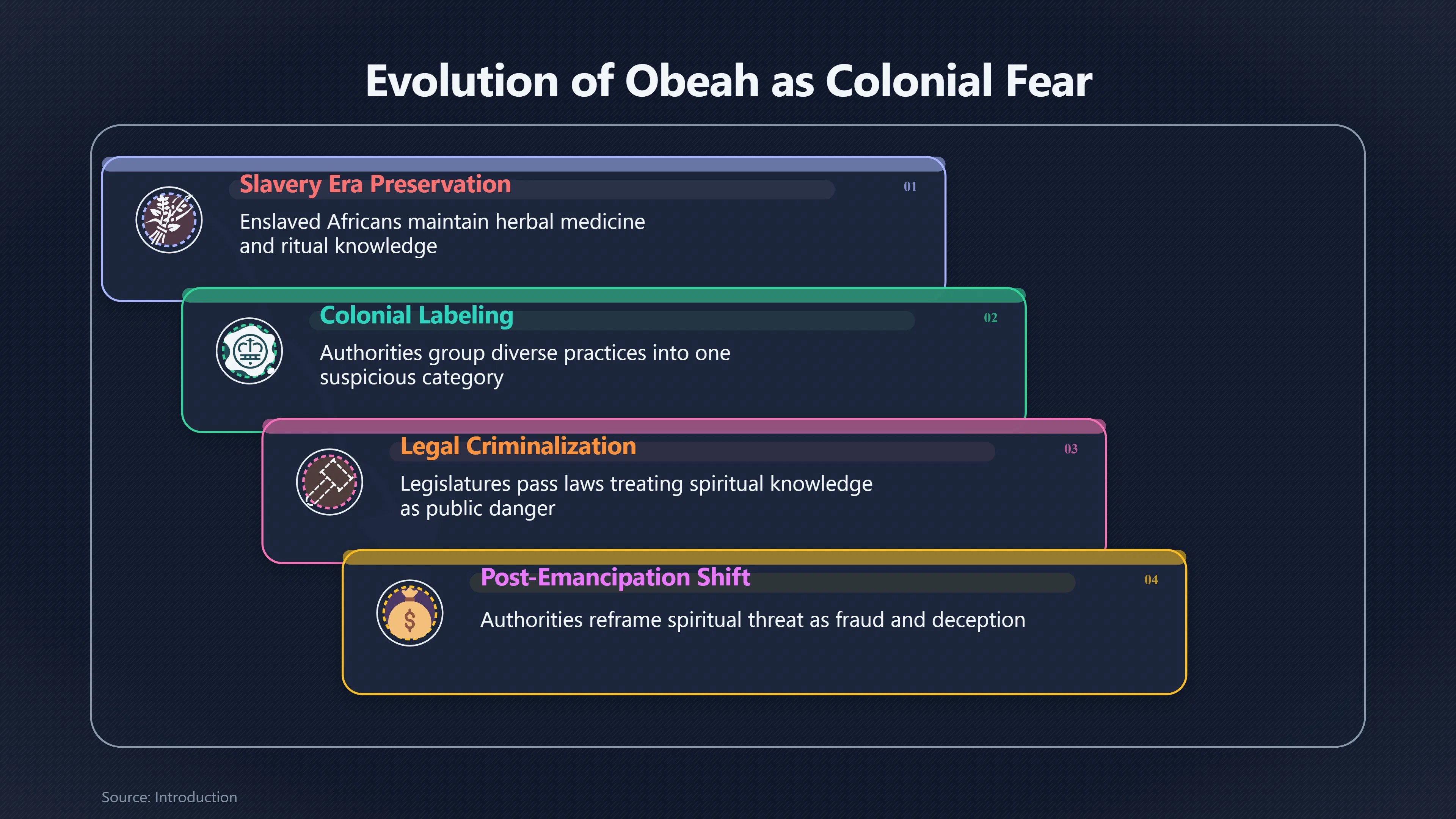
The fear surrounding obeah was closely connected to slavery rather than simply to supernatural belief.
Throughout the British Caribbean, enslaved Africans preserved religious knowledge, herbal medicine and ritual practices despite the destruction of many traditional institutions. These practices often offered practical help during illness and emotional support during extreme hardship. They also helped create trusted community leaders outside the control of plantation owners.
For colonial authorities, this independence appeared threatening. Following slave uprisings elsewhere in the Caribbean—notably Jamaica’s 1760 rebellion—obeah became associated with conspiracy, secret oaths and resistance, even though many people accused of practising it had no connection to rebellion. Colonial legislatures increasingly treated obeah as a danger to public order rather than simply a religious issue. Anti-obeah laws spread across the British Caribbean over the late eighteenth and nineteenth centuries.[Obeah Histories]obeahhistories.orgObeah Histories Legislation | Obeah HistoriesObeah HistoriesLegislation | Obeah HistoriesSeptember 18, 2012…
The Bahamas experienced fewer large slave revolts than colonies such as Jamaica, yet it inherited the same legal and intellectual framework. Bahamian lawmakers adopted the wider British Caribbean understanding that African spiritual specialists represented a potential challenge to colonial authority.
A crime defined by fear rather than clear belief
One unusual feature of anti-obeah laws is that they rarely attempted to determine whether supernatural powers actually existed.
Instead, legislation generally criminalised claims to supernatural knowledge, especially where authorities believed someone was intimidating others, accepting payment or encouraging belief in occult powers. The legal concern was less about proving magic than about controlling people who claimed special spiritual authority.
Modern scholars argue that this transformed obeah into what might be called a legal fiction. The state did not identify one clearly defined religion and then prohibit it. Rather, it created a broad legal category capable of including healing, fortune telling, charms, ritual objects and many other activities under a single criminal label.[Edinburgh Research]research.ed.ac.ukinburgh ResearchObeah acts: Producing and policing the boundaries of religion in the Caribbean - University of Edinburgh Research Explorer…
This distinction helps explain why historians often describe obeah as a colonial construction as much as a religious tradition. The legal definition itself helped produce the image of an organised hidden menace.
Why Christian opposition reinforced the scare
Colonial law was only one part of the process. Churches also played an important role in shaping public attitudes.
During the nineteenth and twentieth centuries, Protestant churches expanded across The Bahamas and promoted Christianity as a marker of respectability and civilisation. Ministers commonly contrasted Christian worship with practices described as superstition, witchcraft or devil worship.
As a result, many Bahamians grew up hearing obeah discussed primarily as something dangerous or sinful rather than as part of African cultural history. Even people who doubted its supernatural power often believed it represented moral corruption or spiritual danger.
This religious framing strengthened the colonial image of obeah. Rather than disappearing after emancipation, fear became embedded within ordinary family life. Parents warned children about curses. Rumours circulated about mysterious objects left near houses. Stories about unexplained illness or sudden misfortune were sometimes interpreted through the language of obeah even when no evidence existed.
The result was not constant public panic but a persistent background anxiety that could be revived whenever unusual events occurred.
Why fear survived after emancipation
Ending slavery did not end the colonial understanding of obeah.
Instead, the justification gradually shifted. Earlier colonial officials often portrayed obeah as politically dangerous because it could unite enslaved people. After emancipation, authorities increasingly described it as fraud, deception or exploitation of vulnerable individuals. The stereotype changed, but the criminal category remained.
In The Bahamas this continuity is striking because laws against obeah survived into the modern era. Their persistence reinforced the impression that obeah represented an exceptional social danger, even though comparable supernatural beliefs within mainstream religions were not treated in the same way.
The continuing existence of these laws also influenced public memory. Many Bahamians encountered obeah first not through practitioners but through warnings from police, churches or older relatives, allowing colonial assumptions to pass from one generation to the next.[Cambridge University Press & Assessment]cambridge.orgCambridge University Press & AssessmentOBEAH, VAGRANCY, AND THE BOUNDARIES OF RELIGIOUS FREEDOM: ANALYZING THE PROSCRIPTION OF “PRETENDIN…
What historians say was really happening
Recent scholarship has shifted attention away from asking whether supernatural powers were “real” and towards understanding why societies became convinced that obeah posed such a serious threat.
Several explanations now receive broad support:
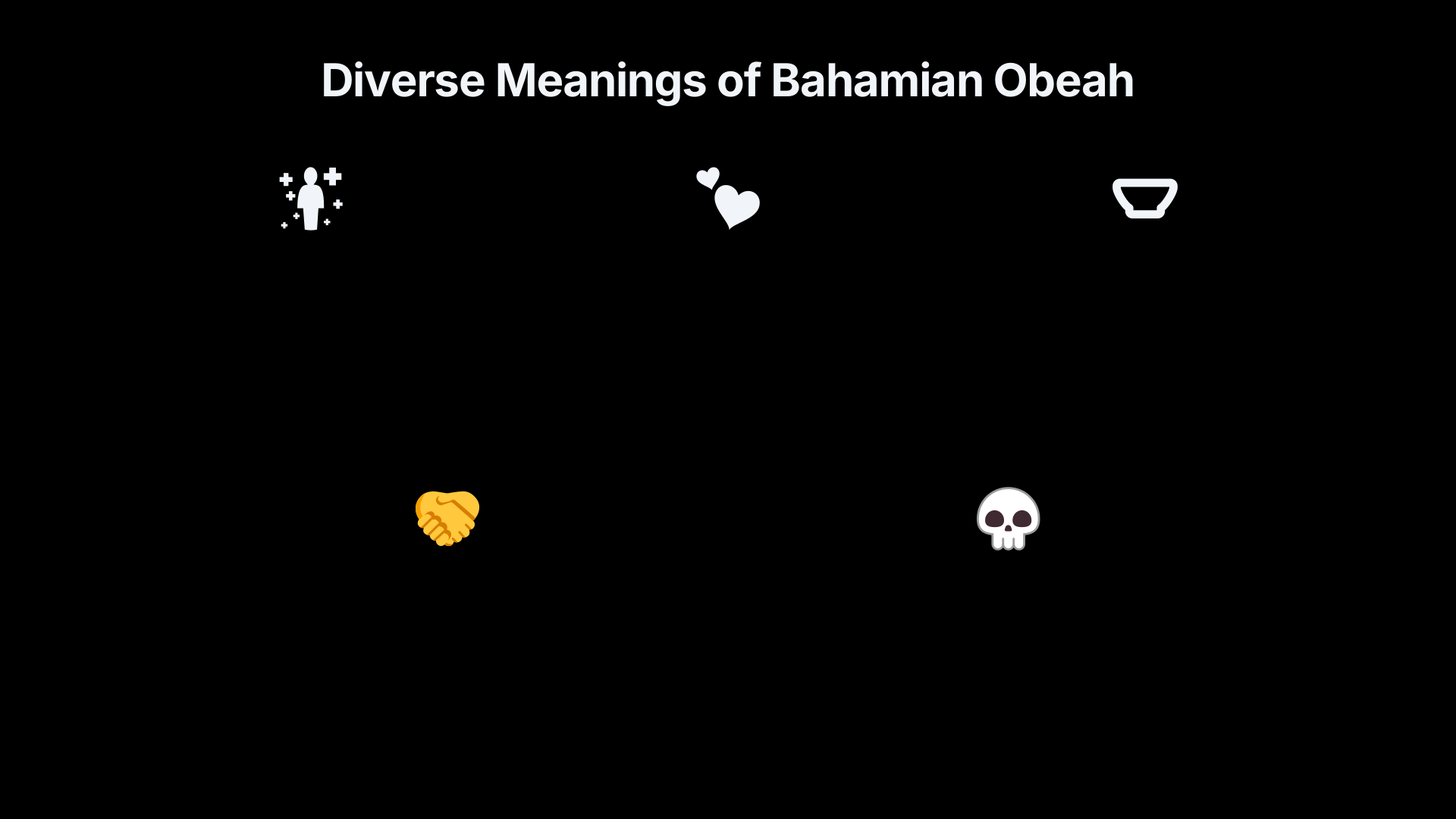
- Colonial control: Anti-obeah laws helped regulate independent African leadership and discourage alternative sources of authority.
- Racial hierarchy: Labelling African traditions as superstition reinforced claims that colonial rule represented civilisation and progress.
- Religious boundary-making: Colonial governments separated practices they classified as “religion” from those they classified as “magic” or “witchcraft”, giving legal protection to some beliefs while criminalising others.
- Social uncertainty: In communities facing illness, poverty or unexplained misfortune, rumours about supernatural harm offered emotionally satisfying explanations when ordinary evidence was lacking.
Rather than treating obeah simply as irrational belief, historians increasingly examine how fear was produced through law, religion and colonial power. The scare was therefore not merely spontaneous public superstition. It was actively reinforced by institutions that determined which beliefs counted as acceptable religion and which became evidence of criminality.[ed.ac.uk]research.ed.ac.ukinburgh ResearchObeah acts: Producing and policing the boundaries of religion in the Caribbean - University of Edinburgh Research Explorer…
Why the colonial scare still matters
The legacy of this history remains visible in The Bahamas today. Obeah continues to occupy an unusual position in public life: widely recognised, frequently discussed in whispers, strongly associated with danger by many Christians, yet difficult to define with precision.
That ambiguity is itself part of the colonial inheritance. Because the word was designed to gather together many different African-derived practices under a single negative label, it has remained capable of carrying fears about hidden enemies, supernatural harm and moral corruption long after the original colonial world disappeared.
Understanding this history changes the question from “Did people believe in obeah?” to a more revealing one: how did a loose collection of healing, protective and spiritual practices become the colony’s defining symbol of hidden supernatural danger? The answer lies less in the practices themselves than in the centuries-long interaction between slavery, colonial law, religious competition and the enduring power of collective fear.
Amazon book picks
Further Reading
Books and field guides related to How Obeah Became The Bahamas' Great Supernatural Fear. Use these as the next step if you want deeper reading beyond the article.
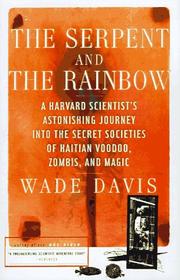
The Serpent and the Rainbow
Provides wider context for supernatural belief in the Caribbean.

The anthropology of religion, magic, and witchcraft
Places witchcraft and magic beliefs in comparative context.
Caribbean Religions: A History
Directly covers Caribbean religious traditions including obeah.
Endnotes
1.
Source: cambridge.org
Link:https://www.cambridge.org/core/journals/journal-of-law-and-religion/article/abs/obeah-vagrancy-and-the-boundaries-of-religious-freedom-analyzing-the-proscription-of-pretending-to-possess-supernatural-powers-in-the-anglophone-caribbean/11EEE1AD5948F72F423FE174FFE61F87
Source snippet
Cambridge University Press & AssessmentOBEAH, VAGRANCY, AND THE BOUNDARIES OF RELIGIOUS FREEDOM: ANALYZING THE PROSCRIPTION OF “PRETENDIN...
2.
Source: cambridge.org
Title: The emergence of Caribbean spiritual politics (Chapter 1)
Link:https://www.cambridge.org/core/books/cultural-politics-of-obeah/emergence-of-caribbean-spiritual-politics/FC51D36577DC37AC641288F0AC718D28
3.
Source: cambridge.org
Title: The Cultural Politics of Obeah
Link:https://www.cambridge.org/core/books/cultural-politics-of-obeah/18560C16399F297C310529C686CD039A
4.
Source: cambridge.org
Title: Creole slave society, obeah, and the law (Chapter 3)
Link:https://www.cambridge.org/core/books/abs/cultural-politics-of-obeah/creole-slave-society-obeah-and-the-law/614D64A80BF1F8CCF008F662FC7AD8D3
5.
Source: cambridge.org
Link:https://www.cambridge.org/core/books/cultural-politics-of-obeah/obeah-in-the-courts-18901939/DC36F64021BD8B2FFDFED90CD9CF9CEF
6.
Source: research.ed.ac.uk
Link:https://www.research.ed.ac.uk/en/publications/obeah-acts-producing-and-policing-the-boundaries-of-religion-in-t/
Source snippet
inburgh ResearchObeah acts: Producing and policing the boundaries of religion in the Caribbean - University of Edinburgh Research Explorer...
7.
Source: obeahhistories.org
Title: Obeah Histories Legislation | Obeah Histories
Link:https://obeahhistories.org/law/
Source snippet
Obeah HistoriesLegislation | Obeah HistoriesSeptember 18, 2012...
Published: September 18, 2012
8.
Source: obeahhistories.org
Title: 1760 jamaica law
Link:https://obeahhistories.org/1760-jamaica-law/
9.
Source: obeahhistories.org
Link:https://obeahhistories.org/
10.
Source: research.ed.ac.uk
Title: ed.ac.uk Witchcraft, poison, law and Atlantic slavery
Link:https://www.research.ed.ac.uk/en/publications/witchcraft-poison-law-and-atlantic-slavery/
Additional References
11.
Source: journals.uchicago.edu
Link:https://www.journals.uchicago.edu/doi/abs/10.1086/713926
Source snippet
Chicago JournalsPowers of Imagination and Legal Regimes against “Obeah” in the Late Eighteenth- and Early Nineteenth-Century British Cari...
12.
Source: islandhopperguides.com
Title: Obeah in The Bahamas: Exploring the Islands’ Rich Spiritual Traditions
Link:https://islandhopperguides.com/bahamas/bahamian-culture/obeah-in-the-bahamas-exploring-the-islands-rich-spiritual-traditions/
Source snippet
Island Hopper GuidesApril 17, 2025 — OBEAH IN THE BAHAMAS: EXPLORING THE ISLANDS’ RICH SPIRITUAL TRADITIONS In 1893, a British colonial a...
Published: April 17, 2025
13.
Source: sciencedirect.com
Title: Religion, Power, Politics, and History in the Southern Caribbean
Link:https://www.sciencedirect.com/org/science/article/pii/S1382237323001137
Source snippet
Whereas Hosay climaxes in public processional spectacle and has ranged between the extremes of criminalized...
14.
Source: youtube.com
Title: Caribbean Origins | History, Migrations & DNA
Link:http://www.youtube.com/watch?v=zAyEMBjr6o0
Source snippet
Obeah Acts religion Caribbean colonialism Church vs. Obeah: Spiritual Warfare in Jamaica | The Hidden War on African Spirituality Jamaica...
15.
Source: youtube.com
Title: How Colonial Jamaica Turned Obeah Into A Crime with Dr. Katharine Gerbner
Link:http://www.youtube.com/watch?v=u0LjnvBHQ2c
Source snippet
Obeah, Vodou and the Banned Spirits of the Caribbean: The Hidden War on Black Religion...
16.
Source: youtube.com
Title: Obeah Is Jamaican Culture: How Colonialism Criminalized Our Tradition
Link:http://www.youtube.com/watch?v=DPBdkCWxEc8
Source snippet
Caribbean Origins | History, Migrations & DNA...
17.
Source: academic.oup.com
Link:https://academic.oup.com/ahr/article-abstract/121/5/1714/2750881
Source snippet
The Cultural Politics of Obeah: Religion, Colonialism, and Modernity in the Caribbean World. | The American Historical Review | Oxford Ac...
18.
Source: academic.oup.com
Link:https://academic.oup.com/edited-volume/61644/chapter-abstract/539849199
Source snippet
Conspiracies in the British Colonies | Oxford Research Encyclopedia of American History | Oxford AcademicJune 21, 2023 — Oxford Research...
Published: June 21, 2023
19.
Source: youtube.com
Link:http://www.youtube.com/watch?v=t16-6g9fG4Y
Source snippet
FAMOUS OBEAH CASES IN JAMAICA...
20.
Source: youtube.com
Title: FAMOUS OBEAH CASES IN JAMAICA
Link:http://www.youtube.com/watch?v=70DFUDwOkvQ
Source snippet
Obeah Is Jamaican Culture: How Colonialism Criminalized Our Tradition...
Topic Tree