Within Rwanda
Was Nyabingi a Cult or Resistance Movement?
Nyabingi joined spirit-medium authority to resistance against taxation, imposed chiefs and European colonial rule.
On this page
- Muhumusa and the rise of Nyabingi authority
- How colonial officials used witchcraft labels
- Belief, political grievance and later resistance
Page outline Jump by section
Introduction
Nyabingi was not simply a religious movement, nor was it merely an anti-colonial rebellion. It was a spirit-medium tradition centred in the mountainous borderlands of northern Rwanda and south-western Uganda that became a powerful source of political authority during a period of dynastic conflict and European conquest. To its followers, Nyabingi represented a revered female spirit whose mediums offered healing, protection and guidance. To many German and British colonial officials, however, Nyabingi became synonymous with witchcraft, superstition and dangerous rebellion.[Africabib]africabib.orgAfrica Bib | Ritual and History: The Case of NyabingiAfricaBib | Ritual and History: The Case of Nyabingi…
Modern historians generally reject the simplistic colonial description of Nyabingi as a “cult”. Instead, they argue that spiritual belief, local political grievances and resistance to outside rule became closely intertwined. Understanding Nyabingi therefore requires looking at both religion and politics together rather than treating one as a disguise for the other.
Was Nyabingi a cult or a resistance movement?
The question reflects a colonial argument rather than a straightforward historical choice. European administrators frequently described Nyabingi as a witchcraft cult because it challenged their authority and did not fit Christian or European ideas about religion. Yet the people who participated did not necessarily see themselves as members of a separate religious organisation. They sought the guidance of spirit mediums, believed in the power of Nyabingi to influence health, fertility and justice, and often turned to these figures during periods of political uncertainty.[Africabib]africabib.orgAfrica Bib | The colonial control of spirit cults in UgandaAfricaBib | The colonial control of spirit cults in Uganda…
Rather than existing outside society, Nyabingi formed part of everyday life across parts of northern Rwanda and neighbouring Uganda. Mediums acted as healers, advisers and ritual specialists. During periods of crisis, that religious authority could also become political authority. When colonial governments imposed taxes, appointed chiefs or interfered with established systems of leadership, Nyabingi mediums offered an alternative source of legitimacy.
This combination of spiritual belief and political resistance explains why colonial officials found the movement particularly threatening. They often assumed that opposition must have been organised by “witch doctors” manipulating a superstitious population. More recent scholarship instead shows that followers had concrete political grievances alongside genuine religious convictions.[IISTE]iiste.orgGender and Spirituality in Anti-Colonial Struggles in Uganda: A Case of Nyabingi Movement in Kigezi Region (1900-1945) | Maria | Res…
Muhumusa and the rise of Nyabingi authority
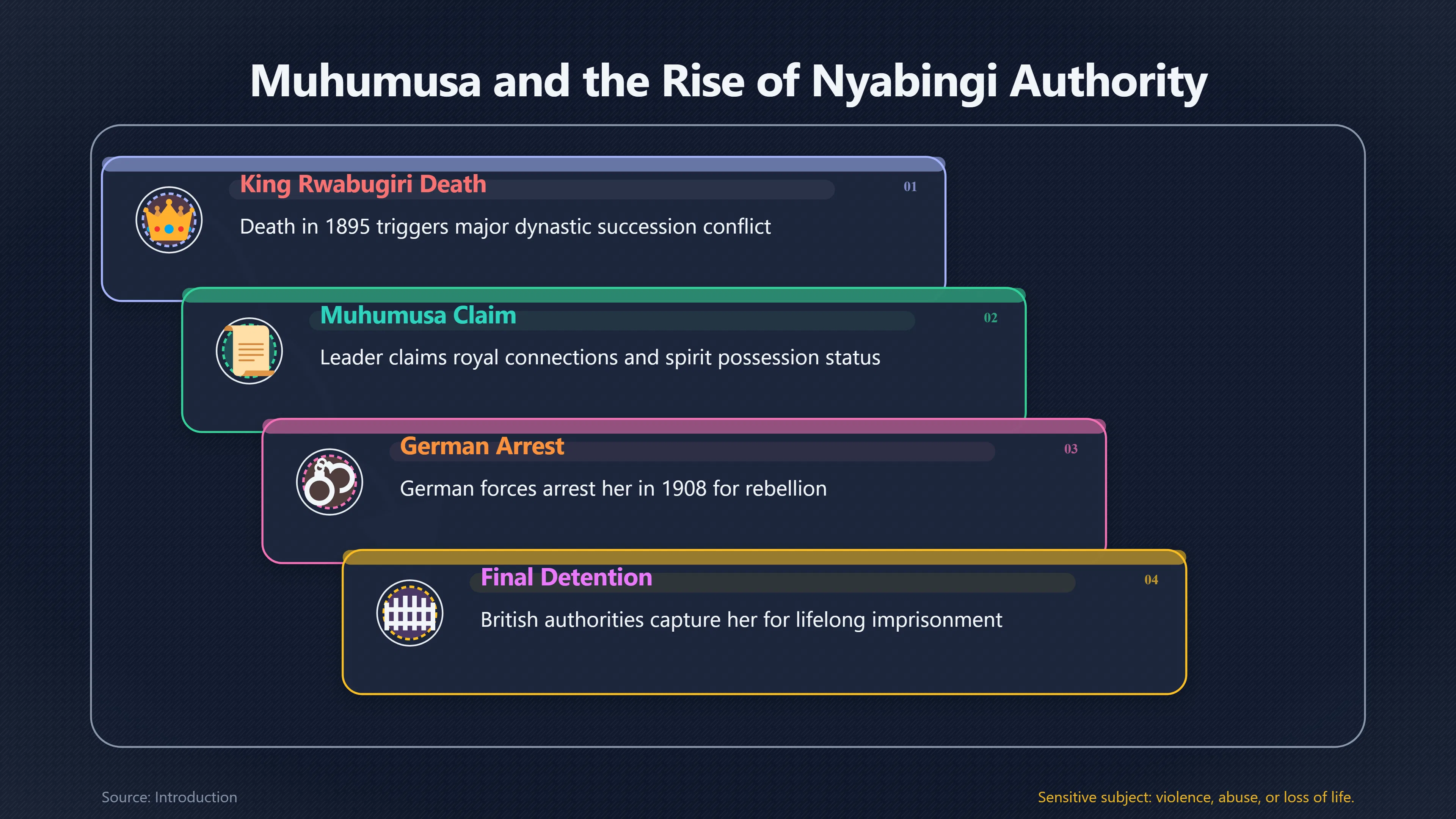
The best-known Nyabingi leader was Muhumusa (also spelled Muhumuza), whose career illustrates how closely spiritual authority and politics became connected after the death of King Rwabugiri of Rwanda in 1895. Claiming both royal connections and possession by the Nyabingi spirit, Muhumusa argued that her son was the rightful heir to the Rwandan throne, directly challenging the succession recognised by the royal court.[Wikipedia]WikipediaOpen source on wikipedia.org.
Her authority rested on more than dynastic claims. Followers believed she possessed exceptional spiritual powers, including healing, prophecy and protection from enemies. People brought tribute and sought advice from her, while she encouraged supporters to reject rival political authorities. As German colonial influence expanded into Rwanda, her movement increasingly became associated with resistance to both the colonial administration and local rulers who cooperated with it.[Wikipedia]WikipediaOpen source on wikipedia.org.
German forces eventually arrested Muhumusa in 1908 on charges framed partly around witchcraft and political rebellion. After escaping imprisonment several years later, she continued organising resistance in territories that later became part of Uganda before British authorities captured her again. She spent the remainder of her life under detention, becoming one of the most significant female anti-colonial figures in the region.[Wikipedia]WikipediaOpen source on wikipedia.org.
Her career also demonstrates that Nyabingi resistance crossed the colonial boundaries drawn by European powers. The movement operated across communities that had long-standing social and religious connections, even after international borders divided them between German East Africa and the British Protectorate of Uganda.[Deep Blue]deepblue.lib.umich.eduashrock 1Deep BlueContingent Homes, Contingent Nation: Rwandan Settlers in Uganda, 1911-64…
Why colonial governments called it witchcraft
European administrators rarely distinguished between indigenous religion, spirit possession and political mobilisation. Colonial reports commonly grouped them together as witchcraft, superstition or dangerous “native cults”. Such language served practical political purposes.
By portraying Nyabingi as irrational rather than political, colonial governments could justify repression while avoiding engagement with complaints about taxation, labour demands, imposed chiefs or loss of local autonomy. Laws aimed at suppressing witchcraft frequently became tools for restricting spirit mediums and gatherings associated with Nyabingi. In Uganda, colonial authorities introduced legislation against alleged witchcraft practices that was explicitly used against Nyabingi activities.[IISTE]iiste.orgGender and Spirituality in Anti-Colonial Struggles in Uganda: A Case of Nyabingi Movement in Kigezi Region (1900-1945) | Maria | Res…
Historians have shown that colonial attitudes evolved over time. Officials were often less concerned with religious belief itself than with whether a movement appeared capable of undermining colonial order. Spirit traditions judged politically harmless might be tolerated, while those associated with resistance were labelled subversive. This distinction reveals that the issue for colonial governments was usually control rather than theology.[Africabib]africabib.orgAfrica Bib | The colonial control of spirit cults in UgandaAfricaBib | The colonial control of spirit cults in Uganda…
The colonial description of Nyabingi as a dangerous “cult” therefore tells historians as much about European fears as it does about the movement itself.
Belief and political grievance worked together
It is misleading to imagine Nyabingi either as pure religion or as political resistance disguised in religious language. The historical evidence suggests that the two were inseparable.
Followers genuinely believed that the Nyabingi spirit could intervene in human affairs through recognised mediums. Those beliefs gave spiritual leaders moral authority that could not easily be replaced by colonial officials or newly appointed chiefs. When communities experienced political disruption, economic pressure or disputed succession, that authority naturally acquired political importance.[Africabib]africabib.orgAfrica Bib | Ritual and History: The Case of NyabingiAfricaBib | Ritual and History: The Case of Nyabingi…
Several overlapping grievances encouraged support for Nyabingi:
- opposition to foreign colonial rule;
- resistance to imposed chiefs viewed as lacking local legitimacy;
- resentment of taxation and compulsory labour;
- disputes over royal succession following Rwabugiri’s death;
- defence of local autonomy in the northern borderlands.[wikipedia.org]WikipediaOpen source on wikipedia.org.
Because these concerns varied from place to place, Nyabingi should not be understood as a single centrally directed rebellion. Instead, it provided a shared religious language through which different communities expressed local political frustrations.
Why historians interpret Nyabingi differently today
Earlier colonial writing tended to portray Nyabingi as irrational fanaticism or evidence of African superstition. Since the 1970s, historians and anthropologists have developed more nuanced interpretations.
Some researchers emphasise Nyabingi’s deep historical roots as a regional spirit tradition that predated European conquest and cannot simply be reduced to anti-colonial protest. Studies of ritual practice suggest that healing, fertility and protection remained central to the tradition even during periods of conflict.[Africabib]africabib.orgAfrica Bib | Ritual and History: The Case of NyabingiAfricaBib | Ritual and History: The Case of Nyabingi…
Others focus on the movement’s political role during colonial expansion, arguing that spirit-medium authority offered communities an alternative basis for leadership when older institutions were disrupted. Rather than treating religion as separate from politics, these scholars see Nyabingi as demonstrating how spiritual belief could become a legitimate foundation for collective action.[Africabib]africabib.orgAfrica Bib | The colonial control of spirit cults in UgandaAfricaBib | The colonial control of spirit cults in Uganda…
There is also debate over whether Nyabingi should be classified alongside other African millenarian or prophetic movements. Some historians argue that this comparison obscures important differences because Nyabingi developed from distinctive regional religious traditions instead of predicting an imminent apocalyptic transformation.[Africabib]africabib.orgAfrica Bib | The colonial control of spirit cults in UgandaAfricaBib | The colonial control of spirit cults in Uganda…

Why Nyabingi still matters
Nyabingi occupies an important place in the history of Rwanda and the wider Great Lakes region because it challenges simple distinctions between religion and politics. It demonstrates how indigenous spiritual traditions could become centres of resistance without fitting modern stereotypes of either revolutionary movements or isolated religious sects.
The movement also illustrates the importance of examining colonial language critically. Labels such as “witchcraft”, “superstition” and “cult” often reflected the priorities of colonial governments seeking to maintain authority rather than neutral descriptions of African religious life.
For historians of collective belief, Nyabingi is significant not because it represents a case of mass hysteria, but because it shows how shared spiritual convictions can shape political action during periods of upheaval. The tradition reminds us that belief systems are embedded in social and historical circumstances, and that understanding them requires taking both religious experience and political grievance seriously rather than dismissing either one.[Africabib]africabib.orgAfrica Bib | The colonial control of spirit cults in UgandaAfricaBib | The colonial control of spirit cults in Uganda…
Amazon book picks
Further Reading
Books and field guides related to Was Nyabingi a Cult or Resistance Movement?. Use these as the next step if you want deeper reading beyond the article.
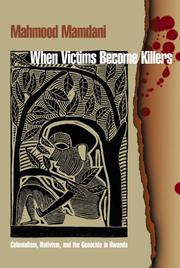
We wish to inform you that tomorrow we will be killed with ou...
Offers accessible Rwanda background for related topics.
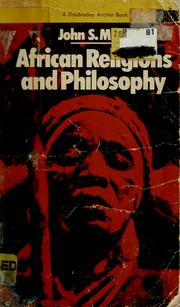
African religions and philosophy
Provides context for African religious traditions including spirit belief.
The scramble for Africa,
First published 1990. Subjects: History, Colonies, Colonization, Colonización, Kolonisatie.
Endnotes
1.
Source: africabib.org
Title: Africa Bib | Ritual and History: The Case of Nyabingi
Link:https://www.africabib.org/rec.php?DB=p&RID=190085053
Source snippet
AfricaBib | Ritual and History: The Case of Nyabingi...
2.
Source: africabib.org
Title: Africa Bib | The colonial control of spirit cults in Uganda
Link:https://www.africabib.org/rec.php?RID=153786779
Source snippet
AfricaBib | The colonial control of spirit cults in Uganda...
3.
Source: iiste.org
Link:https://iiste.org/Journals/index.php/RHSS/article/view/61735/0
Source snippet
Gender and Spirituality in Anti-Colonial Struggles in Uganda: A Case of Nyabingi Movement in Kigezi Region (1900-1945) | Maria | Res...
4.
Source: Wikipedia
Link:https://en.wikipedia.org/wiki/Muhumusa
5.
Source: africabib.org
Link:https://www.africabib.org/rec.php?RID=P00056715
Source snippet
AfricaBib | The Historical Origins and Development of the Nyabingi Cult in Southern Uganda and Northern Rwanda...
6.
Source: africabib.org
Link:https://africabib.org/rec.php?RID=143141368
7.
Source: africabib.org
Link:https://www.africabib.org/rec.php?RID=03832587X
8.
Source: africabib.org
Link:https://www.africabib.org/rec.php?DB=p&RID=143141368
9.
Source: africabib.org
Link:https://www.africabib.org/rec.php?RID=188618678
10.
Source: deepblue.lib.umich.edu
Title: ashrock 1
Link:https://deepblue.lib.umich.edu/bitstream/handle/2027.42/144182/ashrock_1.pdf?sequence=1
Source snippet
Deep BlueContingent Homes, Contingent Nation: Rwandan Settlers in Uganda, 1911-64...
11.
Source: journals.mak.ac.ug
Link:https://journals.mak.ac.ug/mawazo/article/view/257
Source snippet
mak.ac.ug| MAWAZOJune 30, 2024 — ORAL HISTORY AND GENDERED TERRAIN OF ANTI- COLONIAL STRUGGLES AMONG THE BANYAKIGEZI * Grace Maria Kentar...
Published: June 30, 2024
12.
Source: suppressedhistories.net
Link:https://www.suppressedhistories.net/articles2/muhumusa.html
Additional References
13.
Source: researchgate.net
Link:https://www.researchgate.net/publication/403216246_Oral_History_and_Gendered_Terrain_of_Anti-_Colonial_Struggles_among_the_Banyakigezi
Source snippet
June 1, 2024 — bitterly oppose colonial atrocities and to liberate the local population from injustices and bad governance that were bein...
Published: June 1, 2024
14.
Source: persee.fr
Title: Persée Ritual and History: the Case of Nyabingi
Link:https://www.persee.fr/doc/cea_0008-0055_1974_num
Source snippet
PerséeRitual and History: the Case of Nyabingi - Persée...
15.
Source: researchgate.net
Link:https://www.researchgate.net/publication/399107248_Magic_Religion_and_Electoral_Politics_in_Uganda
16.
Source: cambridge.org
Link:https://www.cambridge.org/core/journals/historical-journal/article/abs/black-mischief-crime-protest-and-resistance-in-colonial-kenya/9AEC5D9711677E3F565D540C3A5064C3
17.
Source: cambridge.org
Link:https://www.cambridge.org/core/journals/africa/article/abs/chiefship-and-the-history-of-nyavingi-possession-among-the-bashu-of-eastern-zaire/FF25F93C6A4046AA013FA8BF5A624728
18.
Source: si.edu
Link:https://www.si.edu/object/siris_sil_302954
19.
Source: youtube.com
Link:https://www.youtube.com/watch?v=w5u6dWQdK8M
Source snippet
NYABINGHI The Powerful African Warrior Queen...
20.
Source: youtube.com
Title: Muhumusa THE QUEEN WHO FOUGHT 3 ENEMIES
Link:https://www.youtube.com/watch?v=DJx02LBsE68
Source snippet
THE STORY OF NYAHBINGHI DOCUMENTARY 2016...
21.
Source: cbn.rw
Link:https://cbn.rw/article/323/nyabingi-umugore-uteye-amatsiko-atangaje-inyandiko-ya-dr-munyansanga-olivier-umwalimu-muri-pur-protestant-university-of-rwanda-
Source snippet
"2) Ritual and History: The Case of Nyabingi (Rite et histoire: le cas de Nyabingi), <[https://www.jstor.org/..."](https://www.jstor.org/...")...
22.
Source: youtube.com
Title: Muhumuza Became Queen Nyabingi of Uganda
Link:https://www.youtube.com/watch?v=BW2P1XQ4KGU
Source snippet
Muhumusa THE QUEEN WHO FOUGHT 3 ENEMIES...
Topic Tree