Within South Africa
Why Prophecy Flourished Under Colonial Pressure
The Xhosa cattle-killing and Bulhoek movements turned conquest, disease and land loss into promises of divine renewal.
On this page
- The Xhosa cattle killing movement
- Bulhoek and the Israelites
- Belief, resistance and colonial power
Page outline Jump by section
Introduction
Prophetic movements became especially influential in South Africa when colonial conquest, epidemic disease and land dispossession undermined older political and social certainties. Rather than representing simple outbreaks of irrational belief, these movements offered religious explanations for devastating events and promised that divine intervention could reverse military defeat, restore lost land and reunite fractured communities. The best-known examples—the Xhosa cattle-killing movement of 1856–57 and the Bulhoek Israelites led by Enoch Mgijima—emerged in different periods but shared a common pattern. Both transformed unbearable political realities into expectations of dramatic renewal, while colonial authorities interpreted them primarily as threats to public order. Modern historians view these episodes as windows into the psychological and social pressures created by colonial rule rather than as isolated examples of collective delusion.[wiley.com]compass.onlinelibrary.wiley.comOnline Library The Xhosa Cattle‐Killing Movement in History and LiteratureWiley Online LibraryThe Xhosa Cattle‐Killing Movement in History and Literature - Offenburger - 2009 - History Compass - Wiley Online Lib…
The Xhosa cattle-killing movement
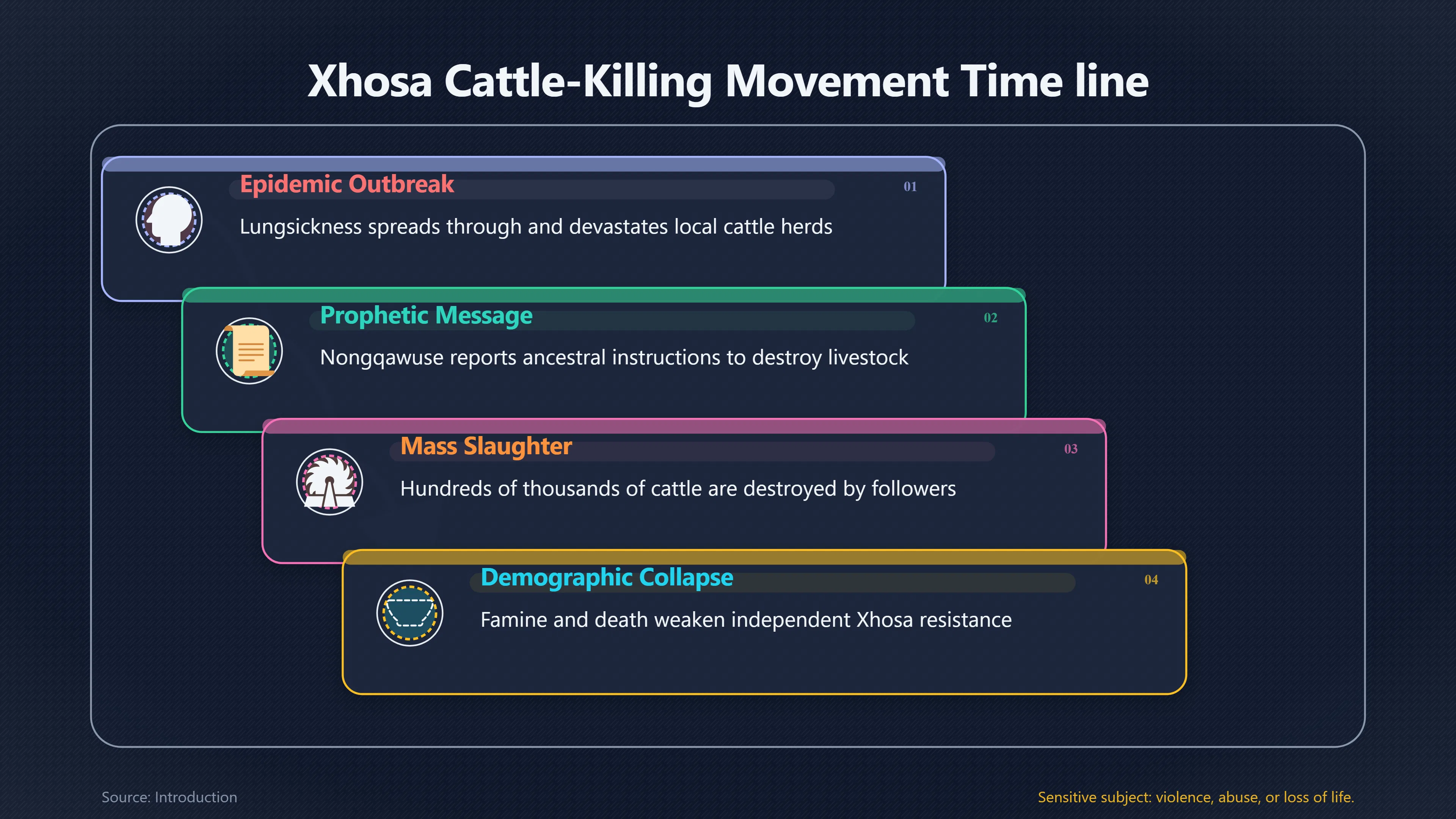
The Xhosa cattle-killing movement remains the most consequential prophetic movement in South African history. In 1856 the teenage prophet Nongqawuse reported receiving messages from ancestral spirits instructing the Xhosa to destroy their cattle and cease planting crops. If the instructions were obeyed completely, the ancestors would return, healthy cattle would emerge, the dead would rise, and British colonial power would disappear.
Seen without context, the prophecy appears extraordinary. Yet it emerged after decades of frontier warfare, territorial loss and repeated disruption of Xhosa political life. An equally important factor was the outbreak of contagious bovine pleuropneumonia, commonly called lungsickness, which had spread through Xhosa cattle after infected animals entered southern Africa. Because cattle lay at the heart of the economy, social status and family life, the epidemic represented far more than an agricultural problem. It threatened the foundations of society itself. Historians argue that the prophecy made sense within existing religious beliefs about ritual purification, ancestors and renewal, while also incorporating influences from Christian ideas circulating through missionary activity.[cambridge.org]cambridge.orgCambridge University Press & AssessmentThe Central Beliefs of the Xhosa Cattle-Killing | The Journal of African History | Cambridge CoreJ…
The movement was never universally accepted. Chiefs, families and local communities debated whether the prophecy should be followed. Some destroyed all their cattle; others refused; many adopted intermediate positions. The division created lasting political and social tensions, with believers blaming sceptics for preventing the promised transformation when expectations went unmet. Research shows that support depended on a combination of local politics, kinship, religious outlook and attitudes towards colonial authority rather than any single cause.[Cambridge University Press & Assessment]cambridge.orgCambridge University Press & Assessment‘Soft’ Believers and ‘Hard’ Unbelievers in the Xhosa Cattle-Killing | The Journal of African Histo…
The consequences were catastrophic. Hundreds of thousands of cattle were slaughtered, famine followed, and tens of thousands of Xhosa died or sought food and work within the Cape Colony. The resulting demographic collapse weakened independent Xhosa resistance and accelerated British colonial expansion into the Eastern Cape. Modern historians caution against reducing the disaster to the actions of one young prophetess. Instead, they emphasise the interaction of epidemic disease, military defeat, economic collapse and cultural trauma that made an apocalyptic promise appear plausible to many contemporaries.[wiley.com]compass.onlinelibrary.wiley.comOnline Library The Xhosa Cattle‐Killing Movement in History and LiteratureWiley Online LibraryThe Xhosa Cattle‐Killing Movement in History and Literature - Offenburger - 2009 - History Compass - Wiley Online Lib…
Bulhoek and the Israelites
More than sixty years later, another prophetic movement emerged under different but related colonial pressures. Enoch Mgijima, leader of an independent Christian movement known as the Israelites, preached that divine judgement and the end of the existing world were approaching. His followers gathered at Ntabelanga near Bulhoek in the Eastern Cape, believing the site held special religious significance and expecting God’s intervention.
Unlike the cattle-killing movement, the Bulhoek conflict centred less on ritual sacrifice than on the creation of a sacred community awaiting the fulfilment of prophecy. The Israelites’ refusal to disperse increasingly collided with state concerns about land occupation, public order and political authority. The dispute unfolded during an era of growing racial segregation, tighter controls over African land ownership and increasing restrictions on independent African religious and political organisation.[South African History Online]sahistory.org.zaOpen source on sahistory.org.za.
Government officials repeatedly ordered the community to leave. Many African political leaders, including figures associated with what later became the African National Congress, also urged the Israelites to avoid confrontation. When negotiations failed, the government deployed an overwhelming police force. On 24 May 1921, armed police confronted followers carrying mainly traditional weapons. The encounter ended within minutes in a massacre in which roughly 200 Israelites were killed, more than 100 wounded and many survivors imprisoned, including Mgijima himself. Exact casualty figures differ between sources, but all agree that the loss of life was severe.[South African History Online]sahistory.org.zaOpen source on sahistory.org.za.
Bulhoek has remained historically contested. Official accounts long portrayed the movement primarily as unlawful resistance to government authority. More recent scholarship places greater emphasis on the interaction between religious expectation, land dispossession, segregationist policy and African aspirations for autonomy. Rather than viewing prophecy and politics as separate, historians increasingly argue that they reinforced one another under colonial conditions.[South African History Online]sahistory.org.zaOpen source on sahistory.org.za.

Why prophecy flourished under colonial pressure
These movements differed in theology and outcome, yet they emerged from remarkably similar conditions.
Several pressures repeatedly created fertile ground for prophetic leadership:
- Military defeat and conquest: Repeated wars undermined confidence in existing political leadership while making promises of supernatural reversal more attractive.
- Disease and environmental crisis: The lungsickness epidemic devastated the Xhosa economy, turning religious explanations into practical responses to an unfolding disaster.
- Land loss: Colonial expansion and later segregation reduced African control over land, making visions of restoration emotionally and politically powerful.
- Disrupted authority: Traditional leaders, Christian missions and colonial governments competed for legitimacy, allowing new prophetic figures to attract followers.
- Collective hope: Prophecies did not merely predict disaster. They promised an imminent end to suffering and the restoration of justice, community and independence.[wiley.com]compass.onlinelibrary.wiley.comOnline Library The Xhosa Cattle‐Killing Movement in History and LiteratureWiley Online LibraryThe Xhosa Cattle‐Killing Movement in History and Literature - Offenburger - 2009 - History Compass - Wiley Online Lib…
Modern scholarship therefore treats these movements as responses to profound historical disruption rather than evidence of irrationality alone. Their religious language expressed political, economic and emotional realities that conventional institutions appeared unable to resolve.
Belief, resistance and colonial power
The two case studies also illustrate why prophetic movements should not automatically be described as “cults” or “mass hysteria”. Both involved sincere religious belief rooted in established traditions, and both developed within communities experiencing genuine crises.
At the same time, neither movement can be understood solely as political resistance. Religious expectations shaped decisions that had real consequences independent of colonial policy. The Xhosa cattle-killing produced one of the greatest humanitarian disasters in southern African history, while the Bulhoek confrontation ended in lethal state violence after negotiations collapsed. Both episodes reveal how faith, political pressure and colonial power interacted in ways that neither purely religious nor purely political explanations can fully capture.[Wiley Online Library]compass.onlinelibrary.wiley.comOnline Library The Xhosa Cattle‐Killing Movement in History and LiteratureWiley Online LibraryThe Xhosa Cattle‐Killing Movement in History and Literature - Offenburger - 2009 - History Compass - Wiley Online Lib…
Their legacy continues to influence South African historical memory. The Xhosa cattle-killing remains central to debates over colonial responsibility, leadership and historical trauma, while Bulhoek stands as a reminder of how independent African religious movements could become entangled with state repression. Together they demonstrate that prophetic movements under colonial rule were not historical curiosities but deeply human attempts to make sense of conquest, dispossession and uncertainty in an era when ordinary political solutions seemed increasingly impossible.


Endnotes
1.
Source: compass.onlinelibrary.wiley.com
Title: Online Library The Xhosa Cattle‐Killing Movement in History and Literature
Link:https://compass.onlinelibrary.wiley.com/doi/abs/10.1111/j.1478-0542.2009.00637.x
Source snippet
Wiley Online LibraryThe Xhosa Cattle‐Killing Movement in History and Literature - Offenburger - 2009 - History Compass - Wiley Online Lib...
2.
Source: cambridge.org
Link:https://www.cambridge.org/core/journals/journal-of-african-history/article/abs/central-beliefs-of-the-xhosa-cattlekilling/ED93C5CE980A972CD3C1D7BBA8130AB3
Source snippet
Cambridge University Press & AssessmentThe Central Beliefs of the Xhosa Cattle-Killing | The Journal of African History | Cambridge CoreJ...
3.
Source: cambridge.org
Link:https://www.cambridge.org/core/journals/journal-of-african-history/article/abs/soft-believers-and-hard-unbelievers-in-the-xhosa-cattlekilling/B5D7102F85FE6221777F57B335D9D88D
Source snippet
Cambridge University Press & Assessment‘Soft’ Believers and ‘Hard’ Unbelievers in the Xhosa Cattle-Killing | The Journal of African Histo...
4.
Source: compass.onlinelibrary.wiley.com
Title: j.1478 0542.2009.00637.x
Link:https://compass.onlinelibrary.wiley.com/doi/10.1111/j.1478-0542.2009.00637.x
5.
Source: youtube.com
Link:https://www.youtube.com/watch?v=ZzKFHnoc5Cc
Source snippet
3 Victims of 1921 Bulhoek massacre in E Cape remembered...
6.
Source: sahistory.org.za
Title: South African History Online Nongqawuse | South African History Online
Link:https://sahistory.org.za/people/nongqawuse
7.
Source: sahistory.org.za
Link:https://sahistory.org.za/article/history-bulhoek-massacre
8.
Source: sahistory.org.za
Link:https://sahistory.org.za/article/cattle-killing-movement
9.
Source: sahistory.org.za
Link:https://sahistory.org.za/dated-event/nearly-200-people-are-killed-bulhoek-massacre-eastern-cape
10.
Source: sahistory.org.za
Title: Timeline of the Bulhoek Massacre | South African History Online
Link:https://sahistory.org.za/article/timeline-bulhoek-massacre
11.
Source: scientiamilitaria.journals.ac.za
Link:https://scientiamilitaria.journals.ac.za/pub/article/view/238
Additional References
12.
Source: newcontree.org.za
Title: The place of the Bulhoek massacre in South African history | Edgar | New Contree
Link:https://newcontree.org.za/index.php/nc/article/view/246/261
Source snippet
Edgar Image: Email Department of History, Faculty of Arts, Stellenbosch University, Stellenbosch, South Africa Department of African Stud...
13.
Source: journals.co.za
Title: The place of the Bulhoek massacre in South African history | New Contree
Link:https://journals.co.za/doi/10.4102/nc.v90.246
Source snippet
Edgar Robert R. Edgar [https://orcid.org/0009-0002-2837-2335](https://orcid.org/0009-0002-2837-2335) 1Department of History, Faculty of Arts, Stellenbosch University...
14.
Source: youtube.com
Title: Remembering the Bulhoek massacre
Link:https://www.youtube.com/watch?v=DktOCFR6D3E
Source snippet
"5 South Africa's Colonization Timeline - What Really Happened?[https://www.youtube.com/watch?v=78Y4T8kpLFA..."](https://www.youtube.com/watch?v=78Y4T8kpLFA...")...
15.
Source: africabib.org
Link:https://www.africabib.org/rec.php?RID=190562226
16.
Source: africabib.org
Link:https://www.africabib.org/rec.php?RID=315240830
17.
Source: tandfonline.com
Link:https://www.tandfonline.com/doi/full/10.1080/03057070601136517
18.
Source: scientiamilitaria.journals.ac.za
Link:https://scientiamilitaria.journals.ac.za/pub/article/view/237
19.
Source: scientiamilitaria.journals.ac.za
Link:https://scientiamilitaria.journals.ac.za/pub/article/view/239
20.
Source: humanities.uct.ac.za
Link:https://humanities.uct.ac.za/apc/articles/2022-05-26-emandulos-nongqawuse-and-great-xhosa-cattle-killing
21.
Source: open.uct.ac.za
Link:https://open.uct.ac.za/items/6ba5b82a-8015-49a4-bb4b-ba00f126f00d
Topic Tree