Within American Panics
Why Failed Prophecies Do Not Always Fail
From Millerism onward, failed predictions often survived through revised dates, spiritual reinterpretation and new religious traditions.
On this page
- Millerism and the Great Disappointment
- How believers reinterpret failed dates
- From Adventism to UFO religions
Page outline Jump by section
Introduction
American history contains repeated examples of groups predicting that the world was about to end, only to face the problem of what to do when the appointed day passed without catastrophe. Rather than simply disappearing, many movements adapted. Some dissolved, but others reinterpreted the failed prophecy as an invisible spiritual event, postponed the expected date, or concluded that believers had misunderstood rather than disproved the original revelation. These responses have had a lasting influence on American religious history, helping to shape new denominations, inspire later apocalyptic movements, and influence how psychologists and sociologists study belief under pressure. The pattern demonstrates that failed prophecy is not necessarily the end of a movement; it can become the beginning of a new phase.
Millerism and the Great Disappointment
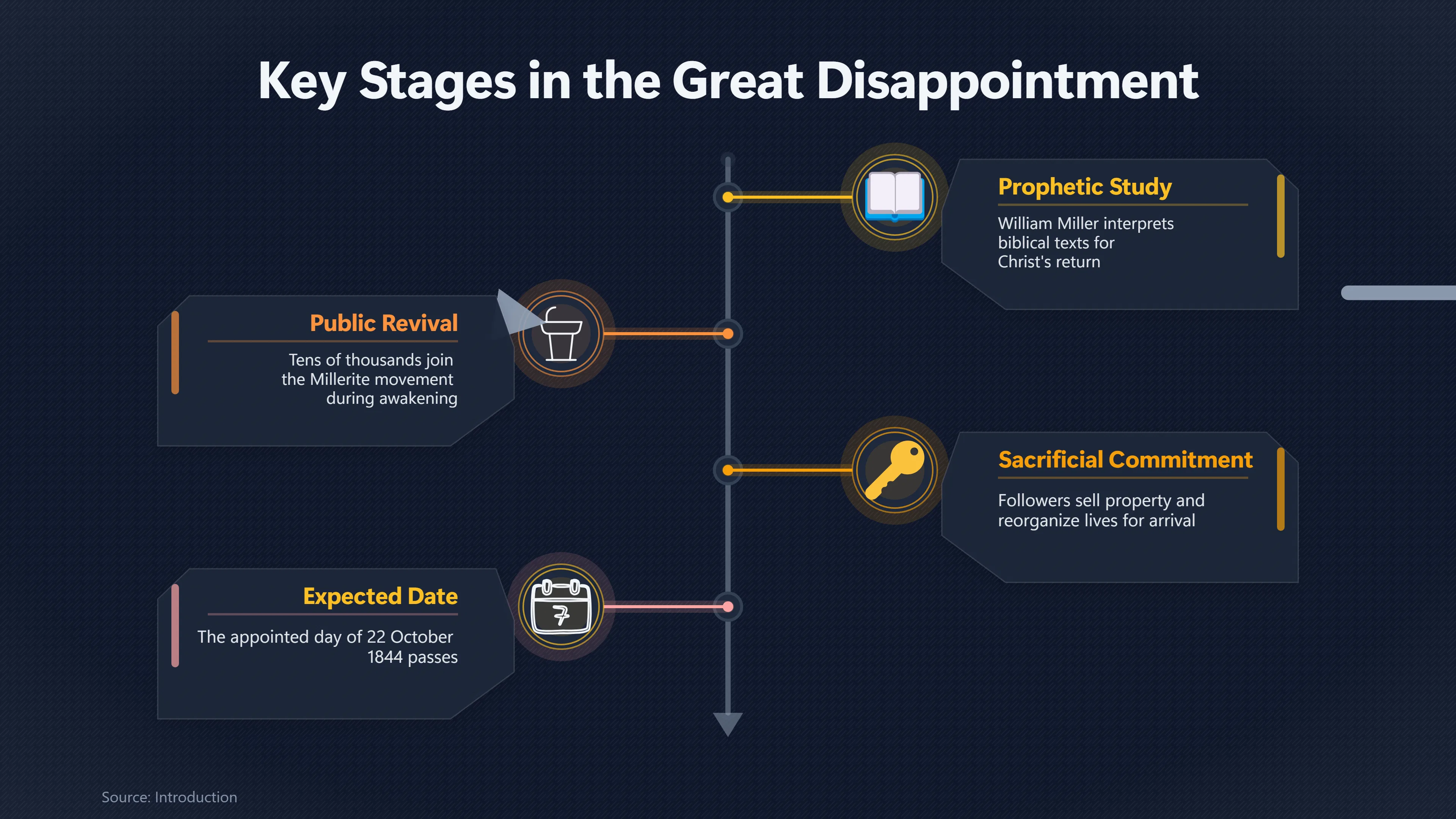
The defining American example is the Great Disappointment of 22 October 1844. William Miller, a Baptist lay preacher, concluded from his reading of biblical prophecy that Christ would return around 1843–44. Tens of thousands of Americans, known as Millerites, accepted the prediction during the revival culture of the Second Great Awakening, selling property, reorganising their lives and expecting the imminent Second Coming.[Wikipedia]WikipediaUnfulfilled Christian religious predictionsUnfulfilled Christian religious predictions
When nothing happened on the expected date, many followers abandoned the movement altogether. Yet the aftermath proved more significant than the failed prediction itself. Rather than agreeing that the prophecy had simply been false, different groups reached different conclusions about what had gone wrong.
Several distinct traditions emerged:
- Some rejected date-setting entirely, concluding that the attempt to calculate Christ’s return had been mistaken.
- Others argued that the date had been correct but the event misunderstood, claiming that Christ had entered a new phase of heavenly ministry rather than visibly returning to Earth.
- Some continued expecting an imminent Second Coming while abandoning precise dates.
These differing interpretations eventually contributed to the emergence of several Adventist traditions, including the Seventh-day Adventist Church and the Advent Christian Church. The Great Disappointment therefore became not merely the collapse of a prophecy but the foundation of enduring religious communities.[Wikipedia]WikipediaUnfulfilled Christian religious predictionsUnfulfilled Christian religious predictions
Why failed prophecies do not always destroy belief
To outside observers, a failed prediction appears decisive. Yet history repeatedly shows that committed believers often respond in more complex ways.
Several mechanisms recur across American apocalyptic movements:
- Reinterpretation. The predicted event is said to have occurred invisibly or spiritually rather than physically.
- Recalculation. The timetable is revised because an earlier calculation is believed to have contained an error.
- Conditional prophecy. Believers argue that repentance, prayer or divine mercy altered the outcome.
- Testing of faith. Failure is interpreted as a divine test separating committed believers from doubters.
- Selective membership. Disappointed members leave, while those who remain often become more committed because they have invested heavily in the movement.
These responses reduce the contradiction between expectation and reality without requiring believers to abandon their entire worldview. Religious historians note that movements possessing strong communities, respected leadership and coherent theological systems are generally better able to survive disappointment than loosely organised prediction campaigns.[Wikipedia]WikipediaWhen Prophecy FailsWhen Prophecy Fails

From Adventism to UFO religions
The same broad pattern later appeared outside traditional Christianity.
One of the best-known twentieth-century examples involved the Seekers, a small Chicago-area UFO movement led by Dorothy Martin in 1954. Martin claimed to receive messages through automatic writing predicting a devastating flood from which believers would be rescued by extraterrestrials. When the prophecy failed, some followers left, but others accepted a new explanation: humanity had been spared because of the group’s faithfulness.[Wikipedia]WikipediaWhen Prophecy FailsWhen Prophecy Fails
The movement became famous because psychologists Leon Festinger, Henry Riecken and Stanley Schachter observed it while developing what became cognitive dissonance theory. Their influential 1956 book When Prophecy Fails argued that some believers become more committed after disconfirmed expectations, especially when they possess strong social support and have publicly invested in the belief.[Google Books]books.google.comBooks When Prophecy FailsGoogle BooksWhen Prophecy Fails - Leon Festinger - Google Books…
The study became one of the most widely cited works in social psychology. However, more recent historical research has questioned aspects of the original account, arguing that the researchers overstated how much the group intensified its beliefs after the failed prophecy and that the movement declined more rapidly than the book suggested. While these criticisms do not eliminate the broader idea that believers sometimes reinterpret failure, they have encouraged scholars to treat the original case with greater caution rather than as a universal model.[PubMed]pubmed.ncbi.nlm.nih.govPub Med Debunking "When Prophecy FailsDebunking "When Prophecy Fails" - PubMed…
Failed prophecy is not one universal story
American examples show that no single outcome follows prophetic failure.
Different movements have experienced very different trajectories:
- Institutional survival. Some groups developed stable religious traditions after abandoning date-setting or redefining earlier expectations.
- Gradual fragmentation. Others split into competing factions that interpreted the failure differently.
- Rapid collapse. Some movements simply dissolved once confidence in their leader disappeared.
- Repeated postponement. Certain groups issued successive dates while retaining a committed core of followers.
This variation explains why historians resist treating all apocalyptic movements alike. The social structure of the community, the authority of its leaders, and the flexibility of its theology often matter more than the prediction itself.
American conditions that encouraged repeated apocalyptic movements
Several features of American religious history made repeated end-time movements more likely.
Religious freedom allowed new churches and prophetic movements to form without requiring approval from an established national church. Revival culture encouraged ordinary believers to interpret Scripture independently, while rapid territorial expansion, economic change, war and social upheaval frequently created a sense that history was approaching a decisive turning point.
These conditions did not produce a uniquely American belief in apocalypse—similar expectations have appeared throughout Christian history—but they created an unusually open religious marketplace in which new prophetic movements could emerge, divide and reorganise without disappearing entirely.
Lasting influence on American religious history
The legacy of failed prophecy extends far beyond the original predictions.[onlinelibrary.wiley.com]onlinelibrary.wiley.com“When Prophecy Fails” - Kelly - 2026 - Journal of the History of the Behavioral Sciences - Wiley Online LibraryNovember 4, 2025 — Volume…
The Great Disappointment reshaped American Adventism and influenced millions of later believers through churches that no longer define themselves primarily by failed date-setting. Twentieth-century UFO movements broadened the phenomenon beyond conventional Christianity, showing that apocalyptic expectations could combine with ideas about extraterrestrials, channelled messages and modern technology. Meanwhile, psychological studies of these movements helped shape enduring debates about cognitive dissonance, commitment and group identity—even as scholars continue to reassess the evidence behind some classic cases.[wikipedia.org]WikipediaWhen Prophecy FailsWhen Prophecy Fails
Rather than demonstrating simple irrationality, these episodes reveal how people respond when deeply held expectations collide with reality. Some abandon the belief, some modify it, and some transform disappointment into the foundation of an entirely new religious tradition.
Amazon book picks
Further Reading
Books and field guides related to Why Failed Prophecies Do Not Always Fail. Use these as the next step if you want deeper reading beyond the article.


The pursuit of the millennium
Provides historical background to apocalyptic expectations.
Endnotes
1.
Source: Wikipedia
Title: Unfulfilled Christian religious predictions
Link:https://en.wikipedia.org/wiki/Unfulfilled_Christian_religious_predictions
2.
Source: Wikipedia
Title: When Prophecy Fails
Link:https://en.wikipedia.org/wiki/When_Prophecy_Fails
3.
Source: books.google.com
Title: Books When Prophecy Fails
Link:https://books.google.com/books/about/When_Prophecy_Fails.html?id=koWJtwEACAAJ
Source snippet
Google BooksWhen Prophecy Fails - Leon Festinger - Google Books...
4.
Source: Wikipedia
Title: Leon Festinger
Link:https://en.wikipedia.org/wiki/Leon_Festinger
5.
Source: encyclopedia.adventist.org
Link:https://encyclopedia.adventist.org/article?id=C9SQ
Source snippet
1820s and 1840s)May 14, 2026 — Photo courtesy of Michael W. Campbell. Image Newark Camp Meeting Tent. Loma Linda University Photo Archive...
Published: May 14, 2026
6.
Source: encyclopedia.adventist.org
Link:https://encyclopedia.adventist.org/article?id=19SO
7.
Source: books.google.com
Link:https://books.google.com/books/about/When_PROPHECY_FAILS_a_Doomsday_Cult_on_A.html?id=Ifvo0AEACAAJ
8.
Source: books.google.com
Title: When PROPHECY FAILS
Link:https://books.google.com/books/about/When_PROPHECY_FAILS.html?id=KgXwzgEACAAJ
9.
Source: books.google.com
Title: When Prophecy Fails
Link:https://books.google.com/books/about/When_Prophecy_Fails.html?id=GRVRvgAACAAJ
10.
Source: adventist.org
Link:https://adventist.org/identity/history
11.
Source: youtube.com
Title: The Great Disappointment
Link:https://www.youtube.com/watch?v=4z80wKIwW6w
Source snippet
Failed Prophecy, Group Loyalty, And The Making Of A Cult | John McKinnon | Episode 600...
12.
Source: pubmed.ncbi.nlm.nih.gov
Title: Pub Med Debunking “When Prophecy Fails”
Link:https://pubmed.ncbi.nlm.nih.gov/41186060/
Source snippet
Debunking "When Prophecy Fails" - PubMed...
Additional References
13.
Source: newyorker.com
Link:https://www.newyorker.com/culture/the-lede/is-cognitive-dissonance-actually-a-thing
Source snippet
The theory posits that people experience psychological discomfort when confronted with contradictions between their beliefs and behaviors...
14.
Source: youtube.com
Link:https://www.youtube.com/watch?v=dSKNReTxOSQ
Source snippet
10 Doomsday Cults That Got It Wrong | When Prophecy Fails...
15.
Source: youtube.com
Title: When Prophecy Fails — Why Failed Beliefs Get Stronger
Link:https://www.youtube.com/watch?v=3sOV0HENbkE
Source snippet
Harold Camping on Rapture: It was an invisible judgement day...
16.
Source: youtube.com
Title: 10 Doomsday Cults That Got It Wrong | When Prophecy Fails
Link:https://www.youtube.com/watch?v=5V6FmVS_Gr0
Source snippet
When Prophecy Fails — Why Failed Beliefs Get Stronger...
17.
Source: onlinelibrary.wiley.com
Link:https://onlinelibrary.wiley.com/doi/abs/10.1002/jhbs.70043
Source snippet
“When Prophecy Fails” - Kelly - 2026 - Journal of the History of the Behavioral Sciences - Wiley Online LibraryNovember 4, 2025 — ORIGINA...
Published: November 4, 2025
18.
Source: onlinelibrary.wiley.com
Link:https://onlinelibrary.wiley.com/doi/10.1002/jhbs.70043
Source snippet
“When Prophecy Fails” - Kelly - 2026 - Journal of the History of the Behavioral Sciences - Wiley Online LibraryNovember 4, 2025 — Volume...
Published: November 4, 2025
19.
Source: onlinelibrary.wiley.com
Link:https://onlinelibrary.wiley.com/doi/abs/10.1002/jhbs.70043?campaign=woletoc
Source snippet
“When Prophecy Fails” - Kelly - 2026 - Journal of the History of the Behavioral Sciences - Wiley Online LibraryNovember 4, 2025 — Volume...
Published: November 4, 2025
20.
Source: christianhistoryinstitute.org
Link:https://christianhistoryinstitute.org/magazine/article/american-adventism-the-great-disappointment
21.
Source: fnac.com
Link:https://www.fnac.com/livre-numerique/a11070719/Leon-Festinger-When-Prophecy-Fails
22.
Source: goodreads.com
Link:https://www.goodreads.com/book/show/35525207-when-prophecy-fails
Topic Tree