Within San Marino
When Sacred Tradition Entered San Marino's Parliament
San Marino's strongest collective belief tradition shaped national identity and later collided with modern freedom of conscience.
On this page
- How Saint Marinus became part of national identity
- Why saint veneration is not a modern cult
- The Gospel oath dispute and freedom of conscience
Page outline Jump by section
Introduction
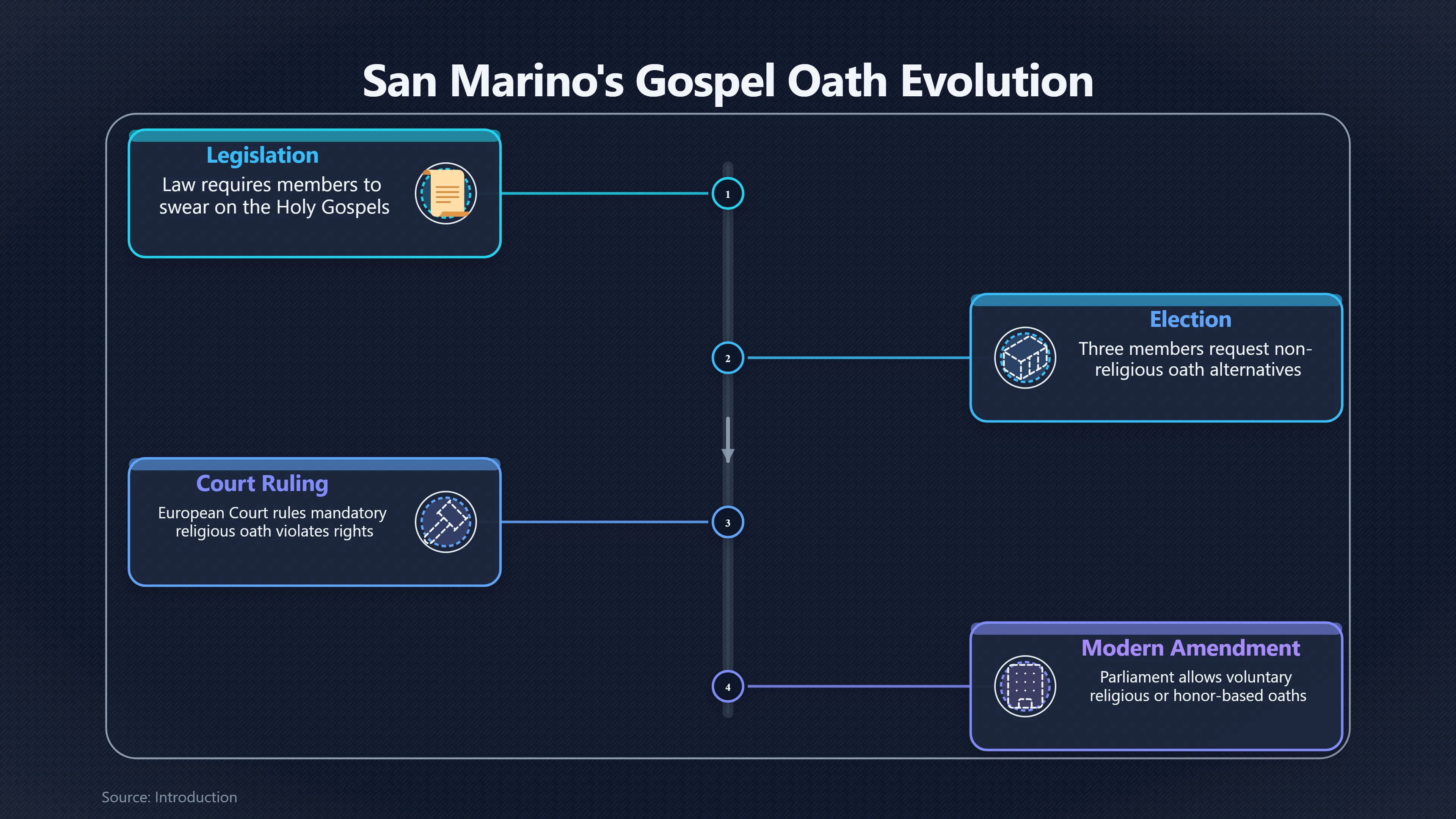
San Marino’s national identity has long rested on an unusual blend of civic independence and religious tradition. According to longstanding tradition, the republic was founded by Saint Marinus, a Christian stonemason whose search for religious freedom became the symbolic origin of one of the world’s oldest republics. For centuries that story shaped not only public ceremonies but also the way political authority was understood. Members of parliament and other senior office holders swore their loyalty on the Christian Gospels, reflecting the assumption that civic duty and Christian faith naturally belonged together.
The most significant modern challenge to that tradition did not come from hostility towards religion, but from changing ideas about freedom of conscience. A dispute over the parliamentary oath in the 1990s forced San Marino to decide whether loyalty to the republic required a public profession of Christianity. The resulting legal reforms and a landmark European human-rights judgment became one of the country’s clearest examples of an inherited civic belief adapting to modern democratic principles.[HUDOC]hudoc.echr.coe.intDE L’EUROPE COUNCIL OF EUROPE COUR EUROPÉEApril 24, 2026…
How Saint Marinus became part of national identity
The historical Saint Marinus is believed to have lived during the late third and early fourth centuries. Tradition holds that he fled persecution under the Roman Emperor Diocletian, settled on Mount Titano, and founded a Christian community that eventually developed into the Republic of San Marino. Although many details belong to tradition rather than verifiable history, the founding narrative has remained central to the republic’s identity for centuries.
Unlike episodes of mass religious enthusiasm or apocalyptic expectation, the veneration of Saint Marinus developed as a stable civic tradition. His story became part of the state’s constitutional memory rather than the basis of a separate religious movement. Public ceremonies, national commemorations and official symbolism all reinforced the idea that political liberty and Christian virtue shared a common origin.
The famous phrase traditionally attributed to Saint Marinus—”I leave you free from both men” (often interpreted as freedom from both emperor and pope)—has acquired enormous symbolic importance, even though historians debate its precise wording and historical authenticity. What matters politically is less whether the phrase was spoken exactly as later generations claimed than how it came to express San Marino’s self-image as an independent republic whose liberty possessed both civic and moral foundations.
This differs markedly from the kinds of collective religious movements often labelled as cults. Saint Marinus was never presented as the leader of an ongoing sect demanding exclusive allegiance from followers. Instead, he functioned as a shared national patron whose memory united citizens across generations.
Why saint veneration is not a modern cult
Modern discussions of “cults” can easily blur together very different forms of religious life. The long-standing honour given to Saint Marinus belongs to mainstream Catholic tradition rather than to a new religious movement or a system of coercive belief.
Several features distinguish civic saint veneration from the kinds of movements examined in studies of cults and moral panics:
- Public continuity: devotion developed gradually over many centuries rather than through a sudden charismatic movement.
- Institutional integration: the tradition became part of recognised Catholic practice and public ceremony instead of existing outside established religious structures.
- Shared symbolism: Saint Marinus serves primarily as a national founder rather than as the object of exclusive personal devotion.
- Limited doctrinal role: citizens are not expected to accept novel revelations or apocalyptic teachings associated with him.
This distinction matters because San Marino’s religious heritage is sometimes mistaken for evidence of unusually intense or exceptional religious belief. In reality, its civic traditions resemble those found elsewhere in historically Catholic Europe, where patron saints often became intertwined with local political identity without producing collective hysteria or socially disruptive movements.

Why politicians once swore on the Gospels
For much of the twentieth century, members of the General Grand Council—the republic’s parliament—could only assume office after taking an oath prescribed by legislation dating from 1909. The wording required them to swear “on the Holy Gospels” that they would remain faithful to the constitution, uphold liberty and faithfully discharge their duties.[HUDOC]hudoc.echr.coe.intDE L’EUROPE COUNCIL OF EUROPE COUR EUROPÉEApril 24, 2026…
To earlier generations this requirement appeared natural. Roman Catholicism dominated public life, and the Gospel oath symbolised that political office carried not merely legal responsibilities but also moral obligations before God.
The oath therefore represented more than a religious ritual. It embodied a traditional understanding of legitimacy in which constitutional loyalty, personal honour and Christian faith reinforced one another. Few questioned this arrangement while religious identity remained broadly uniform.
The issue only became controversial as European democracies increasingly recognised that citizenship and political participation should not depend upon public declarations of religious belief.
The Gospel oath dispute and freedom of conscience
The turning point came after the 1993 parliamentary elections. Three newly elected members of parliament requested permission to take the oath without referring to the Holy Gospels, arguing that compulsory religious language conflicted with their freedom of conscience and with Article 9 of the European Convention on Human Rights, which protects freedom of thought, conscience and religion. When their request was refused, they ultimately complied under protest rather than lose their parliamentary seats.[HUDOC]hudoc.echr.coe.intDE L’EUROPE COUNCIL OF EUROPE COUR EUROPÉEApril 24, 2026…
Their case, Buscarini and Others v. San Marino, reached the European Court of Human Rights. In its 1999 Grand Chamber judgment, the Court unanimously concluded that requiring elected representatives to swear on the Christian Gospels in order to exercise a democratic mandate violated Article 9. The judges rejected the argument that such a requirement was necessary to preserve public order or democratic institutions. Instead, they held that making the exercise of a fundamental political right conditional upon a religious declaration was incompatible with freedom of conscience.[coe.int]hudoc.echr.coe.intDE L’EUROPE COUNCIL OF EUROPE COUR EUROPÉEApril 24, 2026…
The case became a landmark because it clarified an important principle: democratic loyalty may be required, but adherence to a particular religion may not.
How San Marino adapted without abandoning tradition
The dispute did not produce a rejection of Saint Marinus or of the republic’s Catholic heritage. Instead, San Marino distinguished between national tradition and compulsory religious profession.
Parliament amended the relevant legislation so that members could choose an alternative oath based simply on personal honour instead of swearing on the Holy Gospels. The traditional religious wording remained available for those who wished to use it voluntarily. Contemporary reports also noted that some other constitutional offices continued to retain the older form for longer, although these provisions attracted far less legal challenge.[Refworld]refworld.orgU.S. Department of State Annual Report on International Religious Freedom for 2005 - San Marino | RefworldNovember 8, 2005…
This compromise illustrates a broader pattern found across many European democracies. Historical ceremonies are often preserved, but participation in public office is increasingly separated from compulsory religious declarations. The aim is not to erase religious heritage but to ensure equal citizenship regardless of belief.
Why this matters for understanding collective belief
Within a project examining cults, panics and collective belief, San Marino offers an instructive contrast. The central story is not one of mass hysteria or persecution but of a deeply rooted civic tradition adapting peacefully to modern concepts of individual rights.
The reverence shown to Saint Marinus created a powerful shared identity that lasted for centuries without developing into an exclusionary popular movement. The later controversy over the Gospel oath demonstrates how inherited symbols can become subjects of constitutional debate as societies grow more religiously diverse and place greater emphasis on freedom of conscience.
Rather than abandoning its founding legend, San Marino reinterpreted it. The republic continues to celebrate Saint Marinus as the symbolic founder of its independence, while recognising that loyalty to the state no longer requires citizens or elected representatives to profess a particular religious faith. That balance between historical memory and individual liberty has become one of the country’s most distinctive constitutional legacies.
Amazon book picks
Further Reading
Books and field guides related to When Sacred Tradition Entered San Marino's Parliament. Use these as the next step if you want deeper reading beyond the article.
A history of Christianity
Explains the development of Christian traditions that shaped San Marino's civic culture.

Dominion
Examines Christianity's influence on Western political and moral institutions.
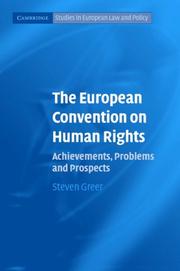
The European Convention on Human Rights
Helps explain the legal principles behind the parliamentary oath dispute.
The rule of law
Useful background for constitutional rights, oaths and freedom of conscience.
Endnotes
1.
Source: refworld.org
Link:https://www.refworld.org/reference/annualreport/usdos/2005/en/38132
Source snippet
U.S. Department of State Annual Report on International Religious Freedom for 2005 - San Marino | RefworldNovember 8, 2005...
Published: November 8, 2005
2.
Source: refworld.org
Link:https://www.refworld.org/reference/annualreport/usdos/2002/en/17279
Source snippet
U.S. Department of State Annual Report on International Religious Freedom for 2002 - San Marino | Refworld...
3.
Source: commonslibrary.parliament.uk
Title: uk What is the Parliamentary Oath?
Link:https://commonslibrary.parliament.uk/what-is-the-parliamentary-oath/
Source snippet
Insight Published Thursday, 04 July, 2024 * Insight * Government * Monarchy * Parliament * David Torrance If an MP tries to take part in...
4.
Source: hansard.parliament.uk
Title: uk Treason Felony, Act Of Settlement And Parliamentary Oa
Link:https://hansard.parliament.uk/Commons/2001-12-19/debates/2662e723-73e5-4be0-8480-eca90421ae1f/TreasonFelonyActOfSettlementAndParliamentaryOath
5.
Source: refworld.org
Link:https://www.refworld.org/reference/annualreport/usdos/1999/en/34097
6.
Source: refworld.org
Link:https://www.refworld.org/themes/custom/unhcr_rw/pdf-js/viewer.html?file=https%3A%2F%2Fwww.refworld.org%2Fsites%2Fdefault%2Ffiles%2Flegacy-pdf%2Fen%2F2011-7%2F4e31312dd.pdf
7.
Source: parliament.uk
Title: Swearing in and the parliamentary oath
Link:https://www.parliament.uk/about/how/elections-and-voting/swearingin/
8.
Source: parliament.uk
Title: Oath of Allegiance
Link:https://www.parliament.uk/site-information/glossary/oath-of-allegiance/?id=32625
9.
Source: hudoc.echr.coe.int
Link:https://hudoc.echr.coe.int/app/conversion/pdf/?TID=nidkhsnsvz&filename=001-58915.pdf&id=001-58915&library=ECHR
Source snippet
DE L’EUROPE COUNCIL OF EUROPE COUR EUROPÉEApril 24, 2026...
Published: April 24, 2026
10.
Source: echr.coe.int
Link:https://www.echr.coe.int/documents/d/echr/fs_freedom_religion_eng
11.
Source: coe.int
Title: Portal Freedom of conscience and religion: landmark judgments
Link:https://www.coe.int/en/web/human-rights-convention/conscience1
Source snippet
PortalFreedom of conscience and religion: landmark judgments - The European Convention on Human Rights...
12.
Source: hudoc.echr.coe.int
Link:https://hudoc.echr.coe.int/app/conversion/docx/html/body?id=001-224559&library=ECHR
Source snippet
9, 2023 — 2. The Court’s assessment (a) General principles (i) Article 9 of the Convention 72. Freedom of thought, conscience and religio...
13.
Source: hudoc.echr.coe.int
Title: int FILIPPIN I v
Link:https://hudoc.echr.coe.int/fre?i=001-212777
Source snippet
SAN MARINOSeptember 21, 2021 — (1 DE 1) FILIPPINI v. SAN MARINO 7025/21 | Décision | Cour (Première Section Comité) | 21/09/2021 Adresse...
Published: September 21, 2021
14.
Source: pace.coe.int
Title: int Doc
Link:https://pace.coe.int/en/files/28322/html
Source snippet
15015 - Report - Working documentDecember 17, 2019 — 2 INTERNATIONAL AND EUROPEAN LEGAL FRAMEWORK FOR FREEDOM OF THOUGHT, CONSCIENCE AND...
Published: December 17, 2019
15.
Source: wipo.int
Link:https://www.wipo.int/wipolex/zh/legislation/details/11430
16.
Source: coe.int
Title: Freedom of thought, conscience and religion
Link:https://www.coe.int/en/web/human-rights-convention/conscience
17.
Source: coe.int
Link:https://www.coe.int/en/web/human-rights-convention/freedom-of-conscience-in-practice
18.
Source: openfactbook.org
Title: San Marino
Link:https://openfactbook.org/countries/san-marino/
Additional References
19.
Source: youtube.com
Title: The Community on The Mount | History of San Marino #1
Link:https://www.youtube.com/watch?v=SYmz4NCYt2g
Source snippet
San Marino Is Tiny… But Its History Is Massive...
20.
Source: youtube.com
Title: Bedtime History of San Marino & City Walk Walking Tour Italy
Link:https://www.youtube.com/watch?v=A93AGFrO6Po
Source snippet
Why isn't San Marino a part of Italy? - Explained in 12 Minutes...
21.
Source: youtube.com
Title: Why isn’t San Marino a part of Italy?
Link:https://www.youtube.com/watch?v=WXxIV1IRMR4
Source snippet
How Did San Marino Manage to Stay Independent?...
22.
Source: youtube.com
Title: San Marino Is Tiny… But Its History Is Massive
Link:https://www.youtube.com/watch?v=VF69qCfU1T4
Source snippet
Bedtime History of San Marino & City Walk Walking Tour Italy...
23.
Source: wipo.int
Link:https://www.wipo.int/wipolex/en/legislation/details/11430
24.
Source: geognos.com
Link:https://www.geognos.com/en/place/san-marino/history
25.
Source: ps.sejm.gov.pl
Link:https://ps.sejm.gov.pl/journal.nsf/PS.xsp?documentId=F0CA8C80CDDBE394C1258BB0006B017F&lang=EN
26.
Source: studocu.com
Title: CAS E OF BUSCARINI AND OTHERS v. SAN MARINO: JUDGMENT ANALYSIS
Link:https://www.studocu.com/sv/document/uppsala-universitet/terminskurs-1-grundlaggande-juridisk-metod-statsratt-och-konstitutionell-eu-ratt/case-of-buscarini-and-others-v-san-marino-judgment-analysis/145154244
27.
Source: docslib.org
Title: CAS E of BUSCARINI and OTHERS V. SAN MARINO
Link:https://docslib.org/doc/3107909/case-of-buscarini-and-others-v-san-marino
28.
Source: youtube.com
Title: How Did San Marino Manage to Stay Independent?
Link:https://www.youtube.com/watch?v=1KS7M1VJ1eY
Topic Tree