Within Mongolia
How the State Made Monks into Enemies
Officials turned real political conflict into a sweeping conspiracy narrative that made mass persecution of Buddhist clergy appear necessary.
On this page
- Why monasteries looked like rival centres of power
- From criticism to claims of hidden conspiracy
- Repression, destroyed institutions and contested responsibility
Page outline Jump by section
Introduction
The destruction of Mongolia’s Buddhist establishment in the late 1930s was not simply an attack on religion. It was also the culmination of a state-driven panic that portrayed Buddhist monks as members of a vast hidden conspiracy threatening the country’s survival. Over many years, Mongolia’s socialist government moved from criticising monasteries as economically outdated to presenting senior clergy as organisers of counter-revolution, foreign espionage and armed rebellion. That narrative helped make extraordinary violence appear both necessary and legitimate. Between late 1937 and 1939, thousands of monks were executed, almost every monastery was closed or destroyed, and one of Mongolia’s most important cultural institutions was devastated. Modern historians argue that this campaign should be understood not merely as Soviet repression imposed from outside, but as a political process in which Mongolian leaders, Soviet advisers and state institutions together constructed an image of an internal enemy.[cam.ac.uk]cam.ac.ukUniversity of CambridgeMongolia: unravelling the troubled narratives of a nation | University of CambridgeFebruary 27, 2015…
Why monasteries looked like rival centres of power
For centuries, Buddhist monasteries had been far more than places of worship. They owned land and livestock, educated much of the population, provided medical care, preserved literature and art, and influenced political life. Before the socialist period, Mongolia had hundreds of monasteries and tens of thousands of monks. The Buddhist establishment therefore represented an organised institution that reached across the country and commanded loyalty independent of the new revolutionary state.[University of Cambridge]cam.ac.ukUniversity of CambridgeMongolia: unravelling the troubled narratives of a nation | University of CambridgeFebruary 27, 2015…
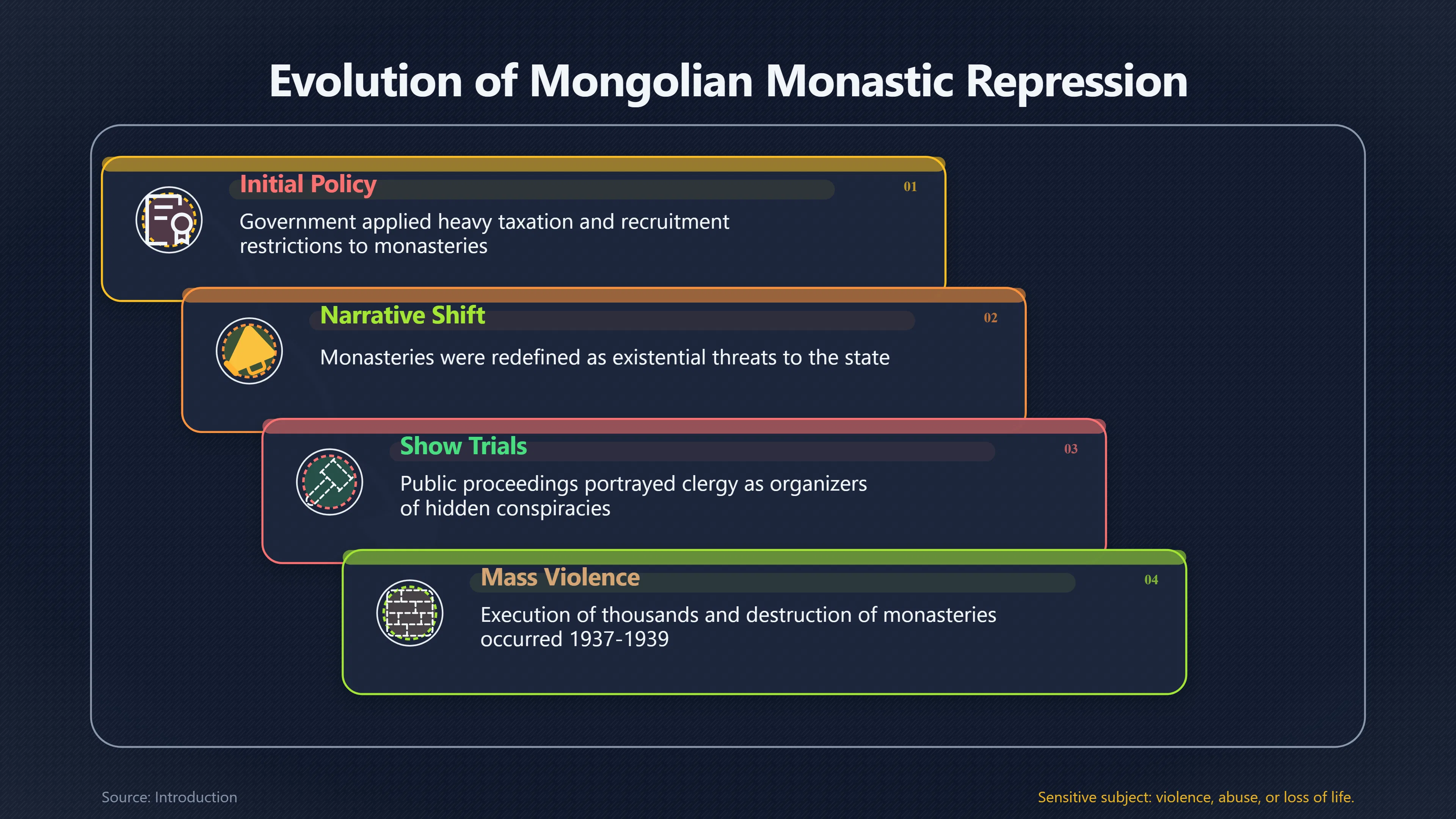
This did not automatically make conflict inevitable. Christopher Kaplonski’s archival research shows that the socialist government spent well over a decade trying different methods to weaken monastic influence before resorting to mass killing. Policies included heavy taxation, restrictions on recruiting young monks, propaganda campaigns and selective prosecutions. Violence was not the government’s immediate response; instead, officials gradually redefined the Buddhist establishment from a political competitor into an existential threat.[University of Cambridge]cam.ac.ukUniversity of CambridgeMongolia: unravelling the troubled narratives of a nation | University of CambridgeFebruary 27, 2015…
The authorities also faced genuine political anxieties. Mongolia was a small state caught between the Soviet Union, China and expanding Japanese influence in East Asia. These international pressures made accusations of foreign collaboration especially potent, allowing officials to present domestic religious leaders as potential agents of hostile powers rather than simply ideological opponents.[University of Cambridge]cam.ac.ukUniversity of CambridgeMongolia: unravelling the troubled narratives of a nation | University of CambridgeFebruary 27, 2015…
From criticism to claims of hidden conspiracy
The crucial shift came when criticism of monasteries evolved into allegations of secret organisation. Rather than arguing that monks represented an outdated social order, state propaganda increasingly claimed that senior clergy were coordinating underground networks to overthrow socialism.
Show trials played a central role in this transformation. Kaplonski argues that the highly publicised trials of 1937 presented an elaborate conspiracy involving leading monks, former aristocrats and political figures supposedly plotting together against the revolutionary government. These proceedings were less about establishing individual guilt than about persuading the public that an extensive hidden enemy already existed. By portraying respected religious leaders as organisers of treason, the trials helped prepare society to accept exceptional violence.[AnthroSource]anthrosource.onlinelibrary.wiley.comj.1548 1425.2008.00038.xPrelude to violence: Show trials and state power in 1930s Mongolia - KAPLONSKI - 2008 - American Ethnologist - Wiley Online L…
This conspiracy narrative reflected a classic mechanism of political moral panic:
- isolated acts of opposition became evidence of a nationwide secret network;
- religious authority was recast as political subversion;
- ordinary monastic activities became suspicious when interpreted through the lens of conspiracy;
- increasingly harsh measures appeared justified because the alleged threat was described as invisible, coordinated and existential.
Historians caution that this narrative should not be confused with evidence of a genuine nationwide conspiracy. While some monks opposed socialist reforms and a number became involved in earlier uprisings, the state’s sweeping claims transformed diverse local conflicts into a single imagined counter-revolutionary organisation.[AnthroSource]anthrosource.onlinelibrary.wiley.comj.1548 1425.2008.00038.xPrelude to violence: Show trials and state power in 1930s Mongolia - KAPLONSKI - 2008 - American Ethnologist - Wiley Online L…
How ordinary religious life became criminalised
One striking feature of the campaign is how everyday religious practice gradually entered the criminal sphere.
Archival court cases examined by Kaplonski include prosecutions over organising traditional religious festivals, involving children in ceremonies and even accusations that Tibetan medicine was being used to poison people. These cases illustrate how ordinary monastic activities increasingly became evidence of supposed criminal intent rather than accepted religious practice.[OUP Academic]academic.oup.comOUP AcademicCriminal Lamas: Court Cases Against Buddhist Monks in Early Socialist Mongolia | Buddhism in Mongolian History, Culture, and…
Such prosecutions blurred the distinction between belief and political crime. The issue was no longer whether particular acts violated specific laws, but whether religious influence itself constituted evidence of counter-revolutionary intent. Once that assumption became established, almost any connection to the monastery system could be interpreted as participation in a hostile network.[OUP Academic]academic.oup.comOUP AcademicCriminal Lamas: Court Cases Against Buddhist Monks in Early Socialist Mongolia | Buddhism in Mongolian History, Culture, and…
Repression, destroyed institutions and contested responsibility
The panic reached its most destructive phase between late 1937 and mid-1939.
Within roughly eighteen months:
- approximately 18,000 Buddhist monks were executed, according to widely cited historical estimates;
- nearly all of Mongolia’s more than 700 monasteries were closed or destroyed;
- religious libraries, artworks and manuscripts disappeared on a massive scale;
- countless cultural traditions were interrupted or permanently lost.[University of Cambridge]cam.ac.ukUniversity of CambridgeMongolia: unravelling the troubled narratives of a nation | University of CambridgeFebruary 27, 2015…
For many years, public memory explained these events almost entirely as orders imposed by Joseph Stalin and the Soviet NKVD. Soviet influence was unquestionably decisive, and Soviet advisers played major roles in the repression. However, more recent scholarship argues that this explanation is incomplete.
Kaplonski’s research suggests that Mongolian institutions actively developed the legal arguments, propaganda campaigns and conspiracy narratives that justified persecution. Rather than treating Mongolia as merely a passive victim of Soviet command, he argues that the violence emerged through interactions between Soviet pressure and Mongolian state-building, political struggles and administrative choices.[cam.ac.uk]cam.ac.ukUniversity of CambridgeMongolia: unravelling the troubled narratives of a nation | University of CambridgeFebruary 27, 2015…
This interpretation does not reduce Soviet responsibility. Instead, it emphasises that the persecution depended upon local officials, courts, investigators and political leaders who transformed fear into policy.
Why historians describe this as a state-created panic
The campaign against Mongolia’s Buddhist clergy illustrates how governments can manufacture a sense of hidden danger powerful enough to justify extraordinary repression.
Several features distinguish it from spontaneous public hysteria:
- the conspiracy narrative was promoted from above through courts, propaganda and official institutions rather than emerging mainly through rumour;
- allegations continually expanded despite limited evidence of a unified underground organisation;
- exceptional measures became normal because the alleged enemy was portrayed as impossible to detect by ordinary legal standards;
- the destruction of religious institutions was presented as a defensive necessity rather than ideological persecution alone.[AnthroSource]anthrosource.onlinelibrary.wiley.comj.1548 1425.2008.00038.xPrelude to violence: Show trials and state power in 1930s Mongolia - KAPLONSKI - 2008 - American Ethnologist - Wiley Online L…
For historians of political violence, Mongolia’s “lama question” therefore represents more than religious repression. It demonstrates how an insecure state can redefine a longstanding social institution as a concealed internal enemy, allowing fear of conspiracy to legitimise mass persecution. The episode remains central to understanding Mongolia’s twentieth-century history because it combined ideological conflict, genuine political insecurity and carefully constructed narratives of hidden treason into one of the country’s greatest human and cultural catastrophes.[cam.ac.uk]cam.ac.ukUniversity of CambridgeMongolia: unravelling the troubled narratives of a nation | University of CambridgeFebruary 27, 2015…
Amazon book picks
Further Reading
Books and field guides related to How the State Made Monks into Enemies. Use these as the next step if you want deeper reading beyond the article.

The history of Mongolia
Explains the socialist era and destruction of Buddhist institutions.

Mongolia
First published 2019. Subjects: Mongolia, history, Asia, politics and government, History, Politics and government.
Genghis Khan and the Making of the Modern World
Provides wider Mongolian historical background.
Endnotes
1.
Source: academic.oup.com
Link:https://academic.oup.com/book/32685/chapter-abstract/270767932?itm_content=Oxford_Academic_Books_0
Source snippet
OUP AcademicCriminal Lamas: Court Cases Against Buddhist Monks in Early Socialist Mongolia | Buddhism in Mongolian History, Culture, and...
2.
Source: academic.oup.com
Link:https://academic.oup.com/book/32685/chapter-abstract/270767932
Source snippet
OUP AcademicCriminal Lamas: Court Cases Against Buddhist Monks in Early Socialist Mongolia | Buddhism in Mongolian History, Culture, and...
3.
Source: academic.oup.com
Link:https://academic.oup.com/hawaii-scholarship-online/book/29976
4.
Source: academic.oup.com
Link:https://academic.oup.com/hawaii-scholarship-online/book/29976/chapter/254957671
5.
Source: academic.oup.com
Link:https://academic.oup.com/hawaii-scholarship-online/book/29976/chapter-abstract/254949690
6.
Source: academic.oup.com
Link:https://academic.oup.com/hawaii-scholarship-online/book/29976/chapter/254949690?searchresult=1
7.
Source: cam.ac.uk
Link:https://www.cam.ac.uk/research/features/mongolia-unravelling-the-troubled-narratives-of-a-nation
Source snippet
University of CambridgeMongolia: unravelling the troubled narratives of a nation | University of CambridgeFebruary 27, 2015...
Published: February 27, 2015
8.
Source: anthrosource.onlinelibrary.wiley.com
Title: j.1548 1425.2008.00038.x
Link:https://anthrosource.onlinelibrary.wiley.com/doi/abs/10.1111/j.1548-1425.2008.00038.x
Source snippet
Prelude to violence: Show trials and state power in 1930s Mongolia - KAPLONSKI - 2008 - American Ethnologist - Wiley Online L...
9.
Source: chriskaplonski.com
Link:https://www.chriskaplonski.com/research.html
10.
Source: countrystudies.us
Link:https://countrystudies.us/mongolia/47.htm
Source snippet
Buddhism...
11.
Source: cambridge.academia.edu
Title: Chris Kaplonski
Link:https://cambridge.academia.edu/ChrisKaplonski
12.
Source: countrystudies.us
Link:https://countrystudies.us/mongolia/30.htm
13.
Source: mongabay.com
Link:https://www.mongabay.com/reference/country_studies/mongolia/SOCIETY.html
Additional References
14.
Source: journal.num.edu.mn
Link:https://journal.num.edu.mn/prs/article/view/2623
Source snippet
MONASTERIES AND STATE SUPPORT IN MONGOLIA A BRIEF OVERVIEW | Philosophy and Religious StudiesSeptember 1, 2020 — BUDDHIST MONASTERIES AND...
Published: September 1, 2020
15.
Source: youtube.com
Title: Torture and execution of Prime Minister of Mongolia who publicly slapped Stalin
Link:https://www.youtube.com/watch?v=GeNXueH1fI8
Source snippet
Mongolia Buddhist purge 1930s Why Did The Mongolian Prime Minister Slap Stalin In The Face? #shorts The Mind Forge...
16.
Source: independentphilosophy.net
Title: Mongol Empire, Tibetan Buddhism, and Communist Suppression
Link:https://www.independentphilosophy.net/Mongol_Empire_Tibetan_Buddhism_Communist_Suppression.html
Source snippet
That composition queried other Mongol histories, daring to criticise Genghis and his successors, while also being in reaction...
17.
Source: youtube.com
Title: How the “Mongolian Stalin” Ruled Mongolia
Link:https://www.youtube.com/watch?v=CtIoGz-g078
Source snippet
Torture and execution of Prime Minister of Mongolia who publicly slapped Stalin - Peljidiin Genden...
18.
Source: library.ee
Title: KAPLONSK I CH
Link:https://library.ee/m/articles/view/KAPLONSKI-CH-THE-LAMA-QUESTION-VIOLENCE-SOVEREIGNTY-AND-EXCEPTION-IN-EARLY-SOCIALIST-MONGOLIA
Source snippet
THE LAMA QUESTION: VIOLENCE, SOVEREIGNTY, AND EXCEPTION IN EARLY SOCIALIST MONGOLIADecember 1, 2024 — KAPLONSKI CH. THE LAMA QUESTION: VI...
Published: December 1, 2024
19.
Source: researchgate.net
Link:https://www.researchgate.net/publication/238046419_Resorting_to_Violence_Technologies_of_Exception_Contingent_States_and_the_Repression_of_Buddhist_Lamas_in_1930s_Mongolia
20.
Source: studybuddhism.com
Link:https://studybuddhism.com/en/advanced-studies/history-culture/buddhism-in-mongolia/buddhism-in-mongolia-during-the-communist-period
21.
Source: researchgate.net
Link:https://www.researchgate.net/scientific-contributions/Christopher-Kaplonski-2015294140
22.
Source: researchgate.net
Link:https://www.researchgate.net/publication/301723016_From_the_Demolition_of_Monasteries_to_the_Installation_of_Neon_Lights_The_Politics_of_Urban_Construction_in_the_Mongolian_People%27s_Republic
23.
Source: researchgate.net
Link:https://www.researchgate.net/publication/364754089_The_Lama_Question_Violence_Sovereignty_and_Exception_in_Early_Socialist_Mongolia
Topic Tree