Within Thailand
Why Did Possession Symptoms Spread Through Thai Schools?
Thailand's school possession cases show how stress, expectation and close social contact can produce real symptoms without infection.
On this page
- The 1993 outbreak among schoolgirls
- How stress and social contagion shape symptoms
- Why medical and cultural explanations can coexist
Page outline Jump by section
Introduction
Thailand has experienced several well-documented school outbreaks in which groups of pupils, most often girls, suddenly developed fainting, trance states, shaking, altered speech or behaviour interpreted locally as spirit possession. These incidents are important because they show that genuine physical and psychological symptoms can spread through close social contact without an infectious disease or environmental toxin. Rather than fitting a simple choice between “spirits” and “science”, the strongest evidence suggests that cultural beliefs, emotional stress and group dynamics can all shape how distress is experienced and expressed. The best-studied Thai case, a 1993 outbreak among schoolgirls in southern Thailand, remains a key reference in international research on mass psychogenic illness and dissociative disorders because it illustrates how medical and cultural explanations can coexist rather than cancel each other out.[PubMed]pubmed.ncbi.nlm.nih.govRisk factors for spirit possession among school girls in southern ThailandJuly 1, 1998…
Why Did Possession Symptoms Spread Through Thai Schools?
School outbreaks are among the most common settings for mass psychogenic illness worldwide. Adolescents spend long periods together, observe one another closely, and often face shared pressures from examinations, family expectations and social relationships. When an unusual event occurs, especially one that already has a familiar cultural explanation, symptoms can spread through observation, conversation and expectation rather than through microbes.[PMC]pmc.ncbi.nlm.nih.govPMCMass Psychogenic Illness: Demography and Symptom Profile of an EpisodeMay 16, 2016…
In Thailand, many communities already possess a cultural vocabulary for unusual behaviour through beliefs about spirits and possession. When pupils suddenly fainted or entered trance-like states, families and teachers could interpret those experiences within that framework. From a psychiatric perspective, however, the symptoms resemble dissociative episodes—temporary disruptions in awareness, identity or voluntary control—that occur without conscious fabrication. These perspectives describe the same observable events from different starting points rather than necessarily contradicting one another.[PubMed]pubmed.ncbi.nlm.nih.govSpirit possession in South Asia, dissociation or hysteria? Part 1: Theoretical background - PubMed…
The 1993 Outbreak Among Schoolgirls
The most thoroughly investigated Thai episode occurred in September 1993 at a girls’ school in southern Thailand. Thirty-two girls aged between nine and fourteen years developed episodes widely described by those around them as spirit possession. The outbreak attracted medical attention because many pupils displayed remarkably similar symptoms within a short period despite the absence of evidence for an infectious disease or toxic exposure.[PubMed]pubmed.ncbi.nlm.nih.govRisk factors for spirit possession among school girls in southern ThailandJuly 1, 1998…
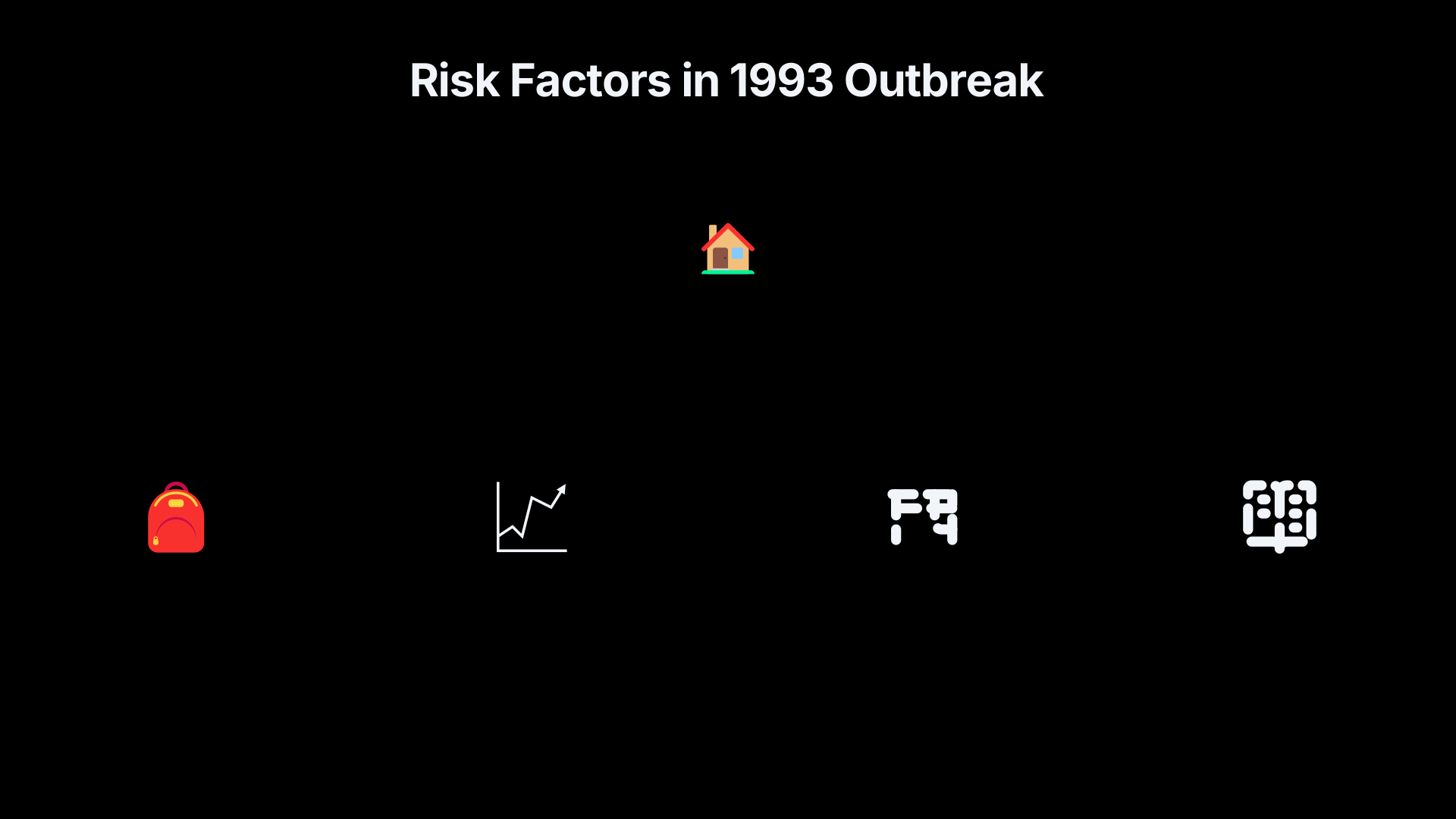
Researchers from Chulalongkorn University later carried out detailed psychiatric assessments and compared affected pupils with unaffected classmates. Their findings challenged simplistic explanations. The girls were not randomly affected. Those who developed possession symptoms were more likely to come from small families, to be first-born children, to have experienced greater psychosocial stress within the family, and to have higher rates of psychiatric disorders, anxious personality traits and previous dissociative or trance-like experiences.[PubMed]pubmed.ncbi.nlm.nih.govRisk factors for spirit possession among school girls in southern ThailandJuly 1, 1998…
The investigators also noted that many affected pupils had experienced significant life difficulties. Histories of trauma and previous exposure to possession ceremonies were somewhat more common among affected girls, although these particular differences were not statistically significant in the study. The researchers concluded that individual vulnerability combined with social stress and group processes provided the most convincing explanation for the outbreak.[PubMed]pubmed.ncbi.nlm.nih.govRisk factors for spirit possession among school girls in southern ThailandJuly 1, 1998…
An earlier epidemiological report on the same outbreak similarly argued that community stress, cultural beliefs, individual psychological vulnerability and group interaction all contributed to the epidemic of dissociative symptoms.[Paperzz]paperzz.comEPIDHnc DISSOCIATION CHILDREN INSeptember 1, 1995…
How Stress and Social Contagion Shape Symptoms
The phrase “social contagion” does not imply pretending or deliberate imitation. Instead, it describes how genuine symptoms can spread through observation, expectation and emotional influence within tightly connected groups.
Several mechanisms appear especially relevant in Thai school outbreaks:
- Shared stress: Pupils often experience similar academic, family or social pressures.
- Visible symptoms: Seeing classmates faint, shake or enter trance states increases attention to one’s own bodily sensations.
- Existing expectations: Where spirit possession is already recognised as a possible explanation, unusual experiences are more likely to take that form.
- Close social networks: Schools provide continuous face-to-face contact that allows symptoms to spread rapidly through observation and discussion.
These mechanisms are not unique to Thailand. Studies from schools in other countries have repeatedly found that unexplained illness clusters are more likely among adolescent girls, spread through close contact rather than physical exposure, and frequently occur despite exhaustive investigations finding no infectious or toxic cause.[nejm.org]nejm.orgOpen source on nejm.org.
Why Medical and Cultural Explanations Can Coexist
One common misunderstanding is that accepting a psychological explanation means dismissing local beliefs as irrational. The Thai evidence points towards a more nuanced picture.
Medical researchers describe these episodes as forms of dissociation or mass psychogenic illness because the symptoms emerge collectively without evidence of infection or poisoning. Anthropologists and psychiatrists studying possession, however, have long argued that culture influences how distress is experienced and communicated. In societies where spirit possession provides an accepted explanation for sudden behavioural change, emotional suffering may naturally be expressed in that form.[PubMed]pubmed.ncbi.nlm.nih.govSpirit possession in South Asia, dissociation or hysteria? Part 1: Theoretical background - PubMed…
This does not mean that symptoms are imagined. Participants may genuinely lose voluntary control, faint, shake or experience altered awareness. The cultural interpretation shapes the form the experience takes, while psychological and social pressures help explain why it develops at that particular time and place.[PubMed]pubmed.ncbi.nlm.nih.govPub Med Dissociative disorders in children: behavioral profiles and problemsDissociative disorders in children: behavioral profiles and problems - PubMed…
Why Investigators Must Rule Out Physical Causes First
Although the southern Thailand outbreak is widely regarded as an example of mass psychogenic illness, clinicians emphasise that this diagnosis should never be made simply because symptoms appear unusual.
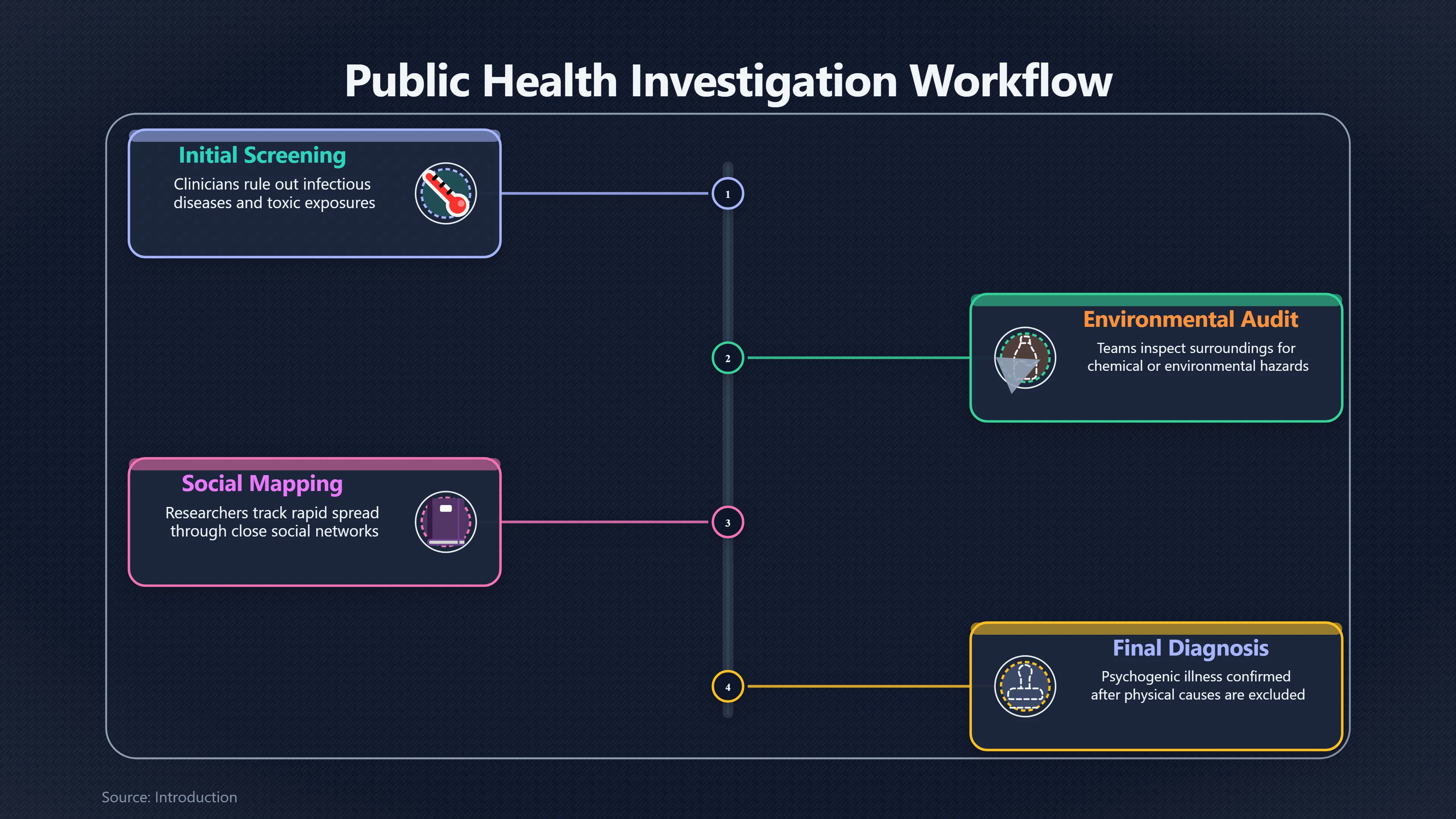
Public health investigations normally begin by excluding infectious disease, environmental contamination, toxic exposure or other medical hazards. International experience shows that school outbreaks can initially resemble poisoning or chemical exposure, making careful environmental and medical investigation essential before concluding that psychological mechanisms are involved.[New England Journal of Medicine]nejm.orgOpen source on nejm.org.
Only after physical explanations have been carefully examined does the pattern of rapid spread, lack of objective medical findings and close social transmission become persuasive evidence for mass psychogenic illness. This cautious approach avoids dismissing genuine environmental risks while recognising that psychologically mediated outbreaks are themselves real health events requiring sensitive management.[New England Journal of Medicine]nejm.orgOpen source on nejm.org.
Why These Cases Remain Important
The 1993 Thai school outbreak continues to appear in international reviews because it demonstrates how collective illness emerges from the interaction of psychology, culture and social relationships rather than from any single cause. It also challenges the outdated language of “mass hysteria”, which can wrongly imply exaggeration or irrationality.
Instead, Thai school possession outbreaks illustrate a broader lesson. Stress is real, cultural beliefs matter, and physical symptoms can spread through groups without infection. Understanding all three elements together provides a more accurate and more humane explanation than reducing such events either to supernatural certainty or to simple imagination.[nih.gov]pubmed.ncbi.nlm.nih.govRisk factors for spirit possession among school girls in southern ThailandJuly 1, 1998…


Endnotes
1.
Source: pmc.ncbi.nlm.nih.gov
Title: PMCMass Psychogenic Illness: Demography and Symptom Profile of an Episode
Link:https://pmc.ncbi.nlm.nih.gov/articles/PMC4884863/
Source snippet
May 16, 2016...
Published: May 16, 2016
2.
Source: paperzz.com
Link:https://paperzz.com/doc/8661010/epidhnc-dissociation-children-in
Source snippet
EPIDHnc DISSOCIATION CHILDREN INSeptember 1, 1995...
Published: September 1, 1995
3.
Source: pubmed.ncbi.nlm.nih.gov
Link:https://pubmed.ncbi.nlm.nih.gov/9676093/
Source snippet
Risk factors for spirit possession among school girls in southern ThailandJuly 1, 1998...
Published: July 1, 1998
4.
Source: pubmed.ncbi.nlm.nih.gov
Link:https://pubmed.ncbi.nlm.nih.gov/8082317/
Source snippet
Spirit possession in South Asia, dissociation or hysteria? Part 1: Theoretical background - PubMed...
5.
Source: nejm.org
Link:https://www.nejm.org/doi/full/10.1056/NEJM200001133420206
6.
Source: pubmed.ncbi.nlm.nih.gov
Link:https://pubmed.ncbi.nlm.nih.gov/35747341/
Source snippet
Predictors of mass psychogenic illness in a junior secondary school in rural Botswana: A case control study - PubMed...
7.
Source: pubmed.ncbi.nlm.nih.gov
Title: Pub Med Dissociative disorders in children: behavioral profiles and problems
Link:https://pubmed.ncbi.nlm.nih.gov/8435785/
Source snippet
Dissociative disorders in children: behavioral profiles and problems - PubMed...
8.
Source: nejm.org
Link:https://www.nejm.org/doi/abs/10.1056/NEJM200001133420206
9.
Source: pmc.ncbi.nlm.nih.gov
Link:https://pmc.ncbi.nlm.nih.gov/articles/PMC9199574/
10.
Source: pubmed.ncbi.nlm.nih.gov
Link:https://pubmed.ncbi.nlm.nih.gov/33312130/
11.
Source: pmc.ncbi.nlm.nih.gov
Link:https://pmc.ncbi.nlm.nih.gov/articles/PMC7704439/
12.
Source: pmc.ncbi.nlm.nih.gov
Link:https://pmc.ncbi.nlm.nih.gov/articles/PMC7368451/
13.
Source: pubmed.ncbi.nlm.nih.gov
Link:https://pubmed.ncbi.nlm.nih.gov/7924398/
14.
Source: pubmed.ncbi.nlm.nih.gov
Link:https://pubmed.ncbi.nlm.nih.gov/8351308/
15.
Source: pubmed.ncbi.nlm.nih.gov
Link:https://pubmed.ncbi.nlm.nih.gov/16195104/
16.
Source: pubmed.ncbi.nlm.nih.gov
Link:https://pubmed.ncbi.nlm.nih.gov/6831135/
Additional References
17.
Source: youtube.com
Link:https://www.youtube.com/watch?v=ra4-gmQT_50
Source snippet
Can Laughter Kill You? - The Mysterious Tanganyika Laughter Epidemic of 1962...
18.
Source: youtube.com
Title: The Razor-Thin Line Between Contagion and Connection | Dan Taberski | TED
Link:https://www.youtube.com/watch?v=u0fFIJapsRY
Source snippet
The Town That Caught Tourettes | Thursday, 9pm | Channel 4...
19.
Source: youtube.com
Title: Teens’ tics: Mysterious illness or hysteria?
Link:https://www.youtube.com/watch?v=rLT5acgRoIg
Source snippet
The medical mystery linking TikTok to an explosion of severe tics in teens | 60 Minutes Australia...
20.
Source: youtube.com
Title: The Town That Caught Tourettes | Thursday, 9pm | Channel 4
Link:https://www.youtube.com/watch?v=yRwFilSEGQ0
Source snippet
Teens' tics: Mysterious illness or hysteria?...
21.
Source: he05.tci-thaijo.org
Link:https://he05.tci-thaijo.org/index.php/WESR/user/setLocale/en_US?source=%2Findex.php%2FWESR%2Farticle%2Fview%2F1392
Source snippet
of mass hysteria during ethics training in one secondary school, Muang district, Ubon Ratchathani, June 2017 | Weekly Epidemiological Su...
Published: June 2017
22.
Source: researchgate.net
Link:https://www.researchgate.net/publication/326473288_Mass_psychogenic_illness_among_school_children_a_descriptive_study_of_demographic_and_clinical_variables
23.
Source: tandfonline.com
Link:https://www.tandfonline.com/doi/full/10.1080/09540120903193732
24.
Source: sciencedirect.com
Link:https://www.sciencedirect.com/science/article/abs/pii/S0736467915010598
25.
Source: cambridge.org
Link:https://www.cambridge.org/core/journals/trans-trans-regional-and-national-studies-of-southeast-asia/article/tall-ghosts-chopsticks-and-monitor-lizards-namecalling-and-its-perpetrators-in-the-cultural-context-of-thailand/1A5BE96A988244B39F8E0F869C79ADBF
26.
Source: cambridge.org
Link:https://www.cambridge.org/core/journals/psychological-medicine/article/abs/tarantism-dancing-mania-and-demonopathy-the-anthropolitical-aspects-of-mass-psychogenic-illness/A2C2EF387B94BC12E4BBB526B5443534
Topic Tree