When Belief, Fear and Power Collided in Peru
Peru’s history of collective belief and fear is not a simple catalogue of “cults” or irrational crowds. Its most revealing episodes grew from conquest, forced conversion, racial inequality, political violence, rapid social change and distrust of institutions.
Page outline Jump by section
Introduction
These cases differ sharply. Some were organised religious movements with committed followers. Others were rumours, official scares or clusters of genuine physical symptoms without an established infectious cause. Treating them all as “mass hysteria” would hide more than it explains. The important questions are who defined a belief as dangerous, what pressures made it persuasive, how authority amplified or suppressed it, and what harm followed.
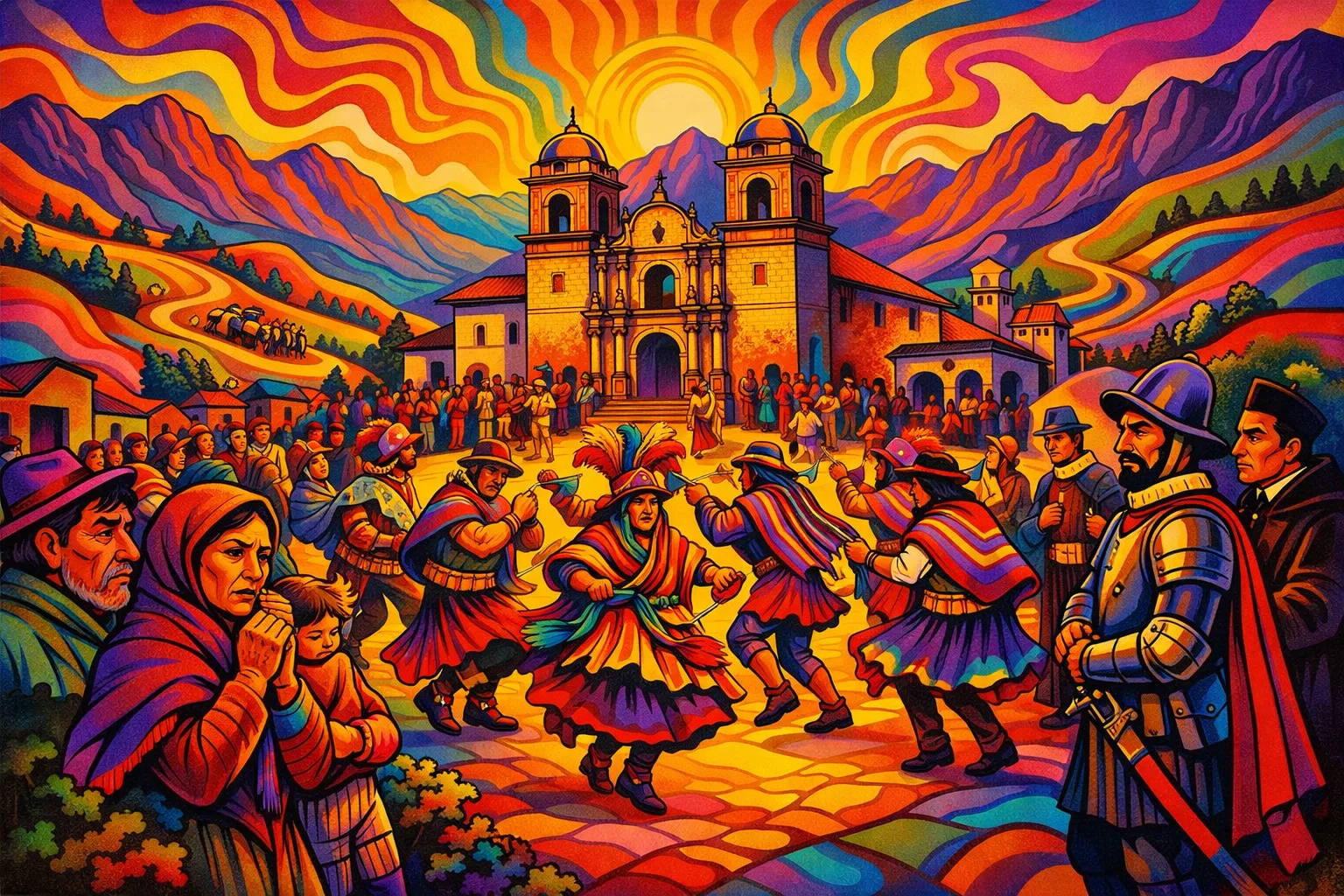
The dancing movement that alarmed colonial Peru
The best-documented early case is usually known by a name meaning “dancing sickness”. It emerged in the Peruvian Andes during the 1560s, roughly three decades after the Spanish conquest, and was concentrated particularly in the Huamanga region, now associated with Ayacucho. Participants reportedly rejected Christian worship, entered ritual states involving dancing or trance, and proclaimed that Indigenous sacred powers would defeat the Christian God and restore an overturned world.[cambridge.org]cambridge.orgED01EFD372FCB96430BEF5FF1F365877Cambridge University Press & AssessmentThe Taki Onqoy and the Andean Nation: Sources and …by J Mumford · 1998 · Cited by 64 — Their res…
Calling this episode a “dance plague” would be misleading. The surviving evidence does not describe an involuntary medical epidemic comparable to outbreaks of contagious fainting or convulsions. Historians more often interpret it as a religious revitalisation movement: an attempt to renew a threatened culture under the immense pressure of conquest, epidemic disease, resettlement, tribute demands and Christian evangelisation. Its bodily performances carried theology and politics at the same time. To dance was to show that older sacred forces had returned and were speaking through human beings.[Cambridge University Press & Assessment]cambridge.orgCambridge University Press & AssessmentMessianic and Revitalization Movements (Chapter 14)5 Apr 2016 — The earliest well-documented Andea…
Colonial officials saw something far more threatening. A movement that told converts to abandon Christian practices challenged not only the Church but the legitimacy of Spanish rule. Clergy and their assistants investigated communities, identified religious teachers and punished adherents. One reason historians must be cautious is that almost everything known about the movement comes through these hostile colonial records. John Mumford notes that it was rapidly suppressed and left few traces beyond a small body of Spanish documentation. The officials who recorded it were also constructing the category of “idolatry” that justified intervention.[Cambridge University Press & Assessment]cambridge.orgED01EFD372FCB96430BEF5FF1F365877Cambridge University Press & AssessmentThe Taki Onqoy and the Andean Nation: Sources and …by J Mumford · 1998 · Cited by 64 — Their res…
This creates a lasting interpretive dispute. Earlier accounts sometimes described a broad, unified Indigenous uprising. Later research has questioned how geographically coherent or socially uniform it really was. Archaeological work suggests that participation varied between places and that the movement was clustered rather than universally embraced across the highlands. The safest conclusion is that a real religious mobilisation occurred, but its boundaries, leadership and political unity cannot be reconstructed with certainty from prosecution records alone.[JSTOR]jstor.orgTaki Onqoy in the Chicha-Soras Valley (Ayacucho, Peru)by SM Norman · 2019 · Cited by 21 — Taki Onqoy was not universally practiced b…
Its cultural importance lies in that uncertainty. The episode shows how a colonial state could turn religious difference into evidence of sedition, while Indigenous communities could use prophecy, possession and ritual performance to interpret catastrophe. It belongs to the history of resistance, but also to the history of how authorities invent threatening categories around beliefs they are trying to eliminate.
When “idolatry” and witchcraft became tools of control
The suppression of the dancing movement formed part of a wider campaign against Indigenous religion. Colonial investigators searched for sacred objects, shrines, ritual specialists and healing practices that they classified as idolatry, superstition or witchcraft. These campaigns did not simply uncover a fixed underground religion. They helped reshape local practices by forcing people to explain them through legal and Christian concepts that had arrived with conquest.[Duke University Press]read.dukeupress.eduOpen source on dukeupress.edu.
Peru did not reproduce the large-scale European witch hunts in exactly the same form. Scholarship on colonial religious repression stresses that formal accusations of explicit pacts with Satan were comparatively exceptional in rural Andean cases. Officials were often more concerned with the persistence of non-Christian ritual authority, local healers and sacred places than with proving membership of an organised devil-worshipping conspiracy.[Duke University Press]read.dukeupress.eduOpen source on dukeupress.edu.
Yet European ideas about witches still changed the meaning of Andean healing. Practices connected with illness, divination, fertility and community protection could be reinterpreted as diabolical. Women and Indigenous ritual experts were especially vulnerable because colonial authorities encountered their knowledge through a framework that linked non-Christian spiritual power with deception or evil. Anthropologist Irene Silverblatt has argued that conquest brought Andean healing into contact with the categories of the contemporary European witch craze, transforming both the social role of healers and the language used against them.[Springer]link.springer.comOpen source on springer.com.
These proceedings should therefore not be treated as neutral records of strange belief. They were produced inside unequal encounters involving priests, Indigenous leaders, interpreters and local rivals. An accusation might express sincere fear, a dispute over authority, an attempt to remove a competitor or pressure to give investigators the answers they expected. The panic was institutional as much as popular: colonial government created a system in which signs of religious survival could be read as proof that an invisible enemy remained everywhere.
The fat-stealer rumour and the politics of mistrust
One of Peru’s most persistent fear figures is a supposedly human predator who murders travellers and removes their body fat. Stories of such attackers have circulated in the Andes since the colonial period. Their identity and methods change, but they are commonly imagined as outsiders—often white or socially powerful men—who transform Indigenous bodies into useful material for medicine, machinery, industry or commerce.[ReVista]revista.drclas.harvard.eduRe Vista Peruvian PishtacosRe Vista Peruvian Pishtacos
This is more than a monster story. Scholars have interpreted it as a flexible language for inequality. The killer does not merely take a life; he extracts something valuable and sends it into a distant system controlled by others. The rumour converts exploitation into a bodily image: powerful outsiders grow richer by literally consuming the substance of poorer people. New technologies and industries can be added to the story because they are already experienced as mysterious forces that benefit outsiders.[Prospect]prospectmagazine.co.ukperuvian fat stealersperuvian fat stealers
The legend became especially potent during periods of conflict. In the violence of the 1980s, some communities associated soldiers or other agents of the state with these predators. Such rumours did not arise in a social vacuum. Rural Peruvians faced real disappearances, massacres, clandestine operations and profound uncertainty about who represented the state, the insurgency or neither. A supernatural or folkloric explanation could coexist with accurate recognition that armed outsiders posed a genuine danger.[verdadyreconciliacionperu.com]verdadyreconciliacionperu.comOpen source on verdadyreconciliacionperu.com.
The most extraordinary modern episode came in November 2009, when Peruvian police announced that they had broken up a criminal network accused of murdering people and selling extracted human fat to the European cosmetics industry. Officers displayed bottles of yellowish material and presented the allegation as a real-world version of the old fat-stealer story. International media rapidly repeated it.[ReVista]revista.drclas.harvard.eduRe Vista Peruvian PishtacosRe Vista Peruvian Pishtacos
The story soon collapsed. Authorities could not substantiate the supposed international market, and senior police leadership suffered political consequences as the credibility of the investigation disintegrated. Reports suggested that the lurid announcement may have diverted attention from allegations involving police misconduct or unlawful killings. Whether every underlying murder allegation was fabricated was less clear than the failure of the grand body-fat conspiracy.[RFI]www1.rfi.frarticle 6053.asparticle 6053.asp
The affair is a near-perfect example of an official panic feeding on established folklore. Police authority gave the rumour legitimacy; the grisly physical display made it visually persuasive; international reporting gave it speed; and familiarity with the traditional predator made it feel culturally plausible. The episode also reversed the usual direction of superstition. This was not simply a frightened rural population misleading officials. State officials themselves activated a folk narrative and turned it into national news.
Prophecy, politics and the Peruvian “promised land”
Peru has also produced new religious movements whose unusual beliefs attracted the label “cult” from critics and journalists. The most politically important is the Israelite Mission of the New Universal Pact, founded by Ezequiel Ataucusi in the 1960s. The movement combined strict attention to parts of the Old Testament with Adventist influences, Indigenous symbolism and the teaching that Peru—and particularly the Amazon—had a special role in sacred history.[reuters.com]reuters.comMaster, president, god? On the trail of Peru's mysteriousMaster, president, god? On the trail of Peru's mysterious
Ataucusi presented himself as a divinely chosen prophet. Followers formed disciplined communities, adopted distinctive clothing and established settlements in forest regions imagined as a promised land or place of preparation for the end times. This message appealed especially to some rural and Indigenous Peruvians who had experienced poverty, displacement, political violence or disappointment with established churches. The movement offered not only prophecy but shared work, moral order, community and a meaningful place for Peru within biblical history.[Academia]academia.eduPDF) Israelites of the New Universal Covenant (PeruPDF) Israelites of the New Universal Covenant (Peru
It also entered electoral politics through the Agricultural People’s Front of Peru. That political arm gained renewed national attention in the 2020 congressional election, forcing many urban Peruvians to confront a movement they had previously viewed as remote or marginal. Its visibility generated alarm about strict gender roles and religious conservatism, but it also exposed how readily the word “sect” could replace serious examination of its social base.[Reuters]reuters.comMaster, president, god? On the trail of Peru's mysteriousMaster, president, god? On the trail of Peru's mysterious
The death of Ataucusi in 2000 produced the movement’s most widely reported millenarian moment. Some followers expected him to return to life after three days, and disappointment followed when this did not happen. Yet the organisation survived. This is important because failed prophecy does not always destroy a movement. Believers may reinterpret what was promised, shift attention to the founder’s spiritual legacy or remain because family, livelihood and community ties matter as much as doctrine.[Wikipedia]WikipediaEvangelical Association of the Israelite Mission of the New Universal CovenantEvangelical Association of the Israelite Mission of the New Universal Covenant
There are legitimate questions about authority, social control and political influence within any tightly organised religious community. Even so, describing the movement only as a bizarre cult misses why it endured. Its history is better understood as Peruvian millenarianism shaped by migration, marginalisation, biblical literalism and the search for dignity in a society where many followers felt excluded.
Peru’s UFO-contact religion
Another influential Peruvian movement began in the 1970s around Sixto Paz Wells and claims of communication with extraterrestrial guides. Groups associated with the movement practised meditation, mental preparation and organised journeys to locations where participants hoped to witness unusual lights or make spiritual contact. From Peru, the network spread into other Latin American countries and Spain.[Wikipedia]WikipediaSixto Paz WellsSixto Paz Wells
Its beliefs mixed the language of space travel with older esoteric traditions, including spiritualism, occult philosophy, meditation and ideas of human transformation. Extraterrestrials were not presented merely as visitors in machines. They became morally advanced teachers guiding humanity through a period of cosmic development. This makes the movement more accurately described as a UFO religion or contactee movement than as a club devoted solely to investigating unidentified objects.[Wikipedia]WikipediaSixto Paz WellsSixto Paz Wells
The desert of Chilca, south of Lima, became central to its public mythology after a reported scheduled sighting in 1974. Inviting journalists to predicted appearances was a powerful publicity method: even an ambiguous light could be interpreted as confirmation, while press attendance established that something had been witnessed. The resulting stories helped connect Peru to the international contactee culture that had already emerged around claims of benevolent space beings.[Wikipedia]WikipediaSixto Paz WellsSixto Paz Wells
There is no accepted scientific evidence that the movement established communication with extraterrestrial intelligence. But dismissing it as simple fraud does not fully explain its appeal. It offered participants disciplined practices, shared experiences, an optimistic cosmic history and a sense that ordinary Peruvians could become central actors in humanity’s future. As with other new religions, the social and spiritual life of the group can be studied without accepting its supernatural claims or assuming that every member was manipulated.
The school outbreak recast as demonic possession
In April and May 2016, pupils at the Elsa Perea Flores school in Tarapoto began fainting and experiencing episodes described as dizziness, crying, convulsions and altered behaviour. Local reports said that dozens of students were affected and that classes were suspended as the incidents continued. A hospital psychologist publicly considered collective hysteria—more neutrally called mass psychogenic illness—as one possible explanation.[viatelevision.pe]viatelevision.peContinúan los desmayos en el colegio Elsa Perea FloresContinúan los desmayos en el colegio Elsa Perea Flores
Mass psychogenic illness refers to the spread of real, involuntary symptoms through a socially connected group when investigation does not establish an infectious or toxic cause sufficient to explain the pattern. It does not mean that people are pretending. Stress, observation of others, expectation and fear can influence bodily responses, particularly in close settings such as schools. Researchers warn, however, that environmental and medical causes must be investigated before applying the diagnosis.[PMC]pmc.ncbi.nlm.nih.govOpen source on nih.gov.
That caution mattered in Tarapoto. While some people suspected supernatural possession, an engineer also raised the possibility of gases or construction defects requiring inspection. The available public reporting does not provide a sufficiently detailed final medical investigation to prove one explanation conclusively. The strongest responsible description is therefore a suspected psychogenic outbreak with alternative environmental concerns considered, not a medically established case of possession or an unexplained paranormal event.[viatelevision.pe]viatelevision.peHisteria colectiva se repite una vez más en la I.E ElsaHisteria colectiva se repite una vez más en la I.E Elsa
The story changed dramatically as it travelled. International outlets emphasised shared visions of a threatening man in black and repeated claims that the school had been built over a burial site. Headlines described “contagious demonic possession”, turning an uncertain school-health event into supernatural entertainment. Some versions increased the number of affected children or stripped away the local discussion of psychological and environmental causes.[trtworld.com]trtworld.comTRT World Hallucination outbreak hits Peruvian schoolTRT World Hallucination outbreak hits Peruvian school
This amplification could itself worsen such an outbreak. When frightened pupils repeatedly hear that an unseen being is attacking classmates, ambiguous bodily sensations gain a ready-made explanation. Crowds, filming, religious ceremonies and sensational reports can keep attention fixed on symptoms. The humane response is not ridicule. It is calm medical assessment, reduced exposure to alarming rumours, psychological support and careful communication that validates suffering without confirming an unsupported supernatural cause.
What Peru’s cases have in common
These episodes do not share a single psychological mechanism. The dancing movement was organised religious resistance, not an epidemic illness. Colonial witchcraft accusations were instruments of conversion and political control. The fat-stealer was a recurring rumour that sometimes attached itself to real violence. The Israelite Mission and the UFO-contact network were durable new religions. The Tarapoto outbreak concerned contagious symptoms and competing explanations.
What links them is the struggle to interpret danger in unequal conditions. Peruvian collective fears have repeatedly gathered around bodies being controlled, invaded or extracted from: sacred forces possessing dancers, colonial investigators criminalising healers, outsiders stealing human fat, prophets preparing followers for apocalypse, extraterrestrial guides entering human consciousness, or schoolchildren appearing to share one terrifying presence.
Authority does not always dispel these beliefs. It can intensify them. Colonial clergy transformed local ritual into evidence of a spiritual conspiracy. Police turned folklore into a supposed international murder industry. Media converted uncertain symptoms into demonic attack. Political and religious opponents used “cult” as a shortcut for movements whose success required deeper social explanation.
The clearest lesson is therefore not that Peru has been unusually susceptible to hysteria. It is that collective belief becomes powerful when it gives recognisable form to genuine pressures: conquest, racism, extraction, state violence, migration, institutional abandonment and fear for children. Understanding those pressures does not prove supernatural claims. It explains why certain stories spread, why some survive failed predictions or official exposure, and why the same old fears can return wearing the language of each new age.
Amazon book picks
Further Reading
Books and field guides related to When Belief, Fear and Power Collided in Peru. Use these as the next step if you want deeper reading beyond the article.

The Penguin book of witches
First published 2014. Subjects: Witchcraft, History, Witchcraft, europe.
The Oxford Handbook of the Incas
Provides broad historical context for Peruvian belief traditions.
Sorcery: A History of Fear, from Ancient Times to the Present
Places Peruvian cases within global histories of supernatural belief.
Endnotes
1.
Source: cambridge.org
Link:https://www.cambridge.org/core/journals/latin-american-research-review/article/[taki-onqoy
Source snippet
Cambridge University Press & AssessmentThe Taki Onqoy and the Andean Nation: Sources and...by J Mumford · 1998 · Cited by 64 — Their res...
2.
Source: jstor.org
Link:https://www.jstor.org/stable/pdf/45217383.pdf
Source snippet
Taki Onqoy in the Chicha-Soras Valley (Ayacucho, Peru)by SM Norman · 2019 · Cited by 21 — Taki Onqoy was not universally practiced b...
3.
Source: cambridge.org
Title: University Press & Assessment7
Link:https://www.cambridge.org/core/books/cambridge-history-of-religions-in-latin-america/evangelization-and-indigenous-religious-reactions-to-conquest-and-colonization/67E8292C7EC28A482306CEC7E7B39AB0
Source snippet
Its adherents were itinerant dancers and teachers who claimed to be...
4.
Source: cambridge.org
Link:https://www.cambridge.org/core/books/cambridge-history-of-religions-in-latin-america/messianic-and-revitalization-movements/95DB2E13B7813F9F341E375F18B15646
Source snippet
Cambridge University Press & AssessmentMessianic and Revitalization Movements (Chapter 14)5 Apr 2016 — The earliest well-documented Andea...
5.
Source: cambridge.org
Title: Early Colonial Peru. Taki Onqoy in the Chicha-Soras Valley (
Link:https://www.cambridge.org/core/journals/latin-american-antiquity/article/conversion-and-persistence-analysis-of-faunal-remains-from-an-early-spanish-colonial-doctrinal-settlement-in-highland-peru/0298F92ED2C6000A2717CF1A5172099F
Source snippet
Cambridge University Press & AssessmentConversion and Persistence: Analysis of Faunal Remains...by SD deFrance · 2016 · Cited by 32 — Fr...
6.
Source: jstor.org
Link:https://www.jstor.org/stable/45217382
Source snippet
Taki Onqoy, siglo XVI. Lima. Instituto de Estudios Peruanos, Lima. Mills, K. (1997). Idolatry and its Enemies. Princeton University Press...
7.
Source: jstor.org
Link:https://www.jstor.org/stable/45217377
8.
Source: link.springer.com
Link:https://link.springer.com/article/10.1007/BF00052240
9.
Source: academia.edu
Link:https://www.academia.edu/54867469/The_evolution_of_witchcraft_and_the_meaning_of_healing_in_colonial_Andean_society
10.
Source: Wikipedia
Link:https://en.wikipedia.org/wiki/Pishtaco
11.
Source: verdadyreconciliacionperu.com
Link:https://www.verdadyreconciliacionperu.com/admin/files/articulos/1285_digitalizacion.pdf
12.
Source: www1.rfi.fr
Title: article 6053.asp
Link:https://www1.rfi.fr/actuen/articles/120/article_6053.asp
13.
Source: reuters.com
Title: Master, president, god? On the trail of Peru’s mysterious
Link:https://www.reuters.com/article/world/master-president-god-on-the-trail-of-perus-mysterious-new-political-power-br-idUSKBN20W16K/
14.
Source: academia.edu
Title: (PDF) Israelites of the New Universal Covenant (Peru)
Link:https://www.academia.edu/128858950/Israelites_of_the_New_Universal_Covenant_Peru_
15.
Source: Wikipedia
Title: Evangelical Association of the Israelite Mission of the New Universal Covenant
Link:https://en.wikipedia.org/wiki/Evangelical_Association_of_the_Israelite_Mission_of_the_New_Universal_Covenant
16.
Source: Wikipedia
Title: Sixto Paz Wells
Link:https://es.wikipedia.org/wiki/Sixto_Paz_Wells
17.
Source: Wikipedia
Title: Sixto Paz Wells
Link:https://en.wikipedia.org/wiki/Sixto_Paz_Wells
18.
Source: academia.edu
Link:https://www.academia.edu/22498430/LAS_SECTAS_1_i
19.
Source: viatelevision.pe
Title: Continúan los desmayos en el colegio Elsa Perea Flores
Link:https://viatelevision.pe/22810/desmayos-colegio-elsa-perea-flores
20.
Source: viatelevision.pe
Title: desmayos masivos colegio elsa perea flores
Link:https://viatelevision.pe/22904/desmayos-masivos-colegio-elsa-perea-flores
21.
Source: pmc.ncbi.nlm.nih.gov
Link:https://pmc.ncbi.nlm.nih.gov/articles/PMC4884863/
22.
Source: viatelevision.pe
Title: Histeria colectiva se repite una vez más en la I.E Elsa
Link:https://viatelevision.pe/23064/histeria-colectiva-repite-vez-mas-i-e-elsa-perea-flores
23.
Source: viatelevision.pe
Title: Tema: IE Elsa Perea
Link:https://viatelevision.pe/tema/i-e-elsa-perea
24.
Source: viatelevision.pe
Title: tarapoto deficiencia constructiva podria generar desmayos estudiantes
Link:https://viatelevision.pe/22951/tarapoto-deficiencia-constructiva-podria-generar-desmayos-estudiantes
25.
Source: news.com.au
Link:https://www.news.com.au/lifestyle/parenting/school-life/dozens-of-children-from-elsa-perea-flores-school-in-peru-in-outbreak-of-contagious-demonic-possession/news-story/2d5172b98a69028bd61f8c8b2bfd8209
26.
Source: Wikipedia
Title: Taki Unquy
Link:https://en.wikipedia.org/wiki/Taki_Unquy
27.
Source: Wikipedia
Title: Mass psychogenic illness
Link:https://en.wikipedia.org/wiki/Mass_psychogenic_illness
28.
Source: Wikipedia
Title: Satanic panic
Link:https://en.wikipedia.org/wiki/Satanic_panic
29.
Source: jstor.org
Link:https://www.jstor.org/stable/2503902
30.
Source: jstor.org
Link:https://www.jstor.org/stable/pdf/27253610.pdf
31.
Source: jstor.org
Link:https://www.jstor.org/stable/43855402
32.
Source: jstor.org
Link:https://www.jstor.org/stable/41494992
33.
Source: jstor.org
Link:https://www.jstor.org/stable/10.3998/mpub.14369000.14
34.
Source: jstor.org
Link:https://www.jstor.org/stable/158120
35.
Source: jstor.org
Link:https://www.jstor.org/stable/2514831
36.
Source: jstor.org
Link:https://www.jstor.org/stable/2504028
37.
Source: cambridge.org
Link:https://www.cambridge.org/core/journals/latin-american-research-review/article/colonial-indian-past-and-future-research-perspectives/A0C25FA608F013D999B5580934AEDA0B
38.
Source: cambridge.org
Link:https://www.cambridge.org/core/journals/americas/article/sense-of-belonging-colonial-indian-cofradias-and-ethnicity-in-the-valley-of-lima-peru/F7C773DF5903ED9318078CF0D5E64725
39.
Source: cambridge.org
Title: Religious Stability and Change (Chapter 10)
Link:https://www.cambridge.org/core/books/cultural-history-of-the-atlantic-world-12501820/religious-stability-and-change/0D504A63D7EBF2ACD505B5F752F77838
40.
Source: cambridge.org
Link:https://www.cambridge.org/core/journals/americas/article/guaman-poma-a-special-case/606DA5305D57E63E325CD0A27DAC551F
41.
Source: assets.cambridge.org
Title: 9780521362757 excerpt
Link:https://assets.cambridge.org/97805213/62757/excerpt/9780521362757_excerpt.pdf
42.
Source: resolve.cambridge.org
Link:https://resolve.cambridge.org/core/services/aop-cambridge-core/content/view/B59144B0AF9B59A5F0600436EDBE0A1D/9781139055260c7_p37-42_CBO.pdf/indian_societies_and_the_spanish_conquest.pdf
43.
Source: academia.edu
Link:https://www.academia.edu/32520158/Peruvian_Pishtacos_Tales_of_Anti_Aging_Cream_and_Other_Rumors
44.
Source: academia.edu
Link:https://www.academia.edu/511597/_The_Taki_Onqoy_and_the_Andean_Nation_Sources_and_Interpretations_Latin_American_Research_Review_33_no
45.
Source: history.com
Title: what was satanic panic 1980s
Link:https://www.history.com/articles/what-was-satanic-panic-1980s
46.
Source: reuters.com
Title: peru protests blockade roads force five airports close 2022 12 16
Link:https://www.reuters.com/world/americas/peru-protests-blockade-roads-force-five-airports-close-2022-12-16/
47.
Source: reuters.com
Title: two dead four injured peru protests demand elections 2022 12 12
Link:https://www.reuters.com/world/americas/two-dead-four-injured-peru-protests-demand-elections-2022-12-12/
48.
Source: reuters.com
Link:https://www.reuters.com/video/watch/idRW486531052026RP1/
49.
Source: link.springer.com
Link:https://link.springer.com/content/pdf/10.1057/9781403984630_3
50.
Source: read.dukeupress.edu
Link:https://read.dukeupress.edu/hahr/article/77/3/513/144710/The-Cross-and-the-Serpent-Religious-Repression-and
51.
Source: read.dukeupress.edu
Title: The Search for Idols and Saints in Colonial Peru
Link:https://read.dukeupress.edu/hahr/article/85/3/417/27271/The-Search-for-Idols-and-Saints-in-Colonial-Peru
52.
Source: revista.drclas.harvard.edu
Title: Re Vista Peruvian Pishtacos
Link:https://revista.drclas.harvard.edu/peruvian-pishtacos/
53.
Source: prospectmagazine.co.uk
Title: peruvian fat stealers
Link:https://www.prospectmagazine.co.uk/world/53543/peruvian-fat-stealers
54.
Source: berghahnbooks.com
Link:https://www.berghahnbooks.com/downloads/OpenAccess/BalkenholAtlantic/BalkenholAtlantic_03.pdf
55.
Source: trtworld.com
Title: TRT World Hallucination outbreak hits Peruvian school
Link:https://www.trtworld.com/article/13083632
56.
Source: scribd.com
Title: sixto paz wells
Link:https://www.scribd.com/document/801231565/sixto-paz-wells
57.
Source: pmc.ncbi.nlm.nih.gov
Link:https://pmc.ncbi.nlm.nih.gov/articles/PMC7396040/
58.
Source: pubmed.ncbi.nlm.nih.gov
Link:https://pubmed.ncbi.nlm.nih.gov/21072458/
59.
Source: pmc.ncbi.nlm.nih.gov
Link:https://pmc.ncbi.nlm.nih.gov/articles/PMC7201200/
60.
Source: ebsco.com
Link:https://www.ebsco.com/research-starters/social-sciences-and-humanities/mass-hysteria
61.
Source: reutersconnect.com
Title: d GFn On Jld XRlcn Mu Y29t LDIw MTk6bm V3c21s X1ZBQUh YQjh FRg
Link:https://www.reutersconnect.com/item/children-survive-after-car-rams-into-them-at-peru-intersection/dGFnOnJldXRlcnMuY29tLDIwMTk6bmV3c21sX1ZBQUhYQjhFRg
62.
Source: reutersconnect.com
Link:https://www.reutersconnect.com/collection/peru-on-alert-due-to-increased-cases-of-coronavirus-in-children/dGFnOnJldXRlcnMuY29tLDIwMjA6bmV3c21sX1ZBQ1MyMkZEMw
63.
Source: ouci.dntb.gov.ua
Link:https://ouci.dntb.gov.ua/en/works/4rgLnD3M/
Additional References
64.
Source: youtube.com
Title: We Earthlings Are the Fruit of a Sowing of Extraterrestrials: Sixto Paz
Link:https://www.youtube.com/watch?v=jcv90p2IytQ
Source snippet
Drawing El Pishtaco - Exploring Latin X-Files - Latin American Cryptids, Myths and Legends...
65.
Source: youtube.com
Title: Drawing El Pishtaco
Link:https://www.youtube.com/watch?v=DMkECkLlTK4
Source snippet
Documental francés "Los Israelitas del Nuevo pacto"- AEMINPU...
66.
Source: youtube.com
Title: Ezequiel Ataucusi Gamonal documentary “A prophet in his land”
Link:https://www.youtube.com/watch?v=FIHs7i5ZKIQ
Source snippet
We Earthlings Are the Fruit of a Sowing of Extraterrestrials: Sixto Paz...
67.
Source: science.gov
Link:https://www.science.gov/topicpages/s/satanic%2Britual%2Babuse
68.
Source: youtube.com
Title: Documental francés “Los Israelitas del Nuevo pacto”- AEMINPU
Link:https://www.youtube.com/watch?v=GsWq8ilBYic
Source snippet
Víctor Heredia: Taki Ongoy COMPLETO en vivo...
69.
Source: researchgate.net
Link:https://www.researchgate.net/publication/351630048_Catholicism_and_Taki_Onqoy_in_the_Early_Colonial_Period_Colonial_Entanglements_of_Church_Interments_at_Iglesiachayoq_Chicha-Soras_Valley_Ayacucho_Peru
70.
Source: howtoperu.com
Link:https://howtoperu.com/a-classic-case-of-mass-hysteria-in-tarapoto-peru/
71.
Source: elcomercio.pe
Link:https://elcomercio.pe/peru/san-martin/continuan-desmayos-masivos-colegio-tarapoto-198473-noticia/
72.
Source: archive.org
Link:https://archive.org/stream/Sabiduria_Oculta/Bosch_Juan_para%20conocer%20las%20sectas_djvu.txt
73.
Source: podcast24.fr
Link:https://podcast24.fr/episodes/the-paranormal-ufo-consciousness-podcast/grant-cameron-interviews-mission-rahma-co-founder-sixto-paz-wells-on-the-concept-of-the-antenna-LEnKZTfGL3
Topic Tree
Follow this branch
Related pages 192
- Antigua and Barbuda
- Argentina Belief Scares
- Azerbaijan Belief
- Bahrain Beliefs
- North Korea
- +187 more in sidebar