Within Tunisia
How a Replacement Conspiracy Targeted Migrants
A demographic conspiracy claim recast Black African migrants as an organised threat and helped turn political anxiety into discrimination.
On this page
- What the demographic conspiracy claimed
- How presidential rhetoric changed the public climate
- The discrimination and violence that followed
Page outline Jump by section
Introduction
In 2023, Tunisia experienced one of its clearest modern examples of a politically charged social scare when a demographic conspiracy theory portrayed migrants from sub-Saharan Africa as participants in a deliberate plan to replace the country’s population and identity. The claim drew on versions of the international “great replacement” conspiracy theory, recasting irregular migration as an organised attempt to transform Tunisia’s Arab and Muslim character. Although concerns about migration routes across North Africa were real, there was no credible evidence for a coordinated demographic plot. Nevertheless, official rhetoric gave the conspiracy unprecedented visibility, helping to fuel fear, discrimination and violence against Black Africans living in Tunisia.[Amnesty International]amnesty.orgAmnesty InternationalTunisian president’s racist speech incites a wave of violence against Black AfricansMarch 10, 2023…
This episode is significant not because it reflected a mass delusion in the medical sense, but because it demonstrates how political messaging, economic anxiety and longstanding racial prejudice can combine to produce a moral panic. It also illustrates how conspiracy narratives can move rapidly from public discourse into everyday behaviour, affecting people’s safety, housing, employment and access to public life.
What the demographic conspiracy claimed
The central claim was that irregular migration from sub-Saharan Africa formed part of a deliberate project to alter Tunisia’s demographic composition. Rather than treating migration as the result of conflict, poverty, regional instability or attempts to reach Europe, the conspiracy portrayed migrants as agents of an organised effort to erase Tunisia’s national identity.
This argument echoed the wider international “great replacement” conspiracy theory, which has appeared in Europe and North America in different forms. In Tunisia, however, it was adapted to local political concerns by claiming that demographic change would transform the country from an Arab and Muslim society into “another African country”. The theory presented migration as an existential threat rather than a policy challenge, encouraging people to see demographic change as intentional rather than driven by complex economic and geopolitical forces.[Amnesty International]amnesty.orgAmnesty InternationalTunisian president’s racist speech incites a wave of violence against Black AfricansMarch 10, 2023…
Researchers and international organisations have found no evidence supporting claims of a coordinated plan to replace Tunisia’s population. While Tunisia has become an important transit country for migrants seeking to reach Europe, estimates of the migrant population have remained relatively modest compared with the country’s overall population, and migration patterns have been shaped by regional instability and European border policies rather than any documented replacement strategy.[AP News]apnews.comAP News Amid crackdown on dissent, Tunisian leader turns on migrantsSaied has called for urgent measures to address irregular immigration, emphasizing the need for diplomatic, security, and military respon…
How presidential rhetoric changed the public climate
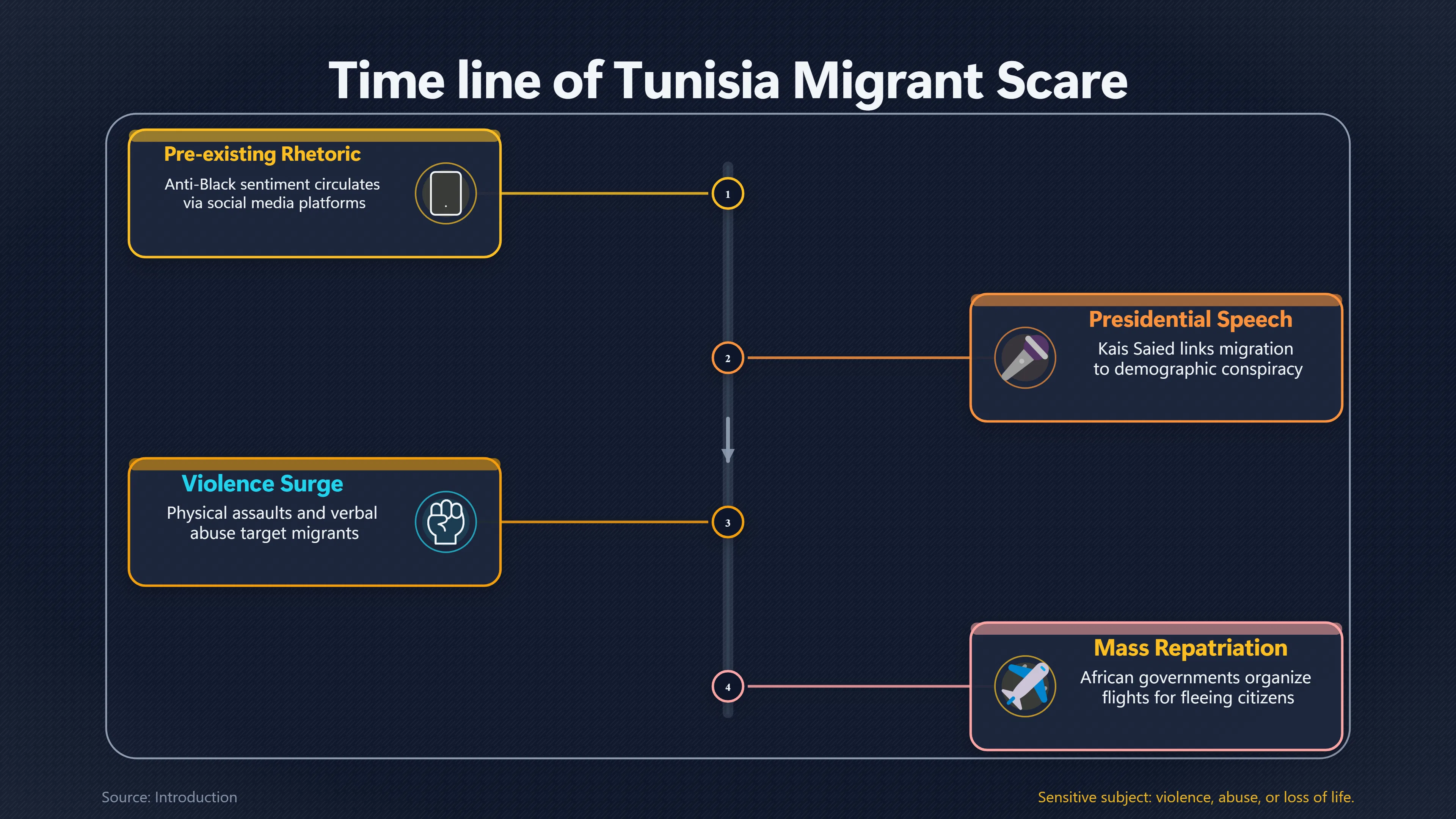
The turning point came on 21 February 2023, when President Kais Saied linked irregular migration from sub-Saharan Africa to crime, violence and an alleged conspiracy to alter Tunisia’s demographic make-up. His remarks were delivered during a National Security Council meeting, giving them exceptional political weight.[Amnesty International]amnesty.orgAmnesty InternationalTunisian president’s racist speech incites a wave of violence against Black AfricansMarch 10, 2023…
The timing mattered. Tunisia was experiencing severe economic difficulties, rising prices, political tension and growing public frustration. In such conditions, conspiracy narratives can provide a simple explanation for complicated problems by identifying a visible group as the source of national decline. Instead of debating migration primarily as an issue of labour markets, asylum or border management, public discussion increasingly centred on claims that migrants threatened the country’s identity and future.
Human Rights Watch observed that the language closely resembled “great replacement” rhetoric seen elsewhere and argued that it transformed migrants into scapegoats for wider economic and political problems.[Human Rights Watch]hrw.orgHuman Rights Watch Trouble in Tunisia | Human Rights WatchHuman Rights Watch Trouble in Tunisia | Human Rights Watch
The episode also showed how official statements can amplify ideas that previously circulated mainly on social media and among nationalist activists. Once echoed by the country’s highest political office, a fringe demographic conspiracy acquired greater legitimacy in parts of the public debate.[Amnesty International]amnesty.orgAmnesty InternationalTunisian president’s racist speech incites a wave of violence against Black AfricansMarch 10, 2023…
The discrimination and violence that followed
Rights organisations, journalists and diplomatic observers reported a sharp deterioration in conditions for Black African migrants after the February speech.
Many migrants described being verbally abused in the street, physically assaulted or threatened by groups of men. Others reported that landlords evicted them, employers dismissed them and neighbours demanded that they leave. Black university students and recognised refugees were also targeted despite having legal status, demonstrating that racial appearance often became more significant than legal category.[Amnesty International]amnesty.orgAmnesty InternationalTunisian president’s racist speech incites a wave of violence against Black AfricansMarch 10, 2023…
Amnesty International documented testimony from migrants who said attacks intensified immediately after the presidential remarks. Witnesses described armed assaults, racist insults and police inaction during some incidents. The organisation also reported large-scale arrests of migrants and asylum seekers, together with allegations of arbitrary detention and forced returns.[Amnesty International]amnesty.orgAmnesty InternationalTunisian president’s racist speech incites a wave of violence against Black AfricansMarch 10, 2023…
The consequences extended beyond physical violence:
- Many migrants lost accommodation after landlords forced them out.
- Some employers dismissed Black African workers or refused to hire them.
- Refugees and asylum seekers reported avoiding public spaces through fear of attack.
- Hundreds gathered outside international organisations seeking protection or assistance.
- Several African governments organised repatriation flights for citizens wishing to leave Tunisia after the deterioration in security.[Human Rights Watch]hrw.orgHuman Rights Watch Trouble in Tunisia | Human Rights WatchHuman Rights Watch Trouble in Tunisia | Human Rights Watch
These developments illustrate a classic feature of moral panic: once a group is publicly associated with danger, ordinary interactions—finding housing, travelling or working—become coloured by suspicion and fear.
Why the conspiracy spread so easily
Several factors made the replacement narrative politically effective despite the lack of supporting evidence.
Economic hardship created a strong demand for simple explanations. Tunisia faced inflation, unemployment and declining confidence in political institutions. Conspiracy theories often become more attractive during periods when people feel that familiar institutions are failing to explain or solve problems.
Migration also had unusual visibility. Tunisia had become an increasingly important transit point for migrants hoping to cross the Mediterranean after changing migration routes through Libya and Europe. Although the numbers involved did not support claims of demographic replacement, the increased public visibility of migrants made exaggerated narratives easier to sustain.[AP News]apnews.comAP News Amid crackdown on dissent, Tunisian leader turns on migrantsSaied has called for urgent measures to address irregular immigration, emphasizing the need for diplomatic, security, and military respon…
Social media further accelerated the spread of rumours, photographs and unverified claims linking migrants to crime or organised settlement. Rights organisations noted that anti-Black rhetoric had already become more common online before the presidential speech, allowing official language to reinforce ideas that were already circulating.[Amnesty International]amnesty.orgAmnesty InternationalTunisian president’s racist speech incites a wave of violence against Black AfricansMarch 10, 2023…
Why this episode matters in Tunisia’s history of collective fear
The migrant replacement scare differs from older forms of collective belief found elsewhere in Tunisia’s history. It was not a panic about supernatural forces, hidden religious movements or unexplained illness. Instead, it was a modern political scare in which demographic conspiracy thinking transformed a real policy issue into an imagined existential threat.
The episode demonstrates several recurring features of moral panics:
- A complex social problem was reduced to a single symbolic enemy.
- Existing anxieties were concentrated on a visible minority.
- Extraordinary claims spread faster than evidence.
- Political authority reinforced rather than calmed public fears.
- The consequences fell disproportionately on people with little political power.
For historians and sociologists, the importance of the episode lies less in the factual accuracy of the conspiracy—which has not been substantiated—and more in its observable social effects. Fear translated into discriminatory behaviour, violence and changes in public attitudes towards an already vulnerable population.[amnesty.org]amnesty.orgAmnesty InternationalTunisian president’s racist speech incites a wave of violence against Black AfricansMarch 10, 2023…
Within Tunisia’s broader history of rumours and moral panics, the 2023 migrant replacement scare stands as a clear example of how demographic conspiracy theories can reshape public behaviour when they intersect with economic uncertainty, political crisis and questions of national identity.

Amazon book picks
Further Reading
Books and field guides related to How a Replacement Conspiracy Targeted Migrants. Use these as the next step if you want deeper reading beyond the article.
Extraordinary Popular Delusions and the Madness of Crowds
Rating: 4.0/5 from 5 Google Books ratings
Historic perspective on mass fears.
Why People Believe Weird Things
Examines conspiracy thinking and extraordinary claims.


Endnotes
1.
Source: amnesty.org
Link:https://www.amnesty.org/en/latest/news/2023/03/Tunisia-presidents-racist-speech-incites-a-wave-of-violence-against-black-africans/
Source snippet
Amnesty InternationalTunisian president’s racist speech incites a wave of violence against Black AfricansMarch 10, 2023...
Published: March 10, 2023
2.
Source: amnesty.org
Link:https://www.amnesty.org/en/latest/news/2023/07/tunisia-human-rights-at-risk-two-years-after-president-saieds-power-grab/
Source snippet
Tunisia: Human rights at risk two years after President Saied’s power grab - Amnesty InternationalJuly 24, 2023 — Image ©Thierry Monasse/...
Published: July 24, 2023
3.
Source: amnesty.org
Title: Human rights under assault two years after President Saied’s power grab
Link:https://www.amnesty.org/en/latest/campaigns/2023/07/human-rights-under-assault-two-years-after-president-saieds-power-grab/
4.
Source: amnesty.lu
Link:https://www.amnesty.lu/actualites/tunisie-le-discours-raciste-du-president-declenche-une-vague-de-violence-contre-les-africain%C2%B7e%C2%B7s-noirs/
5.
Source: amnesty.org
Link:https://www.amnesty.org/fr/latest/news/2023/03/tunisia-presidents-racist-speech-incites-a-wave-of-violence-against-black-africans/
6.
Source: hrw.org
Title: Human Rights Watch Trouble in Tunisia | Human Rights Watch
Link:https://www.hrw.org/the-day-in-human-rights/2023/03/13
7.
Source: apnews.com
Title: AP News Amid crackdown on dissent, Tunisian leader turns on migrants
Link:https://apnews.com/article/a62712d53e72ea2b3de13738a1907a5c
Source snippet
Saied has called for urgent measures to address irregular immigration, emphasizing the need for diplomatic, security, and military respon...
8.
Source: hrw.org
Title: Tunisia: Authoritarian Drift Erodes Rights | Human Rights Watch
Link:https://www.hrw.org/news/2024/01/11/tunisia-authoritarian-drift-erodes-rights
Source snippet
January 11, 2024 — TUNISIA: AUTHORITARIAN DRIFT ERODES RIGHTS Print Donate Now January 11, 2024 10:30AM EST | News Release Available In *...
Published: January 11, 2024
9.
Source: hrw.org
Title: Tunisia: African Migrants Intercepted at Sea, Expelled | Human Rights Watch
Link:https://www.hrw.org/news/2023/10/10/tunisia-african-migrants-intercepted-sea-expelled
Source snippet
October 10, 2023 — TUNISIA: AFRICAN MIGRANTS INTERCEPTED AT SEA, EXPELLED Print Donate Now October 10, 2023 12:30AM EDT | News Release Av...
Published: October 10, 2023
10.
Source: hrw.org
Title: Tunisia: No Safe Haven for Black African Migrants, Refugees | Human Rights Watch
Link:https://www.hrw.org/news/2023/07/19/tunisia-no-safe-haven-black-african-migrants-refugees
11.
Source: hrw.org
Title: Tunisian Terror and “Team Europe”, Daily Brief
Link:https://www.hrw.org/video-photos/audio/2023/07/19/tunisian-terror-and-team-europe-daily-brief-july
12.
Source: hrw.org
Title: Tunisia: Crisis as Black Africans Expelled to Libya Border | Human Rights Watch
Link:https://www.hrw.org/news/2023/07/06/tunisia-crisis-black-africans-expelled-libya-border
13.
Source: hrw.org
Title: Tunisia: Racist Violence Targets Black Migrants, Refugees | Human Rights Watch
Link:https://www.hrw.org/news/2023/03/10/tunisia-racist-violence-targets-black-migrants-refugees
14.
Source: hrw.org
Link:https://www.hrw.org/world-report/2024/country-chapters/tunisia
15.
Source: idea.int
Link:https://www.idea.int/democracytracker/report/tunisia/february-2023
Additional References
16.
Source: tandfonline.com
Link:https://www.tandfonline.com/doi/full/10.1080/13629387.2026.2616008
Source snippet
Omar Sayfoa Institute for Cultural Inquiry, Migration Research Institute, Utrecht University, Utrecht, t...
17.
Source: youtube.com
Link:https://www.youtube.com/watch?v=z4uXw45LtlQ
Source snippet
Sub-Saharan migrants flee Tunisia following wave of racist attacks • FRANCE 24 English...
18.
Source: youtube.com
Title: Tunisia refugees: Sub-Saharan Africans face racist attacks
Link:https://www.youtube.com/watch?v=KeIUdlKwJWw
Source snippet
Sub-Saharan migrants desperate to flee Tunisia as president brands them threat to national identity...
19.
Source: docstore.ohchr.org
Title: Files Handler.ashx
Link:https://docstore.ohchr.org/SelfServices/FilesHandler.ashx?enc=mpqJnB8%2BL8iPXyqFbEH0vTd%2Fcz6RTM3bEq5d6MDNMvdSzA6nv0%2BLivAALB18uyZIHxJWX458glwFsA7QVvIM4gLBbsVLiwOJ2i4ZC1om5u8%3D
Source snippet
23, 2025 — SITUATION OF SUB-SAHARAN MIGRANTS SINCE FEBRUARY 2023 27.The Committee notes of the information provided on the legal framewor...
Published: FEBRUARY 2023
20.
Source: youtube.com
Title: Tunisians rally against president’s anti-immigrant crackdown
Link:https://www.youtube.com/watch?v=mvscS–o1Ko
Source snippet
Tunisian President's Migrant Comments • FRANCE 24 English...
21.
Source: youtube.com
Title: Tunisian President’s Migrant Comments • FRANCE 24 English
Link:https://www.youtube.com/watch?v=gzMvIa9oKWM
Source snippet
Tunisia refugees: Sub-Saharan Africans face racist attacks...
22.
Source: aljazeera.com
Link:https://www.aljazeera.com/news/2023/3/4/african-migrants-desperate-to-leave-tunisia-after-attacks
23.
Source: euronews.com
Link:https://www.euronews.com/2023/03/14/tunisia-misleading-and-racist-content-goes-viral-on-social-media-leading-to-attacks-on-mig
24.
Source: theguardian.com
Link:https://www.theguardian.com/global-development/2023/feb/23/tunisia-president-kais-saied-calls-for-halt-to-sub-saharan-immigration-amid-crackdown-on-opposition
25.
Source: abc.net.au
Link:https://www.abc.net.au/news/2023-04-13/tunisia-protests-and-the-racist-crackdown-behind-them/102164744
Topic Tree