Within Mauritius
Why Unexplained Misfortune Becomes Magical Blame
Witchcraft beliefs can turn unexplained illness, envy and damaged relationships into persuasive stories of deliberate harm.
On this page
- Religious diversity and shared spiritual traditions
- Illness, envy and moral suspicion
- When belief restrains behaviour or harms reputations
Page outline Jump by section
Introduction
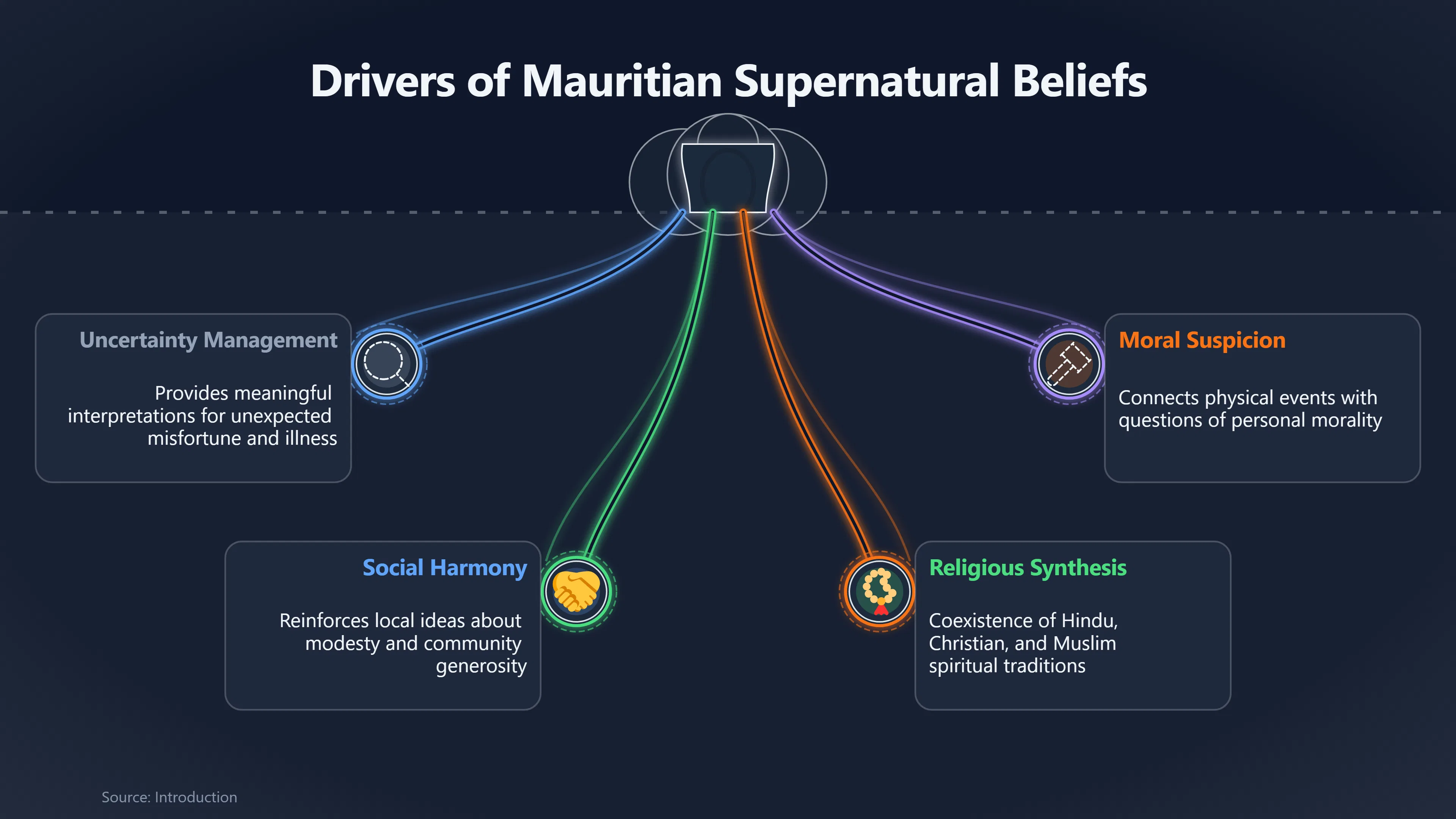
Belief in supernatural harm has persisted in Mauritius not because the island has experienced a single nationwide witch panic, but because magical explanations continue to provide many people with a meaningful way to interpret uncertainty, damaged relationships and unexpected misfortune. In a society shaped by migration, religious diversity and overlapping healing traditions, unexplained illness, family conflict or sudden bad luck may be understood through both natural and supernatural lenses at the same time. Recent research suggests these beliefs are not random relics of the past. Instead, they often reflect concerns about envy, morality, trust and social relationships, making supernatural blame a mechanism for explaining events that otherwise seem unfair or difficult to understand.[bura.brunel.ac.uk]bura.brunel.ac.ukAugust 28, 2024…
Unlike dramatic historical witch hunts elsewhere, Mauritian beliefs usually operate in everyday life rather than through large-scale persecution. They may influence how people interpret illness, decide whom to trust, seek spiritual assistance or judge another person’s behaviour. That makes them an important part of understanding why rumours of magical harm remain persuasive even in a modern, medically advanced society.
Religious diversity encourages shared spiritual explanations
Mauritius is one of the world’s most religiously diverse countries. Hindu, Christian and Muslim communities form the largest religious traditions, while smaller communities and people of mixed heritage have contributed additional beliefs about spirits, ancestors, blessings and harmful supernatural forces over several centuries.
Rather than remaining isolated within individual communities, these traditions have interacted since the colonial period. Plantation life, urban neighbourhoods and everyday social contact encouraged the exchange of healing practices, protective rituals and ideas about invisible causes of suffering. As a result, beliefs about supernatural harm are not confined neatly to one religion or ethnic group. People may simultaneously accept medical treatment while also believing that prayer, ritual or spiritual intervention is necessary to address the deeper cause of an illness or misfortune.[bura.brunel.ac.uk]bura.brunel.ac.ukAugust 28, 2024…
This coexistence is important. Supernatural explanations generally supplement rather than replace ordinary reasoning. Someone may visit a doctor for physical symptoms while also consulting a religious leader or traditional healer if they believe jealousy, a curse or spiritual imbalance contributed to the problem.
Illness, envy and moral suspicion
One of the strongest recent findings from research in Mauritius is that supernatural blame becomes more persuasive when ordinary explanations feel incomplete.
Experiments involving hundreds of Mauritian participants found several consistent patterns:
- Illnesses with uncertain causes attracted more supernatural explanations than illnesses with clear medical causes.
- When a person was known to have behaved immorally, participants became more willing to interpret later misfortune as having a supernatural cause.
- Once participants accepted a supernatural explanation, they were also more likely to believe that a supernatural remedy was required alongside conventional treatment.[bura.brunel.ac.uk]bura.brunel.ac.ukAugust 28, 2024…
These findings help explain why accusations of magical harm often arise after puzzling events rather than predictable ones. A serious illness without an obvious diagnosis, repeated family tragedies or unexpected financial collapse naturally invite questions about why one particular person suffered while others did not.
Instead of treating these beliefs as simple ignorance, researchers argue that they represent attempts to connect physical events with moral and social relationships. The question becomes not only “What happened?” but also “Why did this happen to this person now?”
Why envy is such a powerful explanation
Modern anthropological research in Mauritius identifies envy as one of the central mechanisms behind supernatural blame.
Across two large studies, researchers found that participants strongly associated witchcraft with jealousy and resentment. People who appeared excessively envious or motivated by self-interest were considered more likely to engage in harmful supernatural practices. Participants also judged such individuals more negatively and believed accusations of witchcraft damaged their social reputation.[Springer Nature Link]link.springer.comSpringer Nature LinkWitchcraft, Envy, and Norm Enforcement in Mauritius | Human Nature | Springer Nature Link…
The studies suggest that beliefs about witchcraft perform a social function by discouraging behaviour likely to provoke envy, including:
- excessive boasting;
- conspicuous displays of wealth;
- showing little concern for neighbours or relatives;
- pursuing personal success while ignoring community expectations.
Rather than simply expressing fear of magic, these beliefs reinforce local ideas about modesty, generosity and maintaining harmonious relationships. Someone who appears too successful without sharing their good fortune may become vulnerable to suspicion, even if no evidence of wrongdoing exists.
When supernatural blame shapes everyday behaviour
Belief in magical harm can influence behaviour long before anyone openly accuses another person.
People who worry about attracting envy may deliberately avoid drawing attention to promotions, business success or expensive purchases. Families experiencing repeated problems may quietly seek religious advice before discussing their difficulties publicly. Rumours about curses or harmful rituals can circulate informally within neighbourhoods without ever becoming criminal accusations.
This kind of supernatural blame often serves practical psychological purposes:
- it provides an explanation when events appear random;
- it restores a sense that misfortune has an understandable cause;
- it identifies social relationships that may require repair;
- it offers actions—such as prayer or ritual—that give people a feeling of control.
Research suggests these mechanisms are especially attractive when uncertainty is high. Supernatural explanations become one way of reducing anxiety created by unanswered questions.[bura.brunel.ac.uk]bura.brunel.ac.ukAugust 28, 2024…
When belief protects behaviour—and when it harms reputations
The same beliefs can produce both beneficial and harmful social effects.
On one hand, fear of attracting envy may encourage generosity, modesty and cooperation. If people believe arrogance or selfishness risks supernatural retaliation, those beliefs can reinforce community expectations about respectful behaviour. Researchers argue that this helps explain why witchcraft beliefs have survived despite modern education and healthcare: they continue to perform social functions beyond explaining disease alone.[Springer Nature Link]link.springer.comSpringer Nature LinkWitchcraft, Envy, and Norm Enforcement in Mauritius | Human Nature | Springer Nature Link…
On the other hand, supernatural blame can damage innocent people.
When unexplained events are attributed to magical attack, suspicion may fall upon neighbours, relatives or socially isolated individuals despite the absence of evidence. Reputations can suffer through rumour rather than formal accusation. Personal conflicts may become harder to resolve because disagreements are interpreted as evidence of hidden supernatural hostility instead of ordinary human disputes.
For this reason, historians and psychologists caution against treating every allegation of magical harm as evidence of actual occult practice. The accusation itself often reveals more about social tensions, fear and uncertainty than about any demonstrable supernatural event.
Why these beliefs remain culturally important
The persistence of supernatural blame in Mauritius is best understood as the product of several overlapping influences rather than a simple survival of ancient superstition.
Modern research indicates that these beliefs continue because they:
- provide explanations for difficult or uncertain experiences;
- connect misfortune with questions of morality and relationships;
- reinforce community expectations about envy and social harmony;
- coexist comfortably with mainstream religious belief and modern medicine rather than completely replacing either;
- offer practical ways for people to respond emotionally to events that otherwise seem random or unjust.[bura.brunel.ac.uk]bura.brunel.ac.ukAugust 28, 2024…
Seen in this light, supernatural blame is less about rejecting science than about answering different kinds of questions. Medicine may explain how an illness occurred, but supernatural belief seeks to explain why it happened to a particular person within a particular web of family, friendship and community relationships. That distinction helps explain why such beliefs have remained resilient across generations in Mauritius, even as the country’s healthcare, education and scientific knowledge have expanded.
Amazon book picks
Further Reading
Books and field guides related to Why Unexplained Misfortune Becomes Magical Blame. Use these as the next step if you want deeper reading beyond the article.

The Varieties of Religious Experience
Foundational work on religious belief and experience.

Folk Devils and Moral Panics the Creation of the Mods and Roc...
First published 1972. Subjects: Youth, great britain, Deviant behavior, Case studies, Subculture, Young adults.
Endnotes
1.
Source: bura.brunel.ac.uk
Link:https://bura.brunel.ac.uk/handle/2438/29881
Source snippet
August 28, 2024...
Published: August 28, 2024
2.
Source: link.springer.com
Link:https://link.springer.com/article/10.1007/s12110-024-09484-4
Source snippet
Springer Nature LinkWitchcraft, Envy, and Norm Enforcement in Mauritius | Human Nature | Springer Nature Link...
3.
Source: bura.brunel.ac.uk
Link:https://bura.brunel.ac.uk/handle/2438/30472
Source snippet
University Research Archive: Witchcraft, Envy, and Norm Enforcement in MauritiusJanuary 22, 2025 — Please use this identifier to cite or...
Published: January 22, 2025
4.
Source: bura.brunel.ac.uk
Link:https://bura.brunel.ac.uk/handle/2438/30472?mode=full
Source snippet
University Research Archive: Witchcraft, Envy, and Norm Enforcement in MauritiusJanuary 22, 2025 — Please use this identifier to cite or...
Published: January 22, 2025
Additional References
5.
Source: pmc.ncbi.nlm.nih.gov
Title: PMCWitchcraft, Envy, and Norm Enforcement in Mauritius
Link:https://pmc.ncbi.nlm.nih.gov/articles/PMC11836218/
Source snippet
2025 Jan 22;35(4):347–381. doi: 10.1007/s12110-024-09484-4 WITCHCRAFT, ENVY, AND NORM ENFORCEMENT IN MAURITIUS Aiyana K Willard AIYANA K...
6.
Source: researchgate.net
Title: (PDF) Witchcraft, Envy, and Norm Enforcement in Mauritius
Link:https://www.researchgate.net/publication/388275087_Witchcraft_Envy_and_Norm_Enforcement_in_Mauritius
Source snippet
January 22, 2025 — Article PDF Available WITCHCRAFT, ENVY, AND NORM ENFORCEMENT IN MAURITIUS * January 2025 * Human Nature 35(4):347-381...
Published: January 22, 2025
7.
Source: youtube.com
Link:https://www.youtube.com/watch?v=O62jWdJYa1k
Source snippet
Anthropology of Witchcraft with Prof Tanya Luhrmann...
8.
Source: youtube.com
Title: Anthropology of Witchcraft with Prof Tanya Luhrmann
Link:https://www.youtube.com/watch?v=4GnXnIZGrqM
Source snippet
How Rational Minds Embrace Magic and Witchcraft...
9.
Source: philpapers.org
Link:https://philpapers.org/rec/WILWEA-2
10.
Source: muni.cz
Link:https://www.muni.cz/en/research/publications/2533000
11.
Source: muni.cz
Link:https://www.muni.cz/en/research/publications/1778545
12.
Source: tandfonline.com
Link:https://www.tandfonline.com/doi/abs/10.1080/2153599X.2024.2363748
13.
Source: muni.cz
Link:https://www.muni.cz/en/research/publications/2471663
14.
Source: muni.cz
Link:https://www.muni.cz/vyzkum/publikace/2471663
Topic Tree