When Belief Became Power and Danger in Laos
Laos has no well-documented equivalent of Europe’s great witch trials or the twentieth-century Western “satanic panic”.
Page outline Jump by section
Introduction
These episodes should not be bundled together as “mass hysteria”. Some were organised resistance movements with religious language; some involved genuine armed conflict; others were local persecution driven by fear, misfortune and damaged relationships. Modern claims about religious “sects” may also reflect state security concerns rather than evidence of a destructive cult. The common thread is the power of belief to interpret crisis: explaining disease, inequality, colonial disruption, ethnic marginalisation or sudden religious change when ordinary institutions seemed unable to do so.
When holy men promised a transformed world
The clearest early examples come from southern Laos at the turn of the twentieth century. French colonial expansion disrupted older political arrangements, imposed new taxes and labour demands, and weakened the authority of local rulers. In this unsettled landscape, several charismatic “holy men” claimed exceptional spiritual powers and promised a dramatic reversal of the existing order.
The movement commonly called the Holy Man’s Rebellion spread through southern Laos and north-eastern Siam, now Thailand, from around 1901. It crossed today’s national borders because communities, trade routes and political loyalties already crossed the Mekong. Rumours announced that a new age was approaching, that unjust rulers would fall and that spiritually powerful leaders could protect their followers. Some versions reportedly included miraculous transformations, invulnerability or the arrival of a righteous king.[thesiamsociety.org]thesiamsociety.orgJSS 062 1e Murdoch 1901to1902HolyMansRebellionTHE 1901-1902 "HOLY MAN'S" REBELLIONApril 22, 2012 — by JB Murdoch · 1967 · Cited by 100 — The "Holy Man's" I uprising of 1901-1902 was a…
Ong Keo, an Alak leader from the southern highlands, became one of the movement’s central figures. After French forces suppressed the initial uprisings, resistance continued under Ong Keo and later Ong Kommadam. It survived far longer than a brief outbreak of religious excitement: armed opposition in the Bolaven Plateau region continued, in changing forms, into the 1930s.[LUANG PRABANG CULTURE]luangprabangculture.comLUANG PRABANG CULTUREmillenarian movementsJanuary 22, 2023 — This movement was led by another holy man-known as Ong Khao, probably…
Calling this merely a “cult revolt” would obscure its political substance. Participants were responding to taxation, forced labour, loss of land and authority, ethnic hierarchy and colonial violence. Ian Baird’s research also argues that members of the former Champassak royal establishment may have helped or encouraged parts of the movement, complicating the older picture of a spontaneous uprising by supposedly credulous villagers. Religious expectation, elite manoeuvring and anti-colonial resistance were intertwined.[ResearchGate]researchgate.netResearch Gate(PDF) Millenarian Movements in Southern Laos and NorthResearchGate(PDF) Millenarian Movements in Southern Laos and North…June 1, 2013 — Interrelated holy men millenarian movements destabil…
The French treated miraculous claims as evidence of irrationality or manipulation. Yet promises of supernatural protection made sense within a world in which political legitimacy, moral virtue and spiritual potency were not sharply separated. Belief also solved a practical problem for rebels: it could unite scattered communities speaking different languages and facing a militarily stronger state.
The resulting harm was substantial. Colonial troops and their regional allies killed, captured and displaced participants, while some rebel forces attacked settlements and rival communities. The movement therefore cannot be romanticised as entirely peaceful liberation. Nor should its religious language be used to dismiss it as collective madness. It was a violent struggle in which prophecies supplied both hope and authority.

Pa Chay and the recurring Hmong deliverer
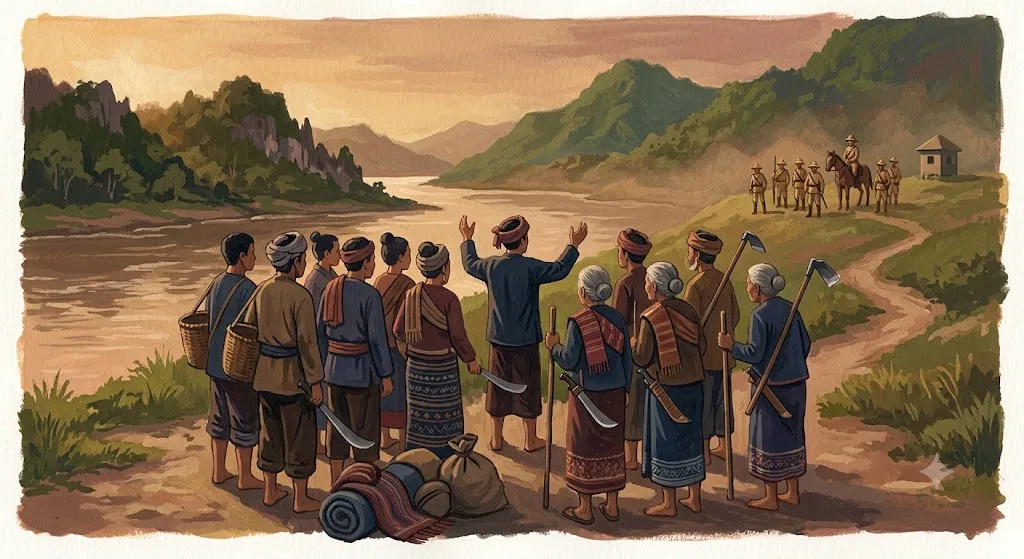
A second major tradition of prophetic mobilisation developed among Hmong communities in the northern highlands. The best-known historical example is the rebellion led by Pa Chay between 1918 and 1921, extending across northern Laos and what was then French Tonkin.
Pa Chay presented himself as a leader with extraordinary powers at a time when many Hmong communities faced heavy opium taxation, exploitation by intermediaries and intrusive colonial administration. Followers understood him not simply as a military commander but as a figure capable of restoring justice and Hmong autonomy. French and allied forces eventually defeated the rebellion and killed him in Laos.[Cambridge University Press & Assessment]cambridge.orgCambridge University Press & AssessmentOf Grasshoppers, Caterpillars, and Beans: A Historical…by N Tapp · 2015 · Cited by 15 — The amb…
Accounts of Pa Chay illustrate a recurring problem in the historical record. Colonial officials tended to describe prophetic leaders as sorcerers, fanatics or impostors. Hmong oral traditions could instead remember them as divinely appointed rescuers. Neither frame is neutral. Official records were produced by the government trying to defeat the movement, while later heroic memories could simplify internal divisions or violence committed by rebels.
Scholars use “millenarianism” for movements anticipating a sudden, fundamental transformation of the world. The word does not necessarily mean that followers expected the literal end of the planet. In Hmong cases, the promised change might be the arrival of a just king, the recovery of political sovereignty, freedom from taxation, supernatural protection or the restoration of a lost moral order.
Nicholas Tapp argued that Hmong messianic themes repeatedly expressed contradictions in social life: dispersed clans imagined unity; politically subordinated communities imagined sovereign leadership; and people living under stronger states pictured a future in which the balance of power would be overturned. More recent research emphasises that these movements did not simply vanish with colonialism. Prophetic politics adapted to war, migration, Christianity, refugee life and modern communication.[thesiamsociety.org]thesiamsociety.orgA CONSIDERATION OF SOME MESSIANIC MYTHSA CONSIDERATION OF SOME MESSIANIC MYTHS
This history matters especially because Hmong religious mobilisation can be confused with Hmong political resistance. During and after the conflicts of the 1960s and 1970s, some armed groups used the title Chao Fa, associated with ideas of sacred or heavenly authority. Their activities belonged partly to the continuing aftermath of the Lao civil war, not simply to a new religious movement. Political opponents, security forces and outside commentators could nevertheless emphasise prophetic language to portray resistance as fanatical or detached from reality.[garyyialee]garyyialee.comtopical hmong rebellion in laostopical hmong rebellion in laos
The fairest interpretation is therefore neither that Hmong prophetic movements were irrational outbreaks nor that every reported miracle claim was merely a disguise for politics. Religious conviction and material grievance reinforced one another. Belief offered an explanation for suffering, a source of discipline and a vision of collective survival. It could inspire courage, but it could also encourage disastrous confidence against superior forces.
When illness becomes an accusation
The most recognisable Lao parallel to a witch panic concerns belief in a ravenous possessing spirit associated with sickness, wasting and death. In affected communities, a person suspected of harbouring such a spirit may be blamed when neighbours fall ill or unexplained misfortune accumulates.
These accusations are not equivalent to the centrally organised witch prosecutions of early modern Europe. Laos has no comparable national legal machinery devoted to hunting witches. The process is generally local: illness or death produces suspicion; rumours gather around someone already involved in a dispute or regarded as socially difficult; divination or ritual consultation may confirm the fear; and community pressure can lead to humiliation, ritual treatment or expulsion.
Anthropologist Ian Baird’s study of Nakasang in Champasak Province shows the human consequences. People accused in communities across Laos, and sometimes in neighbouring Cambodia, have travelled or been driven to Nakasang and nearby villages because the area is known for accepting them. Some have lost homes, land, relationships and social standing despite the absence of evidence that they caused anyone’s illness.[englishkyoto-seas.org]englishkyoto-seas.orgVol. 13, No. 1, Ian G. BairdVol. 13, No. 1, Ian G. Baird
The accusation is powerful because it can absorb several kinds of uncertainty at once. A mysterious illness receives an explanation. A tense relationship acquires a moral narrative. A community experiencing several deaths can identify a removable source of danger. Once respected neighbours agree that a particular person is responsible, dissent becomes difficult: defending the accused may itself appear suspicious.
Baird cautions against treating the belief as a survival from an unchanging, “primitive” past. Accusations respond to contemporary pressures, including migration, competition over resources, widening economic differences and changing village authority. They may intensify when traditional forms of mediation weaken or when illness remains medically unexplained.[englishkyoto-seas.org]englishkyoto-seas.orgVol. 13, No. 1, Ian G. BairdVol. 13, No. 1, Ian G. Baird
Reports of possession rituals can look spectacular to outsiders, encouraging sensational descriptions of “demonic Laos”. The central social fact, however, is not whether an observer believes in spirits. It is that an accusation can isolate a real person and redistribute blame, property and belonging. A humane account must keep the accused person’s vulnerability in view rather than treating the episode as colourful folklore.[South China Morning Post]scmp.comSouth China Morning Post Demonic possession in LaosSouth China Morning Post Demonic possession in Laos
Nakasang also complicates the standard witch-panic story. It functions not only as a destination for outcasts but as a place where ritual reintegration is possible. Rather than simply punishing accused people, local specialists may attempt to remove the feared condition and enable a new social life. That response still accepts the underlying supernatural explanation, but it can reduce the harsher outcome of permanent exclusion.
New religions and the fear of hidden threats
Modern Laos is officially governed by a one-party socialist state. Recognised religious activity is regulated, and local authorities have sometimes regarded unregistered gatherings or rapid conversion as potential threats to unity. This creates another form of collective fear: not a popular witch hunt, but a security narrative in which unfamiliar belief is associated with foreign influence, social division or political disloyalty.
Minority Christians, particularly members of ethnic communities in rural districts, have repeatedly reported pressure to renounce their faith. US State Department religious-freedom reports have recorded threats of village expulsion, obstruction of worship, detention and demands that converts sign statements abandoning Christianity. The severity and enforcement have varied considerably by province and locality.[State Department]2021-2025.state.govOpen source on state.gov.
Village conflict is not always imposed from above. Conversion may disrupt ceremonies that households are expected to support, including rituals intended to protect the whole settlement. When converts refuse to participate, neighbours may believe that communal safety has been weakened. A dispute that outsiders describe as religious persecution may therefore combine official pressure, family conflict, economic obligations and sincere fear that neglected spirits will bring illness or crop failure.
That context explains the fear but does not excuse coercion. Expelling families, confiscating property or detaining people for peaceful worship turns communal anxiety into persecution. It also demonstrates why the word “cult” is dangerous in this setting. A small, unfamiliar or foreign-connected congregation is not necessarily abusive, fraudulent or apocalyptic. Labelling it a sect can provide a vague justification for control without establishing that it has harmed anyone.
Hmong Christians face an additional burden because religion can become entangled with the political memory of the “Secret War”, when Hmong forces allied with the United States fought communist forces. Suspicion of Christian activity may therefore draw on older assumptions about foreign allegiance. Religious difference, ethnic identity and unresolved wartime politics become mutually reinforcing.[Global Human Rights Defence]ghrd.orgGlobal Human Rights Defence Ethnic and Religious Persecution in Laos: SystematicGlobal Human Rights Defence Ethnic and Religious Persecution in Laos: Systematic
Reports from advocacy organisations and foreign governments require careful reading. Laos has restricted independent journalism and research access, making some incidents difficult to verify in detail. Advocacy sources may also frame events in strongly political terms. Nevertheless, the recurrence of similar allegations over many years, across official reports and testimony from religious organisations, supports the conclusion that coercive local campaigns have been a persistent problem rather than a single invented scare.[U.S. Department of State]2009-2017.state.govU.S. Department of State LaosU.S. Department of State Laos
What Laos does not show
There is little reliable evidence for a nationally significant Lao epidemic of mass fainting, contagious laughing, school possession or unexplained bodily symptoms comparable with well-studied mass psychogenic illness cases elsewhere. Individual stories may circulate locally, but they have not produced a robust public record that would justify presenting Laos as a major example of that phenomenon.
This absence is important. Poor documentation should not be filled with copied regional folklore or stories from Thailand, Cambodia or Vietnam. Shared religious traditions cross borders, but events in neighbouring countries are not automatically Lao cases.
The same caution applies to sensational claims about secret cults. Laos’s restricted media environment makes rumours difficult to test, while official descriptions may merge unregistered religion, separatism and criminality. A responsible account should ask several questions before accepting the label:
- Was the group accused of specific coercion or violence, or merely described as strange and unauthorised?
- Did miraculous or apocalyptic beliefs actually motivate events, or were they added by hostile officials and later storytellers?
- Are accounts based on contemporary documents, oral memory or repetition from a single source?
- Was the episode primarily religious, or was religion one language through which land, taxation, ethnicity and political power were contested?
These distinctions protect both accuracy and people. They prevent anti-colonial movements from being reduced to superstition, while also avoiding romantic portrayals that overlook violence. They recognise the seriousness of spirit accusations without mocking the worldview in which they occur. And they separate legitimate concern about harmful organisations from the persecution of minorities simply because their beliefs are unfamiliar.

Why these histories still matter
Laos’s history of collective belief is largely a history of communities under pressure. Prophetic leaders emerged where colonial taxation and political subordination made ordinary reform seem impossible. Hmong messianic expectations repeatedly imagined unity and sovereignty for a dispersed and marginalised people. Spirit accusations gave frightening illness a social cause, sometimes at devastating cost to the accused. Modern religious scares have converted local discomfort and state insecurity into pressure against minority believers.
Across these cases, belief did not spread simply because people lacked education or rational judgement. It spread because it connected private suffering to a larger explanation. It told people why the world had become unjust, who was responsible and what action might restore order. Stories travelled through kinship, ritual specialists, traders, rebel networks and political organisations long before modern mass media became important.
Authorities also helped shape each episode. French officials classified prophetic resistance as fanaticism while using overwhelming force against it. Village leaders could validate rumours and make exclusion collective. The modern state has sometimes treated religious independence as a political danger, giving local hostility an official vocabulary of security and national unity.
The enduring lesson is that “panic”, “cult” and “hysteria” are not interchangeable explanations. They are labels with political consequences. In Laos, the most revealing question is rarely whether an unusual belief was simply true or false. It is how that belief organised fear, offered hope, assigned blame and altered the balance of power—and who suffered when one interpretation became impossible to challenge.
Amazon book picks
Further Reading
Books and field guides related to When Belief Became Power and Danger in Laos. Use these as the next step if you want deeper reading beyond the article.

The Spirit Catches You and You Fall Down
First published 1997. Subjects: Asian Americans, Attitude, Attitude of Health Personnel, Child, Communication.

The Art of Not Being Governed
First published 2009. Subjects: Politics and government, Rural conditions, Peasantry, Ethnology, Political activity.
Weapons of the weak
First published 1985. Subjects: Social conflict, Passive resistance, Peasantry, Political activity, Social conditions.
A history of Laos
First published 1997. Subjects: History, Laos, history, Asian studies, Political science.
Endnotes
1.
Source: thesiamsociety.org
Title: JSS 062 1e Murdoch 1901to1902HolyMansRebellion
Link:https://thesiamsociety.org/wp-content/uploads/1974/03/JSS_062_1e_Murdoch_1901to1902HolyMansRebellion.pdf
Source snippet
THE 1901-1902 "HOLY MAN'S" REBELLIONApril 22, 2012 — by JB Murdoch · 1967 · Cited by 100 — The "Holy Man's" I uprising of 1901-1902 was a...
Published: April 22, 2012
2.
Source: researchgate.net
Title: Research Gate(PDF) Millenarian Movements in Southern Laos and North
Link:https://www.researchgate.net/publication/256841027_Millenarian_Movements_in_Southern_Laos_and_North_Eastern_Siam_Thailand_at_the_Turn_of_the_Twentieth_Century_Reconsidering_the_Involvement_of_the_Champassak_Royal_House
Source snippet
ResearchGate(PDF) Millenarian Movements in Southern Laos and North...June 1, 2013 — Interrelated holy men millenarian movements destabil...
Published: June 1, 2013
3.
Source: cambridge.org
Link:https://www.cambridge.org/core/journals/trans-trans-regional-and-national-studies-of-southeast-asia/article/of-grasshoppers-caterpillars-and-beans-a-historical-perspective-on-hmong-messianism/731242F699217BACF50F4113C788F556
Source snippet
Cambridge University Press & AssessmentOf Grasshoppers, Caterpillars, and Beans: A Historical...by N Tapp · 2015 · Cited by 15 — The amb...
4.
Source: cambridge.org
Link:https://www.cambridge.org/core/journals/journal-of-the-royal-asiatic-society/article/is-this-pa-chay-vue-a-study-in-three-frames/6249A1D5507E3823D1F5C0E7AA88A1F5
5.
Source: cambridge.org
Link:https://www.cambridge.org/core/journals/modern-asian-studies/article/cultivating-subjects-opium-and-rule-in-postcolonial-vietnam/6179DD3E7F977B76868617CBB2155984
6.
Source: thesiamsociety.org
Title: A CONSIDERATION OF SOME MESSIANIC MYTHS
Link:https://thesiamsociety.org/wp-content/uploads/1982/03/JSS_070_0l_Tapp_RelevanceOfTelephoneDirectoriesToLinageBasedSocietyHmong.pdf
7.
Source: core-cms.cambridgecore.org
Link:https://core-cms.cambridgecore.org/core/services/aop-cambridge-core/content/view/731242F699217BACF50F4113C788F556/S2051364X15000113a.pdf/of_grasshoppers_caterpillars_and_beans_a_historical_perspective_on_hmong_messianism.pdf
8.
Source: garyyialee.com
Title: topical hmong rebellion in laos
Link:https://www.garyyialee.com/topical-hmong-rebellion-in-laos
9.
Source: englishkyoto-seas.org
Title: Vol. 13, No. 1, Ian G. Baird
Link:https://englishkyoto-seas.org/2024/04/vol-13-no-1-ian-g-baird/
10.
Source: 2021-2025.state.gov
Link:https://2021-2025.state.gov/reports/2021-report-on-international-religious-freedom/laos/
11.
Source: 2021-2025.state.gov
Link:https://2021-2025.state.gov/reports/2022-report-on-international-religious-freedom/laos/
12.
Source: 2021-2025.state.gov
Link:https://2021-2025.state.gov/reports/2016-report-on-international-religious-freedom/laos/
13.
Source: 2009-2017.state.gov
Title: U.S. Department of State Laos
Link:https://2009-2017.state.gov/j/drl/rls/irf/2014/eap/238308.htm
14.
Source: 2009-2017.state.gov
Title: U.S. Department of State Laos
Link:https://2009-2017.state.gov/j/drl/rls/irf/2004/35404.htm
15.
Source: cambridge.org
Link:https://www.cambridge.org/core/journals/trans-trans-regional-and-national-studies-of-southeast-asia/article/enemy-of-my-enemy-is-my-friend-transnational-ethnic-khmu-antilao-pdr-insurgents-during-the-late-cold-war/A203CA5108F0A645A665D6AC4F5239E6
16.
Source: state.gov
Title: LAOS 2018 INTERNATIONAL RELIGIOUS FREEDOM REPORT
Link:https://www.state.gov/wp-content/uploads/2019/05/LAOS-2018-INTERNATIONAL-RELIGIOUS-FREEDOM-REPORT.pdf
17.
Source: state.gov
Title: Laos 2
Link:https://www.state.gov/wp-content/uploads/2019/01/Laos-2.pdf
18.
Source: 2009-2017.state.gov
Link:https://2009-2017.state.gov/documents/organization/256329.pdf
19.
Source: 2009-2017.state.gov
Link:https://2009-2017.state.gov/documents/organization/222355.pdf
20.
Source: 2009-2017.state.gov
Link:https://2009-2017.state.gov/documents/organization/192851.pdf
21.
Source: researchgate.net
Link:https://www.researchgate.net/publication/339714765_History_Memory_and_Territorial_Cults_in_the_Highlands_of_Laos_The_Past_Inside_the_Present
22.
Source: researchgate.net
Link:https://www.researchgate.net/figure/Accused-Phi-Pop-Sit-under-the-Ta-Ho-in-Nakasang-Village-Awaiting-the-Healing-Ritual_fig3_386370201
23.
Source: history.com
Title: what was satanic panic 1980s
Link:https://www.history.com/articles/what-was-satanic-panic-1980s
24.
Source: englishkyoto-seas.org
Title: SEAS1301 all
Link:https://englishkyoto-seas.org/wp-content/uploads/SEAS1301_all.pdf
25.
Source: luangprabangculture.com
Link:https://www.luangprabangculture.com/uploads/1/8/3/0/18306261/millenarian_movements_in_laos_1895-1936.pdf
Source snippet
LUANG PRABANG CULTUREmillenarian movementsJanuary 22, 2023 — This movement was led by another holy man-known as Ong Khao, probably...
Published: January 22, 2023
26.
Source: scmp.com
Title: South China Morning Post Demonic possession in Laos
Link:https://www.scmp.com/magazines/post-magazine/long-reads/article/2103274/demonic-possession-laos-it-real-or-pretext
27.
Source: ghrd.org
Title: Global Human Rights Defence Ethnic and Religious Persecution in Laos: Systematic
Link:https://www.ghrd.org/ethnic-and-religious-persecution-in-laos-systematic-discrimination-against-hmong-and-christian-minorities/
28.
Source: Wikipedia
Title: Mass psychogenic illness
Link:https://en.wikipedia.org/wiki/Mass_psychogenic_illness
29.
Source: ebsco.com
Link:https://www.ebsco.com/research-starters/communication-and-mass-media/satanic-panic
30.
Source: jstage.jst.go.jp
Link:https://www.jstage.jst.go.jp/article/seas/13/1/13_109/_pdf
31.
Source: sajp.org.za
Link:https://sajp.org.za/index.php/sajp/article/view/1671/2648
Additional References
32.
Source: austriaca.at
Title: Ritual as a Means of Social Reproduction?
Link:https://austriaca.at/0xc1aa5572%200x002a7e9e.pdf
Source snippet
Comparisons in...... Laos was Ong Kaeo (Ong Keo), a member of the. Alak tribe from the village Ban Paktai, who initiated the “holy man's...
33.
Source: theisaanrecord.co
Title: the holy men rise and fall across borders
Link:https://theisaanrecord.co/2022/04/20/the-holy-men-rise-and-fall-across-borders/
Source snippet
เดอะอีสานเรคคอร์ดPART II: The Holy Men Rise and Fall Across Borders20 Apr 2022 — In this segment, Baird explains how the “holy men” of th...
34.
Source: uscirf.gov
Link:https://www.uscirf.gov/countries/vietnam
35.
Source: youtube.com
Title: Behind the Ritual: Meeting a traditional Hmong Shaman in Laos
Link:https://www.youtube.com/watch?v=O33ltrt3XKs
Source snippet
Phi Faa Healing Music Ritual of Thailand (Issan) and Laos...
36.
Source: youtube.com
Link:https://www.youtube.com/watch?v=p2UgD7Q7IkA
Source snippet
Behind the Ritual: Meeting a traditional Hmong Shaman in Laos...
37.
Source: academia.edu
Link:https://www.academia.edu/4544748/Millenarian_Movements_in_Southern_Laos_and_Northeastern_Siam_Thailand_at_the_Turn_of_the_Twentieth_Century_Reconsidering_the_Involvement_of_the_Champassak_Royal_House
Source snippet
In contrast to those...
38.
Source: academia.edu
Link:https://www.academia.edu/37969712/Millenarianism
39.
Source: academia.edu
Link:https://www.academia.edu/93030618/Folded_Persons_Shamans_Witchcraft_and_Wayward_Souls_in_Laos
40.
Source: amnesty.org
Link:https://www.amnesty.org/es/wp-content/uploads/2021/07/asa260032007en.pdf
41.
Source: fieldepidemiology.org
Link:https://fieldepidemiology.org/index.php/ajfe/article/download/7807/6435/21437
Topic Tree
Follow this branch
Related pages 192
- Antigua and Barbuda
- Argentina Belief Scares
- Azerbaijan Belief
- Bahrain Beliefs
- North Korea
- +187 more in sidebar