When Fear and Belief Took Hold in Mauritius
Mauritius does not have a well-documented national equivalent of the Salem witch trials, a medieval dancing plague or a famous school outbreak of mass psychogenic illness. Its history of contagious belief is quieter and more complicated.
Page outline Jump by section
Introduction
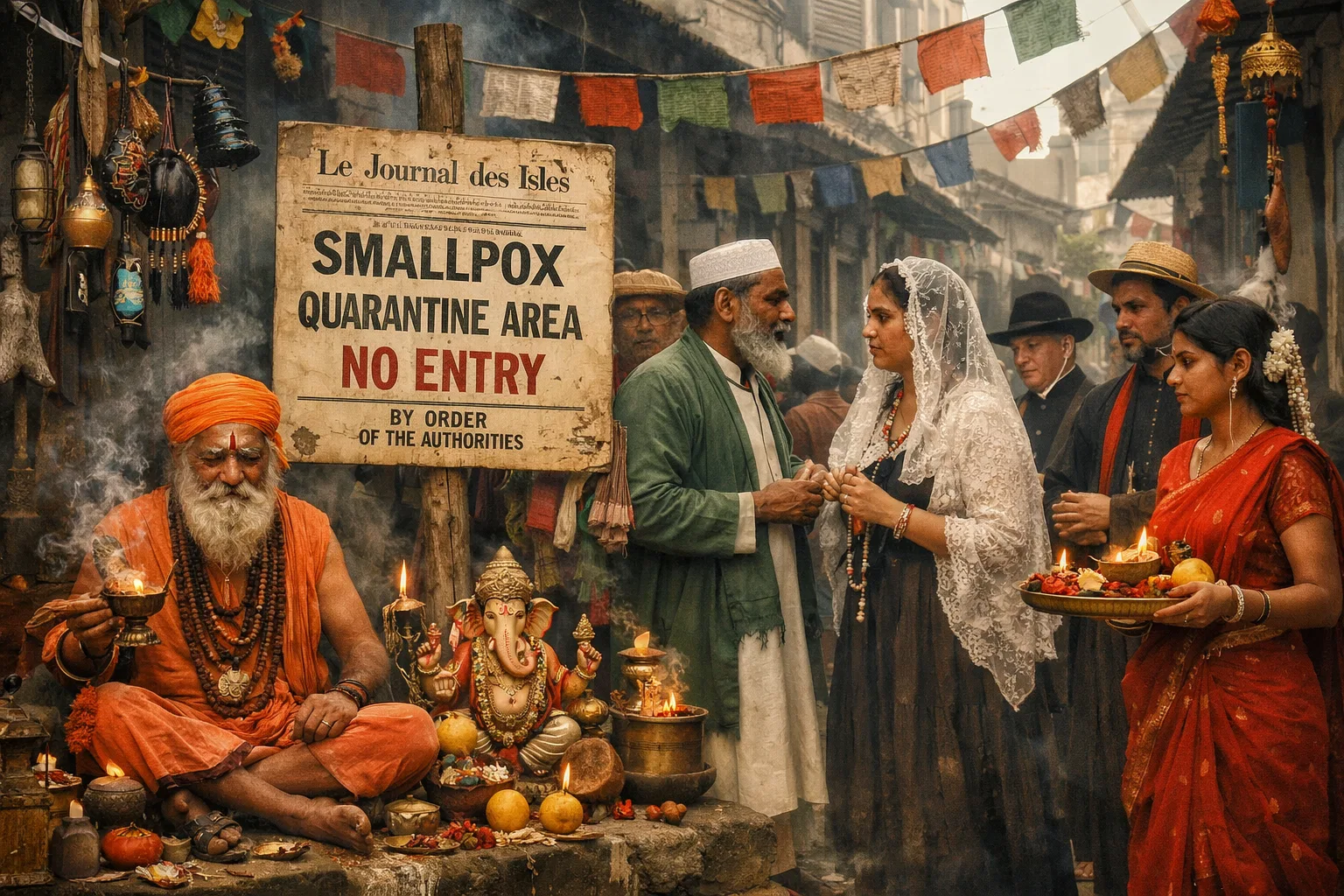
Three episodes reveal the pattern particularly clearly: the political and medical crisis surrounding smallpox in 1792; nineteenth-century reports of deaths attributed to sorcery; and the discovery of ten bodies in a house at Béchard Lane in 2004. None should simply be called “mass hysteria”. The smallpox threat was real, the nineteenth-century stories came through a colonial press inclined to exoticise local practices, and the exact circumstances of the Béchard Lane deaths remain uncertain. What connects them is the rapid construction of explanations under pressure: poison, witchcraft, hidden ritual, religious manipulation or collective suicide.
Mauritius therefore offers a useful warning against treating every strange or frightening event as proof of a cult or delusion. Its history is better understood as an interaction between genuine danger, inherited spiritual traditions, social mistrust, media storytelling and the search for a morally satisfying cause.
Why Mauritius produces distinctive stories of supernatural harm
Mauritius is exceptionally religiously diverse. The 2022 census recorded Hinduism, Christianity and Islam as the country’s three largest religious affiliations, while smaller religious communities and people without a stated affiliation form the remainder. Constitutional protections generally allow people to practise, change and propagate religion, although public recognition and state subsidies have historically favoured certain established communities.[humanists.international]fot.humanists.internationalFreedom of Thought Report MauritiusFreedom of Thought ReportMauritius - Freedom of Thought Report - Humanists International10 Jun 2025 — According to the 2022 census, at le…
This diversity emerged through conquest, slavery, indentured labour and migration from Africa, Madagascar, Europe, India and China. People arriving on the island brought medical knowledge, protective rites, beliefs about ancestors, divine punishment, spirit possession and magical attack. These traditions did not remain sealed within separate communities. They interacted on plantations, in towns and through healers whose clients might cross religious and ethnic boundaries.
Belief in harmful magic should not be mistaken for a continuous nationwide panic. Recent field research instead suggests that supernatural explanations coexist with ordinary medical and religious reasoning. In experimental studies conducted in Mauritius, participants were more inclined to consider witchcraft when an illness was difficult to explain, unusually severe or connected with a person believed to have behaved badly. Another study found that fear of envy and magical retaliation could discourage boasting, conspicuous displays of wealth and behaviour likely to provoke resentment.[brunel.ac.uk]bura.brunel.ac.ukIn a Mauritian sample, we examined how uncertainty around the cause of symptoms…Read more…
That finding changes how the subject should be approached. Witchcraft belief is not merely a collection of frightening stories. It can act as an informal language of blame and social control. An unexplained illness may be interpreted not only as a medical event but as evidence that a relationship has been damaged, an obligation neglected or another person’s jealousy aroused.
The consequences can be contradictory. Such beliefs may encourage modesty or caution, but accusations can also damage reputations and intensify suspicion. A person identified as a magical aggressor may be treated as dangerous even when there is no testable evidence against them. The important historical question is therefore not whether every believer accepted the same supernatural system. It is how particular explanations became persuasive at moments of uncertainty.
Smallpox in 1792: a real epidemic turned into a political struggle
In 1792, when Mauritius was still the French colony of Île de France, a slave ship arriving from South India introduced smallpox. The disease was not imaginary, and the resulting fear was entirely understandable. Smallpox could spread rapidly, kill large numbers of people and leave survivors scarred. Yet the epidemic also produced a dispute in which medical risk, revolutionary politics and slave ownership became inseparable.[nih.gov]pubmed.ncbi.nlm.nih.govSlavery, smallpox, and revolution: 1792 in Ile de France…by M Vaughan · 2000 · Cited by 18 — In 1792 a slave-ship arrived on the…
The proposed defence was inoculation, a procedure predating modern vaccination. Material from a smallpox patient was introduced into a healthy person to provoke what was hoped would be a milder infection and subsequent immunity. The technique could reduce the risk of death, but the inoculated person temporarily carried the disease and might transmit it. It was therefore both a preventive measure and a possible source of further contagion.
French colonists argued fiercely over who had the right to decide. Some slaveholders claimed the authority to inoculate enslaved people as a means of protecting valuable labour. Others objected that deliberately introducing infection endangered their own enslaved workers and neighbouring estates. The rhetoric of revolutionary citizenship and individual rights was being used in a society where enslaved people themselves possessed almost no recognised power over the treatment of their bodies.[PubMed]pubmed.ncbi.nlm.nih.govSlavery, smallpox, and revolution: 1792 in Ile de France…by M Vaughan · 2000 · Cited by 18 — In 1792 a slave-ship arrived on the…
Historian Megan Vaughan’s reconstruction of the crisis also warns against assuming that medicine moved in only one direction, from Europeans to supposedly superstitious subjects. Enslaved people arriving from Africa, Madagascar and India brought their own therapeutic knowledge, and forms of smallpox inoculation were already known in parts of Africa and Asia. The surviving archive, however, records colonial debate much more fully than the views of those who were inoculated, isolated or exposed.[OUP Academic]academic.oup.comOpen source on oup.com.
This episode belongs in a history of social scares because it shows how panic grows around a real threat. People were not collectively imagining smallpox. Rather, uncertainty about transmission and prevention magnified existing conflicts over property, authority and trust. The central fear was not simply “the disease”. It included fear of doctors, fear of other people’s medical decisions, fear of deliberate infection and fear that emergency measures would transfer power to rivals.
It also illustrates why the language of mass hysteria is often inadequate. A frightened population can circulate rumours or make poor decisions without its fear being irrational. In epidemic history, the more revealing question is usually which dangers were emphasised, which people were blamed and whose consent could be overridden in the name of public safety.
Witchcraft reports and colonial mythmaking
By the nineteenth century, newspaper reports were presenting Mauritius as a place where professional sorcerers flourished and clients from several social classes sought their services. An 1885 article, reproduced in the New Zealand press from a correspondent in Port Louis, claimed that hundreds of magical practitioners operated on the island and that belief extended beyond the poor or uneducated. Earlier reporting from 1872 referred to deaths allegedly caused through witchcraft and to public concern about such practices.[Papers Past]paperspast.natlib.govt.nzOpen source on govt.nz.
These reports are valuable, but they cannot be read as neutral surveys. Colonial newspapers often turned non-European healing, ritual and religion into stories of backwardness or danger. The image of a tropical colony filled with secretive sorcerers appealed to overseas readers and helped define European authority as rational and modern. Scholarship on colonial representations of witchcraft has shown how readily the subject became entangled with racial ideas about primitiveness and civilisation.[Oxford University Research Archive]ora.ox.ac.ukOpen source on ox.ac.uk.
The reported incidents nevertheless point to real forms of harm. A healer or ritual specialist might be consulted when conventional treatment had failed. Accusations could fall on a neighbour, relative or rival. People might undergo hazardous ceremonies or consume unknown substances. A death following treatment could then be explained as evidence either of successful magical attack or of a fraudulent practitioner’s violence.
What cannot safely be inferred is that nineteenth-century Mauritius experienced a single, coordinated witch panic comparable to the early modern European trials. The available evidence instead suggests scattered cases, persistent belief and sensational coverage. There is no strong record of a large judicial campaign in which the Mauritian authorities prosecuted waves of alleged witches.
This distinction matters because “witchcraft panic” can refer to very different processes:
- A supernatural interpretation: illness or misfortune is attributed to deliberate magical harm.
- A criminal case: someone accused of healing or sorcery is investigated after injury, poisoning or death.
- A moral campaign: clergy, officials or journalists portray magical practice as a widespread threat to social order.
- A persecution: alleged witches themselves become targets of organised violence or repeated prosecution.
- A colonial stereotype: diverse local customs are grouped together and presented as evidence of an irrational population.
Mauritian material most clearly supports the first three categories, with an additional need to account for colonial stereotyping. Treating every report as proof of mass delusion would repeat the assumptions of the sources rather than analyse them.
Modern research confirms continuity without implying that beliefs have remained unchanged since slavery. People may combine prayer, biomedical treatment and magical explanations rather than choosing one system exclusively. The suspected cause may also change as an illness develops. A common condition can be treated medically at first, while prolonged or mysterious suffering encourages consideration of a curse or divine intervention.[Taylor & Francis Online]tandfonline.comOpen source on tandfonline.com.
Béchard Lane and the rush to find a “cult”
On 27 August 2004, police entered a house in Béchard Lane, Saint-Paul, after investigating missing people. Inside they found ten bodies, including members of two families and several children or teenagers. The bodies were in an advanced state of decomposition, distributed through the two-storey property. The discovery shocked Mauritius and immediately produced questions about poisoning, murder, collective suicide and religious ritual.[lexpress.mu]lexpress.muRetour sur le lieux du crime | Béchard Lane, Saint-PaulRetour sur le lieux du crime | Béchard Lane, Saint-Paul
Early reporting emphasised religious books, meditation, spiritualism and special prayer meetings held at the property. Within days, investigators and newspapers were discussing an “international sect”. One line of inquiry focused on Eckankar, a spiritual movement founded in the United States, because at least one of the dead had previously been associated with its Mauritian organisation.[lexpress.mu]lexpress.muFirst indications point to an international sectFirst indications point to an international sect
The movement’s name therefore became attached to the deaths before a clear causal connection had been established. Membership or former membership in an unconventional religion is not evidence that the organisation ordered, encouraged or even knew about a death. The contemporary coverage demonstrates a familiar feature of cult scares: once unusual spiritual interests are discovered, they can become the master explanation around which every other fact is arranged.
Other details complicated the narrative. Investigators reportedly examined financial transactions, property dealings and possible connections to people outside the religious circle. Later retrospectives continued to describe uncertainty about whether the deaths were suicide, homicide or some mixture of coercion and voluntary action. The unlocked mystery became part of the case’s public identity.[lexpress.mu]lexpress.muDrame de St.-Paul: le lien avec Deelchand sous examenDrame de St.-Paul: le lien avec Deelchand sous examen
The label “collective suicide” has often been repeated, but repetition should not be confused with a conclusive reconstruction. A household containing decomposed bodies, religious material and locked doors can resemble well-known mass-death cases elsewhere. That resemblance encourages comparison with the Order of the Solar Temple, Jonestown or other notorious religious tragedies. Yet resemblance is not proof of a shared mechanism.
Béchard Lane is culturally important precisely because it shows how a cult narrative forms. Several elements reinforced one another:
- The scene was extraordinary. Ten deaths in one residence demanded an explanation proportionate to the horror of the discovery.
- The victims’ spiritual interests appeared unfamiliar. Meditation and esoteric reading were interpreted as clues rather than ordinary private practices.
- International precedents were readily available. Journalists could compare the case with earlier mass suicides attributed to high-control religious groups.
- The dead could not correct the story. With few surviving witnesses, speculation filled gaps left by forensic uncertainty.
- The word “sect” simplified a complicated inquiry. It offered motive, organisation and blame in a single term.
This does not mean that coercive influence was impossible. High-control groups can isolate members, demand obedience and exploit fear. It means that such a conclusion requires evidence of leadership, instruction, dependency and organised pressure. The presence of spiritual ideas alone does not supply it.
Moral panic, minority religion and the problem with labels
Mauritius generally protects religious freedom and contains numerous communities whose practices may be unfamiliar to one another. In this setting, the language used after a scandal matters. “Cult” can refer to a genuinely abusive organisation, but it is also frequently used as a hostile label for a small, foreign or unconventional religion. Religious-studies scholars therefore tend to prefer more descriptive terms such as new religious movement, spiritual association or high-control group, depending on the evidence.
A moral panic develops when a person, practice or group is presented as a threat to society and the scale, organisation or inevitability of the danger becomes exaggerated. The underlying concern need not be invented. Fraud, coercion and abuse can be real. The panic lies in the disproportionate expansion of a limited case into a general menace, particularly when media coverage, political claims and official action reinforce one another.
The reaction to Béchard Lane had several ingredients of a cult scare, but Mauritius did not subsequently establish a broad programme of repression against minority religions. This separates the episode from more sustained anti-cult campaigns in which governments create blacklists, raid communities or treat unorthodox belief as evidence of criminality.
The country’s broader experience also shows why supernatural belief and minority religion should not be treated as interchangeable. Witchcraft accusations usually concern alleged interpersonal harm: envy, a curse, unexplained sickness or retaliation. A cult allegation concerns the structure of a group: manipulation by a leader, isolation, financial exploitation or control over members. One may appear within the other, but they require different evidence.
Conflating them creates two risks. It may stigmatise harmless religious minorities, and it may distract attention from ordinary crimes. A suspicious death attributed too quickly to ritual might involve poisoning, domestic coercion, financial conflict or untreated illness. Conversely, dismissing every spiritual explanation as superstition can prevent authorities from understanding why witnesses acted as they did or why a harmful practitioner retained trust.
What is documented and what remains uncertain
The most responsible account of Mauritius’s history of contagious fear begins with the limits of the evidence.
Well documented: a smallpox epidemic reached Île de France in 1792 and provoked a politically charged conflict over inoculation, ownership and bodily authority. Nineteenth-century newspapers reported continued reliance on magical practitioners and several deaths associated with alleged witchcraft. Ten bodies were found at Béchard Lane in August 2004, and authorities initially pursued theories involving collective suicide and an international sect.[nih.gov]pubmed.ncbi.nlm.nih.govSlavery, smallpox, and revolution: 1792 in Ile de France…by M Vaughan · 2000 · Cited by 18 — In 1792 a slave-ship arrived on the…
Supported by modern research: beliefs in witchcraft and magical harm remain present in Mauritius and can shape interpretations of illness, envy, morality and trust. These beliefs operate alongside formal religion and biomedical care rather than forming a separate, uniform system.[tandfonline.com]tandfonline.comOpen source on tandfonline.com.
Not firmly demonstrated: a nationwide witch hunt, a classic documented outbreak of mass psychogenic illness, or proof that an organised religious movement directed the Béchard Lane deaths. The historical record is too fragmented, and in the 2004 case the public story developed faster than the available evidence.
This mixture of certainty and uncertainty is itself the central lesson. Mauritius’s most revealing panics did not arise because an entire population suddenly abandoned reason. They emerged when frightening events met older social tensions: slavery and citizenship during the smallpox crisis, inequality and interpersonal suspicion in witchcraft accusations, and anxiety about unfamiliar spirituality after Béchard Lane.

Why these stories still matter
Mauritius is often celebrated for sustaining a plural society in which several major religions share a small island. Its history of scares reveals the pressure hidden within that achievement. Close coexistence creates exchange and adaptation, but it can also make neighbours’ rites appear secretive, powerful or threatening. During illness or unexplained death, cultural difference can become a ready-made theory of causation.
The historical cases also show that panic is rarely a choice between truth and fantasy. Smallpox was real, but the political struggle around inoculation shaped how people feared it. Dangerous treatments may have existed, but colonial newspapers transformed scattered witchcraft cases into tales about an exotic population. Ten people genuinely died at Béchard Lane, but uncertainty encouraged a dramatic sect narrative before responsibility had been established.
For readers interested in cults and mass hysteria, Mauritius therefore offers a less spectacular but more useful history than a simple catalogue of strange beliefs. It demonstrates how collective fear is built from fragments of reality, how labels can outrun evidence and how explanations of misfortune reflect the structure of society. The enduring question is not merely why people believed in curses, hidden sects or ritual death. It is why those explanations felt more convincing than competing ones at a particular moment—and who benefited or suffered when they became the accepted story.
Amazon book picks
Further Reading
Books and field guides related to When Fear and Belief Took Hold in Mauritius. Use these as the next step if you want deeper reading beyond the article.
Folk Devils and Moral Panics the Creation of the Mods and Roc...
First published 1972. Subjects: Youth, great britain, Deviant behavior, Case studies, Subculture, Young adults.
Endnotes
1.
Source: state.gov
Title: 547499 MAURITIUS 2023 INTERNATIONAL RELIGIOUS FREEDOM REPORT
Link:https://www.state.gov/wp-content/uploads/2024/04/547499-MAURITIUS-2023-INTERNATIONAL-RELIGIOUS-FREEDOM-REPORT.pdf
Source snippet
State DepartmentMAURITIUS 2023 INTERNATIONAL RELIGIOUS...The constitution prohibits discrimination based on creed and provides for the r...
2.
Source: bura.brunel.ac.uk
Link:https://bura.brunel.ac.uk/handle/2438/29881
Source snippet
In a Mauritian sample, we examined how uncertainty around the cause of symptoms...Read more...
3.
Source: pmc.ncbi.nlm.nih.gov
Title: PMCWitchcraft, Envy, and Norm Enforcement in Mauritius
Link:https://pmc.ncbi.nlm.nih.gov/articles/PMC11836218/
Source snippet
by AK Willard · 2025 · Cited by 7 — We examine how witchcraft is believed to be caused by envy and how this belief can create and enfo...
4.
Source: academic.oup.com
Link:https://academic.oup.com/shm/article-abstract/13/3/411/1667865
5.
Source: academic.oup.com
Link:https://academic.oup.com/shm/article-pdf/13/3/411/9933174/411.pdf
6.
Source: lexpress.mu
Title: Retour sur le lieux du crime | Béchard Lane, Saint-Paul
Link:https://lexpress.mu/s/article/426354/retour-sur-lieux-crime-bechard-lane-saint-paul-dix-cadavres-decouverts-dans-maison
7.
Source: lexpress.mu
Title: il y 13 ans 29 aout 2004 suicide collectif saint paul
Link:https://lexpress.mu/s/article/315073/il-y-13-ans-29-aout-2004-suicide-collectif-saint-paul
8.
Source: lexpress.mu
Title: First indications point to an international sect
Link:https://lexpress.mu/s/article/first-indications-point-international-sect
9.
Source: lexpress.mu
Title: les causes du drame
Link:https://lexpress.mu/s/article/les-causes-du-drame
10.
Source: lexpress.mu
Title: drame de st paul l’enquête s’oriente vers la secte eckankar
Link:https://lexpress.mu/s/article/drame-de-st-paul-l%E2%80%99enqu%C3%AAte-s%E2%80%99oriente-vers-la-secte-eckankar
11.
Source: lexpress.mu
Title: eckankar présente depuis 14 ans
Link:https://lexpress.mu/s/article/eckankar-pr%C3%A9sente-depuis-14-ans
12.
Source: lexpress.mu
Title: Drame de St.-Paul: le lien avec Deelchand sous examen
Link:https://lexpress.mu/s/article/drame-de-st-paul-le-lien-avec-deelchand-sous-examen
13.
Source: state.gov
Link:https://www.state.gov/reports/2023-report-on-international-religious-freedom/mauritius
14.
Source: who.int
Title: history of smallpox vaccination
Link:https://www.who.int/news-room/spotlight/history-of-vaccination/history-of-smallpox-vaccination
15.
Source: lexpress.mu
Title: les enquêteurs sur les traces dune secte
Link:https://lexpress.mu/s/article/les-enqu%C3%AAteurs-sur-les-traces-dune-secte
16.
Source: lexpress.mu
Title: les mawooa s’interrogent sur les motivations des défunts
Link:https://lexpress.mu/article/les-mawooa-s%E2%80%99interrogent-sur-les-motivations-des-d%C3%A9funts
17.
Source: lexpress.mu
Title: deux arrestations relancent l’enquête
Link:https://lexpress.mu/s/article/deux-arrestations-relancent-l%E2%80%99enqu%C3%AAte
18.
Source: lexpress.mu
Title: “mon ex mari rajesh ne projetait pas de s’en aller”
Link:https://lexpress.mu/s/article/%E2%80%9Cmon-ex-mari-rajesh-ne-projetait-pas-de-s%E2%80%99en-aller%E2%80%9D
19.
Source: history.com
Title: mysterious illnesses mass hysteria
Link:https://www.history.com/articles/mysterious-illnesses-mass-hysteria
20.
Source: bura.brunel.ac.uk
Title: Full Text
Link:https://bura.brunel.ac.uk/bitstream/2438/29881/3/FullText.pdf
21.
Source: fot.humanists.international
Title: Freedom of Thought Report Mauritius
Link:https://fot.humanists.international/countries/africa-eastern-africa/mauritius/
Source snippet
Freedom of Thought ReportMauritius - Freedom of Thought Report - Humanists International10 Jun 2025 — According to the 2022 census, at le...
22.
Source: pubmed.ncbi.nlm.nih.gov
Link:https://pubmed.ncbi.nlm.nih.gov/14535269/
Source snippet
Slavery, smallpox, and revolution: 1792 in Ile de France...by M Vaughan · 2000 · Cited by 18 — In 1792 a slave-ship arrived on the...
23.
Source: paperspast.natlib.govt.nz
Link:https://paperspast.natlib.govt.nz/newspapers/TS18850205.2.35
24.
Source: trove.nla.gov.au
Link:https://trove.nla.gov.au/newspaper/article/5861686
25.
Source: ora.ox.ac.uk
Link:https://ora.ox.ac.uk/objects/uuid%3A05d14ae4-2d4d-4680-94b7-c535b47d6225/files/mb9723005ff3bc40552ba876ed2df3c33
26.
Source: tandfonline.com
Link:https://www.tandfonline.com/doi/full/10.1080/2153599X.2024.2363748
27.
Source: tandfonline.com
Link:https://www.tandfonline.com/doi/full/10.1080/2153599X.2021.2006286
28.
Source: Wikipedia
Title: Mass psychogenic illness
Link:https://en.wikipedia.org/wiki/Mass_psychogenic_illness
29.
Source: Wikipedia
Title: Moral panic
Link:https://en.wikipedia.org/wiki/Moral_panic
30.
Source: pmc.ncbi.nlm.nih.gov
Link:https://pmc.ncbi.nlm.nih.gov/articles/PMC7396040/
31.
Source: pmc.ncbi.nlm.nih.gov
Link:https://pmc.ncbi.nlm.nih.gov/articles/PMC9567156/
32.
Source: pmc.ncbi.nlm.nih.gov
Link:https://pmc.ncbi.nlm.nih.gov/articles/PMC546339/
33.
Source: pmc.ncbi.nlm.nih.gov
Link:https://pmc.ncbi.nlm.nih.gov/articles/PMC5471971/
34.
Source: ncbi.nlm.nih.gov
Link:https://www.ncbi.nlm.nih.gov/books/NBK513557/
35.
Source: ebsco.com
Link:https://www.ebsco.com/research-starters/social-sciences-and-humanities/mass-hysteria
36.
Source: trove.nla.gov.au
Link:https://trove.nla.gov.au/newspaper/article/64516517
37.
Source: healthline.com
Title: mass hysteria
Link:https://www.healthline.com/health/mental-health/mass-hysteria
38.
Source: taylorfrancis.com
Title: hinduism popular cults mauritius suzanne chazan gillig pavitranand ramhota
Link:https://www.taylorfrancis.com/books/mono/10.4324/9781003298106/hinduism-popular-cults-mauritius-suzanne-chazan-gillig-pavitranand-ramhota
39.
Source: ora.ox.ac.uk
Link:https://ora.ox.ac.uk/objects/uuid%3A2d37d17a-3853-401e-9a67-ae2a89be5323/files/dnc580n21c
40.
Source: tandfonline.com
Link:https://www.tandfonline.com/doi/full/10.1080/03057070.2012.719688
41.
Source: cdc.gov
Link:https://www.cdc.gov/smallpox/about/history.html
42.
Source: ecoi.net
Link:https://www.ecoi.net/en/countries/mauritius/
43.
Source: frontiersin.org
Link:https://www.frontiersin.org/journals/psychiatry/articles/10.3389/fpsyt.2020.493094/full
44.
Source: end-blasphemy-laws.org
Link:https://end-blasphemy-laws.org/countries/africa-sub-saharan/mauritius/
Additional References
45.
Source: levyna.cz
Title: Witchcraft, Envy, and Norm Enforcement in Mauritius
Link:https://www.levyna.cz/en/news-and-events/news/witchcraft-envy-and-norm-enforcement-in-mauritius
Source snippet
This study highlights how witchcraft beliefs function as a form of localized social control, shaping trust and interactions within...
46.
Source: youtube.com
Title: The Mystery of the 10 Bodies on Béchard Lane Remains Unsolved
Link:https://www.youtube.com/watch?v=0qYNNQPKovI
Source snippet
Keren Poliah–Narratives from Mauritius-when religion & witchcraft merge to resist the colonial masters...
47.
Source: youtube.com
Link:https://www.youtube.com/watch?v=O62jWdJYa1k
Source snippet
Mauritian folklore with The Loup-Garou of Le Morne...
48.
Source: justice.gov
Link:https://www.justice.gov/eoir/media/279146/dl?inline=
49.
Source: youtube.com
Title: Mauritian folklore with The Loup-Garou of Le Morne
Link:https://www.youtube.com/watch?v=KmxJyyHbles
Source snippet
The Evolution of Mauritius From Discovery to Independence...
50.
Source: researchgate.net
Link:https://www.researchgate.net/publication/251545104_Media_Authenticity_and_Authority_in_Mauritius_On_the_Mediality_of_Language_in_Religion
51.
Source: armyheritage.org
Link:https://www.armyheritage.org/soldier-stories-information/a-deadly-scourge-smallpox-during-the-revolutionary-war/
52.
Source: linkedin.com
Link:https://www.linkedin.com/posts/amer-safir123_mauritius-journalism-media-activity-7381683717657870337-7lYy
53.
Source: saflii.org
Link:https://www.saflii.org/mu/cases/UKPC/2004/9.html
54.
Source: ctmiconcernedparents.com
Link:https://www.ctmiconcernedparents.com/wp-content/uploads/2018/10/First-Newspaper-Article-Independent-on-Saturday.pdf
Topic Tree
Follow this branch
Related pages 192
- Antigua and Barbuda
- Argentina Belief Scares
- Azerbaijan Belief
- Bahrain Beliefs
- North Korea
- +187 more in sidebar